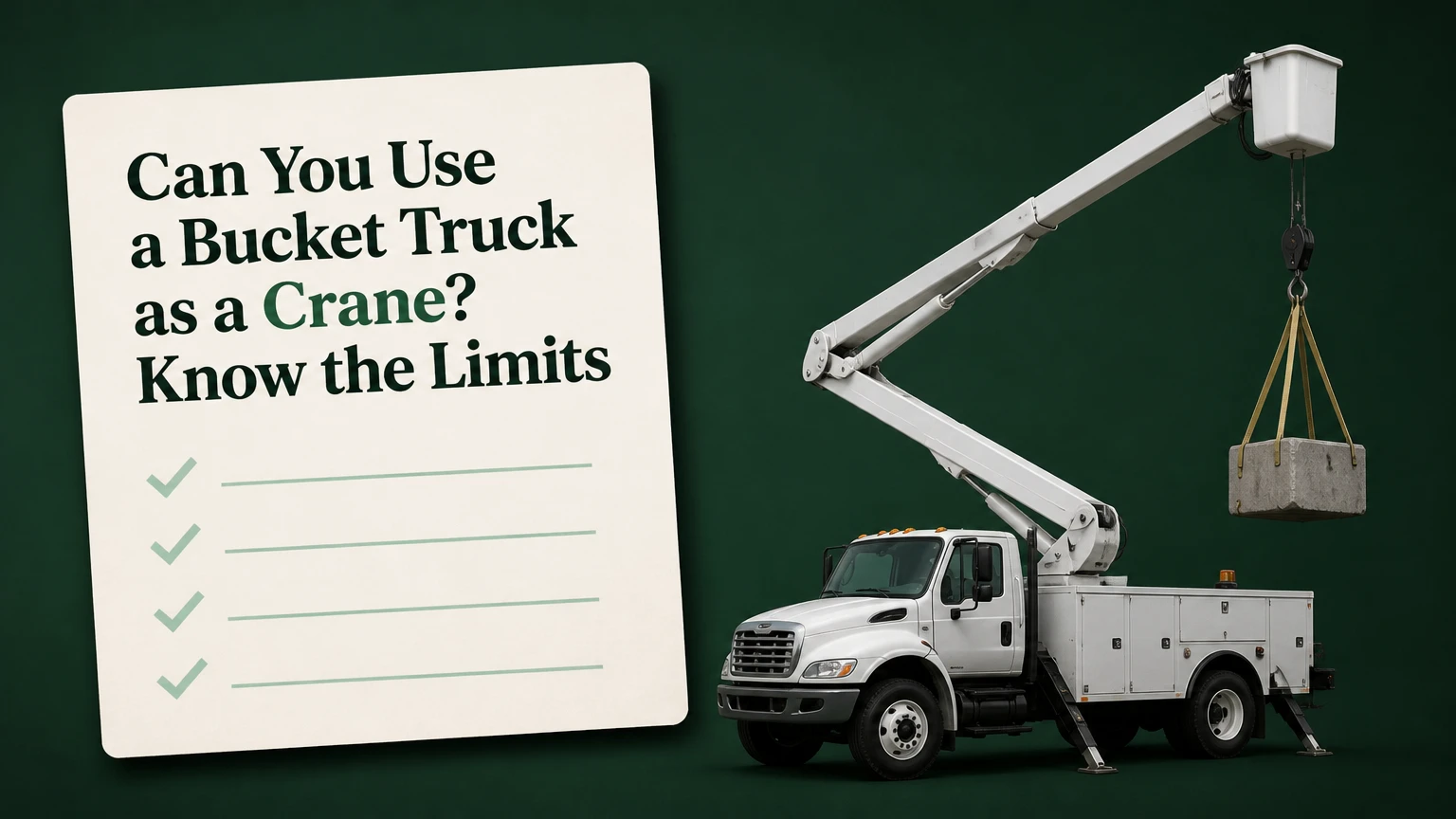
You cannot use a standard personnel bucket truck as a crane by attaching a load to its bucket, platform, or boom tip. A purpose-built material handler bucket truck with a factory-installed jib and winch may lift approved loads within its manufacturer load chart, operator manual, and applicable OSHA requirements.
Key Facts at a Glance
- A standard aerial lift is designed to position personnel, tools, and materials inside its rated platform, not to suspend loads from the bucket or boom.
- A material handler has a manufacturer-designed jib, winch, hook, controls, load chart, and structural load path for limited material lifting.
- Typical material-handler jib ratings range from 1,000 to 2,000 pounds at short radius, but capacity decreases as boom angle and horizontal reach increase.
- A load chart governs each lift. The truck’s maximum advertised jib rating does not apply at every boom angle, jib position, or outreach.
- Outriggers, pads, level, gross vehicle weight, wind, rigging, and ground conditions affect stability before the load leaves the ground.
- A dedicated boom truck or mobile crane is usually the correct choice for heavy loads, long radius, suspended loads, or placement into restricted footprints.
Can You Use a Bucket Truck as a Crane?
A standard personnel bucket truck cannot safely or lawfully be converted into a crane by adding a sling, chain, rope, hook, or homemade winch. The platform, boom, bucket mount, and hydraulic system were not necessarily engineered for the vertical and side loads created by a suspended object.
The answer changes when the vehicle is specifically manufactured and labeled as a material handler. That equipment combines an aerial device with a rated material-handling jib and winch. The distinction is not cosmetic. A material handler has engineered attachment points, a rated lifting system, operating procedures, and capacity information for defined configurations.
A bucket full of tools is different from a freely suspended load. Materials carried inside a platform remain within the aerial device’s intended personnel-and-material capacity, while a load hanging from the boom creates overturning moment, shock loading, and possible side loading. Those forces can travel through components that a standard personnel lift was never designed to support.
The governing document is the exact equipment manual and load chart. OSHA construction rule 29 CFR 1926.453 requires aerial lifts to remain within manufacturer limitations. OSHA states that “the manufacturer’s rated capacity for the boom and basket shall not be exceeded.” Local occupational-safety rules, utility procedures, and state regulations may impose additional requirements.
Is It Legal to Lift a Load From a Bucket Truck?
Lifting from a bucket truck is legal only when the truck, attachment, load, and operating method are designed and rated for that material-handling function. A standard personnel lift does not become a crane because an operator connects a load to a convenient structural point.
OSHA compliance depends on the equipment’s design and use, not on what an operator believes the boom can tolerate. Relevant requirements can include:
- 29 CFR 1926.453 for aerial lifts and manufacturer-rated capacity.
- 29 CFR 1926 Subpart CC when the equipment meets the definition and application of a construction crane.
- Manufacturer instructions, capacity charts, inspection procedures, and attachment approvals.
- State plans, utility-owner rules, ANSI aerial-device practices, and employer lift plans.
- Qualified or trained personnel requirements for the equipment and rigging task.
The exact legal classification can vary by equipment design and task. A material handler may have aerial-lift and crane-like functions, but its operator still must follow the manufacturer’s stated operating envelope. An employer should have a competent person or qualified lift director resolve classification questions before work begins.
A manufacturer-approved accessory is not automatically legal on every truck. The accessory must be approved for that model, installed as specified, and included in the applicable capacity information. An aftermarket eye welded to a boom or a sling wrapped around a fiberglass bucket is not an acceptable substitute.
What Is a Material Handler?
A material handler is an aerial device equipped with a dedicated, rated jib and winch for lifting limited loads while the boom is positioned. The jib may be hydraulic or manually positioned, and the winch line runs through a designed tip sheave to an approved hook.
The material-handling system commonly includes:
- A boom with a defined structural and hydraulic capacity.
- A top-mounted or side-mounted jib.
- A hydraulic or manual winch with a rated line pull.
- A hook, sheave, rope, and attachment hardware.
- Upper and lower controls, sometimes with separate personnel and winch functions.
- Outriggers or stabilizers that transfer overturning forces into the ground.
- Load charts covering boom angle, jib extension, jib angle, and radius.
The personnel platform remains part of the vehicle, but the suspended load should not be treated as an extension of the platform’s capacity. Personnel, tools, and the hanging load may interact with separate limits. The operator must account for every applicable chart and the manufacturer’s restrictions.
Material Handler Types
| Configuration | Typical feature | Typical use | Main limitation |
|---|---|---|---|
| Telescopic material handler | Straight boom, 40-75-foot working height | Light fixtures, cross-arms, small equipment | Less flexible around obstacles |
| Articulating material handler | Hinged boom sections with upper telescope | Utility work over structures | More complex positioning and chart reading |
| Insulated material handler | Fiberglass boom and dielectric components | Utility work near electrical systems | Insulation does not permit energized contact |
| Non-insulated material handler | Conductive or non-dielectric boom | Construction and facility maintenance | Requires greater electrical clearance control |
| Over-center model | Boom articulates beyond vertical centerline | Pole and utility placement | Capacity varies sharply by position |
| Manual-jib model | Manually set jib angle or extension | Repeated light-duty installations | Slower configuration changes |
“Insulated” describes a tested electrical property, not a general guarantee of worker protection. Contamination, moisture, damage, incorrect testing, and contact with multiple electrical potentials can defeat the protection.
How Does a Material Handler Work?
A material handler lifts through a dedicated winch line and jib rather than through the personnel basket. The operator positions the main boom and jib within the load chart, while outriggers stabilize the truck against the combined weight and leverage of the vehicle, boom, and suspended load.
The most important mechanical variable is load moment. A 1,000-pound load close to the truck can impose less overturning force than a much lighter load far from the truck. As radius increases, available capacity often falls because the suspended load produces greater leverage against the chassis and outriggers.
The winch raises or lowers the load vertically, but the boom may move the load laterally. Pulling a load sideways with the winch line creates side loading on the jib, sheave, boom, and hook. A winch is not a substitute for a tag line, proper repositioning, or a crane designed for horizontal dragging.
A simplified planning relationship is:
Load moment = load weight × horizontal radius
The manufacturer’s chart remains controlling because it includes geometry, structural limits, hydraulic pressure, stability, and configuration-specific restrictions. The formula helps explain a chart. It does not replace one.
How Much Can a Material Handler Lift?
A material handler commonly has a maximum jib rating of about 1,000-2,000 pounds when the jib is in a favorable, short-radius configuration. Actual capacity may be substantially lower at long outreach, low boom angle, extended jib length, or unfavorable over-center positions.
Typical figures are planning ranges, not permissions:
| Parameter | Typical planning range | What changes the value |
|---|---|---|
| Jib capacity at short radius | 1,000-2,000 lb | Boom angle, jib angle, radius |
| Personnel platform capacity | 300-700 lb | Single or dual platform, model design |
| Working height | 40-75 ft | Chassis, boom length, articulation |
| Hydraulic winch line pull | 500-2,000 lb | Winch model, rope layers, pressure |
| Practical lift radius | 10-35 ft | Chassis stability and chart limits |
| Outrigger pad size | 18-36 in. square typical | Ground pressure and manufacturer setup |
A 1,500-pound transformer may be within a machine’s maximum rating near the truck but outside the chart at a 25-foot radius. The weight of slings, shackles, spreader bars, hooks, and other below-the-hook equipment also counts toward the lifted load.
Gross vehicle weight creates another limit. A 350-pound worker, 100 pounds of tools, fuel, rigging, and a suspended object can combine to exceed a vehicle or axle rating even when the jib chart appears acceptable. Stability, structural capacity, and vehicle weight are separate checks.
What Must Be Checked Before Lifting?
Before a material handler lift, verify the exact load weight, radius, boom and jib configuration, ground condition, electrical exposure, rigging, weather, and personnel plan. A pre-use inspection and manufacturer-specific load chart review should occur before the winch takes tension.
Use this planning sequence:
- Identify the exact machine. Record the make, model, serial-specific attachments, dielectric status, and current load chart.
- Determine total lifted weight. Include the object, slings, shackles, hook block, spreader, packaging, and any trapped material.
- Measure the working geometry. Establish the horizontal radius from the relevant load-chart reference point, required height, boom angle, jib extension, and jib angle.
- Inspect the ground. Look for voids, trenches, soft shoulders, buried services, asphalt failure, slopes, and drainage channels.
- Set the vehicle. Apply the parking brake, chock wheels when required, deploy outriggers fully as specified, and use suitable pads or cribbing.
- Check the work zone. Identify power lines, trees, buildings, traffic, pedestrians, suspended obstructions, and the planned travel path.
- Inspect rigging. Confirm identification tags, working load limits, condition, angle, edge protection, hook latch, and compatible attachment points.
- Conduct a communication briefing. Assign the operator, signal person, spotter, and exclusion-zone controller before movement begins.
- Perform a controlled test lift. Raise the load only a few inches, then check settlement, level, brake holding, rigging balance, and unexpected movement.
- Stop for any change. Recalculate if the truck moves, an outrigger settles, the load snags, wind increases, or the load’s center of gravity differs from the plan.
A daily inspection normally includes controls, hydraulic leaks, hoses, cylinders, boom sections, pins, welds, platform attachment, winch, rope, hook, outriggers, alarms, interlocks, and emergency systems. Dielectric testing intervals depend on the manufacturer, applicable standard, and employer program; many utility fleets use annual testing, but the truck’s records control.
Which Jobs Fit a Material Handler?
A material handler fits light, controlled placement tasks where the load stays within the jib chart and the truck can be positioned close enough to maintain useful capacity. Typical examples include installing small transformers, cross-arms, street-light fixtures, signs, communications equipment, and limited utility hardware.
| Job scenario | Typical load range | Suitable equipment | Decision condition |
|---|---|---|---|
| Parking-lot light fixture | 50-300 lb | Material handler | Short radius and stable ground |
| Small utility transformer | 500-1,500 lb | Material handler or boom truck | Confirm chart at installation radius |
| Cross-arm and hardware | 100-500 lb | Material handler | Use approved rigging and tag lines |
| Tree limb removal | 100-800 lb | Arborist material handler or crane | Control cut sections and dynamic loads |
| Rooftop HVAC unit | 1,000-8,000 lb | Boom truck or mobile crane | Radius and placement usually exceed jib limits |
| Steel beam placement | 2,000-10,000+ lb | Mobile crane | Requires engineered lift planning |
| Concrete panel placement | 5,000-20,000+ lb | Mobile crane | Dynamic and site loads require crane capacity |
Tree work deserves special caution. A cut limb can catch on another branch, swing, split, or have an unknown center of gravity. A material handler should not be used to drag a hung-up tree section or absorb impact loading.
What Changes Near Energized Lines?
Electrical proximity changes the lift plan even when the material handler has an insulated boom. Dielectric construction reduces certain phase-to-ground risks, but it does not make the truck, load line, rigging, load, or worker safe to contact energized conductors.
The employer must identify the line voltage, establish the applicable approach distance, prevent encroachment, and coordinate with the utility owner when required. A suspended conductive load can swing into a line even when the boom remains outside the intended boundary. Wind and traffic can increase that movement.
A non-insulated material handler requires the same hazard assessment as other conductive equipment. Insulated aerial equipment also requires inspection, contamination control, maintenance, and scheduled dielectric testing. Never rely on a bucket liner or boom color as proof of current electrical protection.
What Does a Material Handler Cost?
Typical United States rental pricing is about $450-$950 per day or $4,500-$8,500 per month before delivery, fuel, insurance, and specialized operator charges. Used purchase prices commonly range from $45,000-$120,000, while new utility-configured units may cost $180,000-$350,000 or more.
| Cost item | Typical amount | Common cost driver |
|---|---|---|
| Daily rental | $450-$950 | Height, jib rating, insulation |
| Monthly rental | $4,500-$8,500 | Term, mileage, delivery |
| Used purchase | $45,000-$120,000 | Chassis mileage and boom hours |
| New purchase | $180,000-$350,000+ | Chassis and utility configuration |
| Delivery charge | $150-$1,000 typical | Distance and truck size |
| Operator labor | $75-$175 per hour typical | Region, certification, project complexity |
A dedicated crane may cost more per mobilization but less than a material handler that cannot complete the lift. Compare the full operation: delivery, setup, operator, traffic control, rigging, second aerial device, permits, and the cost of repositioning.
How Does It Compare With a Crane?
A material handler is more mobile and convenient for light installations, while a dedicated crane provides substantially greater capacity, radius, chart detail, and placement control. The correct choice depends on load moment, access, setup area, lift height, and whether workers must remain elevated during installation.
| Criterion | Material handler | Boom truck crane | All-terrain mobile crane |
|---|---|---|---|
| Typical capacity | 1,000-2,000 lb jib range | 10-40 tons typical | 15-100+ tons typical |
| Personnel access | Integrated aerial platform | Usually separate lift required | Usually separate lift required |
| Setup time | 15-30 minutes typical | 30-60 minutes typical | 45-120 minutes typical |
| Best radius | 10-35 ft typical | 20-100+ ft | 30-150+ ft |
| Mobility between tasks | High | Moderate | Low to moderate |
| Typical rental basis | $450-$950 per day | $1,000-$3,500 per day | $2,000-$8,000 per day |
| Main limitation | Capacity drops quickly with reach | Requires larger setup area | Higher cost and mobilization |
A crane’s higher rated capacity does not eliminate ground, rigging, wind, or communication hazards. It does provide a more appropriate engineered system when the load is heavy, distant, dynamic, or placed over an obstruction.
Which Equipment Should You Choose?
Choose a factory-equipped material handler for a light, known load that can be placed within the exact jib chart while the truck remains stable and properly outrigged. Choose a boom truck or mobile crane when the load exceeds the chart, requires long outreach, involves impact or drag, or must be placed with substantial precision.
| Project condition | Recommended choice | Reason |
|---|---|---|
| 200-lb fixture at 15-ft radius | Material handler | Integrated access and adequate light-lift capacity |
| 1,200-lb transformer at 30-ft radius | Chart review first | Capacity may fall below the maximum rating |
| 4,000-lb rooftop unit | Boom truck crane | Material-handler jib is generally undersized |
| 12,000-lb beam over an obstruction | Mobile crane | Higher capacity and engineered radius |
| Work beside energized distribution lines | Insulated material handler if chart allows | Combines access with controlled utility work |
| Unknown load weight or unstable ground | Stop and reassess | No equipment can safely compensate for unknown inputs |
For arborists, a purpose-built material handler can assist with light, controlled sections, but a knuckle-boom loader or crane is preferable for heavier timber and suspended removal. For utility contractors, an insulated over-center model may improve positioning, but the dielectric rating and capacity chart must match the job.
What Goes Wrong During a Lift?
Most material-handler incidents begin with a wrong assumption about capacity, geometry, ground support, or load behavior rather than a sudden unexplained equipment failure. The operator should lower the load immediately when the truck tilts, an outrigger settles, the line side-loads, or the load snags.
| Failure mode | Likely cause | Immediate response |
|---|---|---|
| Winch stalls | Load exceeds chart, low hydraulic pressure, excessive radius | Stop, lower if possible, verify weight and configuration |
| Tilt alarm activates | Outrigger settlement or side loading | Lower load, secure area, inspect and reset only if approved |
| Load swings | Wind, sudden boom motion, poor tag-line control | Stop movement and wait for controlled stabilization |
| Hook or sling shifts | Incorrect hitch or off-center load | Lower load and re-rig from the ground |
| Boom contacts obstacle | Inadequate spotter or changing clearance | Stop all motion and reassess the path |
| Truck leans during setup | Soft shoulder, slope, inadequate pads | Lower boom, stop work, relocate or improve support |
Never “power through” a stalled winch. Bypassing a relief valve, increasing hydraulic pressure, adding a second line, or jerking the boom can convert a controlled overload into structural failure. A qualified technician should diagnose hydraulic faults.
Expert Rules That Prevent Incidents
- Treat the chart as a two-dimensional limit. Capacity is not a single number; it changes with radius and configuration.
- Measure radius before selecting the truck. A 2,000-pound rating at short radius may provide little value at the actual placement point.
- Plan for the load’s behavior, not just its weight. Wind area, center of gravity, snag potential, and liquid movement can create dynamic forces that a static estimate misses.
- Keep the line vertical. Reposition the truck or boom instead of using the winch to pull sideways.
- Use the bucket for people, not as a counterweight. A worker’s position and platform load can affect the machine, while the bucket itself is not a lifting attachment.
A load that weighs less than the chart maximum can still be unsafe if it is suspended in wind, catches on a structure, or transfers force suddenly through the jib.
Can a Bucket Truck Lift a Transformer?
A material handler may lift a transformer when the transformer’s total weight and installation geometry remain within the exact manufacturer chart. A standard personnel bucket truck must not suspend the transformer from its bucket, boom tip, or an unapproved attachment.
Confirm the transformer nameplate or shipping weight, then add rigging and hardware. Check the radius at the point where the transformer leaves the truck and again where it reaches the pole or pad. A transformer can be within capacity at pickup but outside capacity during placement because the boom extends or lowers.
Use tag lines where appropriate, keep workers out of the fall zone, and prevent the transformer from contacting energized equipment. If the lift requires dragging, rotating under load, tandem lifting, or working beyond the chart, use a crane plan and dedicated lifting equipment.
Can You Lift Tree Sections With a Bucket Truck?
A material handler can lift some tree sections, but a standard bucket truck cannot safely function as a crane for suspended wood. Arboricultural loads are often irregular, wet, snagged, and subject to shock loading when a cut releases.
The operator must know the section’s weight, center of gravity, attachment method, and release path. A load that appears to weigh 500 pounds may impose far greater force if it falls onto the line or catches in the canopy. Crane-assisted tree removal is generally more appropriate for heavy sections, confined sites, or any cut where the load cannot be lowered freely.
The Bottom Line
You cannot use a standard personnel bucket truck as a crane, and attaching a load to the bucket or boom tip is an unsafe misuse of the aerial device. You can use a factory-designed material handler with a rated jib and winch for limited lifts, but only within the exact load chart, manufacturer instructions, site controls, and applicable OSHA requirements.
For can you use a bucket truck as a crane, the practical decision is simple: identify the equipment classification first, calculate the complete load and radius second, and select a dedicated crane whenever the material handler’s chart, stability, access, or electrical controls do not clearly support the lift.
FAQ
Can a bucket truck lift materials inside the platform?
A personnel bucket can carry tools and materials only within its platform capacity and manufacturer restrictions. The platform load normally includes workers, tools, rigging, and materials. A load hanging outside the platform is a separate lifting operation and requires a purpose-designed jib, winch, and rated attachment.
Does a bucket truck operator need crane certification?
Training requirements depend on the equipment classification, employer program, task, and jurisdiction. A person trained only for aerial-lift operation may not be qualified to operate a material-handling winch or crane-like attachment. Employers should document equipment-specific training, rigging competence, signal-person procedures, and any OSHA Subpart CC requirements that apply.
Can I add a jib to an ordinary bucket truck?
Do not install an aftermarket jib unless the truck manufacturer or an authorized engineering source approves that exact attachment and configuration. The installation can change structural loads, stability, hydraulic performance, insulation, and the applicable load chart. A homemade hook or welded lifting eye does not provide a valid rated material-handling system.
How far can a material handler reach with a load?
A typical practical lifting radius may be about 10-35 feet, but the exact distance depends on the truck, jib, boom angle, extension, load weight, and outrigger configuration. The maximum working height is not the same as maximum lifting radius. A machine may reach a location vertically while lacking capacity to place the load horizontally.
Can the bucket remain occupied while the jib lifts?
Some material handlers are designed to support simultaneous personnel and material operations, while others restrict the combination or impose separate limits. The operator must follow the specific manual and chart. Never assume that an occupied bucket is permitted during winching because the vehicle has two sets of controls.
When should I rent a dedicated crane?
Rent a dedicated crane when the load exceeds the material-handler chart, the radius is long, the load is dynamic or unknown, the placement requires dragging, or the job needs greater precision and capacity. A crane is also the safer choice when the material handler cannot maintain required electrical clearances, ground support, or an exclusion zone.