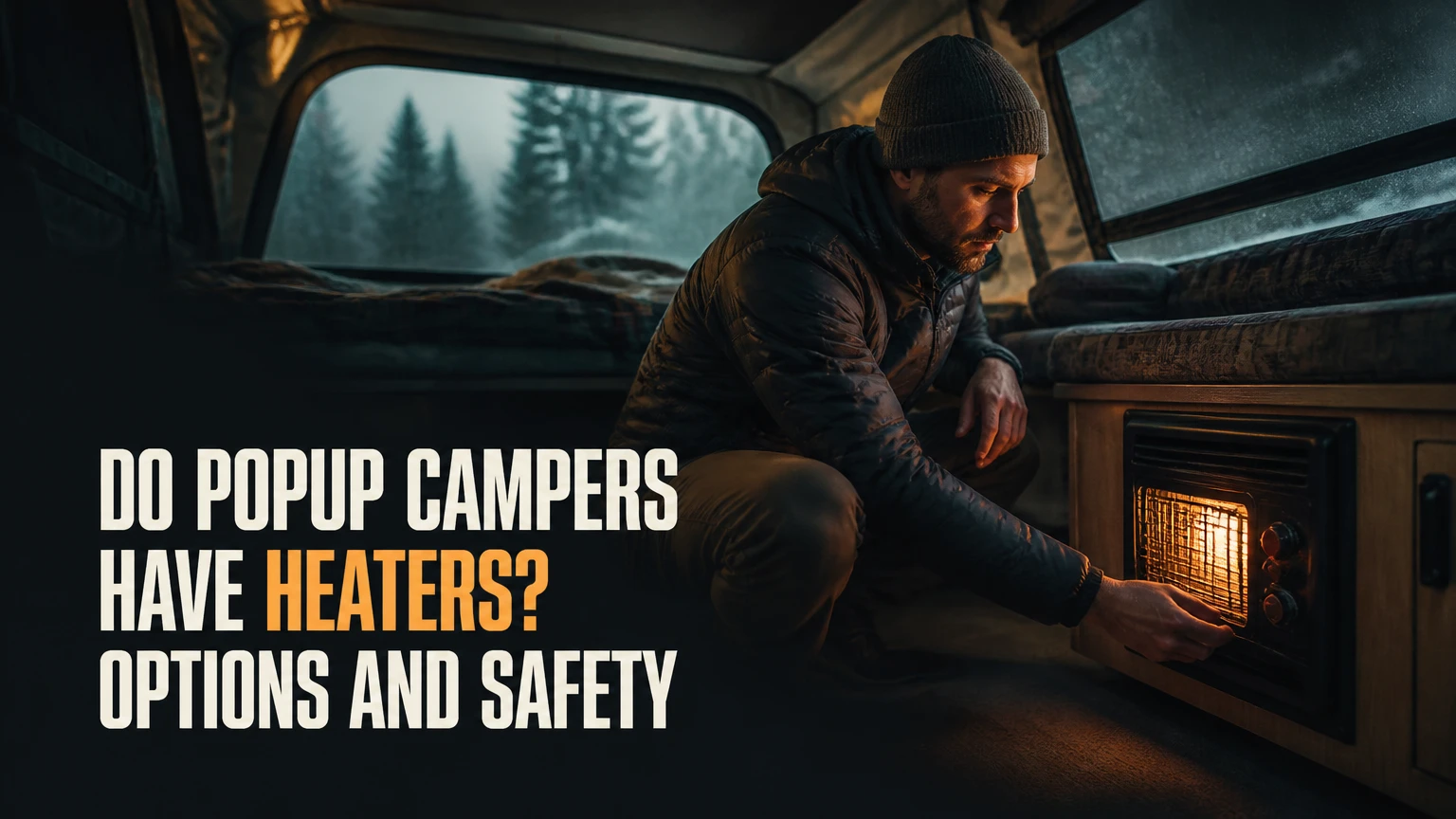
Most modern popup campers have heaters, usually a built-in propane furnace that distributes warm air through a small duct. Older, basic, or tent-trailer models may have no factory furnace, but owners can use a 120-volt electric heater at a powered campsite or install an approved RV heating appliance for off-grid use.
Key Facts at a Glance
- A built-in popup camper furnace typically uses propane for heat and 12-volt DC electricity for its blower, controls, and ignition.
- Typical factory furnace outputs range from 12,000 to 20,000 BTUs per hour, although the correct size depends on canvas area and outdoor temperature.
- A 1,500-watt electric heater produces about 5,118 BTUs per hour and requires a 120-volt electrical hookup.
- Most propane furnaces cannot operate from propane alone because the blower and control board need a charged house battery.
- Fuel-burning heaters require a working carbon-monoxide detector, clear air passages, and installation that follows the appliance manufacturer’s instructions.
- A popup camper loses heat faster than a hard-sided RV because its bunk ends and wall panels contain fabric, vinyl, and relatively little insulation.
Do Popup Campers Have Built-In Heaters?
Most newer popup campers have an optional or standard forced-air propane furnace, while lightweight entry-level trailers often omit one to reduce cost, weight, and cabinet space. A furnace may appear in the specifications as “forced-air heat,” “LP furnace,” or “RV furnace,” and the thermostat is commonly mounted near the main entry or dinette.
The exact equipment varies by brand, model year, floor plan, and package. Jayco, Forest River, Coachmen, Aliner, and older Fleetwood Coleman campers used different combinations of Suburban, Atwood, and Dometic heating equipment. A camper with a furnace usually has an exterior exhaust grille, an interior return-air grille, a thermostat, and a 12-volt fuse labeled “furnace” or “heater.”
A fast inspection can answer the question without removing cabinetry:
- Find a wall thermostat with a heat setting.
- Look for a low interior grille or duct outlet.
- Check the outside wall for a metal combustion exhaust panel.
- Inspect the 12-volt fuse panel for a furnace circuit.
- Search the owner’s manual for “LP furnace,” “ducted heat,” or the appliance model.
An electric receptacle alone does not prove that the camper has a built-in heater. It only confirms that a portable heater could be used when the electrical system is connected to shore power.
How Does a Popup Camper Furnace Work?
A popup camper furnace burns propane inside a sealed combustion chamber, transfers heat through a heat exchanger, and blows warmed cabin air through the camper without intentionally mixing the cabin air with combustion exhaust. The furnace still needs 12-volt electricity for the blower motor, thermostat circuit, safety switches, and ignition system.
The normal sequence is:
- Thermostat call: The thermostat sends a 12-volt signal when cabin temperature falls below the selected setting.
- Blower startup: The fan starts and purges the combustion chamber, typically for 15-30 seconds.
- Sail-switch confirmation: Airflow moves a sail switch, proving that the blower is operating adequately.
- Ignition: The control board opens the propane valve and activates a spark or electronic igniter.
- Flame verification: A flame sensor confirms ignition. If the flame is not detected, the board closes the gas valve.
- Heat delivery: Cabin air moves around the heat exchanger and exits through ducts or registers.
- Fan cooldown: After the thermostat is satisfied, the burner stops while the blower continues briefly to remove residual heat.
A furnace that runs its blower but never ignites is usually responding to a safety condition, fuel problem, low voltage, restricted airflow, or failed ignition component. The blower’s first 15-30 seconds are normally a purge period, not wasted operation.
Why Does the Furnace Need a Battery?
The 12-volt battery powers the blower, thermostat, circuit board, gas-valve controls, and ignition components. Propane supplies the thermal energy, but it does not operate the electrical controls.
| Furnace activity | Typical electrical demand | Practical effect |
|---|---|---|
| Thermostat and control board | 0.1-0.5 amp | Small continuous draw |
| Blower during ignition | 3-7 amps | Highest startup demand |
| Blower while heating | 2-5 amps | Battery drain during burner cycles |
| Overnight operation | 15-40 amp-hours | Depends on temperature and insulation |
| Low-voltage shutdown | About 10.5-11.5 volts | Furnace stops to protect the system |
Manufacturers publish model-specific values, and older motors can draw more than newer ones. A “1.8-3.5 amp” figure may describe a particular furnace under a particular duct arrangement, not every popup camper furnace.
A practical calculation uses usable battery capacity rather than the label alone. A 100-amp-hour lead-acid battery may provide roughly 50 amp-hours before owners commonly recharge it, whereas a lithium battery can generally use a larger percentage without the same voltage sag. Cold temperatures also reduce available lead-acid capacity.
What Heating Options Can a Popup Camper Use?
Popup campers can use built-in propane furnaces, portable electric heaters, rooftop heat pumps, catalytic propane appliances, and, in specialized conversions, diesel air heaters. The best option depends first on the available energy source, then on ventilation, noise, output, and installation constraints.
| Heating option | Energy source | Typical output | Best operating condition |
|---|---|---|---|
| Built-in RV furnace | Propane and 12V DC | 12,000-20,000 BTU/h | Boondocking and automatic overnight heat |
| Portable electric heater | 120V AC | 5,100 BTU/h at 1,500W | Full hookups with a protected outlet |
| Rooftop heat pump | 120V AC | About 8,000-15,000 BTU/h | Mild weather above roughly 40°F |
| Catalytic propane heater | Propane, sometimes no electricity | 3,000-12,000 BTU/h | Ventilated use only, with strict safety controls |
| Diesel air heater conversion | Diesel and 12V DC | 5,000-17,000 BTU/h | Custom, frequent cold-weather installations |
A 1,500-watt resistance heater produces approximately 5,118 BTUs per hour because 1 watt equals about 3.412 BTUs per hour. It does not produce the same heat output as a 12,000-BTU furnace, but a small popup may feel comfortable at a mild campground when the heater runs continuously.
Heat pumps lose effectiveness as outdoor temperatures fall. A furnace remains the more dependable choice for freezing conditions, although neither appliance solves condensation, exposed plumbing, or weak canvas insulation by itself.
Which Heater Is Best for Each Camping Situation?
A built-in propane furnace is usually best for dry camping, a portable electric heater is usually best at a full-hookup campsite, and a heat pump works well in mild weather when the camper already has one. The deciding factors are shore power, battery condition, outdoor temperature, and whether automatic unattended operation is needed.
| Camping situation | Preferred heater | Required resources | Main limitation |
|---|---|---|---|
| Forest campsite without hookups | Built-in propane furnace | Propane cylinder and charged battery | Battery depletion overnight |
| RV resort with 30-amp service | 1,500W electric heater | 120V shore power and safe outlet | Circuit overload or poor heat distribution |
| Autumn night around 45°F | Heat pump or electric heater | Shore power | Heat pump output falls in colder air |
| Winter boondocking | Propane furnace | Full propane supply and battery bank | Canvas heat loss and condensation |
| Emergency backup | Manufacturer-approved portable option | Fuel, detector, ventilation | Higher operating and safety risk |
Is an Electric Space Heater Safe in a Popup Camper?
A listed electric heater with tip-over and overheat protection can be appropriate inside a popup camper when connected directly to a suitable 120-volt receptacle and kept clear of fabric, bedding, curtains, and clothing. The heater should not share an overloaded circuit with a microwave, coffee maker, converter, or hair dryer.
NFPA’s widely used heating-safety guidance states, “Keep anything that can burn at least three feet away from heating equipment.” That distance is difficult to maintain inside a crowded popup, so placement deserves more attention than the heater’s advertised wattage.
Avoid daisy-chained extension cords, lightweight power strips, and damaged receptacles. A 1,500-watt heater draws about 12.5 amps at 120 volts, leaving limited capacity on a 15-amp branch circuit. A campground’s pedestal may provide 30 amps to the RV, but the camper’s interior outlet or adapter can still become the limiting point.
Portable electric heat is also a poor off-grid solution. An inverter would need to supply about 125 amps from a 12-volt battery before conversion losses, which can exhaust a typical house battery rapidly.
Can You Use a Portable Propane Heater Inside?
Portable propane heaters are not automatically safe inside a popup camper. Only use a model specifically listed by its manufacturer for indoor or recreational-vehicle use, follow its ventilation instructions, keep its oxygen-depletion and tip-over safeguards functional, and use a carbon-monoxide detector.
Unvented combustion releases water vapor into the camper, along with carbon dioxide and potentially carbon monoxide if combustion or ventilation is abnormal. A catalytic heater can warm a small space, but condensation may wet canvas, bedding, and mattresses by morning. A portable appliance also lacks the ducted combustion separation of a properly installed RV furnace.
Never use a patio heater, grill, camp stove, lantern, or outdoor-rated propane appliance inside the camper. Never disable a safety shutoff or operate a fuel-burning appliance while sleeping unless the manufacturer explicitly permits that use and the installation meets its instructions.
The safer design principle is simple: combustion air and exhaust should remain outside the living space. A factory RV furnace achieves this through its sealed combustion chamber and exterior intake and exhaust arrangement.
How Much Heat Does a Popup Camper Need?
A typical 8- to 12-foot popup camper often uses a 12,000- to 16,000-BTU-per-hour furnace, but heat demand rises with wind, low outdoor temperature, open canvas, and poor insulation. A larger 20,000-BTU unit is not automatically better because oversizing can create short cycling and uneven temperatures.
| Popup configuration | Typical furnace range | Approximate heated volume | Sizing consideration |
|---|---|---|---|
| 8-foot box, closed bunk ends | 9,000-12,000 BTU/h | 700-1,000 cubic feet | Mild nights and sheltered sites |
| 8-foot box, open bunk ends | 12,000-16,000 BTU/h | 900-1,300 cubic feet | Greater canvas exposure |
| 10-foot box, two bunks | 12,000-16,000 BTU/h | 1,100-1,600 cubic feet | Typical three-season use |
| 12-foot box, slide-out or dinette | 16,000-20,000 BTU/h | 1,400-2,000 cubic feet | More leakage and surface area |
These are typical practitioner ranges, not a substitute for the original appliance specification. The furnace cabinet, duct diameter, gas pressure, exhaust clearance, thermostat wiring, and mounting structure all affect whether a replacement is compatible.
An expert rule of thumb is to improve the thermal envelope before installing a larger furnace. Reflective bunk-end covers, closed-cell foam beneath mattresses, insulated curtains, and sealed drafts often improve comfort more than adding several thousand BTUs.
How Long Do Propane and Batteries Last?
A 20-pound propane cylinder contains about 430,000 BTUs of chemical energy, and a furnace consuming 12,000-20,000 BTUs per hour could theoretically burn continuously for roughly 21-36 hours. Real runtime varies because thermostats cycle the burner, cold wind increases demand, and propane delivery can weaken in severe cold.
| Resource | Typical consumption | Example capacity | Estimated practical duration |
|---|---|---|---|
| Propane furnace | 0.1-0.2 gallon-equivalent per hour | 20-lb cylinder | 1-3 nights, depending on cycling |
| Furnace blower | 2-7 amps while operating | 100-Ah lead-acid battery | About 1-2 cold nights |
| Electric heater | 12.5 amps at 1,500W | 30-amp campsite | Continuous use if circuit remains safe |
| 12V compressor battery system | 30-60 Ah per night for heat support | 100-Ah battery | Depends on furnace duty cycle |
The propane estimate is intentionally broad. A furnace that runs 25 percent of the night may use far less fuel than one running 70 percent in freezing weather. A cylinder can also feel empty when cold because vaporization capacity drops, even if liquid propane remains.
Battery runtime is the more common boondocking failure point. Solar panels may restore daytime energy, but short winter days, shade, snow, and furnace operation can prevent a small panel from replacing overnight consumption.
How Much Does a Popup Camper Heater Cost?
A replacement RV furnace commonly costs about $400-$800 for the appliance, while professional diagnosis or installation often adds $150-$300 in straightforward cases. A portable electric heater may cost $25-$100, but campsite electricity, circuit protection, and safe placement remain necessary.
| Heating purchase or service | Typical price | Typical time | Cost driver |
|---|---|---|---|
| Portable 1,500W electric heater | $25-$100 | 5-15 minutes | Safety features and build quality |
| Indoor-rated portable propane heater | $100-$250 | 10-20 minutes | Output and safety certification |
| Replacement RV furnace | $400-$800 | 1-3 hours | Brand, BTU rating, duct arrangement |
| Furnace diagnosis or repair | $100-$300 | 1-2 hours | Access, parts, and technician rate |
| Custom diesel installation | $700-$2,000+ | 1-2 days | Fuel tank, ducting, exhaust, wiring |
Retrofitting a furnace is more involved than cutting a hole for an appliance. The installation must account for propane piping, combustion intake, exhaust termination, cabinet clearances, duct routing, 12-volt wiring, fuse protection, and structural support. A certified RV technician should inspect any new fuel-burning installation.
What Should You Check When a Furnace Stops Heating?
When a popup camper furnace stops heating, check propane supply, battery voltage, the furnace fuse, thermostat settings, airflow, and exterior exhaust obstruction before replacing parts. A furnace that runs for about 30 seconds and then shuts down has often failed an ignition or flame-proving sequence.
| Symptom | Likely cause | Safe first check | Escalation point |
|---|---|---|---|
| No fan movement | Dead battery, fuse, thermostat, wiring | Measure battery and inspect fuse | Technician for control-board diagnosis |
| Fan runs, no ignition | Empty tank, air in line, low voltage | Confirm tank and light stove outdoors | Stop if gas odor persists |
| Clicking, then shutdown | Failed ignition or flame sensing | Check exhaust for blockage | Service burner and sensor |
| Weak airflow | Blocked return grille or duct | Remove bags and bedding from grilles | Inspect duct and blower wheel |
| Heat cycles rapidly | Oversizing, blocked duct, poor sensor location | Open all registers | Check airflow and thermostat placement |
Lighting the stove can help clear air from a propane line, but only when the stove operates normally and no leak is suspected. Do not repeatedly reset a furnace that smells strongly of propane, produces soot, or has a blocked exhaust.
A weak battery may show acceptable voltage with no load but collapse when the blower starts. Measuring voltage during startup provides more useful information than checking a resting reading alone.
How Do You Prepare a Popup Camper for Cold Weather?
Cold-weather preparation starts with reducing heat loss, controlling moisture, and protecting plumbing rather than simply increasing furnace output. Close unnecessary canvas openings, install bunk-end insulation, place foam under mattresses, and keep roof ventilation partially open to remove humid cabin air.
Human breathing, wet clothing, cooking, and propane combustion all add moisture. Fully closing every vent may make the camper feel warmer for a short period, but condensation can soak canvas and bedding, which then increases evaporative cooling.
Use these practical measures:
- Install reflective or insulated bunk-end covers.
- Add removable foam board beneath mattresses, away from furnace ducts.
- Seal obvious gaps around the door and floor with removable weather stripping.
- Keep interior cabinet doors open if plumbing runs through them.
- Maintain a working carbon-monoxide detector and smoke alarm.
- Keep furnace return air and outlet registers unobstructed.
- Protect exposed water lines according to the camper manufacturer’s winter-use limits.
Many popup campers are designed for three-season camping, not prolonged subfreezing occupancy. Even a correctly sized furnace may not prevent frozen water lines, icy canvas, or uncomfortable bunk ends during sustained temperatures below freezing.
What Are the Most Common Heater Mistakes?
The most common popup camper heating mistakes are blocking airflow, ignoring battery voltage, using an unsuitable fuel-burning appliance, and treating condensation as a furnace failure. Each mistake can reduce heat, trigger safety switches, or create a fire and carbon-monoxide hazard.
- Blocking the return grille: Shoes, duffel bags, and bedding can restrict airflow and cause the furnace to overheat or trip its sail switch.
- Running a heater on an overloaded circuit: A 1,500-watt unit can consume 12.5 amps, leaving little margin on a 15-amp branch circuit.
- Using outdoor propane equipment indoors: Grills and patio heaters do not have the required indoor combustion controls.
- Ignoring the battery: The furnace may stop at 3 a.m. after a cold evening because the blower has depleted the house battery.
- Closing every roof vent: Trapped moisture wets the interior and makes the camper colder after condensation forms.
- Installing a furnace without clearance checks: A replacement must match ducting, exhaust, gas pressure, electrical protection, and cabinet dimensions.
A counterintuitive practitioner rule is that a larger heater can worsen comfort. Short cycling heats the area near the thermostat quickly while leaving bunk ends cold, and frequent starts increase noise and electrical demand.
Which Heater Should You Choose?
Choose a built-in propane furnace for off-grid reliability, a 1,500-watt electric heater for powered campsites, and a factory heat pump for mild-weather efficiency. Choose a portable propane appliance only when its indoor RV listing, ventilation requirements, detector setup, and sleeping-use restrictions fit the exact situation.
- Boondocking: Use the factory furnace, carry adequate propane, and size the battery for the expected overnight duty cycle.
- Full hookups: Use a listed electric heater with tip-over protection, direct wall connection, and clear space around the unit.
- Mild shoulder season: Use a heat pump if the rooftop unit functions effectively at the expected outdoor temperature.
- Frequent winter camping: Consider professional furnace service or a properly engineered diesel conversion rather than an improvised appliance.
- Occasional emergency heat: Follow the portable heater manual exactly and never substitute a camping stove or outdoor heater.
The best heater is the one compatible with the camper’s energy system and ventilation design. Heat output alone is not a sufficient selection criterion.
Frequently Asked Questions
Do Popup Campers Have Heat When They Are Not Plugged In?
A factory propane furnace can heat a popup camper without shore power, but it still requires a charged 12-volt battery for the blower, thermostat, control board, and ignition. A portable electric heater cannot operate without an external 120-volt source unless an inverter and large battery bank provide the electricity.
Can You Add a Heater to a Popup Camper?
You can add heat, but a permanent propane furnace requires compatible ducting, LP piping, combustion intake, exterior exhaust, 12-volt wiring, fuse protection, and safe cabinet clearances. A portable electric heater is simpler for hookup camping. A qualified RV technician should handle any new fuel-burning installation.
Why Is My Popup Camper Furnace Blowing Cold Air?
A popup camper furnace may blow cold air during its normal purge and cooldown cycles, but continuous cold airflow indicates a propane, ignition, flame-sensor, airflow, or low-voltage problem. Check the propane supply, battery voltage under blower load, furnace fuse, thermostat setting, and exterior exhaust before seeking service.
Can a Popup Camper Furnace Run All Night?
A properly installed furnace can normally cycle overnight under thermostat control, but runtime depends on battery capacity, propane supply, outdoor temperature, and canvas insulation. Owners should not assume a full propane cylinder guarantees heat because the 12-volt battery may deplete first.
Do Popup Campers Have Heat Pumps?
Some popup campers with rooftop air-conditioning systems may have a heat-pump function, but many do not. Heat pumps require 120-volt shore power and generally lose heating performance as outdoor temperatures approach freezing, so they do not replace a propane furnace for severe cold.
How Do You Keep a Popup Camper Warm Without a Furnace?
Use a listed electric heater at a powered campsite, improve bunk-end insulation, reduce drafts, insulate beneath mattresses, and manage ventilation to control condensation. Without shore power, avoid improvised indoor combustion devices and use only a manufacturer-approved portable propane heater with the required detector and ventilation.
The Bottom Line
Yes, most modern popup campers have heaters, usually a 12-volt-controlled propane furnace, but equipment varies by model and trim. Electric heaters suit full-hookup camping, while propane furnaces remain the practical off-grid option. Confirm the appliance type, protect the battery, keep air passages clear, and treat ventilation and carbon-monoxide detection as mandatory parts of safe heating.