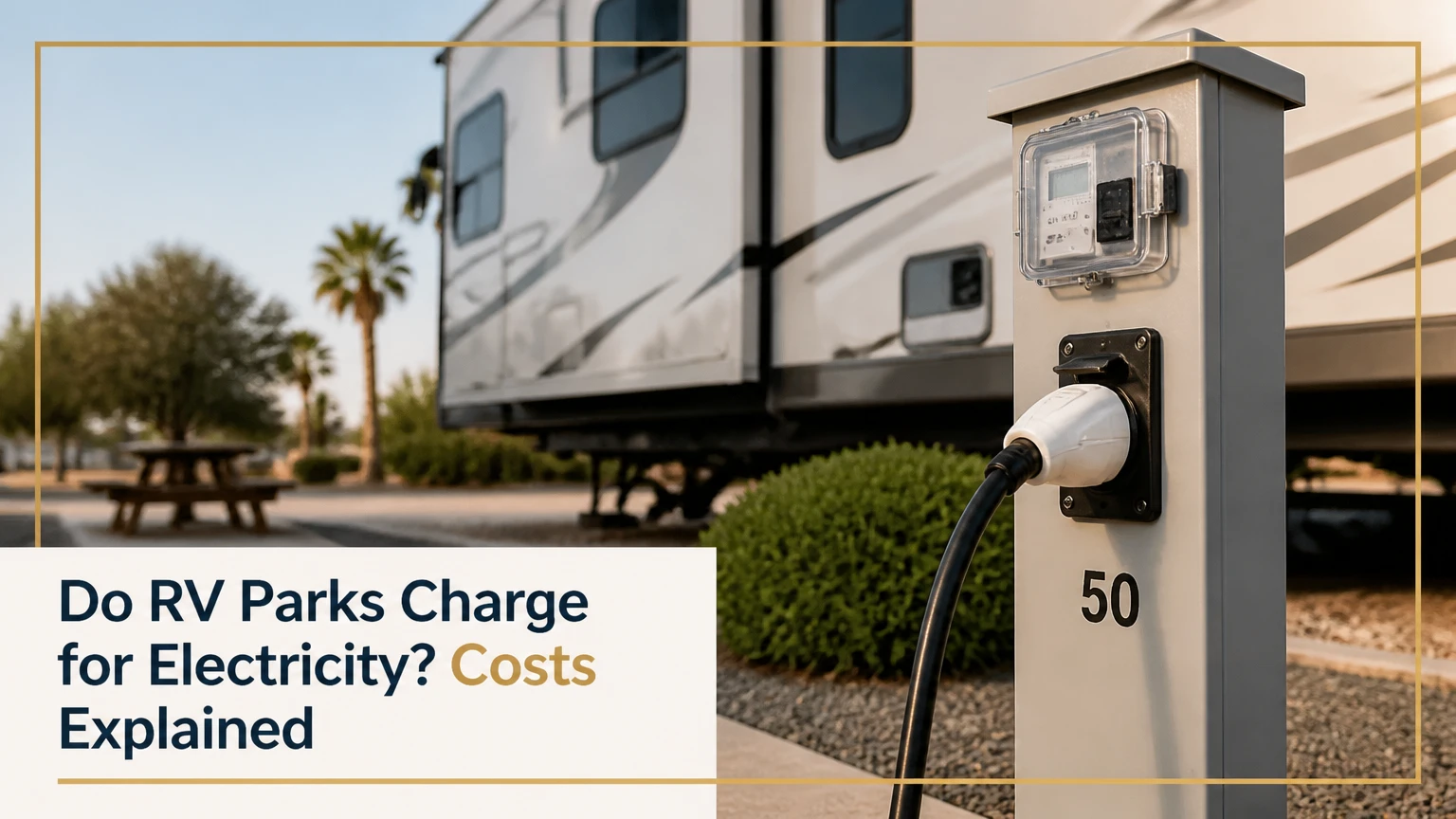
Yes, RV parks often charge for electricity, but the charge may be included in the site price or billed separately from measured kilowatt-hour usage. Short-term stays usually use an all-inclusive nightly rate, while monthly, seasonal, and annual stays more often require a meter reading and a separate electric bill.
Key Facts at a Glance
- RV parks commonly bundle electricity into nightly or weekly rates for stays of 1-14 nights.
- Monthly and seasonal RV sites frequently bill electricity separately through a pedestal meter or a fixed utility fee.
- A 30-amp RV connection provides up to 3,600 watts at 120 volts under ideal conditions.
- A 50-amp RV connection uses two 120-volt legs and can support substantially more simultaneous load than 30-amp service.
- Typical monthly RV electricity use ranges from about 300 kWh in mild weather to more than 1,500 kWh during severe air-conditioning demand.
- A meter photo at arrival and departure can prevent disputes over the starting or ending reading.
Do RV Parks Charge for Electricity?
RV parks charge for electricity in one of two basic ways: the park includes power in the site rate, or the park bills the renter separately for consumption. The correct answer depends mainly on stay length, the rental agreement, local utility rules, and whether the site has an individual meter.
A nightly guest may pay one advertised price that covers water, sewer, electricity, and Wi-Fi. A monthly guest may receive a lower site rate but pay electric usage separately. Some parks use a hybrid arrangement, such as a fixed monthly allowance followed by a per-kWh charge.
The phrase “electricity included” also requires careful reading. It may cover ordinary residential use but exclude electric vehicle charging, space heaters, commercial equipment, or unusually high consumption. A park can also charge different base rates for 30-amp and 50-amp sites even when both include electricity.
What determines the billing method?
| Stay type | Common billing method | Questions to confirm |
|---|---|---|
| Overnight, 1 night | Electricity included | Is 50-amp service an added $5-$15 fee? |
| Short stay, 2-14 nights | Bundled nightly rate | Are heaters, EV charging, or extra rigs excluded? |
| Monthly, 28-31 days | Metered or fixed utility fee | What is the per-kWh rate and billing date? |
| Seasonal, 3-6 months | Metered electricity or allowance | Is there a deposit, minimum bill, or service fee? |
| Annual lease, 12 months | Metered or resident utility account | Who owns the meter and handles disputes? |
RV parks do not follow one universal national pricing model. The booking page, long-term lease, and office policy may use different terms, so a phone confirmation is valuable when the written rate sheet is vague.
How Does RV Park Electricity Billing Work?
RV park electricity billing begins at the site pedestal, where a heavy-duty power cord connects the RV to a 30-amp or 50-amp receptacle. The park either treats that connection as part of the site rental or measures the electricity passing through a dedicated meter.
For a metered stay, the basic calculation is:
Electric charge = ending meter reading minus starting meter reading, multiplied by the applicable rate per kWh, plus permitted fees.
For example, a starting reading of 12,480 kWh and an ending reading of 12,910 kWh represent 430 kWh. At $0.18 per kWh, the energy charge is $77.40 before taxes or an administrative fee.
What happens at check-in and check-out?
- Ask the office to identify the meter assigned to your site.
- Record the starting reading, including decimal places if the display shows them.
- Photograph the meter, pedestal number, and site number in one set of images.
- Ask whether the park bills on a calendar month, a 30-day cycle, or departure.
- At checkout, photograph the ending reading before disconnecting.
- Compare the invoice with the two readings and the stated rate.
- Request a corrected statement promptly if the arithmetic or meter number differs.
A meter photo does not prove that every charge is invalid, but it establishes a useful baseline. The strongest record includes the date, site number, meter serial number, and starting or ending display.
Can an RV park charge more than the utility rate?
An RV park may be able to add an administrative fee, service charge, tax, or other disclosed amount, but the legality of electricity markups varies by jurisdiction and contract. Campground submetering rules are not identical across the United States and Canada, and some locations regulate resale or utility billing more strictly than others.
Do not assume that a park must always pass through the utility’s exact residential rate. Ask whether the listed price is the utility rate, a commercial rate, a fixed park rate, or a pass-through amount with an administration fee. The lease should identify the calculation before money changes hands.
How Much Does RV Park Electricity Cost?
Typical RV electricity costs range from approximately $40-$90 per month in mild weather with moderate consumption and from $120-$300 or more during periods of heavy air-conditioning or electric-heating use. The actual bill depends on kWh consumed, the local rate, the RV’s insulation, and how many high-draw appliances run together.
The U.S. Energy Information Administration publishes state and sector electricity prices that vary substantially by location and change over time. A planning range of $0.12-$0.22 per kWh is useful for rough estimates, but a park’s contract rate is more important than a national average.
| Monthly consumption | At $0.12/kWh | At $0.18/kWh | At $0.22/kWh |
|---|---|---|---|
| 300 kWh | $36 | $54 | $66 |
| 500 kWh | $60 | $90 | $110 |
| 800 kWh | $96 | $144 | $176 |
| 1,200 kWh | $144 | $216 | $264 |
| 1,500 kWh | $180 | $270 | $330 |
These figures exclude taxes, flat utility fees, and any minimum charge. They also describe energy cost only, not the monthly site rental.
How much electricity does an RV use?
A moderate RV may use 300-500 kWh per month in mild weather when refrigeration and water heating use propane and air-conditioning runs intermittently. A large motorhome in a hot climate can exceed 800-1,500 kWh when two or three air-conditioners operate for long periods.
| RV load | Typical operating draw | Approximate monthly impact |
|---|---|---|
| Residential refrigerator | 100-400 watts while running | 70-180 kWh |
| RV absorption refrigerator on electric | 300-500 watts while heating | 100-250 kWh |
| Electric water-heater element | 1,200-1,500 watts | 40-180 kWh |
| Roof air-conditioner | 1,300-2,000 watts while running | 150-600 kWh per unit |
| Portable electric heater | 1,500 watts | 100-900 kWh |
| Microwave oven | 1,000-1,500 watts | 5-25 kWh |
| Laptop, monitor, and router | 80-300 watts combined | 20-150 kWh |
The range is wide because operating hours matter more than the appliance’s nameplate wattage. A 1,500-watt heater used for two hours daily consumes about 90 kWh in a 30-day month, while the same heater running continuously would consume about 1,080 kWh.
Is 50-Amp RV Electricity More Expensive?
A 50-amp RV site is often priced higher than a 30-amp site under a flat-rate model, commonly by about $5-$10 per night, although actual premiums can range from zero to more than $15. Under metered billing, the amperage rating usually affects available capacity or the site fee, while the energy charge is based on kWh consumed.
| Service | Electrical arrangement | Theoretical maximum | Practical meaning |
|---|---|---|---|
| 15/20 amp household outlet | 120 volts, single circuit | 1,800-2,400 watts | Limited RV use, often not full hookup |
| 30 amp RV service | 120 volts, one hot leg | 3,600 watts | One air-conditioner plus managed loads |
| 50 amp RV service | Two 120-volt legs | 12,000 watts total | Multiple air-conditioners and appliances |
| 50 amp with adapter | Rig receives reduced service | Adapter-dependent | Plug fit changes, capacity does not increase |
The 50-amp rating is not a promise that the pedestal will deliver perfect voltage under all conditions. Voltage can fall when a park’s distribution system is overloaded, especially on hot afternoons when many guests run air-conditioners.
A dogbone adapter lets a compatible cord connect to a different receptacle configuration. It does not turn a 30-amp RV into a 50-amp RV, eliminate a metered charge, or make a weak pedestal safe.
What is the difference between amps, volts, watts, and kWh?
Amps describe current, volts describe electrical pressure, and watts describe instantaneous power. Kilowatt-hours measure energy over time, which is the unit generally used for a metered electricity bill.
A 1,500-watt heater running for two hours uses 3,000 watt-hours, or 3 kWh. A 30-amp connection can theoretically supply 30 × 120 = 3,600 watts, but breakers, voltage variation, startup surges, and simultaneous loads reduce the useful margin.
Which RV Park Electricity Plan Should You Choose?
Short-term travelers usually benefit from an included-power rate, while monthly renters should compare the lower site rent against the likely metered bill. The best choice depends on weather, appliance type, occupancy, and whether the park imposes a usage allowance or a separate service fee.
Weekend travelers
Choose a bundled nightly rate when the stay lasts several days and the price difference is transparent. Predictability is usually worth more than a small theoretical saving, particularly when air-conditioning use may change with weather.
Ask whether the advertised rate includes 30-amp or 50-amp service. Confirm separate fees for extra vehicles, visitors, electric cooking devices, and electric vehicle charging.
Snowbirds and monthly renters
Request the electric rate, meter-reading schedule, deposit, minimum charge, and dispute process before signing. A monthly renter using 500 kWh at $0.18 per kWh would budget $90 for energy, while 1,200 kWh would produce a $216 energy charge before fees.
A fixed utility allowance can be attractive in a hot climate if the allowance is realistic. A low base rent becomes less attractive when a strict allowance triggers a high excess-use rate.
Full-time remote workers
Remote workers should estimate computer, monitor, networking, and cooling loads separately. A workstation drawing 250 watts for 10 hours daily uses about 75 kWh per month before accounting for the air-conditioner that cools the occupied space.
A fixed monthly electricity fee improves budget certainty, but it may cost more than metered billing for a frugal occupant. Ask whether the park permits servers, workshops, battery charging, or business equipment.
How Can You Reduce a Metered RV Electric Bill?
The most effective savings usually come from reducing resistance heat and air-conditioning hours, not from switching off small electronics. Use propane for appliances designed for dual-fuel operation when safe and permitted, shade the RV, maintain seals, and avoid running multiple high-wattage loads simultaneously.
Practical actions include:
- Use the refrigerator’s propane mode when the manufacturer permits it and the park allows propane operation.
- Use the water heater’s propane mode instead of its 1,200-1,500-watt electric element when appropriate.
- Set the air-conditioner thermostat sensibly and clean its filters.
- Close blinds on sun-facing windows during the hottest hours.
- Avoid portable electric heaters unless the billed cost and circuit capacity are acceptable.
- Run the microwave, toaster, coffee maker, and hair dryer at separate times.
- Use a plug-in watt meter for individual household devices, not as a substitute for a certified pedestal meter.
- Keep refrigerator and water-heater vents clear so the appliances operate efficiently.
- Ask the park whether electric vehicle charging is billed separately.
An energy management system can protect electronics from miswired pedestals, surges, and low voltage. An EMS does not reduce kWh consumption or lower the park’s rate, so it is electrical protection rather than a conservation device.
What Should You Check Before Booking?
Ask the park for the complete electric policy in writing before reserving a monthly or seasonal site. The essential details are the billing model, rate, meter ownership, included allowance, service fees, and treatment of unusual loads.
Use this booking checklist:
- Is electricity included in the quoted site price?
- If metered, what is the current rate per kWh?
- Is the rate fixed, utility-indexed, or subject to change?
- Does the park add a monthly billing or connection fee?
- Is there a minimum monthly electric charge?
- Does the park provide a meter for each site?
- Who records the opening and closing readings?
- Are electric heaters, EV chargers, or workshops restricted?
- Does 50-amp service cost more than 30-amp service?
- What happens if the pedestal has low voltage or a failed meter?
- Does the lease require a deposit or card on file?
- Are taxes added to the energy charge?
Save the rate sheet, lease, email response, and photos. Verbal promises are difficult to verify after an invoice arrives.
What Electrical Problems Can Occur at an RV Park?
Common RV park electrical problems include low voltage, tripped breakers, loose receptacles, incorrect wiring, and overheated plugs. These conditions can damage air-conditioner compressors, converters, chargers, and other equipment even when the electricity itself is included in the site price.
Low voltage
Disconnect the RV when voltage falls below the equipment manufacturer’s safe operating range, commonly around 104 volts for nominal 120-volt equipment. A digital EMS can disconnect automatically, but the device should not be treated as permission to reconnect repeatedly during a brownout.
Tell the park office, identify the pedestal, and request a qualified inspection. Air-conditioner compressors are particularly vulnerable because low voltage can increase motor heating and prevent reliable startup.
Tripped breakers
Turn off major loads inside the RV before resetting a pedestal breaker. If the breaker trips again, disconnect the RV and request assistance instead of repeatedly forcing the circuit back on.
A 30-amp rig can trip when an air-conditioner, microwave, electric water heater, and portable heater overlap. The problem is load management, not necessarily a defective RV.
Melted or discolored plugs
Do not connect to a receptacle that is charred, loose, cracked, wet, or visibly heat-damaged. A loose connection creates resistance and heat at the plug, which can damage the cord and start a fire.
Ask for another site or a pedestal repair. Inspect the RV plug as well, because a damaged plug can overheat a sound campground receptacle.
Expert rules that prevent expensive mistakes
- Photograph the meter before plugging in, because a baseline dispute is harder to resolve after the first bill.
- Treat a 50-amp label as capacity information, not a guarantee of voltage quality.
- Never reset a breaker repeatedly when the cause is unknown.
- A monthly electricity allowance should be compared with seasonal demand, not average spring weather.
- Propane conversion can reduce electric consumption, but it does not make an unsafe appliance installation acceptable.
Does Solar Eliminate RV Park Electricity Charges?
Solar and lithium batteries can reduce an RV’s grid consumption, but they do not automatically eliminate an RV park electricity charge. A park may bill through a site meter whenever shore power is connected, and a fixed utility fee may apply regardless of the energy drawn.
Solar works best for lights, electronics, refrigeration, and battery charging. Roof air-conditioners, electric heaters, and water-heater elements require substantial continuous power, so they can exceed a typical RV solar system’s output unless the system includes significant battery capacity and an inverter.
Before relying on off-grid equipment, check the park’s rules. Some parks require shore-power connection for long-term sites, prohibit generator operation, or do not alter a fixed monthly utility charge for guests who use solar.
What Is the Bottom Line on RV Electricity Charges?
Do RV parks charge for electricity? Frequently, yes, but the charge may be bundled into the nightly rate or calculated separately from a meter. Short-term guests usually receive predictable included power, while long-term guests should expect a detailed utility policy and should budget according to climate, RV size, and appliance use.
For a reliable decision, obtain the per-kWh rate or fixed fee before booking, photograph the meter at both ends of a metered stay, and ask about allowances, heating, air-conditioning, and EV charging. The advertised site price alone does not reveal the real monthly cost.
Frequently Asked Questions
Do RV parks charge for electricity by the night?
Most RV parks include ordinary electricity in nightly rates, particularly for stays of 1-14 nights. Some parks add a 30-amp or 50-amp surcharge, while others separately bill unusually high loads such as electric vehicle charging. Confirm exactly what the nightly price includes before arrival.
Is electricity included in monthly RV park rent?
Monthly RV park rent may include electricity, cap usage at a stated allowance, or exclude electricity entirely. Metered billing is common for monthly and seasonal sites because consumption varies substantially between a mild month and a hot month with continuous air-conditioning.
How do I know whether an RV site has a meter?
Inspect the pedestal for a digital display, mechanical register, or labeled submeter, then ask the park office to identify the meter assigned to your site. A breaker box alone does not prove that electricity is metered. Request the opening reading and billing formula in writing.
Can I refuse an RV site with bad electrical service?
You should not connect to a pedestal that is damaged, wet, loose, discolored, or producing unsafe voltage. Notify park management and request another site or a qualified inspection. If the park cannot provide safe service, document the condition and review the cancellation or relocation terms.
Does running an RV air-conditioner increase the electric bill?
Running an RV air-conditioner increases a metered electric bill because the compressor and fan consume energy while operating. One roof unit may use roughly 1,300-2,000 watts while running, with actual monthly consumption determined by thermostat settings, outdoor temperature, insulation, and operating hours.
Are RV park electricity rates negotiable?
Nightly electricity-inclusive rates are rarely negotiable, but long-term renters may be able to compare fixed-fee, allowance, and metered arrangements. Ask whether the park can offer a documented utility cap or a different site rate, and verify every concession in the lease before moving in.