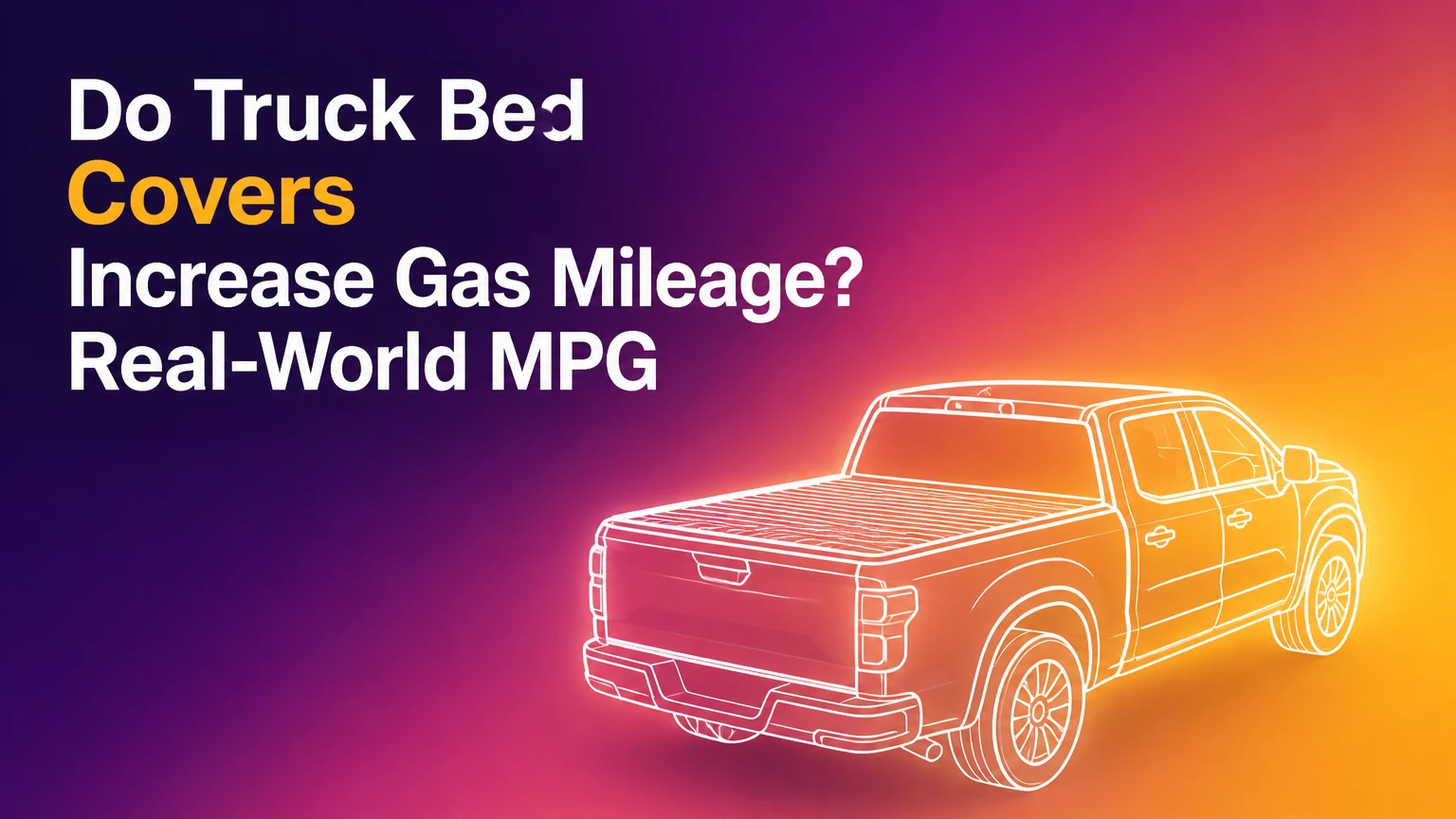
Truck bed covers can increase gas mileage, but the improvement is usually modest and concentrated at steady highway speeds. A properly fitted tonneau cover may reduce aerodynamic drag enough to improve fuel consumption by roughly 1%-5% in many real-world situations, while city driving may show no measurable gain. Results depend on speed, truck design, cover fit, weather, tires, and driving habits.
Key Facts at a Glance
- A tonneau cover can improve highway fuel economy, but no universal MPG increase applies to every pickup.
- Aerodynamic drag rises with the square of speed, so a cover matters more at 60-75 mph than at 25-40 mph.
- A realistic mixed-driving improvement is often about 0%-3%, not a guaranteed 2-8%.
- Cover weight can offset aerodynamic savings during frequent stop-and-go driving.
- A loose soft cover, exposed ladder rack, or poorly sealed rail can increase turbulence rather than reduce it.
- Fuel savings alone rarely justify an expensive hard cover unless the truck travels many highway miles.
Does a Truck Bed Cover Increase Gas Mileage?
Yes, a truck bed cover can increase gas mileage by smoothing airflow over the pickup bed, but the measurable gain varies widely. Highway drivers are most likely to notice an improvement, while urban drivers may see no change because rolling resistance, acceleration, idling, and traffic dominate fuel consumption.
A tonneau cover changes the pickup’s rear-body airflow. An open bed allows air descending from the cab roof to separate from the body and circulate inside the cargo box. The tailgate and bed sides then create a turbulent wake behind the cab, increasing pressure drag. A cover can reduce the size or strength of that separated flow region.
The effect is not equivalent to adding several MPG in every situation. A 5% fuel-economy improvement on a truck achieving 18 mpg equals approximately 18.9 mpg, an increase of only 0.9 MPG. That distinction matters when calculating payback.
The U.S. Department of Energy states, “Aggressive driving (speeding, rapid acceleration and braking) wastes gas.” That principle often outweighs a tonneau cover’s aerodynamic benefit, particularly on short urban trips.
How Does a Tonneau Cover Reduce Drag?
A tonneau cover reduces drag by giving airflow a more continuous surface behind the cab, which can reduce flow separation and wake turbulence. The cover does not eliminate aerodynamic drag because the truck’s grille, mirrors, tires, suspension, cab edges, and rear tailgate still disturb the air.
At highway speed, the aerodynamic force opposing motion follows this relationship:
[ F_d = \frac{1}{2}\rho C_d A v^2 ]
Here, (F_d) is drag force, (\rho) is air density, (C_d) is the drag coefficient, (A) is frontal area, and (v) is vehicle speed. The squared speed term explains why a cover has little influence during a 25-mph trip but greater potential at 70 mph.
The open cargo bed creates a complicated flow pattern rather than a simple hole in the truck. Air from the cab roof can shear away at the rear window and bed transition, producing recirculation zones. A level cover may reduce the energy lost in those zones, although the exact result depends on cab height, bed length, tailgate geometry, side-rail height, and cover shape.
Does a flat cover create laminar airflow?
Usually, no. A tonneau cover may produce smoother external airflow, but a pickup truck remains a bluff body with substantial turbulence. Claims that a cover creates fully laminar airflow or eliminates drag overstate the aerodynamic change.
A cover’s practical benefit comes from reducing unfavorable pressure differences and turbulence, not from converting the entire truck into a streamlined vehicle. A flush hard cover can maintain its shape at speed, while a loose vinyl cover can flutter and introduce new disturbances.
How Much Fuel Can a Truck Bed Cover Save?
A typical fuel-economy improvement is approximately 0%-1% in city driving, 1%-3% in mixed driving, and 2%-5% during sustained highway travel. Larger claims, including 8%, may occur under particular test conditions, but they should not be treated as a normal guaranteed result.
| Driving condition | Typical cover effect | Example on an 18-mpg truck | Main limiting factor |
|---|---|---|---|
| City at 20-40 mph | 0%-1% | 0-0.2 MPG | Acceleration and traffic |
| Suburban at 40-55 mph | 1%-2% | 0.2-0.4 MPG | Stops and varied speed |
| Highway at 60-75 mph | 2%-5% | 0.4-0.9 MPG | Wind and cover fit |
| Long trip with strong headwind | 2%-6% typical range | 0.4-1.1 MPG | Wind direction and speed |
| Mixed use, 70% highway | 1%-4% | 0.2-0.7 MPG | Mileage distribution |
These are practical planning ranges, not a laboratory certification. Truck manufacturers, cover retailers, and owner reports often publish higher percentages, but tests may compare different speeds, weather conditions, tire pressures, payloads, or driving routes.
Fuel economy also changes because MPG is not linear. A 10% reduction in fuel consumption does not always appear as a 10% increase in the displayed MPG number. For example, reducing consumption from 5.56 gallons per 100 miles to 5.05 gallons per 100 miles changes fuel economy from 18 to approximately 19.8 mpg.
At What Speed Does a Bed Cover Help?
A bed cover has its greatest fuel-economy potential above approximately 50 mph, with the clearest opportunity during steady driving at 60-75 mph. Below 40 mph, aerodynamic drag is generally a smaller part of the total resistance, so a cover’s benefit is often hidden by acceleration, tire losses, engine warm-up, and idling.
A highway trip provides the cleanest conditions for detecting a difference. A truck traveling at 70 mph experiences substantially more aerodynamic resistance than the same truck traveling at 50 mph because drag force scales with velocity squared. Wind can amplify the effect: a 15-mph headwind raises the airspeed over the vehicle to roughly 85 mph.
That does not mean a cover lowers engine RPM. Gear selection and transmission programming determine engine speed. The cover reduces the power required to maintain speed, which may allow the powertrain to use less fuel under the same operating conditions.
Do bed covers improve city fuel economy?
Truck bed covers rarely produce a noticeable city-mileage improvement. Stop-and-go driving repeatedly converts fuel into acceleration energy, and the cover cannot recover that energy when the truck slows for traffic lights or congestion.
A lightweight cover has a better chance of remaining neutral in urban use. A 100-pound retractable system adds mass that must be accelerated repeatedly. The penalty is usually small compared with the truck’s curb weight, but it can offset a small aerodynamic gain when highway exposure is limited.
Which Truck Bed Cover Has the Best Fuel-Economy Potential?
A flush, rigid cover generally has the strongest aerodynamic potential because it resists flutter and maintains a consistent surface. A lightweight soft roll-up cover may deliver nearly as much practical benefit for some owners because its lower mass, lower cost, and correct installation can outweigh the theoretical advantage of a heavier hard cover.
| Cover type | Typical weight | Typical price | Fuel-economy potential | Main trade-off |
|---|---|---|---|---|
| Soft roll-up | 10-25 lb | $150-$500 | 1%-3% highway | Vinyl can flap or sag |
| Soft folding | 20-40 lb | $250-$700 | 1%-3% highway | Seams and frame gaps |
| Hard folding | 45-75 lb | $500-$1,500 | 2%-5% highway | Higher mass and cost |
| Hard retractable | 70-120 lb | $800-$2,500 | 2%-5% highway | Canister uses bed space |
| One-piece fiberglass | 100-160 lb | $1,000-$2,500 | 2%-5% highway | Heavy and slow to remove |
The table describes typical market ranges rather than guaranteed performance. A $250 soft cover installed tightly can outperform a $1,500 rigid cover installed with misaligned rails, exposed crossbars, or a large rear gap.
Are hard covers better than soft covers for MPG?
Hard covers are not automatically better for MPG. Rigid panels preserve their shape at 70 mph, but the additional 40-140 pounds can reduce efficiency during acceleration, while a properly tensioned soft cover can remain aerodynamically effective at highway speed.
Choose a hard cover when security, weather resistance, and structural stability matter alongside highway travel. Choose a soft cover when low weight, low purchase cost, and frequent removal matter more than maximum cargo protection.
Does the Tailgate-Up Air Bubble Make a Cover Unnecessary?
The tailgate-up air bubble makes the comparison more complicated, because a closed tailgate can perform better aerodynamically than a removed or lowered tailgate. The popular MythBusters demonstration showed that an open pickup bed with the tailgate installed can maintain a circulating air pocket that reduces some flow entering the bed.
That finding does not prove that every tonneau cover improves fuel economy over every tailgate configuration. It does establish that driving with the tailgate down or removing it can worsen airflow and should not be assumed to save fuel.
The correct comparison is usually:
- Tailgate installed and closed.
- Tailgate installed with a cover.
- Tailgate lowered or removed.
- Bed filled with cargo, with and without the cover.
A cover may reduce wake turbulence compared with an uncovered bed, but the difference depends on the pickup model and cover design. The tailgate-up configuration remains a valid baseline, not an aerodynamic failure.
Does Cargo Placement Change the Result?
Cargo placement can change a tonneau cover’s benefit more than the cover type itself. Items extending above the bed rails, an open toolbox, a ladder rack, and tall camping equipment interrupt the intended airflow path and can produce strong local turbulence.
Cargo hidden below the bed rails usually creates less aerodynamic disruption than cargo above the rails. However, heavy cargo still increases rolling resistance and acceleration demand. A covered bed containing 500 pounds of tools may use more fuel than an empty uncovered bed despite its smoother airflow.
| Bed configuration | Aerodynamic condition | Added mass | Likely fuel result |
|---|---|---|---|
| Empty bed, cover installed | Smooth upper surface | 15-70 lb | Best cover-case potential |
| Cargo below rails, cover closed | Mostly contained flow | 100-500 lb | Cover benefit, payload penalty |
| Ladder rack above cover | Exposed obstruction | 40-150 lb | Benefit partly or fully lost |
| Open toolbox above rails | Large local turbulence | 40-100 lb | Often neutral or negative |
| Tailgate down, no cover | Disturbed wake and higher exposure | 0 lb change | Not a reliable MPG strategy |
What Installation Details Affect Fuel Economy?
Correct tension, parallel rails, a level rear edge, and intact seals determine whether a tonneau cover helps rather than hurts fuel economy. Installation usually takes 20-90 minutes, depending on the cover and whether the truck already has a bedliner, utility rails, or a toolbox.
Check these points after installation:
- Measure the gap between the rails and cover at several locations.
- Confirm the side rails run parallel to the bed edges.
- Tighten clamps evenly instead of forcing one corner into alignment.
- Set soft-cover tension according to the manufacturer’s instructions.
- Inspect the rear seal for lifting at 60-70 mph.
- Verify that the cover does not bow upward in crosswinds.
- Remove or account for racks, crossbars, and bed accessories above the cover.
A loose vinyl panel can flutter like a flexible wing. That movement creates noise, changes pressure distribution, and can damage the material. A low-profile cover also fails to provide its intended benefit when the rear corners sit several inches above the bed rails.
How can you tell whether installation is causing extra drag?
Inspect for visible flapping, raised corners, damaged seals, and air marks on dusty surfaces. A correctly fitted cover should remain stable at highway speed, with no repeated lifting, snapping, or contact against the rails.
If fuel economy drops immediately after installation, first check tire pressure, payload, weather, driving speed, and fuel blend. A single tank cannot isolate the cover’s effect because wind, temperature, traffic, and regenerative or engine-control behavior can move fuel economy by more than the expected gain.
Can a Truck Bed Cover Hurt Gas Mileage?
A truck bed cover can hurt gas mileage when its added weight, exposed hardware, poor fit, or cargo interference creates a larger penalty than its aerodynamic benefit. The risk is greatest for short trips, low-speed delivery routes, and heavy one-piece or retractable systems.
Weight matters because every stop requires acceleration. A 120-pound cover is a small fraction of a 5,000-pound half-ton truck, but the expected aerodynamic improvement may also be small. A heavy cover is more likely to reduce net economy when the truck spends most of its time below 45 mph.
Other negative conditions include:
- A soft cover that is loose enough to balloon.
- A cover left folded against the cab while driving.
- A canister that protrudes into the airflow or bed opening.
- A rack mounted above the cover.
- A cover installed over a damaged or uneven bed rail.
- Snow or standing water accumulating on the panel.
A cover is not a fuel-saving device for every route. Security and weather protection may justify the purchase, but fuel savings should remain a secondary benefit for most owners.
How Much Does a Tonneau Cover Need to Save to Pay Back?
At $3.50 per gallon, a truck that travels 15,000 miles annually at 18 mpg spends approximately $2,917 on fuel. A 3% reduction in fuel consumption saves about $88 per year, assuming the same mileage, fuel price, speed, and conditions.
| Annual miles | Baseline economy | Fuel at $3.50/gal | Savings at 3% | Five-year savings |
|---|---|---|---|---|
| 10,000 | 18 mpg | $1,944 | $58 | $292 |
| 15,000 | 18 mpg | $2,917 | $88 | $438 |
| 20,000 | 18 mpg | $3,500 | $105 | $525 |
| 30,000 | 18 mpg | $5,833 | $175 | $875 |
The calculation uses a 3% reduction in fuel consumption, not a direct three-percent addition to the MPG display. A $250 soft cover might approach fuel-only payback in several years for a high-mileage highway driver. A $1,200 hard cover is unlikely to pay for itself through gasoline savings alone at ordinary annual mileage.
Use this formula:
[ \text{Annual fuel savings} = \frac{\text{annual miles}}{\text{baseline MPG}} \times \text{fuel price} \times \text{consumption reduction} ]
Fuel prices, speed, and annual mileage matter more than a cover’s advertised maximum percentage. Cargo security, dry storage, and theft prevention often provide the real financial justification.
How Should You Test a Cover’s MPG Effect?
Test the cover over multiple matched fuel tanks, using fill-to-fill calculations rather than the dashboard estimate. A useful test needs at least two comparable tanks before installation and two after installation, with similar tire pressure, payload, route, weather, and highway speed.
Follow this procedure:
- Record the odometer and fill the tank to the same pump-shutoff method.
- Check cold tire pressures and remove unnecessary cargo.
- Drive the same route with a similar city-highway split.
- Record fuel added at the next refill and calculate miles divided by gallons.
- Repeat the baseline for two or three tanks.
- Install the cover and repeat the route for two or three tanks.
- Exclude tanks with major towing, unusual wind, snow, or traffic.
- Compare average consumption, not the best individual tank.
Do not compare one winter tank against one summer tank. Cold air, winter gasoline, lower tire pressure, longer warm-up periods, and road conditions can overwhelm a 1%-3% aerodynamic change.
An owner testing a 3% improvement on an 18-mpg truck is looking for approximately 18.5 mpg. Dashboard rounding, pump variation, and route differences can hide that result unless the test includes several hundred miles.
What Are the Best Alternatives to a Bed Cover?
A tailgate-up configuration, a lightweight cover, or reducing highway speed may provide better value than an expensive tonneau cover, depending on the truck’s use. Removing the tailgate is not a generally recommended fuel-saving alternative because it can alter vehicle behavior, create legal concerns, and expose the cargo bed.
| Alternative | Typical cost | Aerodynamic implication | Best use |
|---|---|---|---|
| Keep tailgate closed | $0 | Stable factory configuration | Universal baseline |
| Soft roll-up cover | $150-$500 | Moderate highway smoothing | Low-cost daily use |
| Hard folding cover | $500-$1,500 | Stable, rigid surface | Security plus highway miles |
| Remove roof or bed rack | $0-$1,000 | Often removes major turbulence | Trucks with unused racks |
| Reduce cruising speed | $0 | Strong drag reduction | Highway fuel savings |
| Reduce unnecessary payload | $0 | Lowers rolling and acceleration losses | Work and travel trucks |
Reducing speed from 75 to 65 mph can produce a larger fuel-economy change than adding a tonneau cover because aerodynamic drag rises sharply with speed. The exact savings depend on gearing, wind, tires, and engine load, but speed is usually the first variable to address.
Which Drivers Benefit Most From a Truck Bed Cover?
High-mileage highway drivers benefit most from a tonneau cover, while urban drivers should purchase one primarily for cargo protection, security, and weather resistance. The right choice depends on the truck’s speed profile, access requirements, and tolerance for added weight.
Long-distance highway commuter
A low-profile soft or hard folding cover fits a driver traveling 15,000-30,000 highway miles annually. A 2%-5% reduction in fuel consumption can produce meaningful savings over several years, especially when the cover also protects luggage.
City-based contractor
A bed cover has limited MPG value for a contractor making frequent stops. A lightweight roll-up cover may still protect tools from rain, but a heavy retractable model should be selected for security and access rather than fuel economy.
Recreational truck owner
A weekend driver is unlikely to recover a $1,000 cover through fuel savings. A $200-$500 soft cover can make sense when it keeps camping gear dry and avoids the need for a separate cargo box.
Towing or payload-focused owner
A cover may improve airflow when the bed is empty, but towing a trailer introduces additional aerodynamic drag that can dominate the result. Weight, hitch setup, trailer shape, and cargo distribution deserve priority.
Diesel pickup owner
Diesel engines often travel efficiently at highway speed, but aerodynamic drag still requires power. A tonneau cover can help a diesel truck under steady conditions, although the percentage improvement remains dependent on vehicle shape and speed rather than fuel type alone.
What Common Mistakes Produce False MPG Conclusions?
The most common mistake is attributing a small fuel-economy change to the cover without controlling speed, wind, tire pressure, and payload. A 2-mpg difference between tanks does not prove a cover caused the change.
Practitioner rules improve the diagnosis:
- Compare averages across several tanks, not one trip.
- Record average highway speed because a 10-mph difference can outweigh the cover effect.
- Check TPMS pressure when tires are cold, especially during seasonal temperature changes.
- Remove bed racks before testing if the goal is to isolate the cover.
- Weigh the cover when comparing a 15-pound roll-up against a 120-pound retractable.
- Keep the tailgate configuration unchanged throughout the comparison.
One counterintuitive truth is that a cover can improve highway aerodynamics while reducing mixed-driving economy. The two results are compatible because highway drag and stop-and-go acceleration emphasize different losses.
Another is that a cheaper cover can provide better financial value without producing the best theoretical airflow. Purchase cost, weight, durability, and annual highway miles determine payback more reliably than the cover’s label.
FAQ
Does a tonneau cover improve MPG with the tailgate up?
A tonneau cover may improve MPG compared with an uncovered bed while the tailgate remains closed, but the improvement is not guaranteed for every truck. The tailgate-up air pocket can already reduce some bed turbulence, so the cover’s incremental benefit may be smaller than marketing claims suggest.
Is a soft truck bed cover worth buying for fuel savings?
A soft cover can be worth buying when it costs $150-$500, weighs approximately 10-25 pounds, and the truck travels substantial highway mileage. Fuel savings alone usually do not justify the purchase for a low-mileage city truck, but weather protection and cargo security may justify it.
Does driving with the tailgate down save gas?
Driving with the tailgate down does not reliably save gas and may increase drag or affect vehicle handling. The tailgate-up configuration can support a recirculating air pocket, and removing or lowering the tailgate changes the truck’s designed airflow and cargo retention.
Does a tonneau cover improve towing fuel economy?
A tonneau cover may improve the pickup’s airflow when the bed is empty, but trailer drag usually dominates fuel consumption during towing. Trailer frontal area, speed, wind, load weight, and hitch alignment generally matter more than the cover.
Should I remove a heavy bed cover in winter?
Remove a heavy bed cover in winter only if the truck’s use is predominantly short-distance stop-and-go driving and the cover provides no security or weather benefit. Snow accumulation can add substantial temporary weight, so clear the panel before driving and follow the manufacturer’s load limits.
Can a truck bed cover improve diesel mileage?
A truck bed cover can improve diesel mileage during steady highway travel by reducing aerodynamic drag. Diesel fuel type does not guarantee a larger percentage gain, because the result depends primarily on speed, wind, truck geometry, cover fit, payload, and driving conditions.
The Bottom Line
Do truck bed covers increase gas mileage? Usually, a properly fitted tonneau cover can improve highway fuel economy by approximately 2%-5%, while mixed-driving gains commonly fall between 0% and 3%. The result is too small and variable to justify an expensive cover on fuel savings alone.
Choose a lightweight soft cover for low cost and minimal mass, or a rigid cover when security and weather protection matter. Keep the tailgate closed, remove exposed racks, maintain correct tire pressure, and test several comparable tanks before claiming a measurable MPG improvement.