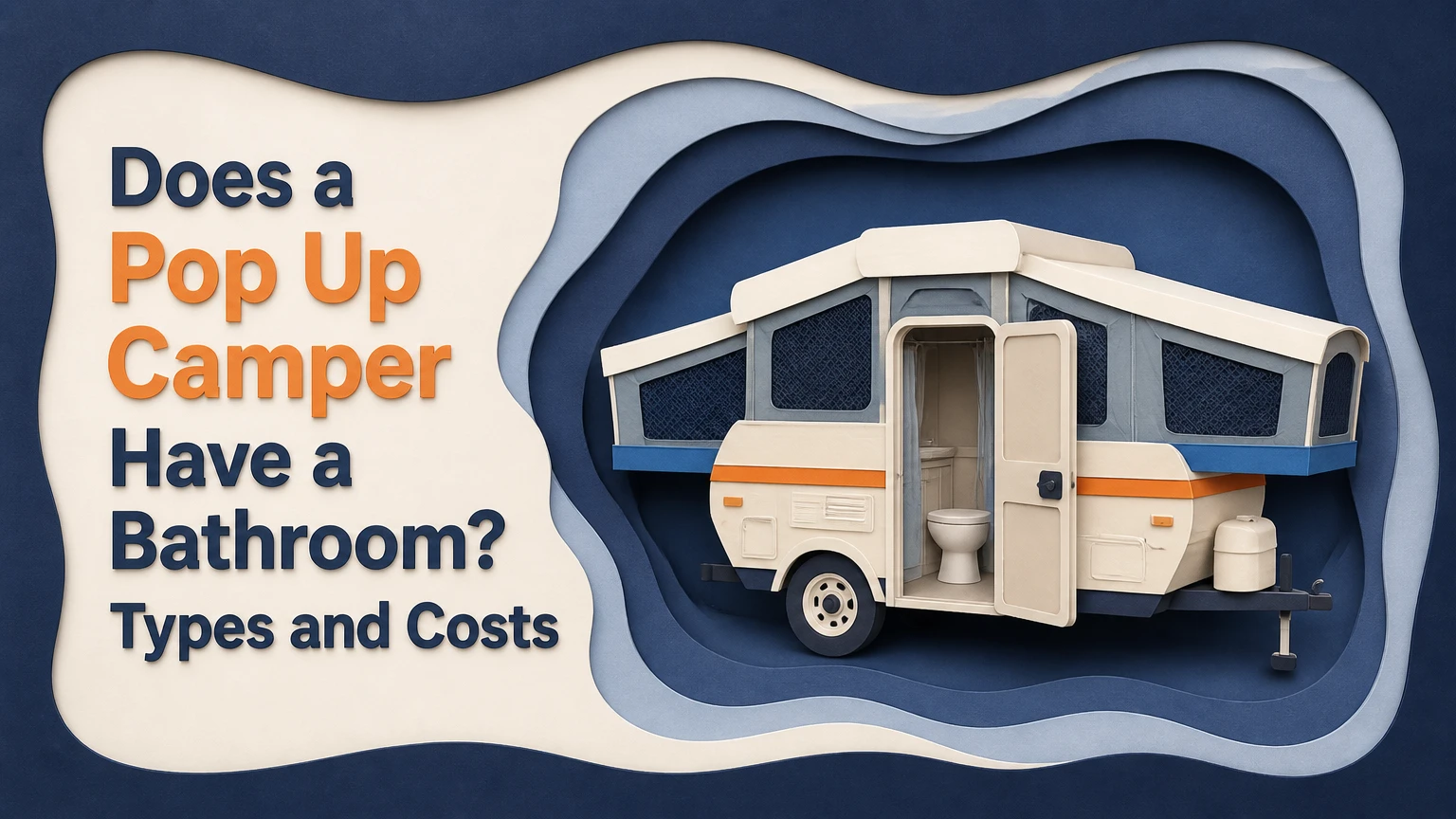
Some pop-up campers have bathrooms, but a bathroom is not standard equipment. Entry-level folding campers usually provide beds, dinettes, and storage without fixed plumbing, while high-wall or premium models may include a cassette toilet, wet bath, or portable toilet cabinet. The exact bathroom depends on the floorplan, roof height, water system, and available interior space.
Key Facts at a Glance
A pop-up camper bathroom is optional, not a universal feature.
Most built-in pop-up camper bathrooms use a cassette toilet rather than a conventional black tank.
A wet bath combines the toilet and shower in one waterproof compartment.
A Porta-Potti can provide indoor toilet access without permanent plumbing.
A built-in bathroom commonly adds interior complexity, water-system maintenance, and several thousand dollars to the purchase price.
Bathroom availability must be confirmed in the manufacturer floorplan and specification sheet, not inferred from the camper’s exterior size.
Does a Pop Up Camper Have a Bathroom?
A pop-up camper can have a toilet, shower, or combined bathroom, but many models have neither. The most common built-in arrangement is a cassette toilet, while a full wet bath appears mainly in taller high-wall folding campers and specialized designs.
A conventional soft-sided pop-up has limited vertical space when closed. That restriction makes a residential-style bathroom impractical because the roof, canvas walls, beds, and interior furniture must fold or slide into a compact travel position. Manufacturers therefore use removable toilets, folding privacy enclosures, cassette systems, or exterior wash stations.
The word “bathroom” also causes confusion in listings. A camper advertised with a “bath” may contain only a cassette toilet, while a “shower package” may mean an exterior shower hose with no indoor toilet. Read the equipment list carefully.
A practical classification is:
- No bathroom: The camper relies on campground facilities.
- Portable toilet: A chemical toilet sits in a cabinet or privacy area.
- Cassette toilet: A fixed bowl drains into a removable waste cassette.
- Wet bath: A toilet and shower occupy one waterproof room.
- Exterior shower: A hose and showerhead operate outside the camper.
The manufacturer’s floorplan is the controlling evidence. Dealer photographs can show optional equipment, discontinued layouts, or accessories that were added after purchase.
What Bathroom Types Are Available?
Pop-up campers use four main sanitation arrangements: wet baths, cassette toilets, portable toilets, and exterior showers. These options differ in privacy, plumbing, water consumption, tank capacity, cleaning effort, and suitability for cold or off-grid camping.
| Bathroom type | Typical equipment | Typical capacity or space | Main limitation |
|---|---|---|---|
| Wet bath | Toilet, shower pan, faucet, privacy door or curtain | 20-35 square feet; 10-25 gallon freshwater system | Small room gets completely wet |
| Cassette toilet | Fixed bowl, 4-6 gallon removable cassette | About 1-2 square feet of floor area | No indoor shower in toilet-only layouts |
| Porta-Potti | Portable chemical toilet, 2-5 gallon lower tank | 1-2 square feet when stored | Requires carrying and emptying the unit |
| Exterior shower | Hose, showerhead, exterior connection, privacy tent | 6-25 gallon freshwater system | Limited privacy, weather-dependent use |
Wet Bath
A wet bath combines a toilet, shower, floor drain, and waterproof enclosure in one compact compartment. The user sits on or near the toilet while showering, so the room must dry after every use.
Pop-up wet baths are space-efficient but rarely feel spacious. A roof-high or high-wall design may create enough vertical clearance for an interior compartment, whereas a standard tent-style camper generally cannot provide the same arrangement. Some wet baths have molded fiberglass or plastic walls; others use a hard folding partition with a waterproof curtain.
A wet bath works well for young children, rainy conditions, and campers who value indoor washing more than open floor space. It is less suitable for people who expect a separate shower, dry changing area, or residential bathroom comfort.
Cassette Toilet
A cassette toilet has a permanent bowl mounted above a removable waste tank. An exterior service door lets the owner slide out the cassette without opening the living area.
The cassette usually holds approximately 4-6 gallons, although capacities vary by toilet model. The tank is carried to an approved disposal point and emptied through a pour-out spout. A cassette toilet does not require the large sewer hose used by many full-size RV black tanks.
A cassette toilet can connect to the camper’s freshwater system or use a separate flush reservoir. The second arrangement reduces dependence on the main water tank and can simplify winterization. Chemicals must match the toilet manufacturer’s instructions and local disposal rules.
Porta-Potti
A Porta-Potti is a self-contained portable toilet with an upper flush reservoir and a lower waste tank. Some pop-up campers store the unit inside a dedicated cabinet, under a bench, or behind a curtain.
Portable toilets have the lowest installation burden. Owners can remove the unit for cleaning, transport it to a restroom, and replace it without modifying the camper’s floor or plumbing. The trade-off is weaker privacy and a more visible sanitation routine.
A portable toilet is often the sensible first choice for a used camper. It provides nighttime convenience without committing the buyer to a floorplan that sacrifices seating or storage.
Exterior Shower
An exterior shower supplies warm or unheated water through a wall-mounted connection. The user normally adds a privacy tent or shower enclosure beside the camper.
Exterior showers keep humidity out of the canvas interior and avoid the need for an indoor shower pan. They work for rinsing feet, washing muddy children, cleaning dishes, and bathing in warm weather. Wind, rain, campground rules, freezing temperatures, and privacy limitations reduce their usefulness as a complete bathroom replacement.
How Does a Bathroom Fit in a Folding Camper?
A pop-up camper bathroom fits through a combination of removable fixtures, foldable partitions, flexible connections, and equipment placed in unused corners. The bathroom must clear the roof, beds, cabinets, and lifting mechanism when the camper closes.
Manufacturers do not all use the same engineering. A cassette toilet may remain fixed during travel, while a Porta-Potti may be stored separately. A privacy curtain can fold flat, but hard panels may hinge against a wall or require removal before lowering the roof.
Typical setup for a camper with a folding privacy enclosure is:
- Park and level the trailer.
- Raise and secure the roof according to the owner’s manual.
- Install or unfold the bathroom partition.
- Attach the privacy curtain or latch the wall panels.
- Position the cassette or portable toilet.
- Connect the freshwater, drain, or exterior shower hose if fitted.
- Test the flush, faucet, and drain before use.
Allow approximately 5-10 additional minutes for bathroom setup after the owner knows the camper. A first-time setup can take longer because the owner must identify panel latches, curtain tracks, water connections, and waste-tank access.
A bathroom does not automatically mean a private room. Some floorplans provide only a curtain around the toilet, and the curtain may leave gaps at the roof or floor. Inspect the enclosure in person if privacy matters.
How Do Water and Waste Systems Work?
Pop-up camper bathroom plumbing normally uses a freshwater tank and pump, a city-water connection, or both. Waste may enter a removable cassette, a portable container, a greywater tote, or, less commonly, a fixed holding tank.
A typical water path is:
- Freshwater enters through a tank or pressurized campground connection.
- A 12-volt pump supplies water when the camper is not connected to city water.
- A faucet or shower valve mixes hot and cold water where a heater is installed.
- Sink and shower water drain into a greywater container or tank.
- Toilet waste remains in the cassette or portable toilet unless the design has a fixed black tank.
A 6-gallon water heater is common in larger RVs, but it should not be assumed in a pop-up camper. Many folding campers have no water heater, use a small on-demand heater, or offer hot water only as an option. Confirm the heater type, fuel source, recovery time, and electrical demand.
| System component | Typical pop-up range | What changes the figure | Owner consequence |
|---|---|---|---|
| Freshwater tank | 15-30 gallons | Floorplan and tank option | More capacity increases payload |
| Cassette tank | 4-6 gallons | Toilet model | Frequent emptying for multiple users |
| Portable toilet tank | 2-5 gallons | Porta-Potti model | Easy removal, smaller capacity |
| Greywater container | 5-25 gallons | Sink and shower configuration | May require a portable tote |
| Water heater | 0-6 gallons | Standard versus optional equipment | Hot showers may be unavailable |
Water weighs 8.34 pounds per US gallon. A full 20-gallon freshwater tank therefore adds about 167 pounds before counting the tank, pump, heater, dishes, propane, and camping equipment. Owners should use the trailer’s payload and axle ratings rather than relying on a generic “bathroom weight” estimate.
The claim that every bathroom pop-up uses flexible high-pressure hoses is too broad. Some systems use flexible tubing near moving sections, while others use rigid PEX, removable hoses, or conventional RV fittings. The owner’s manual identifies the actual plumbing material.
Which Bathroom Option Is Best?
A cassette toilet is the best compromise for many couples because it provides an installed toilet while using little floor space and avoiding a large black-water tank. A wet bath suits families that need indoor washing, while a Porta-Potti suits buyers who want the lowest cost and simplest maintenance.
| User priority | Best-fit option | Typical added complexity | Practical reason |
|---|---|---|---|
| Lowest purchase price | Porta-Potti | Low | No permanent plumbing required |
| Nighttime toilet access | Cassette toilet | Moderate | Fixed bowl and exterior cassette hatch |
| Indoor showering | Wet bath | High | Requires enclosure, drain, and water management |
| Exterior cleaning | Exterior shower | Moderate | Keeps mud and humidity outside |
| Dry camping | Cassette toilet plus exterior shower | Moderate | Low water and electrical demand |
| Family privacy | Wet bath or enclosed cassette area | High | Reduces nighttime trips and exposure |
A bathroom can also reduce usable living space. The owner may lose one cabinet, a dinette corner, or part of the floor needed for changing clothes. The value depends on the camping routine, not the feature list.
Which Bathroom Works for Families?
Families with young children usually benefit from a wet bath or an enclosed cassette toilet. Indoor access reduces nighttime walks, gives parents a place to manage muddy clothing, and helps during rain, illness, or crowded campground conditions.
A wet bath becomes less attractive when several people need showers in succession. A small freshwater tank and limited greywater capacity can make long showers impractical, especially without a campground water connection. Families should inspect the floor area, toilet position, curtain coverage, and storage for towels and toiletries.
A family that primarily camps at serviced campgrounds may gain more from a private toilet than from an indoor shower. That choice preserves space and reduces drying problems.
Which Bathroom Works for Couples?
Couples often prefer a cassette toilet because the design preserves more seating and sleeping space than a wet bath. A removable Porta-Potti can work equally well for short trips, particularly when the campground has clean restrooms nearby.
For two adults, a 4-6 gallon cassette may require emptying every one to three days, depending on toilet use, tank treatment, and whether campground facilities are available. Treat that range as a planning estimate, not a guaranteed service interval.
Which Bathroom Works for Boondocking?
Boondockers should prioritize low water use, simple waste removal, and easy winterization. A cassette toilet or Porta-Potti combined with an exterior shower usually consumes less space and fewer resources than a wet bath.
An exterior shower still requires water and privacy. In public land areas, owners must follow local wastewater and human-waste rules; pouring greywater on the ground can be prohibited even when the water appears clean.
How Much Does a Pop-Up Camper Bathroom Cost?
A bathroom-equipped pop-up camper commonly costs several thousand dollars more than a comparable model without one, while a portable toilet can cost roughly $100-$250 and a retrofit can exceed the value of an older trailer.
| Purchase or upgrade | Typical US price range | Labor or setup time | Main price variable |
|---|---|---|---|
| Basic Porta-Potti | $100-$250 | 15-30 minutes | Tank size and flush design |
| Portable privacy tent | $50-$180 | 10-20 minutes | Fabric, poles, and floor |
| Exterior shower kit | $150-$700 | 1-4 hours | Heater, fittings, and installation |
| Used cassette toilet replacement | $500-$1,500 | 2-8 hours | Hatch, plumbing, and floor changes |
| Bathroom floorplan premium | $3,000-$6,000 typical | Factory-built | Brand, age, and equipment |
| Permanent retrofit | $1,500-$4,000 typical | 1-3 days | Structural access and waste routing |
These are planning ranges, not manufacturer price guarantees. New pop-up campers with built-in bathroom equipment can fall around $18,000-$35,000 or more, depending on brand, year, options, freight, and dealer pricing.
Retrofitting a permanent wet bath is rarely a simple toilet installation. The project may require a shower pan, drain slope, greywater routing, waterproof walls, a cassette hatch, ventilation, roof-clearance changes, and structural reinforcement. A portable toilet is usually the financially rational retrofit.
Used buyers should compare two campers with similar age, condition, and tow weight. A $4,000 bathroom premium may not make sense if the bathroom has cracked fittings, a damaged cassette hatch, delaminated panels, or canvas mildew.
Can You Add a Bathroom Later?
You can add a portable toilet or exterior shower to almost any pop-up camper, but adding a factory-style wet bath is technically difficult and often uneconomical. A portable toilet requires no structural alteration, while a permanent cassette installation needs floor, wall, drain, and service-door modifications.
Before approving a retrofit, check:
- Closed-roof clearance above the toilet and enclosure.
- Floor structure and the location of crossmembers.
- Access to a greywater outlet or portable tote.
- Freshwater pump capacity and hose routing.
- Electrical supply for a heater or pump.
- Weight distribution, tongue weight, and axle ratings.
- Ventilation and waterproofing around every penetration.
- Local rules for waste disposal and exterior bathing.
A bathroom installed behind the axle can affect loading balance, while a water tank mounted forward can increase tongue weight. The total weight includes tanks, fixtures, partition panels, heater, hoses, chemicals, and personal supplies.
The honest limitation is simple: a pop-up camper is not a good platform for a residential bathroom conversion. Owners who need a permanent shower, generous toilet room, and large holding tanks should compare small travel trailers or molded fiberglass trailers before cutting the folding camper.
How Do You Use and Maintain the Bathroom?
Use the toilet according to its design, control water consumption, and dry every wet surface before lowering the camper roof. Bathroom problems usually result from incorrect chemicals, overfilled tanks, trapped moisture, or winterization mistakes.
Follow these operating practices:
- Use only toilet chemicals approved for the cassette or portable unit.
- Use rapidly dissolving RV toilet paper, or place paper in a lined waste bin if the manufacturer permits it.
- Keep the blade seal or lower-tank seal clean and lightly lubricated with a compatible product.
- Empty the cassette or portable tank before it reaches the maximum mark.
- Rinse the tank at an approved dump point.
- Wipe the shower pan, curtain, walls, and floor.
- Ventilate the camper until the canvas and bathroom surfaces are fully dry.
- Store the toilet with the recommended amount of water or treatment.
Residential toilet paper is not automatically a problem in every RV toilet, but thick paper can fill a small cassette rapidly and may interfere with seals. The manufacturer’s manual takes priority over generic campground advice.
Winterization requires special attention because folding campers often have exposed fittings and small water lines. Drain the freshwater tank, water heater, pump, toilet reservoir, shower hose, and low-point drains. Use compressed air at the manufacturer’s specified pressure or RV antifreeze where the manual allows it. Never assume an empty tank has removed water from every valve.
What Problems Do Pop-Up Camper Bathrooms Have?
The most common pop-up camper bathroom problems are odor, slow drainage, leaking seals, low shower pressure, mold, and freeze damage. Each symptom points to a different inspection area, so replacing the toilet chemical alone will not solve every failure.
| Symptom | Likely cause | First inspection | Practical fix |
|---|---|---|---|
| Strong toilet odor | Dry seal, full tank, incorrect treatment | Bowl seal and cassette level | Clean seal, add approved treatment, empty tank |
| Slow shower drain | Full tote, blocked strainer, poor leveling | Drain outlet and shower pan | Empty tote, clean strainer, level camper |
| Low water pressure | Weak pump, clogged aerator, kinked hose | Pump filter and hose bends | Clean filter, straighten hose, clear aerator |
| Water under floor | Loose fitting or cracked hose | Connections after pressurizing | Tighten or replace fitting |
| Mildew after storage | Damp curtain or canvas | Bathroom and roof fabric | Dry completely, clean according to fabric guidance |
| No water after winter | Frozen or split fitting | Low points and pump housing | Replace damaged components and pressure-test |
A shower pan may drain slowly when the camper is off-level because gravity carries water toward the wrong side. Level the trailer side to side and front to back, then inspect the drain hose and greywater container.
A toilet odor can come from a dry bowl seal, a damaged cassette vent, excessive heat, or a tank that has sat too long. Tank treatments reduce odor, but they cannot repair a split seal or blocked vent.
What Should You Inspect Before Buying?
Before buying a bathroom-equipped pop-up camper, test the entire water and waste system while the roof is raised. A dry visual inspection can miss leaks that appear only when the pump pressurizes the lines or the shower drains.
Use this inspection sequence:
- Confirm the floorplan includes the bathroom equipment you expect.
- Check that the roof closes without contacting the toilet, faucet, or privacy panels.
- Fill the freshwater tank partially and run every faucet.
- Listen for a pump that cycles repeatedly after the taps close.
- Operate the cassette latch, seal, vent, and exterior service door.
- Pour water into the shower pan and verify drainage.
- Examine the floor around the toilet for softness or staining.
- Inspect canvas, curtains, and wall panels for mildew or water damage.
- Test the water heater only after confirming the correct fuel and electrical procedure.
- Weigh the loaded trailer or calculate payload against the tow vehicle’s limits.
A repeatedly cycling water pump often indicates a leak or a pressure problem. Soft flooring around a toilet is a more serious warning because hidden water damage can involve subfloor replacement.
Confirm whether the advertised bathroom is standard or optional. Dealers sometimes photograph a camper with an accessory Porta-Potti and describe the entire trailer as “bathroom equipped.”
FAQ
Do pop-up campers have black tanks?
Most pop-up campers with toilets use a removable cassette or portable waste tank instead of a fixed black tank. A few specialized or larger folding campers may use fixed holding tanks, but the plumbing layout, dump connection, and tank capacity must be verified in the specifications.
Can you shower inside a pop-up camper?
You can shower inside a pop-up camper only when the floorplan includes a wet bath or indoor shower enclosure. An exterior shower does not provide indoor bathing, even when the listing describes the camper as having shower capability. Indoor shower use also requires water supply, drainage, ventilation, and a way to dry the enclosure.
Are pop-up camper bathrooms private?
Pop-up camper bathroom privacy ranges from a curtain around a portable toilet to a hard-sided compartment with a door. Curtains may leave roof and floor gaps, and some partitions are visible from the main living area. Buyers who need full privacy should stand inside the closed compartment before purchasing.
How often do you empty a cassette toilet?
A 4-6 gallon cassette toilet may need emptying every one to three days for two adults, depending on use and whether campground restrooms handle some trips. Children, guests, and heavy nighttime use shorten the interval. Empty the tank before the maximum-fill indicator whenever possible.
Do pop-up campers have hot water?
Some pop-up campers have a water heater, but many do not. Hot water may come from a propane heater, electric heater, on-demand unit, or optional package. The presence of a sink or shower does not prove that hot water is available, so check the plumbing and appliance specifications.
Is a bathroom worth it in a pop-up camper?
A bathroom is worth the space and cost for campers who need nighttime toilet access, travel with young children, or camp far from reliable restrooms. A portable toilet is usually better for occasional use, while a wet bath is harder to justify if the owner rarely showers inside.
The Bottom Line
The answer to “does a pop up camper have a bathroom” is yes, but only some models do. A cassette toilet is the most practical built-in option, a wet bath offers the most indoor comfort at the highest space and maintenance cost, and a Porta-Potti gives nearly any pop-up camper basic toilet access without permanent modifications. Verify the exact floorplan, water system, waste capacity, roof-clearance requirements, and loaded trailer weight before choosing.