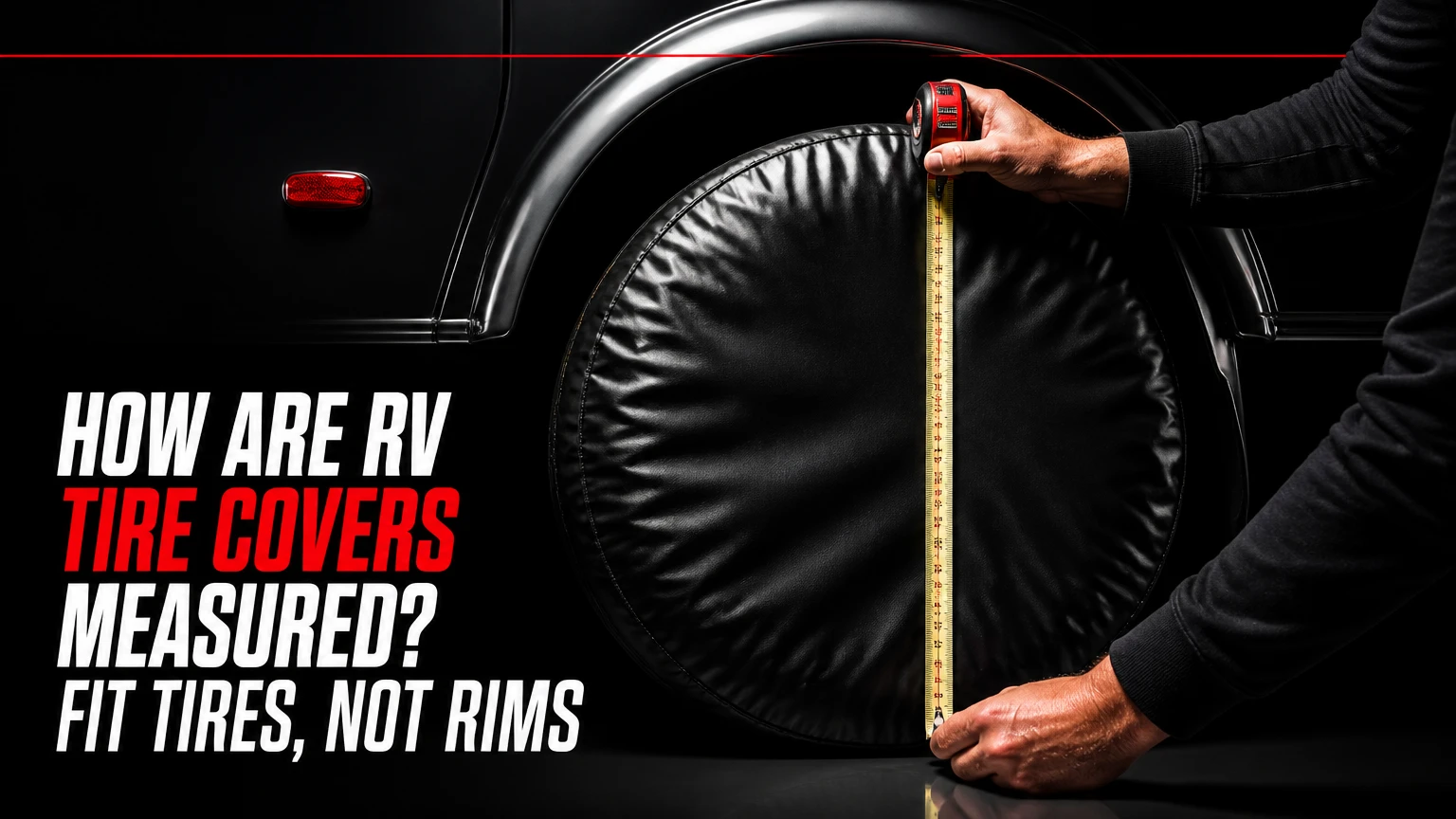
RV tire covers are measured by the tire’s complete outside diameter and usable width, not by the wheel’s rim diameter. Measure an inflated tire straight across its widest vertical span, measure the tread or section width, and match both dimensions to the cover manufacturer’s chart because a 15-inch rim may carry a tire nearly 28 inches tall.
Key Facts
RV tire cover size refers primarily to the inflated tire’s outside diameter.
A wheel marked 15 inches identifies the rim diameter, not the finished tire diameter.
Physical measurement is more reliable than sidewall calculations because inflation, wear, and tire construction change the result.
Measure each axle position when tire sizes, dual-wheel spacing, or cover designs differ.
A correct cover fits over the rubber without dragging on the ground or leaving large wind-catching folds.
Cover dimensions and sizing labels vary by manufacturer, so the maker’s chart overrides a generic diameter range.
What Dimensions Do RV Tire Covers Use?
RV tire covers use two dimensions: the tire’s outside diameter and its width. Outside diameter determines the circular size the cover must enclose, while width determines how far the cover must extend across the tread and sidewalls.
Manufacturers do not label covers consistently. Some list only a diameter range such as 27-29 inches, while others provide a tire-size list, cover height, cover width, or a combined specification such as 30 inches by 8.5 inches. The product chart is therefore the final authority after you take physical measurements.
A tire cover is designed to shield rubber exposed to sunlight, ozone, rain, road salt, dirt, and storage debris. Ultraviolet exposure can accelerate cracking in aging rubber, but a cover that is too loose can flap against the sidewall and fail at the seams. Fit is protective only when the cover remains attached and does not abrade the tire.
Why is rim diameter the wrong measurement?
Rim diameter is the wrong measurement because the rim sits inside the tire. The number stamped in a tire code identifies the wheel diameter that accepts the tire bead, not the tire’s total outside height.
For example, ST225/75R15 means a nominal section width of 225 millimeters, a 75-series aspect ratio, radial construction, and a 15-inch rim. The finished tire is approximately 28.3 inches in diameter before variations from brand, load, inflation, and wear. A cover labeled for a 15-inch wheel would be dramatically undersized.
How Are RV Tire Covers Measured in Practice?
Measure an RV tire while it is fully inflated to the pressure specified for the actual load, using a tape measure and a straightedge. The practical process takes about 10-15 minutes for one axle and produces a more dependable result than reading the rim marking alone.
Measure when the tire is cold, before driving or towing. Heat increases air pressure and can slightly change the tire’s dimensions. If the RV has been parked for storage, check the tire pressure with a gauge first and inflate it according to the vehicle, trailer, or tire manufacturer’s instructions.
What tools are needed?
You need a flexible tape measure, a tire-pressure gauge, a straightedge or broom handle, paper or a phone note, and the tire sidewall code. A second person makes the diameter measurement easier, but a single person can hold the tape against the tire and use a straightedge as a reference.
Do not use the wheel well, fender opening, or hubcap as a substitute for the tire measurement. Those parts describe the vehicle clearance, not the cover size. Record the tire’s position, because a motorhome may use different front, rear, or tag-axle dimensions.
Step 1: Identify every tire group
Record the sidewall size and location before measuring. A travel trailer may use one tire size on all wheels, while a Class A motorhome can have different front and rear assemblies, including dual tires on the drive axle.
Write down the number of covers needed. A four-wheel trailer normally needs four single covers, but a tandem-axle model may use two double covers if the product is designed for the gap between adjacent tires.
Checkpoint: You should know whether the cover will protect one tire, two adjacent trailer tires, or a dual-wheel assembly.
Common mistake: Counting wheels without checking whether the selected product is a single, tandem, or dual-wheel cover.
Step 2: Measure the outside diameter
Measure straight across the center of the tire from the highest rubber point to the lowest rubber point. Keep the tape or straightedge perpendicular to the ground, and measure from rubber edge to rubber edge rather than from hub to hub.
For a more stable reading, place a straightedge across the top of the tire and measure vertically from the straightedge to the ground. Then repeat at the bottom if the tire is not sitting on a level surface. Round the result to the nearest quarter inch, then compare it with the manufacturer’s range.
Checkpoint: Your measurement represents the entire inflated rubber circle, usually about 26-32 inches on many RV and trailer tires.
Common mistake: Measuring from the rim center to the ground and doubling the number. That method can include uneven ground and produces less reliable results.
Step 3: Measure the tire width
Measure the tire’s widest side-to-side dimension across the tread and sidewalls, depending on the cover design. A conventional single tire cover usually needs enough depth to reach across the tread and wrap around both sidewalls without pulling at the seams.
For a basic measurement, place the tape across the tire’s front face from the outer edge on one side to the outer edge on the other. If the product chart specifies tread width rather than overall section width, follow that definition precisely. Tire sidewall bulges can make overall width wider than the nominal number in the sidewall code.
Checkpoint: You have both outside diameter and width recorded in inches.
Common mistake: Treating the 225 in ST225/75R15 as inches. The 225 is a nominal width in millimeters, equal to about 8.86 inches before construction differences.
Step 4: Compare the measurements with the product chart
Match the measured diameter first, then verify the width, tire arrangement, and retention system. A cover marked 27-29 inches may fit a 28-inch tire, but it may not fit a wide tire or a tandem arrangement with a narrow inter-tire gap.
Check whether the listed dimensions describe the tire or the cover itself. A cover may have a larger fabric measurement than its recommended tire diameter because it needs to wrap around the tire. Product photographs are not a substitute for the chart.
Checkpoint: The cover listing explicitly accepts your diameter, width, and tire configuration.
Common mistake: Selecting a cover solely because the diameter range looks correct, without checking whether the cover is for a single tire, dual tires, or tandem trailer tires.
Can You Calculate RV Tire Cover Size From the Sidewall?
You can estimate RV tire diameter from the sidewall code when physical measurement is unavailable, but the result is nominal rather than exact. The formula works well for screening products, while an inflated physical measurement remains the safer choice before ordering.
For a metric tire code in the form of width/aspect ratio R rim, use:
Overall diameter = rim diameter + 2 × sidewall height
Sidewall height = section width × aspect ratio
Convert millimeters to inches by dividing by 25.4.
Example: ST225/75R15
| Calculation stage | Formula | Result |
|---|---|---|
| Section width | 225 ÷ 25.4 | 8.86 inches |
| Sidewall height | 8.86 × 0.75 | 6.65 inches |
| Two sidewalls | 6.65 × 2 | 13.30 inches |
| Estimated outside diameter | 13.30 + 15 | 28.30 inches |
A cover rated for a 28-29-inch tire would be the logical starting point for this example. Confirm the actual tire’s measured diameter because ST tires from different manufacturers can differ slightly, and load range affects construction and deflection.
The formula is less useful for flotation sizes, commercial tire codes, unusual trailer dimensions, or tires with substantial wear. It also does not calculate the exact cover depth required for a particular product.
What Size Cover Fits Common RV Tire Codes?
The following figures are calculated nominal diameters, not guaranteed physical measurements. Use them to narrow the search, then verify the selected product’s chart and the tire’s actual dimensions.
| Tire code | Nominal section width | Calculated diameter | Typical cover search |
|---|---|---|---|
| ST205/75R15 | 8.07 inches | 27.1 inches | 27-28 inches |
| ST225/75R15 | 8.86 inches | 28.3 inches | 28-29 inches |
| ST235/80R16 | 9.25 inches | 30.8 inches | 30-31 inches |
| LT245/75R16 | 9.65 inches | 30.5 inches | 30-31 inches |
| LT225/75R16 | 8.86 inches | 29.3 inches | 29-30 inches |
| LT235/85R16 | 9.25 inches | 31.7 inches | 31-32 inches |
A nominal diameter does not tell you whether a cover will clear a tandem axle, fender skirt, hub extension, or wheel simulator. Those are installation and product-design questions. Tire-code math identifies the approximate circular size only.
Should You Measure Every RV Tire Separately?
Measure every tire group separately when the RV has different axles, dual wheels, mixed tire brands, or visibly different wear. If all tires carry the same code and are evenly worn, measuring one tire on each side is usually sufficient for an initial cover decision, but confirming the largest tire prevents a tight fit.
Motorhomes often use one size on the steering axle and another on the drive axle. A tag axle can introduce a third group. Trailer tires commonly match across axles, yet replacement tires may have a different brand or actual diameter despite identical nominal markings.
Single, tandem, and dual-wheel covers
| Cover configuration | Tires covered | Typical quantity | Main fit issue |
|---|---|---|---|
| Single cover | 1 tire | 4 for a standard trailer | Diameter and cover depth |
| Tandem cover | 2 adjacent trailer tires | 2 for a four-tire tandem | Axle spacing and wind load |
| Dual-wheel cover | 2 side-by-side motorhome tires | 2 for a four-tire drive axle | Inner tire access and width |
| Full axle cover | 2 or more tires plus hardware | 1-2 per axle | Custom geometry and attachment |
A tandem cover is not interchangeable with a dual-wheel cover. Tandem trailer tires sit one behind another along the axle line, while motorhome duals sit side by side on the same hub. The cover’s curvature, opening, and attachment points are different.
Which RV Tire Cover Material and Retention System Fits Your Storage?
Material and attachment determine how long a correctly measured RV tire cover remains useful. Standard vinyl usually costs less and installs quickly, while breathable canvas or solution-dyed acrylic generally handles repeated sun exposure and wind better.
Typical lifespan varies with climate, fabric weight, seam construction, cleaning, and whether the RV is stored under a roof. The ranges below are practical retail expectations, not guarantees.
| Cover type | Typical lifespan | Typical price per pair | Best storage condition |
|---|---|---|---|
| Standard vinyl | 1-3 years | $15-$35 | Covered driveway, occasional use |
| Heavy-duty canvas | 3-5 years | $40-$70 | Outdoor storage with wind and rain |
| Acrylic fabric | 5-10 years | $100-$220 or more | Full-time, high-UV storage |
| Molded hard shell | 8-12 years | $150-$300 | Long-term stationary storage |
Elastic hems suit owners who install covers frequently and remove them before travel. Straps, buckles, grommets, and security cables take longer to use but resist gusts more effectively when properly tensioned.
| Retention system | Installation time per pair | Wind resistance | Typical failure |
|---|---|---|---|
| Elastic hem | 2-4 minutes | Moderate | Elastic loosens or cover slips |
| Rear buckle | 4-7 minutes | High | Strap abrasion or buckle damage |
| Front and rear straps | 6-10 minutes | Very high | Mud-clogged hardware |
| Snap or screw-on | 10-20 minutes initially | High | Hardware loosens or body fit changes |
No cover material compensates for a poor fit. Loose fabric can whip against the sidewall, while an undersized cover can stretch seams and expose the lower rubber.
What If Your Measurement Falls Between Two Cover Sizes?
Choose the smaller size only when the elastic cover still reaches the lower sidewall without excessive tension. Choose the larger size when the smaller cover cannot wrap fully, when the product uses rigid panels, or when the manufacturer specifically recommends sizing up.
The correct decision depends on the cover’s construction, not a universal rule. A 30-inch tire may fit a 30-32-inch strap cover better than a 27-29-inch elastic cover, but a stretchy vinyl model may be designed around a narrower range.
Use these checks before ordering:
- The cover reaches below the tire’s widest point.
- The bottom hem does not drag on the pavement.
- The fabric does not form a large loose pocket.
- The attachment system can be tightened without excessive force.
- The wheel remains fully covered when the tire is turned or the RV settles.
A cover that fits tightly at the top but leaves the lower sidewall exposed is too small. A cover that hangs several inches below the contact patch is too large or poorly shaped.
Why Do RV Tire Covers Blow Off or Tear?
RV tire covers blow off when wind enters from below, the hem is loose, the straps are under-tensioned, or the cover is shaped for a different tire configuration. Correct diameter alone does not prevent wind loss because the lower edge behaves like a sail when air reaches the tire from underneath.
Install the cover with the top seam centered and the bottom edge evenly distributed. Tighten straps until the cover cannot lift several inches, but do not compress the sidewall or place a sharp buckle against the rubber.
If a cover still slips, use the manufacturer’s security grommets with a bungee ball or cable lock. Do not drill holes through an ordinary cover because punctures enlarge under repeated wind loading and can expose the tire.
Common failure modes and fixes
| Failure mode | Likely cause | Corrective action |
|---|---|---|
| Cover falls off overnight | Loose hem or gust entry | Add approved straps or grommet retainers |
| Lower sidewall remains visible | Cover diameter too small | Replace with the next compatible size |
| Fabric tears at the seam | Excess tension or flapping | Check size, reduce stress, replace damaged cover |
| Mildew appears inside | Non-breathable fabric on damp tire | Dry the tire and use breathable material |
| Cover fades within one season | High ultraviolet exposure | Use UV-rated acrylic or add overhead shade |
| Buckle damages sidewall | Hardware contacts rubber | Reposition buckle behind the cover or use padding |
Inspect covers every month during long storage. Replace them when stitching opens, the waterproof coating flakes, the elastic loses recovery, or sunlight passes visibly through a fabric that was previously opaque.
Are RV Tire Covers Worth Buying for Short or Long Storage?
RV tire covers are worthwhile when tires remain parked outdoors for weeks or months, especially in strong sunlight. They provide less value for a vehicle stored indoors, used daily, or parked under a complete roof where the tires receive little ultraviolet exposure.
The cover does not replace tire maintenance. Check cold inflation pressure, inspect for cracks and bulges, and follow the RV manufacturer’s load and storage instructions. A cover cannot repair aging rubber or prevent damage caused by overload, underinflation, curb impacts, or incorrect pressure.
| Storage situation | Recommended cover | Typical setup | Reason |
|---|---|---|---|
| Indoor storage | Optional single vinyl | 2-4 minutes per pair | Low UV and weather exposure |
| Covered outdoor storage | Vinyl or canvas | 2-7 minutes per pair | Moderate sun and rain |
| Full-time desert storage | Acrylic or heavy canvas | 4-10 minutes per pair | High UV, heat, and dust |
| Snowy winter storage | Waterproof canvas with straps | 6-10 minutes per pair | Slush, freeze-thaw cycles, and wind |
| Coastal storage | Breathable synthetic fabric | 4-10 minutes per pair | Salt air and persistent moisture |
A cover is not suitable for highway travel unless its manufacturer expressly permits that use. Remove wheel covers before driving, because loose material can interfere with wheel rotation, collect heat, or detach into traffic.
What Are the Most Common Measuring Mistakes?
The most common mistake is buying by rim diameter, followed by measuring a low-pressure tire or ignoring the cover’s intended tire configuration. These errors produce a cover that either cannot reach the lower sidewall or flaps enough to damage itself.
Use this final inspection list:
- Read the complete sidewall code, including the load range where applicable.
- Measure the tire cold and inflated to the specified pressure.
- Record outside diameter and width in inches.
- Check the largest tire in each axle group.
- Confirm single, tandem, or dual-wheel compatibility.
- Compare the measurements with the exact product chart.
- Inspect the installed cover for ground contact and loose fabric.
- Remove the cover before travel.
One practitioner rule is especially useful: select based on the largest actual tire, not the smallest nominal code. Tire replacement can change the physical dimensions enough to make an old cover tight even when the printed size appears unchanged.
Frequently Asked Questions
Do RV tire covers protect against tire dry rot?
RV tire covers reduce direct ultraviolet exposure, which can slow surface aging, but they do not eliminate dry rot. Tire age, ozone, heat, underinflation, chemical contamination, and long periods of inactivity also affect rubber condition. Inspect sidewalls and tread regularly, and follow the tire maker’s replacement guidance.
Can I use car tire covers on an RV?
You can use car tire covers only when their measured diameter, width, and attachment method match the RV tire. Many passenger-car covers are too shallow for trailer sidewalls, lack sufficient UV resistance, or cannot handle the larger tire diameter. The vehicle category on the package matters less than verified dimensions.
Should RV tire covers touch the ground?
RV tire covers should not drag on the ground. The lower edge should cover the sidewall and stop above the pavement, allowing enough room for rainwater to drain and preventing abrasion. If the hem rests on concrete or asphalt, choose a better-shaped cover or a smaller compatible size.
Do tire covers need to be removed after rain?
Remove or open RV tire covers when moisture becomes trapped between the fabric and rubber. Breathable covers tolerate damp conditions better, but a wet tire enclosed in non-breathable vinyl can encourage mildew and prolonged moisture contact. Dry the tire and inside of the cover before reinstalling it.
Can tire covers fit tires with wheel simulators?
A tire cover can fit a wheel simulator because the cover goes over the complete outside tire assembly, including the visible sidewall area around the simulator. Measure the rubber, not the simulator, and confirm that the cover’s depth clears protruding hub hardware without pressing against sharp edges.
The Bottom Line
RV tire covers are measured by the complete inflated tire, not the wheel rim. Measure the outside diameter across the rubber, record the width, check every distinct axle or tire group, and match those values to the manufacturer’s chart. For the target query, how are RV tire covers measured is answered most accurately with a physical measurement, while sidewall-code math is a useful backup. Choose the largest compatible cover that fully protects the sidewall without dragging, flapping, or interfering with the wheel.