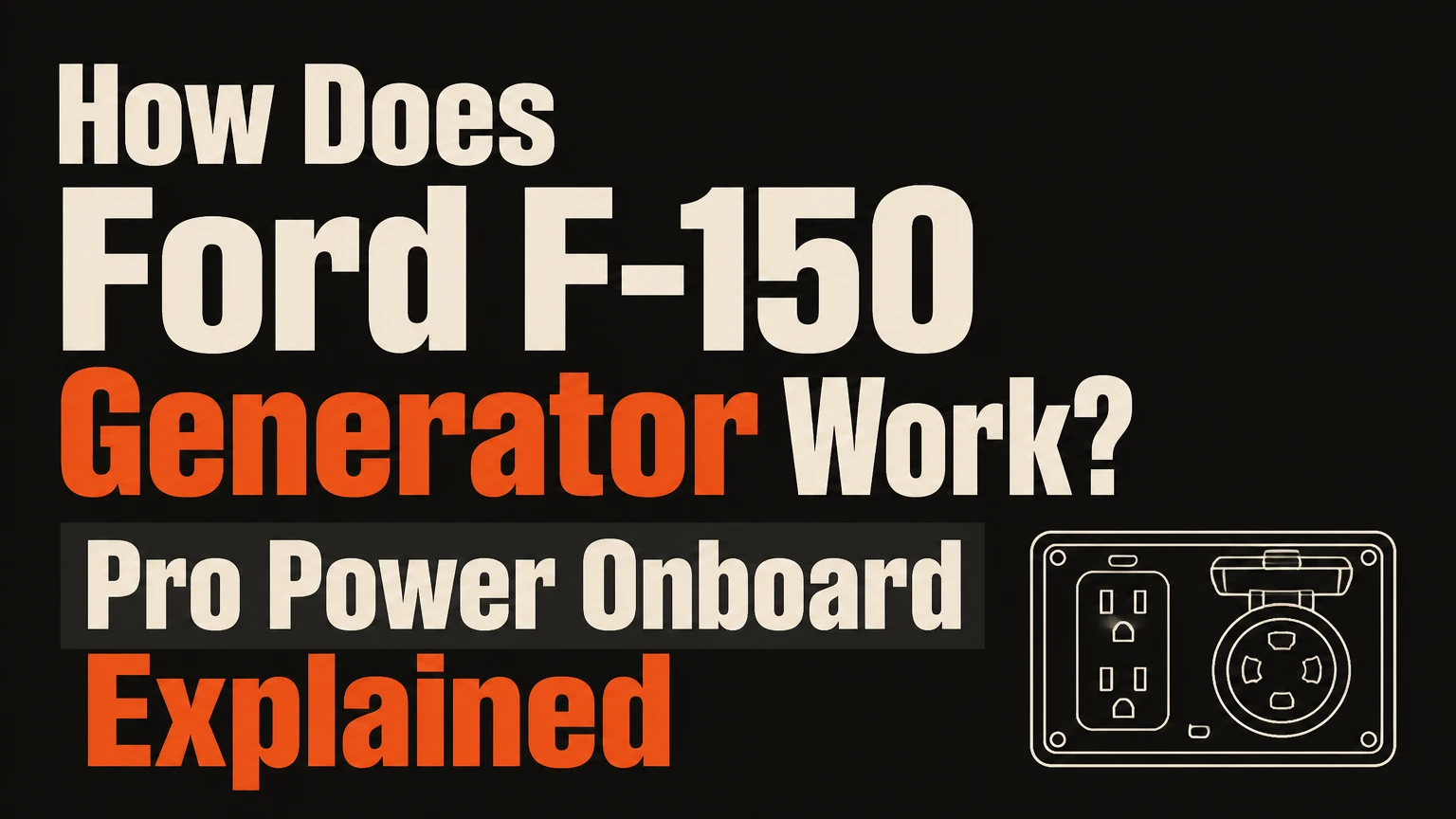
The Ford F-150 generator, called Pro Power Onboard, converts energy from the truck’s engine, alternator, or hybrid drivetrain into regulated AC electricity at outlets in the bed and cabin. Gas models run the engine to produce power through an inverter, while PowerBoost hybrids draw from a battery and restart the engine automatically when charging is needed.
Key Facts at a Glance
- Ford Pro Power Onboard is a factory-integrated vehicle-to-load system, not a low-power accessory inverter.
- Depending on configuration, an F-150 provides 2.0 kW, 2.4 kW, or 7.2 kW of maximum output.
- Gas-only versions require the engine to keep running while supplying electricity.
- PowerBoost versions use a hybrid battery and motor-generator, so the engine can cycle on and off.
- A 7.2 kW system can provide 240-volt power, but home connection requires correctly configured transfer equipment.
- Pro Power Onboard produces exhaust, so the truck must operate outdoors and away from doors, windows, and air intakes.
How Does Ford F-150 Generator Work?
Ford Pro Power Onboard follows this energy path: fuel creates mechanical energy, the truck’s charging system produces DC electricity, and a heavy-duty inverter converts that DC electricity into clean 120-volt or 240-volt AC power. The inverter regulates voltage and frequency while protective electronics monitor current, temperature, ground faults, and circuit demand.
The important distinction is that the outlets do not receive raw alternator output. The inverter creates household-style AC power suitable for chargers, refrigerators, televisions, lights, and many job-site tools within the system’s rated capacity. Ford’s owner information identifies the outlets as power outlets with overload and ground-fault protection, while the exact outlet layout depends on model year and equipment package.
A portable generator has its own fuel tank, engine, alternator, frame, and receptacles. Pro Power Onboard shares the F-150’s fuel tank, control modules, cooling system, and vehicle safety systems. That integration improves convenience, but it also means the truck is not electrically independent from the vehicle.
Gas F-150 power flow
On a non-hybrid F-150 equipped with the available 2.0 kW system, the gasoline engine turns a high-output alternator. The alternator generates DC power, and the Pro Power inverter changes that DC supply into 120-volt AC at the bed outlets.
The gasoline engine must remain operating because the truck has no large hybrid battery to buffer the electrical load. Engine speed may change as demand changes, although the driver generally does not control generator frequency directly. The truck’s control system manages the engine and inverter together.
PowerBoost hybrid power flow
The PowerBoost F-150 uses a 3.5-liter V6, a high-voltage lithium-ion battery, and an electric motor-generator integrated into the transmission. Ford describes the electric machine as a 35-kW motor-generator in its PowerBoost system documentation. Pro Power Onboard can draw from the hybrid battery first, then request engine operation when battery state of charge falls.
That operating pattern explains the quiet periods reported by many owners. Low and moderate loads can run from stored battery energy for a time, while larger or sustained loads cause more frequent engine operation. The hybrid system does not create electricity from nothing. The gasoline engine eventually supplies the energy used by the outlets and the battery.
What does the inverter contribute?
The inverter performs three jobs: it changes DC to AC, controls output quality, and limits unsafe electrical conditions. A 120-volt circuit delivering 20 amps has a theoretical maximum of 2,400 watts, but continuous use should remain within the truck’s published system and outlet limits.
Pure-sine or sine-wave inverter output is valuable for electronics, battery chargers, refrigerators, and equipment with electronic controls. Output quality alone does not make every appliance compatible. Motor starting current, heating elements, extension-cord losses, and circuit protection still determine whether a load will operate.
Which F-150 Generator Systems Are Available?
The F-150 generator system is offered in three commonly discussed capacities: 2.0 kW on selected gas trucks, 2.4 kW as the standard PowerBoost arrangement, and 7.2 kW as the higher-output PowerBoost configuration. Availability varies by model year, trim, engine, cab, market, and build configuration, so the vehicle window sticker and owner’s manual take priority over dealer summaries.
| System | Powertrain | Maximum output | Typical outlet arrangement |
|---|---|---|---|
| 2.0 kW | Selected gasoline engines | 2,000 W | Two 120 V, 20 A bed outlets |
| 2.4 kW | 3.5 L PowerBoost hybrid | 2,400 W | Two 120 V, 20 A bed outlets |
| 7.2 kW | 3.5 L PowerBoost hybrid | 7,200 W | Four 120 V outlets plus one 240 V, 30 A outlet |
| F-150 Lightning Pro Power Onboard | Battery-electric F-150 | Model-specific | 120 V and 240 V outlets, configuration dependent |
The F-150 Lightning is a separate battery-electric architecture. It does not run an internal combustion engine during stationary power use, although its available output, battery capacity, charge state, and model-year features differ from gasoline and PowerBoost trucks.
2.0 kW gas system
The 2.0 kW gasoline system fits light and medium electrical work. It can usually handle a refrigerator, lighting, chargers, a television, or one moderate power tool, but startup surges can reduce the practical combination of loads.
A circular saw rated at 1,500 running watts may briefly demand substantially more when its motor starts. Adding a space heater or compressor can trip the system even when the nameplate wattages appear to total less than 2,000 watts.
2.4 kW PowerBoost system
The 2.4 kW hybrid system adds battery buffering and engine cycling to a modest 120-volt output. It suits camping, tailgating, emergency refrigeration, communications equipment, and smaller tools.
The 2.4 kW rating is the system ceiling, not a guaranteed amount available at every outlet simultaneously under every condition. Ford’s manual and outlet labels determine the applicable circuit limits.
7.2 kW PowerBoost system
The 7.2 kW system is the most capable gasoline F-150 option. It can supply higher total wattage and includes a 240-volt receptacle for compatible equipment, such as selected welders, well-pump equipment, and RV loads.
The 7.2 kW figure should not be interpreted as unlimited household split-phase service. Users must confirm the outlet’s voltage, amperage, plug type, neutral arrangement, and breaker allocation before connecting equipment.
How Much Power Does an F-150 Generator Deliver?
An F-150 generator delivers 2,000, 2,400, or 7,200 watts depending on its installed Pro Power Onboard configuration. The practical limit is set by the smallest restriction among total system output, individual outlet rating, circuit allocation, startup surge, cord capacity, and temperature protection.
| Load | Typical running watts | Typical startup or surge | Suitable example |
|---|---|---|---|
| LED lighting circuit | 50-200 W | 50-200 W | Emergency lighting |
| Refrigerator | 100-400 W | 800-1,500 W | One household refrigerator |
| Battery charger | 100-1,200 W | 100-1,200 W | Tool battery charging |
| Microwave oven | 1,000-1,500 W | 1,500-2,000 W | Short cooking cycle |
| Circular saw | 1,200-1,800 W | 2,400-4,000 W | One saw, no large heater |
| Portable air conditioner | 900-1,500 W | 1,800-3,500 W | Model-specific |
| Space heater | 1,500 W | 1,500 W | One heater only |
| RV air conditioner | 1,200-1,800 W | 3,000-5,000 W | Compressor and converter dependent |
Use the appliance nameplate whenever possible. For motors and compressors, the locked-rotor or startup requirement matters more than the running-watt figure.
How should loads be calculated?
Add running watts for all devices expected to operate together, then allow for the largest startup surge that may occur at the same moment. A refrigerator drawing 300 watts, lights drawing 100 watts, and chargers drawing 500 watts create an 900-watt running load, but a compressor startup can temporarily push demand above 2,000 watts.
The 7.2 kW system also requires circuit awareness. A high total capacity does not mean every outlet can deliver the entire amount. Divide loads according to the outlet and circuit information shown in the truck’s display or manual.
How Do You Turn On Pro Power Onboard?
To turn on Pro Power Onboard, park outdoors, place the transmission in Park, activate the system from the bed control or vehicle touchscreen, select the generator function when available, and connect loads only after the outlet indicator confirms operation. The exact menu names differ across model years and software versions.
Before connecting equipment
- Park on firm ground outdoors, at least away from doors, windows, and building air intakes.
- Keep the tailpipe unobstructed, including by snow, mud, or a tonneau cover.
- Inspect plugs, extension cords, and appliance cables for cuts, crushed insulation, or wet connectors.
- Switch loads off before plugging them in.
- Confirm each device’s running and startup wattage.
- Keep the truck fueled above the reserve threshold needed for transportation.
Operating steps
- Shift into Park and start the truck. The vehicle must be in the operating state specified by the owner’s manual. Generator operation is not safe in a garage, carport, enclosed trailer, or partially enclosed structure.
- Open the bed outlet panel. Press the physical power control if fitted, or open the Pro Power Onboard screen in SYNC. Some trucks display the system through a dedicated power-outlet menu.
- Enable generator mode when available. Generator mode changes how automatic engine shutdown behaves. It does not increase the wattage rating or remove overload protection.
- Plug in the smallest load first. Start with a charger or light, then add appliances one at a time. This approach makes startup surges and faulty equipment easier to identify.
- Watch the power display. The screen or FordPass interface may show total wattage and circuit information, although available monitoring functions vary by vehicle and software.
- Stop loads before shutting down. Turn appliances off, disconnect cords, disable Pro Power Onboard, and then turn the vehicle off according to the manual.
You will know the system is operating when the outlet indicator shows the active state and the connected equipment runs without a fault message. A blinking indicator, immediate shutdown, or reset request signals a protection event rather than normal operation.
How Long Will the F-150 Generator Run?
F-150 generator runtime depends on fuel level, electrical load, engine temperature, climate-control use, battery state of charge, and reserve logic. Ford does not provide one universal runtime number for every F-150, so claims such as 85 hours for 2.4 kW or 32 hours for 7.2 kW should be treated as scenario estimates, not guaranteed results.
A light hybrid load may allow long periods of engine-off operation, while a sustained 7.2 kW load consumes fuel much faster. A gasoline truck also uses fuel for vehicle electronics, cooling, and engine operation even when outlet demand is low.
| Use scenario | Approximate load | Expected behavior | Main constraint |
|---|---|---|---|
| Refrigerator, router, lights | 300-800 W | Hybrid engine cycles occasionally | Battery state of charge |
| Camping electronics | 100-500 W | Long engine-off intervals | Overnight fuel reserve |
| Microwave and chargers | 1,500-2,400 W | Frequent engine operation | 2.4 kW system limit |
| Job-site tools | 2,000-4,000 W | Engine runs often | Circuit and surge limits |
| Large 240 V load | 5,000-7,200 W | Sustained engine operation | Fuel and thermal management |
Ford vehicles can also preserve a fuel reserve or stop generator operation when the remaining range becomes low. The exact threshold depends on model software and calibration. Never plan emergency power around consuming the entire tank.
Can an F-150 Power a House?
An F-150 can power selected household circuits through a properly installed transfer system, but it must not connect directly to a household receptacle or service panel with a homemade cable. Direct backfeeding can energize utility lines, bypass protection, damage the truck, and injure or kill utility workers.
A licensed electrician must match the truck’s output configuration to the transfer equipment. The electrician should verify voltage, amperage, neutral bonding, grounding, circuit selection, interlock or transfer-switch design, and local electrical-code requirements.
The neutral arrangement deserves special attention. Some PowerBoost configurations use a bonded neutral, while many household transfer installations assume a different neutral-ground relationship. A mismatch can trip GFCI protection or create an objectionable current path. The solution is not to defeat the GFCI. It is to use equipment designed for the truck’s electrical configuration.
Suitable home loads
A 2.0 or 2.4 kW system may support a refrigerator, internet equipment, lights, phone chargers, and a small television, but not a typical electric range, central air conditioner, or electric water heater. A 7.2 kW configuration can support more circuits, yet it still cannot replace unlimited utility service.
A transfer switch also prevents grid power and truck power from being connected simultaneously. Portable extension cords are appropriate for isolated appliances, not for improvised whole-house energizing.
Can You Use Pro Power Onboard While Driving?
Pro Power Onboard can support selected loads while the F-150 is moving, provided the owner’s manual permits that use and all equipment is secured. Charging tool batteries, cameras, coolers, or e-bikes may be practical, but loose cords, unsecured cargo, and exposed equipment create risks.
Do not run a cord through a window or place an appliance where braking can cause it to move. Keep inverter loads within their outlet ratings, and remember that a moving truck still produces exhaust. Vehicle motion does not make an enclosed cargo area safe for combustion-powered equipment or people.
Is Pro Power Onboard Better Than a Portable Generator?
Pro Power Onboard is usually better for owners who already need an F-150 and want integrated, mobile electricity. A portable inverter generator remains better when the user needs an independent power source, lower replacement cost, or electricity after the truck must leave.
| Decision factor | F-150 2.0 kW | F-150 7.2 kW | Portable inverter generator | Home standby generator |
|---|---|---|---|---|
| Maximum output | 2,000 W | 7,200 W | 1,800-7,000 W typical | 8,000-26,000 W typical |
| Fuel source | F-150 gasoline tank | F-150 gasoline tank | Separate gasoline or propane | Natural gas or propane |
| 240 V capability | No | Yes, configuration dependent | Model dependent | Common |
| Mobility | Truck required | Truck required | Carryable or towable | Permanently installed |
| Typical purchase cost | Vehicle option, often about $995 typical | Vehicle option, often about $750 typical | About $500-$3,000 typical | About $4,000-$12,000 installed typical |
| Home connection | Transfer equipment required | Transfer equipment required | Transfer equipment required | Automatic transfer switch |
| Engine noise | Engine-dependent | Engine-dependent | Generator-dependent | Generator-dependent |
The F-150 saves the owner from storing a separate engine and fuel system. The trade-off is opportunity cost: using the truck as a stationary generator may leave the household without transportation.
What Can Each F-150 Generator Run?
The 2.0 kW system is appropriate for one large intermittent tool or several small electronic loads. The 2.4 kW hybrid system adds quieter low-load operation, while the 7.2 kW version suits higher-demand tools and selected 240-volt equipment.
Job-site use
A 7.2 kW truck can support several battery chargers, lighting, a saw, and a compressor if their startup events do not overlap and the loads are distributed correctly. A 2.0 kW truck should normally run one major motor-driven tool at a time.
Heating devices deserve caution. A 1,500-watt heater consumes most of a 2.0 kW system’s capacity while providing no motor-starting margin for a refrigerator or saw.
Camping and RV use
An F-150 can run an RV converter, refrigerator, lights, chargers, and selected air conditioners. The air conditioner’s compressor startup determines compatibility, and a 15,000-BTU unit may exceed a 2.4 kW system even when its running wattage appears acceptable.
Use the RV manufacturer’s electrical specifications. Do not assume a plug adapter creates a correctly configured 240-volt or split-phase supply.
Emergency use
Prioritize refrigeration, communications, lighting, medical equipment, sump pumps, and heating controls. Turn off electric water heaters, ranges, dryers, resistance heaters, and central air conditioning unless a qualified electrician has confirmed adequate capacity and transfer-switch compatibility.
Why Does the F-150 Generator Trip or Stop?
An F-150 generator usually trips because of overload, motor startup current, ground leakage, damaged cords, moisture, or a load connected to a circuit that has already reached its limit. A hybrid engine that starts and stops is often operating normally, but rapid cycling can indicate a heavy or unstable demand.
Use this diagnostic sequence:
- Disconnect every load and inspect the cords.
- Reset the outlet or inverter protection control.
- Plug in one small known-good load.
- Add devices individually while watching wattage.
- Identify whether one appliance causes the fault.
- Stop if the fault returns with no load, then contact Ford service.
A wet connector or damaged extension cord can trip ground-fault protection even below the wattage limit. Never bypass a GFCI, use a damaged cord, or substitute a higher-rated fuse.
Common failure modes
- One circuit overloads: Move a load to the other approved circuit, provided the outlet layout permits it.
- A saw trips the inverter at startup: Remove other loads and use a shorter, correctly rated cord.
- The light blinks after rain: Disconnect equipment, dry the area, and do not reset repeatedly.
- The engine cycles every few minutes: Reduce demand and switch off truck climate control, heated seats, and unnecessary accessories.
- The outlet stays inactive: Check Park status, system activation, vehicle warnings, and the manual’s reset procedure.
- Home transfer equipment trips: Stop using the connection and have an electrician verify neutral and grounding compatibility.
What Does Pro Power Onboard Cost to Own?
Typical factory option prices have been reported around $995 for a 2.0 kW gas configuration and around $750 to upgrade from the standard PowerBoost arrangement to 7.2 kW, but pricing changes by model year, trim, market, and package. PowerBoost availability can also make the hybrid powertrain the larger cost decision.
Ownership costs include gasoline, scheduled truck maintenance, extension cords, weather protection, and any transfer-switch installation. A home connection can add roughly $500-$2,000 or more in typical electrician and equipment costs, depending on panel changes, wiring distance, permits, and local labor rates.
The truck’s existing fuel tank is convenient, but it is not free capacity. At high electrical demand, fuel consumption approaches the behavior of a running vehicle engine under substantial load.
Expert Rules for Safe, Efficient Use
Treat startup watts as the controlling number for motors. A refrigerator marked at 400 running watts can momentarily demand more than twice that amount. Size the system around the largest simultaneous startup event, not the average display reading.
Do not confuse 7.2 kW with seven available kilowatts at one receptacle. Outlet amperage, circuit allocation, and plug configuration can limit a single load before total system wattage is reached.
Turn off truck accessories before diagnosing short cycling. Cabin heating, cooling, heated seats, entertainment, and battery charging consume energy that the outlet display may not present as an appliance load.
Keep the truck available for evacuation. During an outage, reserve fuel and avoid using every gallon for stationary power. The truck is also transportation, and that function may become more important as conditions worsen.
FAQ
Does the F-150 generator use gasoline?
Gasoline F-150 Pro Power Onboard systems use fuel from the truck’s main tank. The 2.0 kW gas system runs its engine continuously during electrical operation, while PowerBoost models burn fuel intermittently or continuously depending on battery state and outlet demand.
Is the F-150 generator an inverter generator?
Pro Power Onboard uses an inverter to create regulated AC electricity, but it is integrated into the vehicle rather than packaged as a portable inverter generator. The truck’s engine, alternator, hybrid battery, cooling system, and control modules all participate in power production.
Can Pro Power Onboard charge another electric vehicle?
The outlets can charge many portable devices and selected electric-vehicle charging equipment when voltage, amperage, and cord requirements match. Charging another EV at high power can consume substantial capacity and fuel, so confirm the EV charger’s input before connecting it.
Does Pro Power Onboard work with the truck turned off?
PowerBoost models can provide short periods of engine-off electricity because the hybrid battery buffers the load, but the vehicle must remain in the operating state required by Ford’s controls. The engine will restart as needed, and the system may shut down under low fuel or fault conditions.
Is a 7.2 kW F-150 enough for a 50-amp RV?
A 7.2 kW system may run selected RV equipment, but a 50-amp RV connection can represent up to 12,000 watts at 240 volts. The truck cannot deliver that full theoretical 50-amp service, so users must limit simultaneous loads and verify the adapter and outlet configuration.
Can the F-150 generator run indoors?
No. A gasoline or hybrid F-150 must operate outdoors because engine exhaust contains carbon monoxide. A garage door, open tailgate, fan, or partially open window does not provide a safe substitute for outdoor operation away from openings and air intakes.
The Bottom Line
The answer to “how does ford f150 generator work” is that Ford Pro Power Onboard uses the truck’s fuel-powered charging hardware and an integrated inverter to deliver usable AC electricity. Gas models keep the engine running, while PowerBoost hybrids alternate between battery power and automatic engine charging. Choose the output by measured startup loads, follow the Ford owner’s manual, and use a professional transfer switch for any home connection.