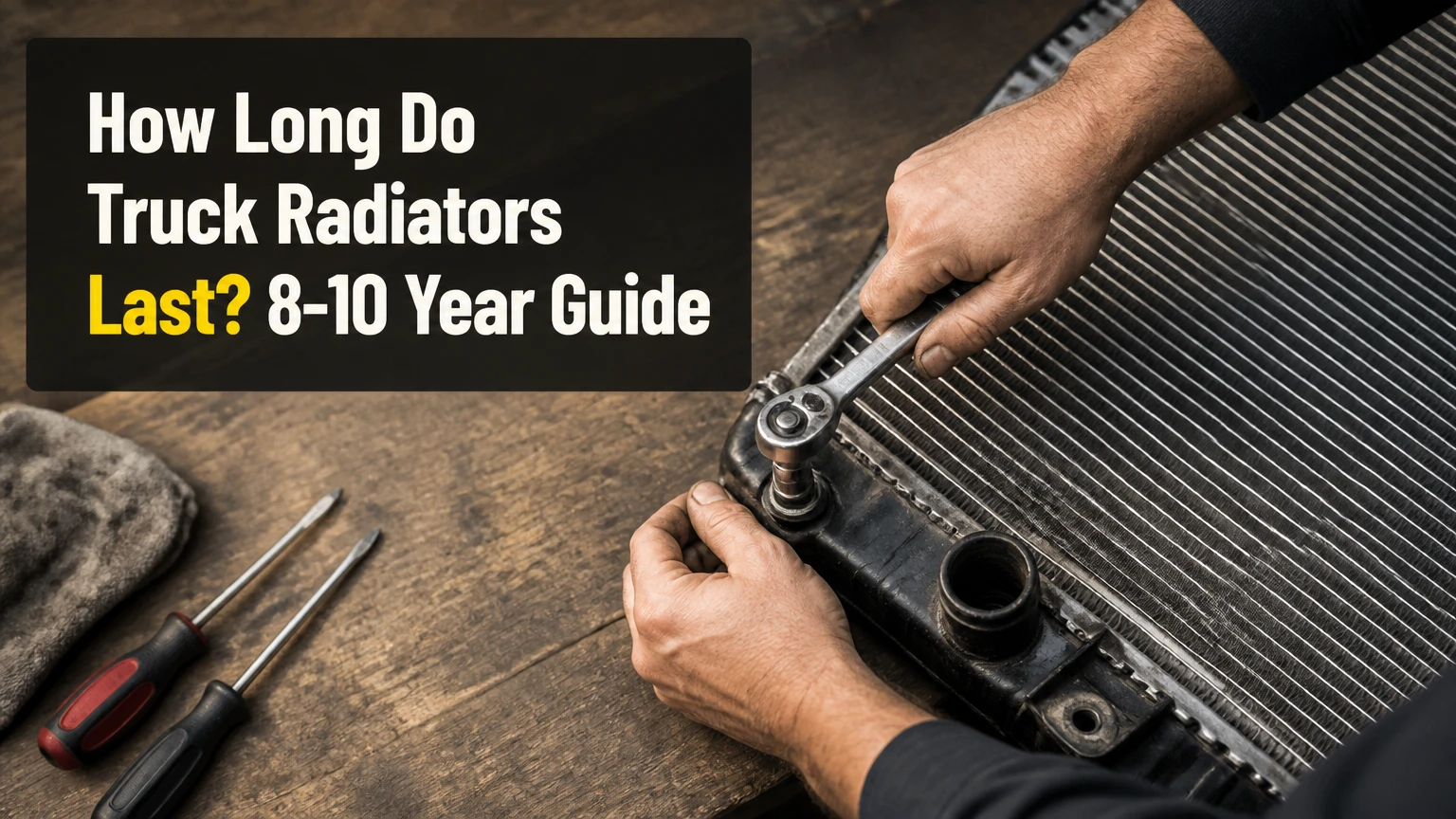
A truck radiator typically lasts 8-10 years or 150,000-250,000 miles, whichever comes first, when the cooling system uses the correct coolant, maintains proper pressure, and receives scheduled inspection. Light-duty trucks may exceed 200,000 miles, while towing, corrosion, neglected coolant, vibration, and repeated overheating can shorten radiator life to five years or less.
Key Facts at a Glance
- A plastic-tank, aluminum-core truck radiator commonly lasts 8-10 years and 150,000-250,000 miles.
- Heavy-duty truck radiators often reach 10-15 years, but severe hauling, debris, vibration, and corrosion can reduce that range.
- Radiator age alone does not prove failure; a pressure test, visual inspection, coolant check, and temperature diagnosis provide stronger evidence.
- Repeated overheating can damage the engine even when the radiator leak appears small.
- A radiator replacement typically costs $400-$900 for a pickup, $800-$1,500 for a medium-duty truck, and $1,500-$4,000 or more for a heavy-duty truck.
- Coolant chemistry, pressure-cap condition, airflow, and external cleanliness often matter more than radiator material alone.
How Long Do Truck Radiators Last?
Truck radiators generally last 8-10 years in ordinary service, but mileage, engine load, climate, construction, and maintenance determine whether a particular unit reaches that range. A lightly used pickup in a dry climate may retain its original radiator beyond 200,000 miles, while a salt-exposed work truck can develop corrosion much earlier.
Mileage provides an imperfect estimate because a radiator experiences time-based thermal cycles as well as driving distance. A truck that travels 10,000 miles annually still heats and cools its radiator repeatedly, and those cycles age plastic tanks, seals, solder joints, hoses, and pressure caps.
The 150,000-250,000-mile range is a practical industry estimate rather than a guaranteed replacement interval. Truck manufacturers normally prescribe coolant testing, inspection, and fluid replacement, not automatic radiator replacement at a specific odometer reading.
Lifespan by Truck Class
| Truck application | Typical radiator life | Common replacement mileage | Main stress factor |
|---|---|---|---|
| Half-ton or three-quarter-ton pickup | 8-12 years | 150,000-250,000 miles | Plastic-tank cracking and road debris |
| One-ton pickup or service truck | 7-10 years | 140,000-220,000 miles | Towing load and engine-bay heat |
| Medium-duty box or vocational truck | 8-12 years | 180,000-300,000 miles | Vibration, dust, and long idle periods |
| Heavy-duty diesel tractor | 10-15 years | 300,000-600,000 miles | Coolant chemistry, airflow, and corrosion |
| Severe-duty mining or construction truck | 5-10 years | Usage-dependent | Abrasion, debris, vibration, and heat |
These ranges describe original or properly maintained radiators under typical conditions. A repaired radiator, replacement core, or used component may have a different remaining life because its solder joints, tanks, mounting points, and internal passages have an unknown service history.
What Does a Truck Radiator Do?
A truck radiator transfers heat from engine coolant to outside air, preventing combustion heat from pushing the engine beyond its designed operating temperature. The radiator sits near the front of the truck so grille airflow and the cooling fan can move air through its fins.
The cooling cycle begins when coolant absorbs heat inside the cylinder block and cylinder head. After the thermostat opens, the water pump sends hot coolant through the upper radiator hose into the inlet tank. The fluid passes through small tubes, fins transfer heat to air, and cooled coolant exits through the lower tank before returning to the engine.
The radiator is only one part of the cooling system. The thermostat, water pump, fan clutch or electric fan, hoses, cap, expansion tank, coolant, heater core, and engine passages must work together. A new radiator cannot correct a failed water pump, restricted condenser, slipping fan clutch, incorrect thermostat, or combustion gas entering the coolant.
What Happens During a Cooling Cycle?
- Heat absorption: Coolant carries heat away from combustion chambers and cylinder walls.
- Thermostat control: The thermostat restricts flow during warm-up, then opens near its specified temperature.
- Pressure circulation: The water pump moves hot coolant toward the radiator.
- Heat rejection: Tubes and fins transfer thermal energy to ambient air.
- Return flow: Cooler coolant returns to the engine for another cycle.
- Expansion control: The cap and reservoir accommodate fluid expansion while maintaining system pressure.
A blocked radiator reduces flow and heat-transfer area. A damaged fan or blocked grille reduces airflow. A weak cap lowers boiling protection, so the engine may overheat even when the radiator core remains unobstructed.
Which Radiator Materials Last the Longest?
All-aluminum radiators can last longer than many plastic-tank, aluminum-core units, but construction quality and operating conditions matter more than material labels alone. Copper-brass radiators are highly repairable, whereas aluminum radiators are lighter and common in modern trucks.
| Radiator construction | Typical life | Typical cost position | Principal failure mode |
|---|---|---|---|
| Plastic tank, aluminum core | 8-10 years | $400-$1,500 installed | Tank seam cracks and gasket leaks |
| Welded all-aluminum | 10-15 years | $700-$4,000 installed | Weld fatigue, abrasion, salt corrosion |
| Copper-brass | 10-12 years | $600-$2,500 installed | Solder deterioration and tube corrosion |
| Heavy-duty modular | 10-15 years | $1,500-$5,000 installed | Core damage, tank leaks, vibration fatigue |
Is an All-Aluminum Radiator Better?
An all-aluminum radiator is usually better for repeated towing, competition, high ambient temperatures, or trucks that need greater heat-rejection capacity. It is not automatically the best choice for a daily-driven pickup because the upgrade may cost hundreds of dollars more without solving a dirty condenser, weak fan clutch, or undersized transmission cooler.
All-aluminum units eliminate many crimped plastic-to-aluminum seams and can tolerate demanding temperature cycles when properly welded and mounted. However, aluminum can suffer from galvanic corrosion, road-salt attack, and weld fatigue if the radiator lacks adequate brackets or uses incompatible mounting hardware.
When Is Copper-Brass the Better Choice?
Copper-brass radiators suit vintage trucks and some older heavy-duty applications where repairability matters more than weight. A radiator shop can often unsolder a damaged tank, repair a tube, or install a replacement core, while a severely damaged modern unit is commonly replaced.
Copper-brass construction is heavier and may not provide a meaningful cooling advantage in a modern truck with a well-designed aluminum radiator. Solder bloom, internal corrosion, restricted passages, and repeated vibration can still end its service life.
Which Factors Shorten Radiator Life?
The largest radiator-life reducers are acidic or contaminated coolant, external corrosion, physical impact, chronic overheating, excessive vibration, and inadequate airflow. These conditions attack different components, so a radiator can appear clean externally while its tubes are restricted internally.
Main Service-Life Factors
| Factor | Typical consequence | Inspection interval | Corrective action |
|---|---|---|---|
| Incorrect coolant mixture | Corrosion or poor freeze protection | Every service visit | Test concentration and chemistry |
| Tap-water mineral content | Scale and restricted tubes | During each drain | Use distilled or deionized water |
| Road salt | Tank, tube, and fin corrosion | Monthly in winter | Rinse underside and inspect seams |
| Bent or clogged fins | Reduced airflow and heat transfer | Every oil service | Straighten carefully and clean debris |
| Excessive engine vibration | Bracket, tank, or solder fatigue | Every 15,000-30,000 miles | Inspect mounts and isolators |
| Repeated overheating | Warped components and seal damage | Immediately after event | Diagnose before continued driving |
Coolant becomes more damaging when its additive package is depleted or when incompatible formulas are mixed. Heavy-duty diesel engines may also require supplemental coolant additives or an approved extended-life coolant, depending on the manufacturer and engine family.
The truck owner’s manual and coolant manufacturer’s specification control the correct product. Color is not a reliable compatibility standard because different coolant chemistries can share similar colors.
What Are the Signs of a Failing Truck Radiator?
The most dependable radiator-failure signs are an external leak, unexplained coolant loss, a failed pressure test, visible core blockage, or a temperature problem that persists after other cooling components test correctly. A rising temperature gauge alone indicates overheating, not necessarily a radiator defect.
Symptoms That Deserve Immediate Diagnosis
- Coolant at the radiator seam: Wetness near a plastic tank crimp, drain plug, hose neck, or welded joint indicates a leak path.
- Sweet-smelling vapor: Steam or coolant odor after shutdown can indicate a hot leak, but a heater hose or water pump may be responsible.
- Repeated reservoir loss: Needing to add coolant every few days means the system has a leak, an internal loss, or an air-purging problem.
- Cold spots across the core: An infrared scan showing uneven temperature can indicate restricted tubes.
- External fin blockage: Mud, insects, paper, and bent fins reduce airflow through the radiator and condenser stack.
- Rust-colored or oily coolant: Corrosion, oil contamination, or neglected fluid service requires immediate testing.
- Overheating under load: Temperature rise during towing or hill climbs often points to restricted flow, poor airflow, or inadequate capacity.
Do not open a radiator cap on a hot engine. A pressurized cooling system can release scalding coolant and steam. Let the engine cool completely, then inspect the level and leak evidence.
How Can You Tell Whether the Radiator Is Actually Bad?
A cooling-system pressure test is the most useful first test for an external radiator leak, while temperature-pattern testing helps identify internal restriction. A technician should also test the cap, thermostat, fan operation, water-pump circulation, coolant concentration, and possible combustion-gas intrusion before condemning the radiator.
A typical diagnostic sequence takes 30-90 minutes and includes a visual inspection, pressure test at the manufacturer’s specified pressure, cap test, scan-tool temperature comparison, and examination of the radiator surface. The exact pressure value varies by truck, so substituting a universal cap or test specification can produce a false conclusion.
Common Faults That Mimic a Bad Radiator
| Symptom | Possible radiator cause | Other likely cause | Useful confirmation |
|---|---|---|---|
| Overheats at highway speed | Restricted core | Thermostat, low coolant, head gasket | Temperature scan and flow test |
| Overheats at idle | Blocked fins | Fan clutch or electric-fan failure | Fan engagement and airflow test |
| Coolant disappears | Tank or tube leak | Water pump, hose, heater core | Pressure test and UV dye |
| Upper hose collapses | Restricted return flow | Weak hose or thermostat issue | Hose inspection and flow diagnosis |
| Coolant bubbles continuously | Internal radiator fault is uncommon | Head-gasket or cylinder pressure | Combustion-gas test |
| Coolant is oily | Oil cooler or radiator failure | Transmission cooler, head gasket | Fluid separation and pressure testing |
A radiator is not proven defective merely because it is old. Conversely, an apparently clean radiator may have internal scaling that limits flow under load.
Can a Truck Radiator Be Repaired?
A truck radiator can often be repaired when the damage is localized, accessible, and economically smaller than replacement. Plastic tank cracks, severely corroded cores, multiple leaks, blocked tubes, and damaged mounting points usually justify replacement rather than a temporary patch.
Radiator shops may repair copper-brass tanks and solder joints, replace a core, or install a tank. Aluminum repairs require clean metal, proper welding, and secure mounting; epoxy products may stop a minor seep temporarily but are not a dependable solution for a pressurized truck cooling system.
Repair or Replace?
| Condition | Repair suitability | Typical result | Planning estimate |
|---|---|---|---|
| Single copper-brass tube leak | High | Solder or tube repair | $100-$300 |
| Plastic tank seam crack | Low to moderate | Tank replacement or radiator replacement | $250-$900 |
| Blocked aluminum core | Low | Replace radiator or core | $500-$2,000 |
| Bent fins without leakage | High | Fin straightening and cleaning | $75-$250 |
| Multiple corrosion leaks | Low | Complete replacement | $400-$4,000+ |
| Damaged mounting brackets | Moderate | Repair brackets and inspect vibration | $150-$700 |
The repair decision depends on truck downtime, part availability, warranty, and radiator condition. A fleet may choose replacement even when repair costs less because a repaired core can create a second failure during a scheduled route.
How Much Does Truck Radiator Replacement Cost?
Truck radiator replacement typically costs $400-$900 for a light-duty pickup, $800-$1,500 for a medium-duty truck, and $1,500-$4,000 or more for a heavy-duty diesel. Labor rates, access, coolant capacity, attached coolers, fan shrouds, and regional pricing create substantial variation.
| Truck type | Typical parts price | Typical labor time | Typical installed total |
|---|---|---|---|
| Light-duty pickup | $180-$600 | 2-5 hours | $400-$900 |
| One-ton service truck | $300-$1,000 | 3-7 hours | $700-$1,500 |
| Medium-duty box truck | $500-$1,500 | 5-10 hours | $800-$2,500 |
| Heavy-duty tractor | $900-$3,000 | 6-14 hours | $1,500-$4,000+ |
| Performance all-aluminum upgrade | $600-$2,000 | 3-8 hours | $900-$3,000 |
These are typical North American planning ranges, not quotations. Replacement may also require new hoses, clamps, cap, coolant, transmission-cooler seals, fan shroud hardware, or a condenser cleanout.
A pickup radiator replacement often takes 2-5 labor hours. A heavy-duty truck can remain out of service for a full day or longer when the radiator is integrated with charge-air and transmission-cooling hardware.
How Should You Maintain a Truck Radiator?
Truck radiator maintenance requires correct coolant, periodic leak inspection, clean airflow, and prompt diagnosis after overheating. Maintenance extends service life by preventing corrosion and restriction, but it cannot restore a cracked tank, weakened weld, or badly deteriorated core.
Practical Maintenance Schedule
- Inspect radiator seams, hoses, cap, reservoir, and mounting brackets at every oil service.
- Clean debris from the grille and condenser stack before towing season and after off-road use.
- Test coolant freeze protection and, where required, additive concentration at least annually.
- Follow the truck manufacturer’s coolant replacement interval rather than using color as a service guide.
- Use distilled or deionized water when the coolant specification requires mixing concentrate.
- Pressure-test the system after unexplained coolant loss or an overheating event.
- Replace a damaged pressure cap with the truck’s specified pressure rating.
- Verify fan clutch engagement, electric-fan operation, thermostat temperature, and water-pump circulation.
The Car Care Council describes the radiator as “the heart of your vehicle’s cooling system,” a useful reminder that radiator health depends on the rest of the cooling circuit rather than on the core alone. A radiator cannot reject heat that never reaches it, and it cannot compensate for inadequate airflow.
Practitioner Rules That Prevent Expensive Failures
Rule one: diagnose the load condition. If temperature rises only while towing uphill, test airflow, coolant flow, and capacity under load rather than relying on an unloaded idle test.
Rule two: inspect the entire cooling stack. Dirt between the air-conditioning condenser, intercooler, and radiator can block airflow even when the front grille looks clean.
Rule three: treat every overheating event as consequential. Continuing to drive after the gauge enters the hot zone can turn a radiator replacement into a cylinder-head, head-gasket, or engine replacement.
What Mistakes Damage Truck Radiators?
The most damaging maintenance mistakes are mixing incompatible coolant, using untreated tap water, installing the wrong pressure cap, ignoring small leaks, and replacing a radiator without finding the original cause. Each error can create a delayed failure that appears unrelated to the initial service.
Mistake 1: Mixing Coolant by Color
Coolant color does not reliably identify chemistry. Mixing incompatible organic-acid, hybrid, and conventional formulations can reduce corrosion protection or create deposits. Drain and refill with the manufacturer-approved coolant when the existing formula is unknown.
Mistake 2: Using Tap Water
Hard-water minerals can form scale inside narrow radiator tubes. Use premixed coolant or the water type specified by the coolant maker, and never assume bottled drinking water has the same mineral profile as distilled water.
Mistake 3: Fitting the Wrong Cap
A cap with excessive pressure can stress tanks, hoses, and seals. A cap with insufficient pressure lowers the coolant’s boiling margin. Match the cap rating and design to the truck manufacturer’s specification.
Mistake 4: Patching a Pressurized Leak Permanently
Stop-leak chemicals may temporarily reduce a seep, but they can restrict heater-core passages, thermostat movement, or radiator tubes. Use them only when the manufacturer specifically permits them, and disclose their use during later diagnosis.
Mistake 5: Replacing Only the Radiator
A failed fan clutch, blocked condenser, failing water pump, or combustion leak can destroy the replacement radiator or cause another overheating episode. The repair should include a cause check, not only component installation.
Should You Replace a Truck Radiator Before It Fails?
Preventive radiator replacement usually makes sense for a commercial truck facing an expensive route interruption, but it is rarely necessary solely because a personal pickup reaches eight years. Condition testing, leak history, corrosion, and the consequences of downtime should determine the decision.
Replace proactively when the radiator has repeated repairs, visible widespread corrosion, restricted flow, damaged mounting points, or a known service campaign. Fleet operators may also replace radiators during planned refurbishment when labor access is already available.
Continue monitoring an older radiator when it passes a pressure test, maintains stable temperatures under load, has clean coolant, and shows no significant corrosion. Keep a replacement plan for trucks that are difficult to source parts for, especially during peak hauling seasons.
Which Radiator Should You Choose for Your Truck?
The best radiator choice depends on truck application, cooling capacity, warranty, parts availability, and exposure to corrosion. An OEM-style plastic-tank radiator suits most daily pickups, while a properly mounted all-aluminum or modular heavy-duty radiator better suits repeated towing and commercial duty.
| Use case | Recommended construction | Priority specification | Avoid when |
|---|---|---|---|
| Daily commuting pickup | OEM plastic/aluminum | Correct fit and warranty | The truck regularly hauls beyond rated capacity |
| Occasional towing | Heavy-duty OEM replacement | Larger approved core and cooler provision | The upgrade blocks condenser airflow |
| Frequent trailer towing | Heavy-duty aluminum or modular | Verified heat-rejection capacity | Mounting vibration is unresolved |
| Off-road work truck | Protected OEM or welded aluminum | Debris protection and robust brackets | Road salt protection is poor |
| Vintage truck restoration | Copper-brass or period-correct core | Repairability and original fit | Weight or modern cooling demand dominates |
| Commercial fleet | OEM heavy-duty or modular | Downtime, parts supply, and warranty | The supplier cannot support fleet volume |
More rows or thicker cores do not automatically improve cooling. A poorly designed multi-row radiator can reduce airflow, interfere with the fan shroud, or leave inadequate clearance for the transmission cooler and condenser.
How Long Can a Truck Radiator Last After Overheating?
A truck radiator may continue operating after one brief overheating event, but the event can weaken plastic tanks, seals, hoses, and the engine head gasket. A radiator that overheated should receive a pressure test and coolant inspection before the truck returns to towing or heavy service.
The severity depends on coolant level, engine load, ambient temperature, duration, and whether the gauge reached the red zone. A fan-belt failure can create a rapid temperature spike, while a slow leak may allow repeated high-temperature operation that causes greater cumulative damage.
After an overheating event, check for a hard upper hose when cold, combustion gases in the reservoir, coolant loss, warped plastic fittings, oil contamination, and unstable temperature readings. Do not use a new radiator to conceal continuing combustion leakage.
FAQ
Can a truck radiator last 20 years?
A truck radiator can last 20 years in low-mileage, dry-climate, lightly loaded service, but that result is outside the common 8-15-year range. Such a radiator may still have aged seals, weakened plastic, restricted tubes, or corrosion hidden inside the core, so pressure testing and coolant analysis matter more than age alone.
Does changing coolant make a radiator last longer?
Changing coolant can extend radiator life by preserving corrosion inhibitors and reducing deposits, but the interval must match the truck and coolant specification. Heavy-duty diesel systems may require additive testing or a specific extended-life coolant, while an ordinary pickup may use a manufacturer-approved long-life formulation.
Is a thicker radiator always better for towing?
A thicker radiator is not always better for towing because cooling also depends on airflow, fin design, coolant flow, fan performance, and available space. Select a radiator with documented compatibility and capacity for the truck’s engine, transmission cooler, fan shroud, and towing configuration.
Can a bad radiator cap cause overheating?
A bad radiator cap can cause overheating by losing pressure, lowering coolant boiling protection, or failing to return coolant from the reservoir. The cap is inexpensive to test and replace, so technicians should verify its pressure rating before condemning an otherwise sound radiator.
How far can you drive with a leaking truck radiator?
Driving with a leaking truck radiator is unsafe because coolant loss can produce rapid overheating and severe engine damage. A small seep may permit movement to a repair facility after the engine cools, but the truck should not tow, idle unattended, or continue after the temperature rises.
Does a radiator flush remove every restriction?
A radiator flush can remove loose deposits and contaminated coolant, but it cannot reliably clear hardened scale, collapsed tubes, internal corrosion, or a mechanically damaged core. Persistent temperature differences across the radiator after flushing justify flow testing or replacement.
The Bottom Line
A truck radiator typically lasts 8-10 years or 150,000-250,000 miles, with heavy-duty units often reaching 10-15 years under controlled conditions. The best replacement decision comes from combining age, mileage, coolant condition, pressure-test results, airflow, operating temperature, and truck duty cycle.
Replace a leaking, restricted, badly corroded, or repeatedly repaired radiator rather than relying on sealants. Maintain the correct coolant, cap pressure, airflow, and fan operation, and the answer to how long do truck radiators last can move from a rough estimate toward the upper end of the truck’s practical service life.