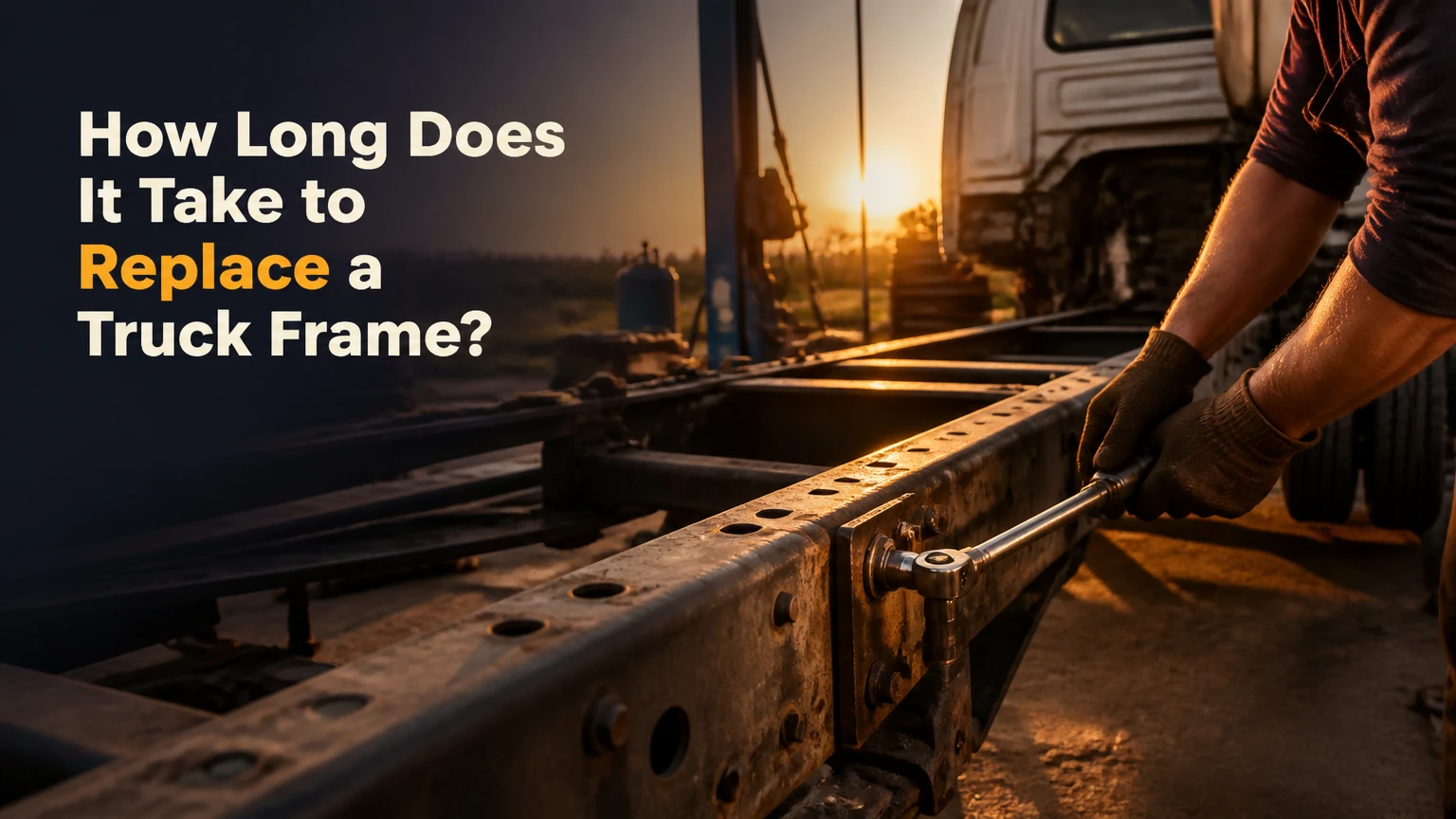
Replacing a truck frame typically requires 40-80 labor hours and keeps the truck in a shop for approximately 2-4 weeks. A half-ton 2WD pickup with an available frame may take less time, while a rusty, diesel, 4WD, long-bed, or heavily damaged truck can exceed 80 hours and remain unavailable for several additional weeks.
Key Facts at a Glance
A standard half-ton frame swap commonly requires 40-60 labor hours.
A heavy-duty, diesel, 4WD, commercial, or severely corroded truck commonly requires 60-80 or more labor hours.
Labor hours measure technician work, while calendar duration includes shop scheduling, insurance approval, frame sourcing, paint, calibration, and rework.
Typical total costs range from approximately $8,500 to more than $22,000, depending on the frame and damage.
A used frame is acceptable only after compatibility, straightness, welds, corrosion, and mounting points are inspected.
A completed repair should include alignment, diagnostic scanning, safety-system calibration where required, leak checks, and a documented road test.
How Long Does It Take to Replace a Truck Frame?
A complete truck frame replacement usually takes 40-80 labor hours, but the truck’s real shop duration is normally 14-30 business days. The largest timing variables are frame availability, corrosion, cab and bed configuration, hidden collision damage, technician queue time, and whether the truck requires electronic safety-system calibration.
Labor time and possession time are different measurements. A shop may spend 50 hours on the vehicle but hold it for three weeks while waiting for an insurer’s approval, a replacement frame, body mounts, or a back-ordered fuel line. A written estimate should state both measurements separately.
| Truck configuration | Typical labor | Typical calendar duration | Main schedule pressure |
|---|---|---|---|
| Half-ton 2WD, gasoline, low rust | 40-50 hours | 10-15 business days | Frame delivery and alignment |
| Half-ton 4WD, gasoline, moderate rust | 50-65 hours | 14-22 business days | Transfer case, seized hardware, wiring |
| Three-quarter-ton or one-ton diesel | 60-80 hours | 18-30 business days | Weight, exhaust, powertrain, corrosion |
| Commercial or modified truck | 80-120+ hours | 25-45 business days | Upfits, hydraulic equipment, custom parts |
These are typical planning ranges, not a promise for a particular model. A 2015 Ford F-150, a 2020 Chevrolet Silverado 2500HD, and a classic pickup do not have the same fastener access, electronics, frame supply, or reassembly requirements.
Why Do 50 Labor Hours Become Several Weeks?
A truck frame replacement becomes a multi-week repair because the job combines intensive labor with nonworking delays. Parts procurement, teardown approval, corrosion treatment, paint or coating cure time, alignment scheduling, ADAS calibration, and quality-control corrections can add days without adding billed technician hours.
A realistic schedule has four phases:
- Authorization and inspection: one to five business days for photographs, measurements, insurer review, and a final estimate.
- Frame sourcing: three to ten days for a suitable used frame, or two weeks to six months for a new OEM frame on an older or low-volume truck.
- Mechanical transfer: five to ten working days of teardown, cleaning, frame preparation, assembly, and fluid service.
- Verification: one to three business days for alignment, scanning, calibration, road testing, and corrections.
A shop that quotes “five days” may mean five working days of active labor rather than five days from drop-off to collection. Ask whether the estimate includes parts waiting time, body-shop queue time, corrosion treatment, paint, calibration, and inspection.
Which factors change the schedule most?
The replacement frame and the damaged truck determine the schedule more than the frame swap itself. A clean, documented 2WD truck with a confirmed VIN-compatible frame is predictable; a collision-damaged 4WD truck with crushed mounts and seized bolts is not.
| Schedule factor | Added labor, typical | Added calendar time, typical | Why it matters |
|---|---|---|---|
| Moderate surface rust | 4-10 hours | 1-3 days | Cleaning and hardware replacement |
| Severe rust or seized fasteners | 10-30+ hours | 3-10 days | Cutting, extraction, line replacement |
| 4WD drivetrain | 6-14 hours | 1-4 days | Transfer case, front differential, driveshafts |
| Diesel or heavy-duty powertrain | 8-20 hours | 2-6 days | Weight, exhaust, cooling, and access |
| Hidden collision damage | 8-40+ hours | 3-14 days | Additional suspension or body components |
| ADAS recalibration | 2-6 hours | 1-3 days | Special equipment and calibration bay |
| Back-ordered frame | 0 labor hours | 2 weeks to 6+ months | No installation can begin |
One practical rule is to treat every seized fastener as a schedule risk rather than a minor nuisance. Rust frequently damages brake pipes, fuel lines, body mounts, electrical grounds, and threaded holes that were not included in the initial visual estimate.
What Work Does a Frame Replacement Include?
A truck frame replacement requires removing nearly every major assembly attached to the chassis, transferring serviceable components to the replacement frame, and verifying the rebuilt truck against factory geometry and safety requirements. The job is closer to controlled vehicle reconstruction than to ordinary suspension repair.
How does a shop replace the frame?
A qualified shop normally follows this sequence:
- Document the vehicle. Technicians photograph routing, connector positions, shim locations, body gaps, ride height, and damage. Labels and parts bins reduce reassembly errors.
- Measure and inspect. The shop confirms frame damage with a dedicated measuring system or manufacturer dimensions, then records VIN, wheelbase, cab style, drivetrain, and frame number where applicable.
- Recover fluids. Oil, coolant, transmission fluid, brake fluid, fuel, and air-conditioning refrigerant are handled using appropriate recovery and disposal procedures.
- Remove the cab and bed. A hoist or lift separates the body from the chassis after technicians disconnect steering, brake, electrical, fuel, exhaust, and HVAC connections.
- Extract the powertrain. The engine, transmission, transfer case, exhaust, driveshafts, and related brackets are supported and removed in a controlled sequence.
- Strip the original chassis. Axles, suspension, steering, fuel tank, brake lines, parking-brake cables, wiring, bumpers, and crossmembers are removed.
- Inspect transferred parts. Technicians check bushings, ball joints, wheel bearings, brake pipes, fuel lines, mounts, driveshaft joints, and wiring for impact or corrosion damage.
- Prepare the replacement frame. The frame is verified for wheelbase, cab mounts, suspension brackets, straightness, weld quality, corrosion, coating condition, and model compatibility.
- Transfer components. Reusable assemblies are installed with new specified fasteners, mounts, bushings, seals, clips, and damaged lines as required.
- Reassemble and service. The cab, bed, powertrain, suspension, fluids, brakes, electrical grounds, and exhaust are restored.
- Align and calibrate. The truck receives a four-wheel alignment, steering-angle reset, diagnostic scan, and ADAS calibration when the model and repair procedure require it.
- Test and document. The shop checks leaks, warning lights, driveline vibration, steering return, braking, body gaps, torque records, and road behavior.
The exact sequence varies by manufacturer. Factory repair information, not a generic internet checklist, controls bolt torque, lifting points, one-time-use fasteners, frame dimensions, and calibration requirements.
Should the Frame Be Repaired or Replaced?
A repairable frame section may be straightened or replaced according to the manufacturer’s structural procedure, but a severely kinked, cracked, perforated, or dimensionally unstable frame often requires replacement. The decision should follow measured damage, published repair limits, corrosion depth, and insurer or jurisdictional requirements, not appearance alone.
Frame repair can be appropriate when damage is localized and the manufacturer permits sectioning, straightening, or reinforcement. Replacement is more likely when a collision has created a sharp rail kink, when rust has perforated a load-bearing area, or when multiple crossmembers and suspension mounts are displaced.
A frame machine measurement printout is more informative than a visual statement that the truck “looks straight.” Ask for the before-and-after dimensions, the repair method, and the structural warranty.
What makes a damaged frame unsafe?
A truck frame carries the cab, bed, powertrain, suspension, steering loads, and cargo forces. Crushed or corroded steel can change suspension geometry and reduce predictable crash-load management, even when the truck drives normally after a temporary repair.
Rust inside a boxed rail is particularly difficult to judge from the outside. A frame can have acceptable-looking paint while losing section thickness around drain holes, spring hangers, cab mounts, or crossmember attachments. Surface rust and structural perforation are different conditions.
Which Replacement Frame Is Suitable?
A new OEM frame offers the most predictable fitment, while a properly inspected used frame usually offers the best price-to-availability balance. Aftermarket or custom frames suit specialized builds, but they can require modifications that increase labor, certification, and resale risk.
| Frame option | Typical frame price | Typical sourcing time | Best fit | Main risk |
|---|---|---|---|---|
| New OEM frame | $4,500-$12,000 | 2 weeks to 6+ months | Late-model daily driver | Backorder and high price |
| Certified refurbished frame | $3,000-$8,000 | 1-6 weeks | Insured repair with documentation | Limited availability |
| Salvage or used frame | $1,500-$4,000 | 3-10 days | Common truck with verified donor | Hidden bends or corrosion |
| Aftermarket boxed frame | $5,000-$15,000 | 4-12 weeks | Off-road or towing build | Fitment and modification work |
A used frame should match the truck’s wheelbase, cab configuration, bed length, drivetrain, suspension design, engine family, fuel system, and mounting brackets. A visually similar frame from the same model line may still have different crossmembers, emissions brackets, wiring clips, or transfer-case supports.
What should a buyer inspect on a used frame?
Inspect boxed sections with a borescope where possible, measure both rails, examine welds and brackets, and look for crushed flanges, elongated holes, fresh paint over rust, and heat discoloration. Obtain the donor vehicle identification, mileage if available, photos before coating, and a written return policy.
A replacement frame is not automatically safe because it came from a salvage yard. Supplier reputation, measurement records, corrosion treatment, and traceable fitment matter more than a low advertised price.
What Is the Total Cost?
A complete frame replacement commonly costs $8,500-$22,000 or more, including the frame, 40-80 labor hours, fluids, hardware, alignment, calibration, and unexpected parts. Regional labor rates of approximately $120-$230 per hour can move the total sharply, and severe corrosion or collision damage can push a repair beyond the truck’s market value.
| Cost component | Typical range | What changes the amount |
|---|---|---|
| Replacement frame | $1,500-$15,000 | Used, refurbished, OEM, or custom |
| Mechanical labor | $4,800-$18,400 | 40-80 hours at $120-$230 |
| Mounts, bushings, lines, hardware | $500-$3,000 | Rust and wear during teardown |
| Fluids, refrigerant, coating, consumables | $300-$1,500 | Powertrain and corrosion treatment |
| Alignment and calibration | $200-$1,200 | Vehicle electronics and local rates |
| Additional collision or rust damage | $1,000-$10,000+ | Hidden damage found after stripping |
Dealership labor can cost more but may offer direct access to factory procedures and model-specific calibration equipment. Independent collision or structural specialists may offer stronger frame-measurement experience and lower rates. Compare documentation and equipment, not hourly price alone.
When does frame replacement make financial sense?
Frame replacement can make financial sense when the truck is valuable, parts are available, the engine and drivetrain are strong, and the total repair remains below the vehicle’s post-repair value. A repair that approaches or exceeds market value may still be reasonable for a rare, modified, sentimental, or income-producing truck, but the owner should understand the resale and insurance consequences.
The 70% threshold is a screening rule, not a universal insurance standard. Insurers use state-specific total-loss formulas, actual cash value, salvage value, repair estimates, and policy language. Request a written valuation before authorizing a structural teardown.
How Do Insurance and Title Issues Affect Timing?
Insurance approval can add several days before teardown, and a frame replacement may create salvage, rebuilt, or structural-damage disclosures depending on local law. The insurer, repairer, and vehicle owner should agree on the frame source, supplements, warranty, measurement records, and post-repair inspection before work begins.
Collision claims often require photographs, estimates, teardown authorization, and supplemental approval when hidden damage appears. A used frame may be accepted if it is traceable and inspected, while an insurer may require OEM or certified parts for a newer vehicle.
Ask these questions in writing:
- Does the policy cover structural frame replacement or only repair?
- Is a used, refurbished, or aftermarket frame permitted?
- Who pays for hidden rust, calibration, alignment, and diagnostic work?
- Will the title or vehicle history report contain a structural or rebuilt notation?
- Does the shop warranty labor, transferred parts, corrosion protection, and alignment?
- What inspection authority must approve the truck before registration?
A commercial owner should also calculate lost revenue. Two extra weeks may cost more than the price difference between a readily available inspected frame and a delayed OEM frame.
What Problems Can Appear After Replacement?
Post-repair problems usually arise from transferred components, incorrect routing, poor grounding, incomplete calibration, or unresolved geometry rather than from the replacement rail alone. Warning lights, a crooked steering wheel, driveline vibration, clunks, leaks, and uneven body gaps require documented follow-up before normal heavy towing or off-road use.
| Symptom after repair | Likely inspection area | Appropriate first action |
|---|---|---|
| ABS, airbag, or chassis warning light | Pinched harness, ground strap, connector | Full scan with manufacturer-capable tool |
| Steering wheel off-center | Steering linkage, toe setting, steering-angle sensor | Alignment and sensor reset |
| Pulling or uneven tire wear | Axle position, camber, toe, tire condition | Four-wheel alignment with printout |
| Driveline vibration | Driveshaft phasing, U-joints, mounts | Inspect runout, seating, and torque |
| Cab or bed clunk | Body mounts, crossmember bolts, isolation bushings | Recheck torque and mount placement |
| Coolant, fuel, or brake leak | Pinched or reused lines, damaged seals | Stop driving and pressure-test systems |
The handover should include alignment results, diagnostic codes before and after repair, ADAS calibration confirmation when applicable, fluid-leak inspection, torque documentation, and the frame supplier’s identification.
When is ADAS calibration required?
ADAS calibration may be required when frame geometry, ride height, suspension position, steering angle, radar mounting, camera position, or wheel alignment changes. The vehicle manufacturer’s repair information determines whether static, dynamic, or combined calibration is required.
A calibration warning is not a cosmetic issue. Radar and camera systems can report no fault while aiming incorrectly if the repair process does not meet the required target, surface, tire, lighting, and alignment conditions.
What Are the Most Common Frame-Swap Mistakes?
The most expensive frame-swap mistakes are reusing damaged mounts and lines, choosing an incompatible donor frame, skipping measurement records, and returning the truck without calibration or a complete road test. These errors often appear after the truck leaves the shop, when correction requires disassembly and additional downtime.
- Reusing rubber mounts automatically. Cab mounts, body bushings, and suspension isolators compress with age. Replace visibly cracked, oil-soaked, collapsed, or model-specified one-time-use parts.
- Accepting a frame without internal corrosion inspection. Coating can hide thin steel. Inspect cavities before applying rust protection.
- Failing to document wiring and grounds. A missing ground strap can produce intermittent sensor faults, charging problems, or network communication codes.
- Treating alignment as the final proof of structural accuracy. A truck can align within limited adjustment while an axle, cab, or bed remains incorrectly positioned.
- Using generic fasteners. Structural and suspension joints require the specified grade, thread engagement, torque, and angle procedure.
- Skipping a loaded road test. A truck that behaves correctly empty may reveal driveline vibration, mount movement, or brake pull under normal cargo weight.
An experienced technician also compares pre-repair and post-repair ride height. A changed ride height can alter headlamp aim, camera geometry, steering behavior, and the calibration result.
How Can You Reduce the Truck’s Downtime?
Downtime falls when the shop confirms frame availability and compatibility before disassembly, orders common replacement hardware early, and schedules alignment and calibration before mechanical completion. Owners can reduce delays by supplying the VIN, drivetrain details, damage history, and insurance authorization at the estimate stage.
Use this planning checklist:
- Provide the complete VIN, wheelbase, cab style, bed length, engine, transmission, and 2WD or 4WD configuration.
- Ask the supplier for frame photographs, measurements, corrosion details, and a return policy.
- Authorize teardown supplements promptly when the insurer requires approval.
- Reserve alignment and ADAS equipment for the expected completion week.
- Approve replacement of clearly worn mounts, bushings, lines, seals, and fasteners before installation.
- Require a written completion checklist rather than relying on a verbal “road tested” statement.
The cheapest frame is not always the least expensive repair. A $2,000 frame with severe corrosion can add 20 labor hours and several days, eliminating the apparent saving.
Is Truck Frame Replacement Suitable for DIY Work?
A complete frame swap is generally unsuitable for a home garage because the truck must be lifted, supported, measured, and separated from its chassis while heavy assemblies remain controlled. A professional shop typically needs a multi-post lift or frame rack, transmission and engine supports, lifting equipment, diagnostic tools, and manufacturer repair information.
DIY work becomes especially hazardous with diesel engines, 4WD systems, air-conditioning refrigerant, loaded suspension components, and rusted structural fasteners. The owner may remove accessories or document parts, but structural lifting and final inspection should remain with trained personnel.
A shop should be able to identify its equipment and process:
- Frame rack or approved structural measuring system
- Vehicle-specific service and torque information
- Engine, transmission, and cab lifting supports
- Brake and refrigerant service equipment
- Scan tool and calibration capability, directly or through a qualified partner
- Written warranty and documented final inspection
A home replacement is not a good substitute for a structural measurement record. The frame can be installed in the wrong position even when every bolt appears to fit.
How Should Different Truck Owners Decide?
A daily driver usually favors a clean OEM or documented refurbished frame when the repair remains economically defensible and preserves safety-system support. A fleet owner may favor a verified used frame with immediate availability because downtime affects revenue, while an off-road builder may accept a custom frame only after confirming registration and component compatibility.
| Owner situation | Preferred frame path | Decision threshold | Main caution |
|---|---|---|---|
| Daily commuter, late-model truck | New OEM or certified refurbished | Repair value below expected vehicle value | Preserve calibration and warranty records |
| Older daily driver | Inspected used frame | Compare total repair with replacement truck cost | Rust and title history |
| Fleet or work truck | Compatible used or refurbished frame | Minimize downtime and lost revenue | Confirm commercial upfit fitment |
| Restored classic truck | OEM-style or custom frame | Parts availability and originality | Registration and modified geometry |
| Off-road or towing build | Reinforced aftermarket frame | Verify load rating and component fit | Custom work can exceed the estimate |
A sentimental truck can justify a repair that fails a simple market-value calculation. The financial decision should still include insurance, future resale disclosure, parts availability, and the condition of the engine, transmission, axles, cab, and electrical system.
Frequently Asked Questions
Can a truck frame be replaced in one day?
A complete truck frame replacement almost never finishes in one day because the work commonly requires 40-80 labor hours. One day may cover inspection, partial teardown, or frame delivery, but cab removal, powertrain transfer, reassembly, fluids, alignment, calibration, and testing require multiple working days.
Does a frame replacement reduce a truck’s value?
A documented structural repair can reduce resale value because buyers and vehicle-history services may record the damage, even when the repair restores safe operation. The effect depends on age, title status, repair quality, measurements, frame source, mileage, and whether the truck has a rebuilt or branded title.
Is a used truck frame safe?
A used truck frame can be safe when it matches the vehicle configuration and passes dimensional, weld, mounting-point, and corrosion inspection. A salvage frame with unknown impact history, internal rust, fresh concealment coating, or altered brackets should not be installed without qualified structural verification.
Will the engine need to be rebuilt during a frame replacement?
The engine does not normally require rebuilding solely because the truck frame is replaced. The engine and transmission are removed and transferred, but collision forces, rollover damage, oil starvation, cracked mounts, damaged accessories, or high mileage may justify separate powertrain inspection while access is available.
How long should a truck be driven gently after frame replacement?
A shop should define any break-in or recheck interval, because a steel frame does not require the same break-in as an engine. Owners should return promptly for leaks, loose mounts, steering changes, warning lights, vibration, or clunks, and should avoid heavy towing until the repair passes its final inspection.
What should I ask before authorizing a frame replacement?
Ask for the measured damage report, replacement-frame identification, compatibility confirmation, labor-hour estimate, calendar schedule, included parts, calibration plan, warranty, title consequences, and final documentation. Also ask whether the quoted cost includes supplements, corrosion treatment, alignment, diagnostic scanning, ADAS calibration, and road testing.
The Bottom Line
The answer to how long does it take to replace a truck frame is usually 40-80 labor hours and 2-4 weeks of real-world shop time. A clean half-ton pickup with an available compatible frame may finish near the lower end, while a rusty heavy-duty 4WD truck, delayed OEM frame, hidden collision damage, or calibration requirement can extend the repair well beyond that range.
Authorize the work only after separating labor hours from calendar duration, confirming frame compatibility, obtaining a complete cost range, and agreeing on measurement, alignment, calibration, road-test, and warranty documentation. Time, price, and safety all depend on the same decision: whether the frame and the finished repair are properly verified.