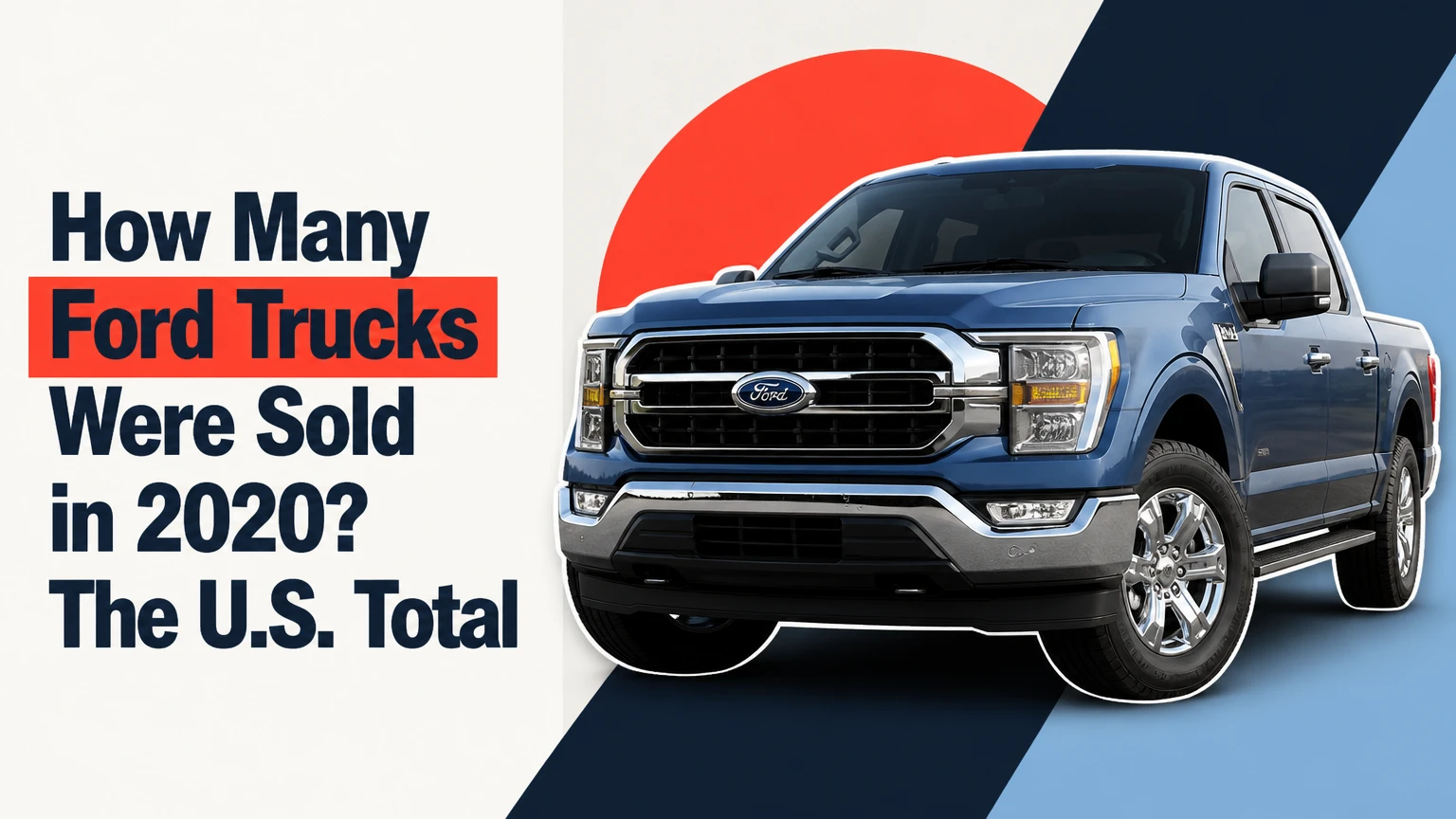
Ford Motor Company sold 888,908 pickup trucks in the United States during calendar year 2020. The total consisted of 787,422 Ford F-Series pickups and 101,486 Ford Ranger pickups, according to Ford’s 2020 year-end sales reporting and compiled U.S. industry results.
Key Facts at a Glance
Ford sold 888,908 U.S. pickups in 2020.
The Ford F-Series accounted for 787,422 sales.
The Ford Ranger accounted for 101,486 sales.
The reported total combines F-Series trucks with Ranger trucks.
F-Series sales fell about 12.2% from 2019, while Ranger sales rose about 13.3%.
The figure refers to U.S. calendar-year deliveries, not worldwide Ford truck sales.
How Many Ford Trucks Were Sold in 2020?
Ford sold 888,908 trucks in the United States in 2020, using the industry’s pickup-truck definition. Ford’s reported total combines full-size F-Series pickups, including F-150 and Super Duty nameplates, with midsize Ranger pickups.
The calculation is straightforward:
787,422 F-Series sales + 101,486 Ranger sales = 888,908 Ford pickups.
The number is a sales or delivery count, not a count of every truck Ford manufactured. A vehicle built in late December but delivered in January 2021 belongs to the later sales year, while a truck assembled earlier and delivered during 2020 belongs to 2020 deliveries.
The most authoritative starting point is Ford’s January 2021 Q4 and full-year sales release. Secondary industry compilations, including Pickup Truck Talk and Good Car Bad Car, reproduce the same headline figures.
What Does the 2020 Ford Truck Total Include?
The 2020 Ford truck total covers pickup vehicles sold in the United States, rather than every Ford vehicle with a truck-like body or commercial purpose. It includes the F-Series family and the Ranger, but it does not automatically include Transit vans, E-Series cutaway models, or Ford medium-duty commercial trucks.
| Included vehicle group | 2020 sales | Market classification | Reported treatment |
|---|---|---|---|
| Ford F-Series | 787,422 | Full-size pickup | Aggregate nameplate total |
| Ford F-150 | Included in F-Series | Full-size light-duty pickup | Not separately stated in the headline total |
| Ford Super Duty | Included in F-Series | Heavy-duty pickup | Not separately stated in the headline total |
| Ford Ranger | 101,486 | Midsize pickup | Separate nameplate total |
| Total Ford pickups | 888,908 | U.S. pickup market | F-Series plus Ranger |
The distinction matters because “Ford trucks” can mean different things in casual conversation. A buyer may mean only F-150s, while an analyst may include F-250, F-350, F-450, and Ranger. The 888,908 figure uses the broader pickup interpretation.
Which Ford Truck Models Are Counted?
The F-Series and Ranger are the two Ford pickup lines represented in the commonly cited 2020 U.S. total. F-Series covers the full-size range, while Ranger is Ford’s midsize pickup.
Ford F-Series
Ford F-Series sales totaled 787,422 units in 2020. That aggregate includes the light-duty F-150 and the heavy-duty Super Duty family, which includes F-250, F-350, and F-450 pickup configurations.
The 2020 F-150 used a high-strength aluminum body over a steel frame and offered 3.3-liter V6, 2.7-liter EcoBoost V6, 3.5-liter EcoBoost V6, 5.0-liter V8, and 3.0-liter Power Stroke diesel engines. The F-150 served personal-use buyers, contractors, and light commercial fleets.
Super Duty trucks addressed higher payload and towing requirements. The 2020 range offered the 7.3-liter gasoline V8 and 6.7-liter Power Stroke diesel, with chassis, axle, cooling, and suspension hardware designed for heavier work.
Ford Ranger
Ford sold 101,486 Rangers in the United States in 2020. The U.S.-market Ranger used a 2.3-liter EcoBoost four-cylinder engine and a 10-speed automatic transmission, with SuperCab and SuperCrew body configurations.
Ranger sales increased from approximately 89,571 units in 2019 to 101,486 in 2020, a gain of about 13.3%. Its smaller footprint and lower entry price positioned it below the F-150 for commuters, recreational users, and buyers who did not need full-size towing capacity.
Did Ford Report F-150 and Super Duty Sales Separately?
Ford did not present the headline 2020 U.S. truck result as separate F-150 and Super Duty totals. Ford reported the F-Series nameplate as a combined figure, so 787,422 is the defensible official-level number for the full F-Series, not a standalone F-150 count.
| Ford nameplate or family | Public 2020 figure | What the figure means | Reporting caution |
|---|---|---|---|
| F-Series | 787,422 | Combined F-Series sales | Includes F-150 and Super Duty |
| F-150 | Not separately stated in headline release | Component of F-Series | Do not label 787,422 as F-150-only |
| Super Duty | Not separately stated in headline release | Component of F-Series | Includes F-250, F-350, and F-450 |
| Ranger | 101,486 | Ranger nameplate sales | Reported separately |
| Ford pickups total | 888,908 | F-Series plus Ranger | U.S. sales total |
Some third-party databases estimate individual F-150 or Super Duty volumes using registration records, production data, or model-level datasets. Those estimates can be useful, but they should not replace Ford’s official aggregate when answering the annual sales question.
This is a common data error. The F-Series is a nameplate family, not a single model.
How Did Ford Truck Sales Change From 2019 to 2020?
Ford’s U.S. pickup sales declined overall in 2020 because the F-Series decrease outweighed Ranger growth. F-Series sales fell from approximately 896,526 in 2019 to 787,422 in 2020, while Ranger sales increased from approximately 89,571 to 101,486.
| Vehicle group | 2019 sales | 2020 sales | Change | Percentage change |
|---|---|---|---|---|
| F-Series | 896,526 | 787,422 | -109,104 | -12.2% |
| Ranger | 89,571 | 101,486 | +11,915 | +13.3% |
| Total Ford pickups | 986,097 | 888,908 | -97,189 | -9.9% |
| F-Series share of 2020 total | 896,526 | 787,422 | 88.6% | 88.6% |
The 2019 values are included as comparison baselines from industry sales compilations. Percentage results can differ slightly because some publications round source figures or classify reporting periods differently.
The most important interpretation is mix. Ranger growth was substantial in percentage terms, but its 11,915-unit increase recovered only a small portion of the F-Series decline because F-Series volume was nearly eight times larger.
Why Did COVID-19 Affect 2020 Ford Truck Sales?
COVID-19 disrupted Ford’s production, dealership operations, transportation networks, and inventory levels during 2020. Ford temporarily halted North American vehicle production in March, then restarted plants under revised health and safety procedures, creating interruptions that affected available inventory and delivery timing.
Demand did not disappear evenly across the market. Pickup trucks remained important to contractors, outdoor users, rural households, and commercial fleets, while reduced inventory limited the number of vehicles dealers could deliver in some regions.
Ford’s 2020 annual reporting also separates operational results from retail conditions. That distinction prevents a simplistic conclusion that every lost sale represented lost consumer demand. A customer unable to find a preferred engine, cab, bed, or trim may have delayed the purchase or selected a competing truck.
Ford’s January 2021 sales communication described the F-Series as “America’s best-selling truck for 44 consecutive years.” That statement concerns ranking among truck nameplates, not an absence of year-over-year decline.
Does the Total Include Fleet and Commercial Sales?
The 888,908 figure generally represents Ford’s total U.S. pickup deliveries, which can include retail and fleet transactions. Retail sales go to individual customers or businesses through dealer channels, while fleet deliveries can involve rental companies, governments, utilities, and large commercial operators.
| Sales category | Typical buyer | Example transaction | Included in total? |
|---|---|---|---|
| Retail | Individual household | F-150 purchased from a dealer | Generally yes |
| Small-business retail | Contractor or local company | Ranger bought for daily work | Generally yes |
| Commercial fleet | Utility, construction, or delivery company | Multiple Super Duty trucks | Generally yes |
| Government fleet | Municipal, state, or federal agency | Public-works F-250 order | Generally yes |
| Export delivery | Buyer outside the United States | U.S.-built truck shipped abroad | No, not in U.S. total |
| Production unit not delivered | Ford or dealer inventory | Truck built in December | No, until delivered |
Automakers use internal dealer reporting systems and sales definitions that can differ from registration databases. Ford’s investor-relations materials and annual filings provide the appropriate context for interpreting its reported sales, while state registration data measures vehicles titled or registered in a jurisdiction.
The practical consequence is that the number should not be described as “888,908 individual consumers bought Ford trucks.” It is better described as U.S. pickup deliveries or sales, including relevant fleet activity.
How Does Ford Compare With Other 2020 Pickup Leaders?
Ford’s F-Series was the highest-volume U.S. pickup nameplate in 2020. Chevrolet Silverado and Ram pickup were the closest full-size competitors, while Toyota Tacoma competed primarily with Ranger in the midsize segment.
| U.S. pickup nameplate or family | 2020 reported sales | Primary segment | Comparison with Ford |
|---|---|---|---|
| Ford F-Series | 787,422 | Full-size pickup | Highest-volume truck nameplate |
| Ford Ranger | 101,486 | Midsize pickup | Ford’s smaller pickup line |
| Chevrolet Silverado | Approximately 594,094 | Full-size pickup | Lower than F-Series |
| Ram pickup | Approximately 562,676 | Full-size pickup | Lower than F-Series |
| Toyota Tacoma | Approximately 163,181 | Midsize pickup | Higher than Ranger |
Competitor totals require care because General Motors and Stellantis may group body styles, cab configurations, or related models differently from Ford. The table is therefore best used for market context, not as a substitute for each manufacturer’s accounting definition.
The F-Series lead also does not mean every F-Series configuration outsold every competitor. Sales rankings operate at the nameplate or family level.
What Can 2020 Sales Data Tell a Used-Truck Buyer?
High sales volume usually supports parts availability, mechanic familiarity, aftermarket selection, and resale liquidity, but it does not prove that an individual used truck is reliable. A 2020 F-150 with documented maintenance and moderate private use can be a safer purchase than a neglected low-mileage fleet truck.
Used buyers should interpret the sales number alongside vehicle history:
- Verify the exact model. Confirm whether the truck is an F-150, F-250, F-350, F-450, or Ranger.
- Check ownership use. Rental, utility, construction, and municipal histories can mean heavier duty cycles.
- Inspect the frame. Aluminum body panels do not prevent corrosion on steel frame rails, suspension components, or axle housings.
- Review powertrain records. Check transmission repairs, software updates, turbocharger work, diesel emissions maintenance, and oil-change intervals.
- Match capacity to the job. A Ranger is not a substitute for a Super Duty when trailer weight exceeds midsize-truck limits.
- Compare asking prices with condition. A high-volume vehicle can have abundant listings, but desirable engine, cab, and four-wheel-drive combinations command premiums.
A practitioner rule of thumb is to budget for a professional pre-purchase inspection before negotiating. A typical inspection costs about $150-$300, while a more detailed diesel or commercial-truck inspection commonly costs $250-$500, depending on location and testing scope.
Is a 2020 Ford Truck Good for Heavy Towing?
A 2020 Super Duty is the appropriate Ford pickup for heavy towing, while a 2020 F-150 suits lighter trailers and general-purpose hauling. A 2020 Ranger is designed for midsize-pickup duties and should not be selected solely because its purchase price is lower.
| Ford truck | Typical 2020 role | Engine examples | Suitable buyer |
|---|---|---|---|
| Ranger | Daily driving and light recreation | 2.3L EcoBoost, 270 hp | Commuter or small-load owner |
| F-150 | General hauling and moderate towing | 3.3L V6, 2.7L EcoBoost, 5.0L V8 | Household or contractor |
| F-250 Super Duty | Heavy trailer and jobsite use | 7.3L gas V8, 6.7L diesel V8 | Towing-focused owner |
| F-350 Super Duty | Higher payload and fifth-wheel work | 7.3L gas V8, 6.7L diesel V8 | Farmer or commercial operator |
Exact towing capacity depends on cab, axle ratio, drivetrain, wheelbase, hitch type, and equipment package. Buyers should use the truck’s door-jamb payload label and Ford’s 2020 towing guide rather than relying on the maximum number printed in a general advertisement.
The counterintuitive point is that a higher tow rating does not automatically make a Super Duty better for daily commuting. The heavier chassis, larger dimensions, stiffer unloaded ride, higher tire costs, and diesel maintenance requirements can make an F-150 the more sensible choice for a driver who rarely tows.
What Are the Main 2020 Ford Truck Ownership Risks?
The principal risks vary by powertrain and use history, not simply by model year. A used buyer should pay particular attention to transmission behavior, cold-start noises, diesel emissions components, frame corrosion, and evidence of commercial abuse.
Known inspection points include:
- 10R80 transmission behavior: Test for harsh shifts, hesitation, delayed engagement, and gear hunting under light and moderate throttle.
- 3.5-liter EcoBoost cold-start rattle: Listen for abnormal startup noise and verify whether cam-phaser or related warranty work was completed.
- Diesel emissions equipment: On 6.7-liter Power Stroke trucks, inspect records for diesel particulate filter, selective catalytic reduction, exhaust gas recirculation, and sensor repairs.
- Steel-frame corrosion: Check boxed frame sections, crossmembers, brake lines, spring mounts, and rear suspension hardware in salt-exposed regions.
- Fleet wear: Examine hitch hardware, bed floors, door hinges, seat bolsters, and idle hours instead of trusting odometer mileage alone.
The historic spark-plug problems associated with older Ford 5.4-liter engines should not be treated as a defining 2020 F-150 issue. A buyer should inspect the actual engine and service records rather than transferring a problem from an earlier generation.
Why Is the F-Series Sales Number So Important?
The F-Series reached 787,422 U.S. sales in 2020, retaining the annual truck-sales lead despite the pandemic-driven market disruption. Ford’s 44-year leadership claim measures consecutive years as the best-selling truck, while the 2020 unit total measures the number of F-Series deliveries.
That distinction matters because rankings and volume answer different questions. A nameplate can remain first while selling fewer units if the entire market contracts or if production constraints affect competitors differently.
The F-Series result also illustrates why a family-level comparison can be powerful. F-150 and Super Duty buyers overlap in brand and dealer network, but they serve different payload, towing, price, and operating-cost requirements. Combining them creates a useful view of Ford’s full-size pickup presence, yet it conceals the product mix inside that family.
What Are the Limits of the 888,908 Figure?
The 888,908 figure is not a global Ford truck total, a production total, a registration total for every country, or a count of individual retail customers. It is a U.S. calendar-year pickup-sales figure assembled from Ford and industry reporting.
The number also does not reveal:
- The exact split between F-150 and Super Duty.
- The percentage sold to fleet operators.
- The average transaction price.
- Regional differences in inventory or demand.
- The number of trucks later returned, resold, or exported.
- The number of trucks built but still held in inventory at year-end.
Ford’s corporate filings, sales releases, and competitor reports use different levels of aggregation. Analysts should preserve the original unit and geography labels whenever they cite the result.
Which Sources Verify 2020 Ford Truck Sales?
Ford’s Q4 2020 Sales Release, published through Ford Investor Relations in January 2021, is the primary source for Ford’s annual U.S. sales communication. Ford’s 2020 Form 10-K provides corporate reporting context, while secondary industry summaries provide the model and competitor comparisons commonly used in market coverage.
Useful source types include:
| Source | Publication period | Best use | Limitation |
|---|---|---|---|
| Ford Investor Relations Q4 release | January 2021 | Ford’s reported annual sales | May aggregate F-Series models |
| Ford 2020 Form 10-K | 2021 | Corporate reporting definitions | Less model-level detail |
| Pickup Truck Talk results | January 2021 | U.S. truck comparison | Secondary compilation |
| Good Car Bad Car databases | Ongoing | Historical model series | Methodology varies by page |
| CNBC vehicle-sales coverage | January 2021 | Market ranking context | Secondary reporting |
A reliable citation should identify Ford Motor Company, the 2020 reporting year, the United States, and whether the figure concerns F-Series, Ranger, or all Ford pickups. Removing any of those qualifiers makes the statistic easier to misinterpret.
Frequently Asked Questions
How many F-150 trucks did Ford sell in 2020?
Ford’s commonly cited official 2020 U.S. figure is 787,422 F-Series trucks, not F-150-only trucks. Ford grouped F-150 and Super Duty sales under the F-Series nameplate in the headline annual reporting, so a precise standalone F-150 total requires a separate registration or industry database and should be labeled as an estimate if derived externally.
How many Ford Ranger trucks were sold in 2020?
Ford sold 101,486 Ranger pickups in the United States in 2020. Ranger sales increased about 13.3% from approximately 89,571 units in 2019, although the Ranger remained much smaller in volume than the combined F-Series family.
Did Ford sell more trucks in 2020 than in 2019?
No. Ford sold 888,908 U.S. pickups in 2020, compared with approximately 986,097 in 2019, a decrease of about 97,189 units or 9.9%. The F-Series decline drove the reduction, while Ranger growth offset only part of the lost full-size volume.
Were 2020 Ford truck sales worldwide?
No. The 888,908 figure is a U.S. pickup-sales total. Ford sold trucks in other markets, but global totals require separate geographic and product reporting. A worldwide Ford truck figure should not be created by adding U.S. F-Series and Ranger sales to an unrelated regional dataset.
Did the 2020 total include Ford Transit vans?
No. The 888,908 figure refers to Ford pickups, specifically F-Series and Ranger. Transit vans, E-Series commercial products, chassis cabs, and medium-duty trucks belong to different vehicle categories and should not be added unless a source explicitly defines “truck” to include them.
Was the Ford F-Series still America’s best-selling truck in 2020?
Yes. Ford reported that the F-Series remained America’s best-selling truck in 2020, extending its streak to 44 consecutive years. The ranking does not mean F-Series sales increased; the F-Series still declined approximately 12.2% from 2019 while retaining first place.
The Bottom Line
The answer to how many Ford trucks were sold in 2020 is 888,908 U.S. pickup trucks: 787,422 F-Series trucks and 101,486 Ranger trucks. The figure represents calendar-year U.S. deliveries, may include retail and fleet transactions, and does not provide a separate official F-150-only count.