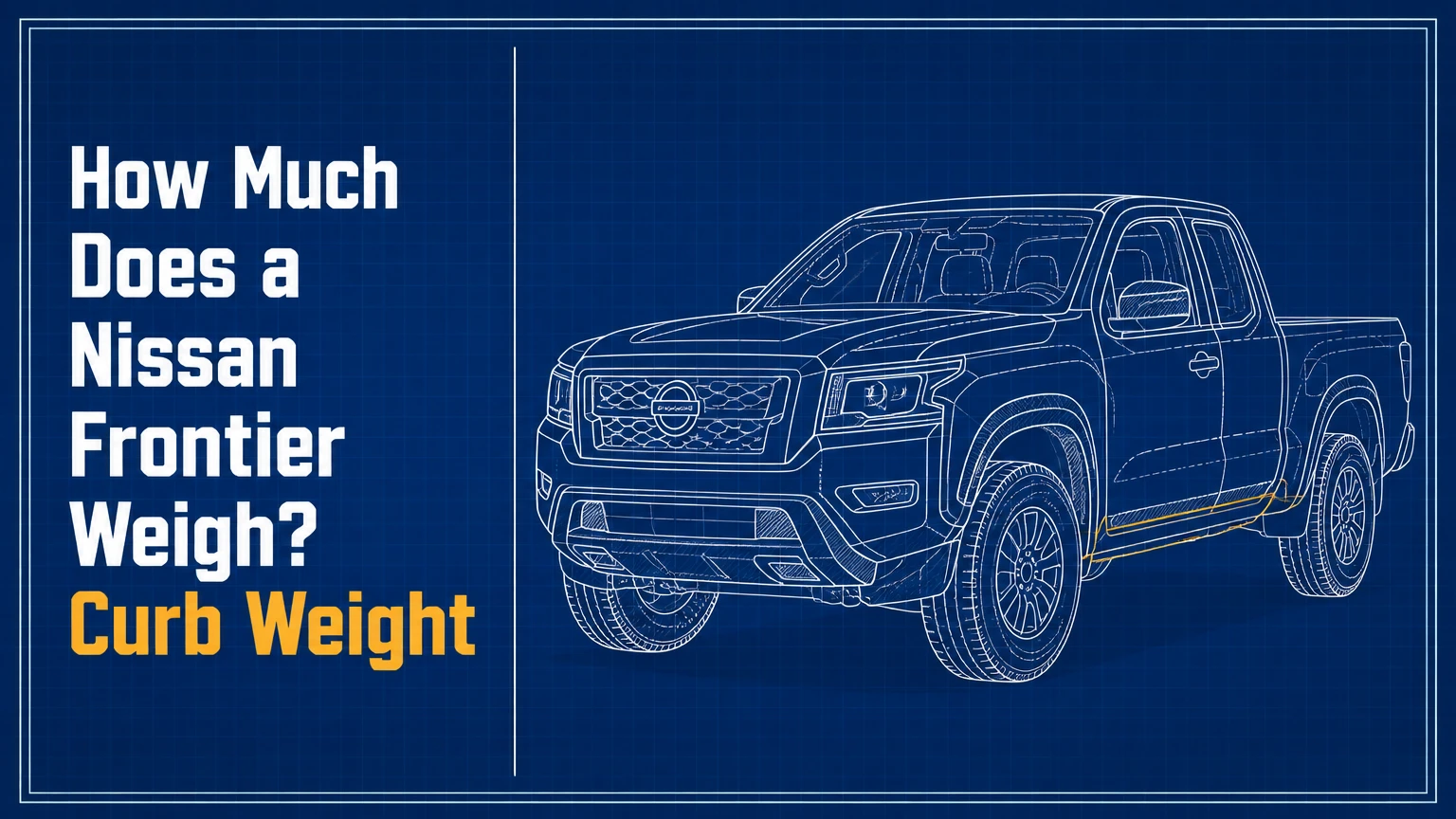
A late-model Nissan Frontier weighs approximately 4,344-4,865 pounds at the curb, or about 1,970-2,207 kilograms, depending on cab, bed, trim, drivetrain, and factory equipment. The lightest examples are typically King Cab 4×2 trucks, while the heaviest are PRO-4X 4×4 Crew Cab models with off-road hardware.
Nissan Frontier Weight at a Glance
- A late-model Nissan Frontier curb weight generally falls between 4,344 and 4,865 pounds.
- King Cab 4×2 configurations are usually the lightest Frontier trucks.
- Crew Cab 4×4 and long-bed models weigh more because of additional structure, driveline components, and passenger space.
- PRO-4X 4×4 models can approach 4,865 pounds because of skid plates, off-road suspension, and locking-differential equipment.
- A typical Frontier GVWR is about 6,012 pounds, but the exact rating belongs to the individual vehicle.
- Payload equals GVWR minus the truck’s actual curb weight, passengers, cargo, accessories, and trailer tongue load must remain within that limit.
What Does Curb Weight Mean for a Nissan Frontier?
Nissan Frontier curb weight is the truck’s weight with standard equipment, operating fluids, and a full fuel tank, but without passengers, cargo, or trailer tongue weight. Curb weight is different from GVWR, which is the maximum permitted loaded weight of the truck, and from payload, which is the remaining carrying capacity.
Manufacturers publish curb weights as configuration-specific values because a two-wheel-drive King Cab and a four-wheel-drive PRO-4X do not contain the same hardware. Published specifications may also vary with trim, wheel design, optional equipment, production changes, and measurement conventions.
A useful distinction is the difference between published curb weight and scale weight. A truck with a bed cover, running boards, recovery gear, a larger spare tire, and a full tank may weigh several hundred pounds more than its base specification. That extra weight reduces available payload even when the truck’s GVWR does not change.
Nissan’s Frontier documentation identifies the certification label as the place to confirm vehicle weight ratings. The 2024 Frontier Owner’s Manual states that the “GVWR … is listed on the F.M.V.S.S. certification label,” giving owners a more authoritative source than a generic web specification.
Curb Weight, GVWR, Payload, and GCWR
| Term | Meaning | Frontier application |
|---|---|---|
| Curb weight | Empty truck with fuel and standard fluids | Approximately 4,344-4,865 pounds |
| GVWR | Maximum loaded truck weight | Typically about 6,012 pounds |
| Payload | Weight the truck can carry | GVWR minus actual truck weight |
| GCWR | Maximum truck-and-trailer combination | Configuration-specific Nissan rating |
GVWR includes the truck, occupants, luggage, accessories, cargo, hitch equipment, and trailer tongue weight. GCWR includes the loaded truck plus the loaded trailer. Neither rating is a suggestion that every truck can safely use the highest published number in every condition.
How Much Does a Nissan Frontier Weigh by Configuration?
A late-model Nissan Frontier weighs about 4,344-4,865 pounds, with cab style, bed length, drivetrain, and trim creating most of the spread. The following figures are representative published ranges for recent-generation Frontier configurations, rather than a substitute for the certification label on a specific truck.
| Frontier configuration | Drivetrain | Representative curb weight | Typical payload range |
|---|---|---|---|
| King Cab, 6-foot bed | 4×2 | 4,344-4,376 lb | Up to 1,590 lb |
| King Cab, 6-foot bed | 4×4 | About 4,543 lb | Configuration-dependent |
| Crew Cab, 5-foot bed | 4×2 | About 4,466 lb | Up to 1,490 lb |
| Crew Cab, 5-foot bed | 4×4 | 4,666-4,728 lb | About 1,330-1,400 lb |
| Crew Cab, 6-foot bed | 4×2 | About 4,573 lb | About 1,400 lb |
| Crew Cab, 6-foot bed | 4×4 | 4,758-4,773 lb | About 1,200-1,300 lb |
| PRO-X, 5-foot bed | 4×2 | About 4,534 lb | About 1,220 lb |
| PRO-4X, 5-foot bed | 4×4 | 4,795-4,865 lb | About 1,100-1,220 lb |
These numbers explain why a single answer to “how much does a Nissan Frontier weigh” is incomplete. A King Cab 4×2 may be roughly 500 pounds lighter than a heavily equipped PRO-4X 4×4, and that difference directly affects payload.
How Much Does a King Cab Frontier Weigh?
A late-model King Cab Nissan Frontier weighs approximately 4,344-4,376 pounds in 4×2 form and about 4,543 pounds with 4×4 equipment. Its smaller rear seating area and relatively low equipment weight make the King Cab one of the lightest Frontier configurations.
The King Cab generally uses a 6-foot bed. Its lower curb weight can leave more capacity for building materials, tools, passengers, or trailer tongue weight. Nissan and automotive specification sources list maximum payload near 1,590 pounds for selected King Cab 4×2 configurations, although the door label on the truck remains the controlling source.
The trade-off is interior utility. Rear access and seating are less practical than in a Crew Cab, particularly for adults or child seats. A King Cab is a capacity-oriented choice, not the best Frontier layout for frequent rear-passenger use.
How Much Does a Crew Cab Frontier Weigh?
A late-model Crew Cab Nissan Frontier weighs approximately 4,466 pounds in a 4×2 standard-bed configuration and about 4,666-4,728 pounds in comparable 4×4 versions. A 6-foot-bed Crew Cab generally weighs about 4,573 pounds in 4×2 form and 4,758-4,773 pounds with 4×4.
The Crew Cab adds a full second row, additional doors, and more body structure. The long bed adds further length and material. Those changes improve passenger and cargo flexibility, but they consume some of the payload margin available in a lighter King Cab.
Payload is not determined by curb weight alone. Two trucks with similar curb weights can have different ratings because of tires, axle limits, suspension specifications, optional equipment, and the manufacturer’s certification for that VIN.
How Much Do PRO-X and PRO-4X Models Weigh?
A Nissan Frontier PRO-X 4×2 weighs approximately 4,534 pounds, while a PRO-4X 4×4 weighs approximately 4,795-4,865 pounds. The PRO-4X is usually the heaviest Frontier because its off-road package adds skid plates, Bilstein shocks, an electronic locking rear differential, all-terrain tires, and other equipment.
| Trim or layout | Approximate curb weight | Main added equipment or design factor | Practical effect |
|---|---|---|---|
| King Cab 4×2 | 4,344-4,376 lb | Smaller cab, two-wheel drive | Highest payload potential |
| Crew Cab 4×2 | About 4,466 lb | Full rear cabin | More passenger space |
| Crew Cab 4×4 | 4,666-4,728 lb | Transfer case and front-drive hardware | More traction, less payload |
| PRO-X 4×2 | About 4,534 lb | Off-road-oriented trim equipment | Higher trim weight without 4WD |
| PRO-4X 4×4 | 4,795-4,865 lb | 4WD and off-road hardware | Strong trail capability, lower payload |
The heavier PRO-4X is not automatically inferior. Its equipment improves traction, ground protection, and wheel control on rough terrain. It is simply less efficient as a maximum-payload work truck than a lightly equipped King Cab.
Why Does the Frontier’s Weight Vary So Much?
Nissan Frontier weight changes because every added component increases scale weight, while the truck’s GVWR may remain similar across several configurations. The largest contributors are the cab, bed, 4WD system, suspension hardware, wheels and tires, protection equipment, and factory options.
Drivetrain and Bed Length
Four-wheel drive commonly adds roughly 180-260 pounds compared with a similar 4×2 configuration. The added transfer case, front differential, driveshaft, axle components, controls, and protective structure account for most of that difference.
A 6-foot Crew Cab bed can also add weight compared with a 5-foot bed. More sheet metal, bed structure, frame length, and related components affect the curb figure. Bed length can also alter the truck’s weight distribution and turning dimensions, not only its scale reading.
Trim, Wheels, Tires, and Accessories
Off-road tires, alloy wheels, skid plates, running boards, spray-in bed liners, tonneau covers, winches, steel bumpers, camper shells, and toolboxes all reduce real-world payload. A steel bumper can weigh 100-200 pounds, while a loaded toolbox may add several hundred pounds before tools are included.
The practical rule is simple: every pound added to the empty truck is approximately one pound removed from available payload. A 180-pound accessory package does not increase GVWR.
How Is Frontier Payload Calculated?
Frontier payload is calculated by subtracting the truck’s actual loaded-ready weight from its GVWR. The basic equation is:
Payload remaining = GVWR – actual truck weight
For example, assume a Frontier has a 6,012-pound GVWR and weighs 4,700 pounds with its normal equipment and fuel. Its theoretical remaining capacity is 1,312 pounds. Four 190-pound adults use 760 pounds, leaving 552 pounds for luggage, bed cargo, accessories, and trailer tongue weight.
| Loading item | Example weight | Remaining capacity from 1,312 lb |
|---|---|---|
| Empty truck with fuel | 4,700 lb | 1,312 lb |
| Four adults | 760 lb | 552 lb |
| Bed cargo | 300 lb | 252 lb |
| Trailer tongue weight | 200 lb | 52 lb |
| Additional tools | 100 lb | Over the example limit |
The calculation is only a starting point. The truck must also remain within its front and rear Gross Axle Weight Ratings, tire load limits, hitch rating, and the trailer’s required tongue-weight range.
What Counts Against Payload?
The following loads count against Frontier payload:
- Driver and passengers.
- Fuel beyond the manufacturer’s curb-weight assumption.
- Cargo in the cab or bed.
- Bed covers, racks, steps, bumpers, winches, and camper equipment.
- Hitch receivers, weight-distribution hardware, and trailer tongue weight.
- Tools, coolers, recovery equipment, and spare parts.
Trailer weight itself does not all sit on the truck. The portion pressing down through the hitch does. A conventional trailer with 10-15% tongue weight can therefore use 400-600 pounds of payload when the trailer weighs 4,000 pounds.
What Are the Frontier’s GVWR and Towing Limits?
A late-model Nissan Frontier commonly has a GVWR near 6,012 pounds, while maximum towing ranges from approximately 6,270 to 7,150 pounds depending on configuration. The highest advertised towing figure generally belongs to a lighter King Cab 4×2, not to every Crew Cab or PRO-4X.
| Configuration example | Approximate maximum towing | Approximate maximum payload | Main limitation |
|---|---|---|---|
| King Cab 4×2 | Up to 7,150 lb | Up to 1,590 lb | Limited rear-seat practicality |
| Crew Cab 4×2 | About 7,070 lb | Up to 1,490 lb | More cabin weight |
| Crew Cab 4×4 | About 6,960 lb | About 1,330 lb | Added drivetrain mass |
| Crew Cab long bed 4×4 | About 6,760 lb | About 1,200-1,300 lb | Bed and 4WD weight |
| PRO-4X 4×4 | About 6,270-6,680 lb | About 1,100-1,220 lb | Off-road equipment and tires |
Maximum towing is a test-based rating under specified conditions. It does not mean a fully loaded PRO-4X can tow the maximum number while also carrying four adults, camping equipment, and a full bed.
For comfortable towing, trailer frontal area, tongue weight, road grade, wind, payload, cooling conditions, and trailer brakes matter. A tall enclosed camper near the maximum rating can feel less stable than a low utility trailer of the same weight.
Which Frontier Configuration Carries the Most?
The King Cab 4×2 generally carries the most because it combines the lowest curb weight with a useful 6-foot bed. A base Crew Cab 4×2 is the better compromise when rear-seat space matters, while the PRO-4X is the better choice for trail capability rather than maximum payload.
| Buyer situation | Best-fit configuration | Why | What to give up |
|---|---|---|---|
| Maximum payload | King Cab 4×2 | Lowest typical curb weight, up to 1,590-lb payload | Smaller rear seating |
| Family transportation | Crew Cab 4×2 | Full rear doors and lower drivetrain weight | Less traction than 4×4 |
| Snow and unpaved roads | Crew Cab 4×4 | Four-wheel traction and passenger space | Roughly 200-plus lb weight penalty |
| Technical off-road use | PRO-4X 4×4 | Skid plates, locking differential, Bilstein shocks | Lower payload and towing margin |
| Long-bed cargo use | Crew Cab long bed 4×2 | Six-foot bed with four-door cabin | More curb weight and length |
A common mistake is choosing PRO-4X equipment for a payload-heavy job. The PRO-4X can be the correct truck for rocks, mud, and uneven trails, but its additional hardware leaves less capacity for a slide-in camper, dense tools, or a heavy tongue load.
How Do You Find the Exact Weight of Your Frontier?
The exact Nissan Frontier payload rating is found on the Tire and Loading Information label inside the driver-side door area, while the GVWR and axle ratings appear on the certification label. A certified public scale provides the truck’s actual weight, which is necessary when accessories, passengers, or cargo make published curb weight unreliable.
Use this verification process:
- Read the door labels. Record GVWR, front GAWR, rear GAWR, tire size, and the label’s maximum combined occupant-and-cargo statement.
- Inspect the tires. Confirm that each tire’s load capacity meets or exceeds the truck’s axle and loading requirements.
- Load the truck as used. Include passengers, fuel, tools, hitch equipment, and normal cargo.
- Visit a certified scale. CAT Scale locations commonly weigh vehicles by axle and provide a printed ticket; prices vary by location, with a typical single weighing often around $15-$20.
- Compare each value. Check total weight against GVWR and each axle reading against its GAWR.
- Reweigh after changes. A camper, steel bumper, suspension accessory, or trailer can materially change axle loading.
The scale result is more useful than a brochure number for a modified truck. Weighing only the truck without the trailer does not reveal tongue-weight loading, so a combined loaded measurement may be necessary.
What Happens If a Frontier Is Overloaded?
An overloaded Nissan Frontier can exceed its GVWR, axle rating, tire capacity, or hitch rating even when the engine can still accelerate normally. Typical warning signs include rear suspension sag, increased braking distance, vague steering, tire overheating, poor headlight aim, and trailer sway.
Overloading also changes component stress. Rear leaf springs, shock absorbers, wheel bearings, tires, brakes, and frame-mounted hitch components carry forces that rise with mass and road impact. A truck may appear level on smooth pavement while still exceeding a rear-axle or tire limit.
If the truck is overloaded, remove cargo before continuing. Do not solve a payload violation by adding helper springs, airbags, or stiffer shocks, because those parts may improve ride height without increasing the factory GVWR, axle rating, or tire rating.
Does Added Equipment Reduce Payload?
Added equipment reduces available payload unless the truck’s certified weight rating also changes, which ordinary aftermarket parts do not accomplish. A 250-pound camper shell, rack, and tools reduce payload by roughly 250 pounds before passengers or bed contents are counted.
This is an important counterintuitive point: a suspension upgrade can make an overloaded truck feel better without making it legal or structurally rated for more weight. Ride comfort and load capacity are separate engineering limits.
How Heavy Is an Older Nissan Frontier?
Older Nissan Frontier models can weigh substantially less or more than late-model trucks, so model year must be specified before comparing figures. First-generation models from 1998-2004, second-generation models from 2005-2019, and the current generation introduced for 2022 use different frames, engines, bodies, and rating systems.
| Frontier generation | Model years | Typical body variations | Why figures should not be mixed |
|---|---|---|---|
| First generation | 1998-2004 | King Cab and Crew Cab | Smaller vehicle architecture |
| Second generation | 2005-2019 | King Cab, Crew Cab, multiple beds | Different frame and V6 options |
| Transitional final model | 2020-2021 | Crew Cab and King Cab availability varied | Late second-generation specifications |
| Current generation | 2022-present | King Cab and Crew Cab layouts | New frame, 3.8-liter V6, 9-speed automatic |
The 4,344-4,865-pound range in this guide applies to recent-generation examples and representative published specifications. It should not be used to estimate a 2010 Frontier, a diesel conversion, a utility-bodied truck, or a vehicle with extensive aftermarket equipment.
Frequently Asked Questions
Is the Nissan Frontier heavier than a Toyota Tacoma?
A Nissan Frontier and Toyota Tacoma overlap in curb weight, but the exact comparison depends on model year, cab, bed, drivetrain, trim, and options. A lightly equipped Frontier King Cab can weigh less than a heavily equipped Tacoma Crew Cab, while off-road versions of both trucks commonly approach or exceed 4,700 pounds.
How much does a Nissan Frontier weigh in kilograms?
A late-model Nissan Frontier weighs approximately 1,970-2,207 kilograms at the curb. The conversion uses 1 pound equal to 0.453592 kilograms, so 4,344 pounds is about 1,970 kilograms and 4,865 pounds is about 2,207 kilograms.
Can a Nissan Frontier carry a slide-in camper?
A Nissan Frontier can carry a small, properly matched camper only when the camper, passengers, water, propane, food, equipment, and tie-down hardware remain within the truck’s payload and axle limits. Weigh the loaded truck before travel because camper dry weight excludes many items used on the road.
Does a full fuel tank change the published Frontier weight?
A full fuel tank is generally included in the manufacturer’s curb-weight convention, but exact test procedures can vary by source. Fuel weighs roughly 6 pounds per U.S. gallon, so a significantly different fuel level can alter scale weight by dozens of pounds.
Where is the Frontier’s VIN-specific payload rating?
The VIN-specific payload information is on the Tire and Loading Information label inside the driver-side door area. That label accounts for the vehicle’s factory equipment and should take precedence over a general trim brochure, dealer listing, or online specification table.
The Bottom Line
How much does a Nissan Frontier weigh? A late-model Frontier weighs about 4,344-4,865 pounds at the curb, with the King Cab 4×2 at the light end and the PRO-4X 4×4 near the heavy end. Four-wheel drive, a longer bed, off-road hardware, accessories, passengers, and cargo all reduce available payload.
Use published curb weight for initial comparisons, not final loading decisions. For towing, hauling, or camper use, read the door labels and weigh the configured truck at a certified scale. The exact truck’s GVWR, axle ratings, tires, and remaining payload matter more than the headline number.