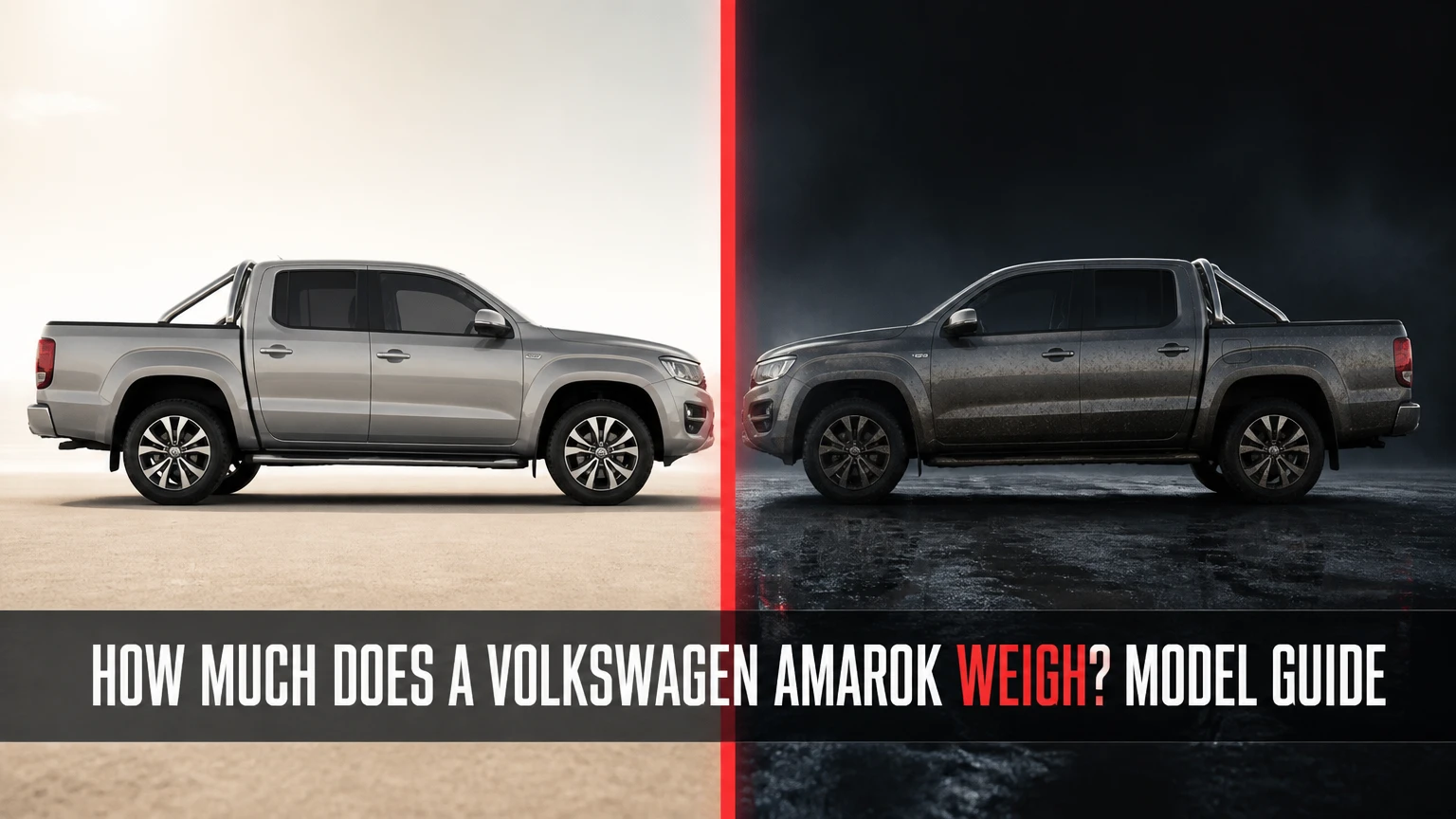
A current-generation Volkswagen Amarok weighs approximately 2,144-2,400 kg at kerb, depending on engine, trim, market, and factory equipment. Most 2023-2026 Amarok variants fall near 2,200-2,400 kg, while their GVM is typically 3,250-3,350 kg and their maximum braked towing capacity is 3,500 kg.
Key Facts at a Glance
- A current-generation Volkswagen Amarok has an approximate kerb-weight range of 2,144-2,400 kg.
- A Volkswagen Amarok’s payload equals its GVM minus its actual empty vehicle mass.
- Current Australian-market Amarok variants commonly have a 3,250 kg or 3,350 kg GVM.
- The advertised maximum braked towing capacity is 3,500 kg, but maximum towing does not guarantee full payload remains available.
- A 3,500 kg trailer can place about 350 kg on the Amarok’s tow ball at a typical 10% ball-weight ratio.
- Bull bars, winches, canopies, passengers, luggage, fuel, and tow-ball mass all consume the Amarok’s payload.
What Is the Kerb Weight of a Volkswagen Amarok?
The current Volkswagen Amarok’s kerb weight is approximately 2,144-2,400 kg, with four-cylinder Core and Life models generally lighter than V6-powered Style, PanAmericana, and Aventura versions. Volkswagen technical data uses market-specific equipment and measurement conventions, so a listed figure should be treated as a specification reference rather than the guaranteed mass of every vehicle.
Kerb weight normally represents a vehicle ready to operate, including standard fluids and a specified fuel level, but excluding occupants and cargo. The exact convention differs between markets. Australian documents may use terms such as tare mass, kerb mass, or unladen mass, and those terms should not be assumed identical without checking the relevant compliance documentation.
A practical owner’s measurement is more useful than a brochure estimate. A full tank, factory accessories, a tow bar, roof rails, a roller cover, tools, and a spare wheel can move the real scale reading materially above the published figure.
Does Engine Choice Change the Amarok’s Weight?
Yes. The 3.0-litre V6 diesel is heavier than the 2.0-litre diesel because of its engine, cooling system, exhaust hardware, and related equipment. Higher trims also add larger wheels, electric covers, premium audio systems, powered seats, and driver-assistance hardware.
The result is a trade-off: the V6 provides 184 kW and 600 Nm in relevant Australian specifications, but its higher vehicle mass usually leaves less payload than a lighter four-cylinder configuration with the same broad vehicle-class limits.
Amarok Weight by Trim and Engine
The table below provides approximate current-generation figures, primarily aligned with Australian-market 2023-2026 specifications. Exact values can vary by body configuration, options, wheel package, accessories, and the compliance plate attached to the individual vehicle.
| Amarok variant | Typical engine | Approximate kerb weight | Typical GVM | Approximate payload |
|---|---|---|---|---|
| Core | 2.0-litre turbo-diesel | 2,144 kg | 3,250 kg | 1,106 kg |
| Life | 2.0-litre bi-turbo diesel | 2,187 kg | 3,250 kg | 1,063 kg |
| Style | 3.0-litre V6 diesel | 2,303 kg | 3,350 kg | 1,047 kg |
| PanAmericana | 3.0-litre V6 diesel | 2,356 kg | 3,350 kg | 994 kg |
| Aventura | 3.0-litre V6 or market-specific petrol | 2,400 kg | 3,350 kg | 835 kg |
| Walkinshaw W600 | 3.0-litre V6 diesel | 2,450 kg or higher | 3,350 kg, subject to certification | About 900 kg |
The figures are not interchangeable across countries. The UK, South Africa, Australia, and Middle Eastern markets can use different engines, option packages, gross vehicle limits, and test definitions. Always match the table to the vehicle identification number, local technical sheet, and door- or pillar-mounted compliance label.
Which Amarok Has the Highest Payload?
The Core usually provides the highest quoted payload, at approximately 1,106 kg, because it combines a lower equipment weight with a 3,250 kg GVM. The Life follows at roughly 1,063 kg, while luxury V6 variants generally provide less usable payload despite their higher 3,350 kg GVM.
The Aventura illustrates the effect of equipment. Its approximate 835 kg payload can be around 270 kg lower than the Core’s figure, even though both are dual-cab pickups with similar broad towing claims. A heavy tow vehicle is not automatically a high-payload tow vehicle.
How Do Amarok Weight Ratings Work?
A Volkswagen Amarok’s weight ratings describe different limits, and each one controls a different part of a loaded trip. GVM limits the truck itself, GCM limits the truck and trailer together, payload describes the available load capacity, and towing capacity limits the trailer under specified conditions.
| Rating | Meaning | Typical Amarok value | What counts toward it |
|---|---|---|---|
| Kerb mass | Empty operating vehicle reference | 2,144-2,400 kg | Vehicle, fluids, specified fuel, standard equipment |
| GVM | Maximum legal mass of the loaded truck | 3,250-3,350 kg | Occupants, cargo, accessories, fuel, tow-ball load |
| GCM | Maximum combined truck and trailer mass | 6,200-6,400 kg | Loaded Amarok plus loaded trailer |
| Payload | GVM minus actual vehicle mass | 835-1,106 kg | People, luggage, accessories, cargo, ball load |
| Braked towing capacity | Maximum permitted braked trailer mass | 3,500 kg | Trailer mass, subject to local conditions and ratings |
The arithmetic is simple, but the inputs must be accurate. A payload calculation based on an optimistic brochure mass can become unsafe after a bull bar, winch, canopy, passengers, water tank, recovery gear, and trailer coupling are added.
Is Payload the Same as Towing Capacity?
No. Payload is the weight the Amarok can carry on its own chassis, while towing capacity is the maximum permitted mass of the trailer. The trailer’s downward force on the tow ball counts as payload on the Amarok, even though most of the trailer’s mass remains supported by its own wheels.
A 3,500 kg caravan with a 10% ball load places approximately 350 kg on the vehicle. The Amarok must therefore have room for that 350 kg inside its GVM and rear-axle limits, in addition to people and equipment.
How Much Payload Does an Amarok Have in Practice?
A new Amarok’s quoted payload is approximately 835-1,106 kg, but the usable payload after accessories and passengers can be several hundred kilograms lower. The accurate figure is calculated from the vehicle’s actual weighed mass, not by subtracting a generic brochure value from the GVM.
Consider a V6 Aventura with an approximate 835 kg payload:
| Load item | Typical mass | Payload remaining |
|---|---|---|
| Quoted payload | 835 kg | 835 kg |
| Two adults and two children | 280 kg | 555 kg |
| Canopy and mounting hardware | 90 kg | 465 kg |
| Tow bar and wiring | 35 kg | 430 kg |
| Recovery equipment and tools | 60 kg | 370 kg |
| Caravan tow-ball load | 350 kg | 20 kg |
This example leaves only about 20 kg for additional luggage, although the caravan itself may weigh within the advertised towing limit. The actual result changes with occupants, accessories, fuel, water, and ball weight.
Which Accessories Reduce Payload Most?
A typical steel bull bar adds around 50-70 kg, a winch adds approximately 25-35 kg, and a canopy can add 60-100 kg before stored equipment is counted. A full set of camping drawers, a second spare wheel, roof equipment, and a fridge can consume another 100 kg or more.
Factory accessories are not weight-free. A powered roller cover, larger wheels, premium seats, electric steps, and audio equipment can explain why an Aventura’s payload is lower than a basic Core’s payload. Every accessory should be weighed, including brackets and mounting hardware.
Can a Volkswagen Amarok Tow 3,500 kg?
A suitably specified Volkswagen Amarok can tow up to 3,500 kg braked, but that figure does not mean the truck can carry its maximum payload at the same time. The limiting calculation is the lower of the vehicle’s GVM, rear-axle rating, tow-hitch rating, trailer rating, and GCM allowance.
For example, if the applicable GCM is 6,400 kg and the loaded trailer weighs 3,500 kg, the loaded Amarok can weigh no more than:
6,400 kg – 3,500 kg = 2,900 kg
If the truck’s GVM is 3,350 kg, the GCM calculation has reduced the practical vehicle limit by 450 kg. That 2,900 kg includes fuel, passengers, accessories, luggage, and tow-ball mass.
| Loaded trailer mass | 6,400 kg GCM vehicle allowance | 3,500 kg GVM comparison | Practical result |
|---|---|---|---|
| 3,500 kg | 2,900 kg | 450 kg below GVM | Heavy caravan requires strict payload control |
| 3,000 kg | 3,400 kg | 50 kg above GVM | GVM remains the controlling limit |
| 2,500 kg | 3,900 kg | 550 kg above GVM | GVM controls the loaded truck |
| 2,000 kg | 4,400 kg | 1,050 kg above GVM | Payload, axle, and hitch ratings still apply |
The table assumes the stated GCM applies to the exact vehicle. Confirm the rating on the compliance documents before relying on the calculation.
How Does Tow-Ball Mass Affect the Calculation?
Tow-ball mass is the vertical load transferred from the trailer coupling to the Amarok. A common planning estimate is 8-10% of loaded trailer mass, so a 3,500 kg trailer may impose 280-350 kg on the truck, although the trailer manufacturer and local rules determine the permitted setup.
Tow-ball load counts toward GVM and usually increases rear-axle load. A ball weight that fits within total GVM can still overload the rear axle if passengers, cargo, or a long tray overhang move too much mass rearward.
How Do You Check an Amarok’s Actual Weight?
The most reliable method is a certified public weighbridge, using the vehicle in the condition in which it will travel. Weigh the Amarok with the intended fuel level, passengers, accessories, tools, and cargo, then compare the result with the GVM and axle limits printed on the vehicle documentation.
Use this process:
- Read the compliance label and owner’s manual. Record GVM, front-axle limit, rear-axle limit, GCM, and tow-hitch limits.
- Prepare the trip load. Add fuel, passengers, water, tools, recovery equipment, luggage, and the intended trailer coupling load.
- Weigh the complete combination. Obtain the truck-and-trailer total to check GCM.
- Weigh the Amarok alone. Compare its total mass with GVM.
- Weigh each axle where possible. Check front and rear results against their separate limits.
- Keep the weighbridge ticket. It records the vehicle’s condition and supports later adjustments.
A full diesel tank can add roughly 60-75 kg compared with a near-empty tank, depending on tank size and fuel density. That mass is part of real trip weight, even if a published kerb figure uses a different fuel condition.
What Does the Amarok Door Placard Show?
The door-pillar or driver-door compliance label identifies legally relevant ratings for that vehicle, rather than a generic trim average. Depending on market and model year, the label may show GVM, axle loads, tyre information, seating capacity, and other compliance data.
The placard does not always tell an owner the exact current mass after modifications. A weighbridge supplies that missing value. The difference between the placard’s GVM and the measured loaded mass is the remaining legal margin.
Does the Older Amarok Weigh the Same?
No. The first-generation Volkswagen Amarok, sold from 2010 to 2022 in many markets, has different kerb weights, engines, body specifications, and ratings from the next-generation model launched from 2022 onward. Older 2.0-litre and 3.0-litre V6 versions should not be assigned current-generation figures.
Older Amarok weights can vary widely according to single-cab or dual-cab body style, manual or automatic transmission, 4Motion system, engine, and trim. The exact model year and local registration data are essential. A 2017 V6 Amarok and a 2024 V6 Amarok are not weight-equivalent vehicles.
| Amarok generation | Typical production period | Common engine examples | Weight-check priority |
|---|---|---|---|
| First generation | 2010-2022 | 2.0 TDI, 3.0 V6 TDI | Model year and body style |
| Second generation | 2022 onward | 2.0 TDI, 3.0 V6 diesel | Market, trim, option package |
| Walkinshaw W-series | Conversion-specific | 3.0 V6 diesel | Conversion certification and placard |
Do not use a marketplace listing as the final authority. Use the vehicle’s compliance plate, manufacturer technical sheet, and a weighbridge reading.
Which Amarok Trim Is Best for Heavy Loads?
The Core is generally the strongest payload choice for tradespeople, fleets, and owners carrying dense equipment because its approximate payload reaches 1,106 kg. The Life offers a middle ground at about 1,063 kg, while Style and PanAmericana provide more V6 performance and equipment with less remaining capacity.
| Buyer situation | Suitable starting point | Relevant figure | Main compromise |
|---|---|---|---|
| Work tools and regular tray loads | Core | About 1,106 kg payload | Fewer luxury features |
| Mixed family and work use | Life | About 1,063 kg payload | Four-cylinder engine |
| V6 towing and road touring | Style | About 1,047 kg payload | More equipment mass |
| Off-road touring | PanAmericana | About 994 kg payload | V6 and heavier trim |
| Luxury recreational use | Aventura | About 835 kg payload | Lowest listed payload |
| Modified performance model | W600 | About 900 kg payload | Conversion-specific limits |
The PanAmericana’s 18-inch wheel configuration can be more practical for off-road tyre selection and pressure adjustment than a luxury trim with 21-inch wheels. That does not make it a higher-capacity work vehicle.
Is the Aventura Good for Maximum Payload?
No. The Aventura is a poor choice when maximum payload is the primary requirement because its luxury equipment reduces available carrying capacity to approximately 835 kg in the cited configuration. It can suit owners who carry light recreational gear and value specification, but it offers less margin for a family, accessories, and a heavy caravan.
A heavier trim can also reach its rear-axle limit sooner when cargo sits behind the rear axle. A suspension upgrade may improve ride height, but it cannot make an unapproved weight legal.
What Are the Most Common Amarok Weight Mistakes?
The most common Volkswagen Amarok weight errors involve counting the trailer but ignoring tow-ball mass, using published kerb weight after fitting accessories, and checking GVM without checking axle limits. These errors can produce a vehicle that appears compliant on total mass while exceeding a separate axle or combined-mass rating.
Mistake 1: Treating 3,500 kg as a Universal Towing Result
The 3,500 kg figure applies only when the trailer, hitch, vehicle, GCM, brakes, and local regulations all permit it. A heavy trailer can reduce the allowable mass of the truck under GCM, even when the Amarok’s GVM has unused capacity.
Mistake 2: Ignoring Rear-Axle Leverage
A load placed at the back of the tray creates more rear-axle load than the same load positioned close to the cab. Long overhangs can also unload the front axle, producing light steering and less stable handling.
Mistake 3: Assuming Suspension Fixes Weight
Airbags and helper springs can reduce visible sag, but they do not automatically increase GVM, GCM, rear-axle capacity, tyre capacity, or tow-hitch capacity. A legal GVM upgrade requires an approved kit, certification, and compliance with the applicable jurisdiction.
Mistake 4: Weighing Without the Travel Load
A vehicle weighed without passengers, fuel, water, tools, or the caravan coupling load does not represent the trip condition. The correct check uses the heaviest realistic configuration, not the easiest weighbridge visit.
Do GVM Upgrades Increase Amarok Capacity?
A certified GVM upgrade can increase the permitted vehicle mass for some Amarok configurations, with aftermarket Australian packages commonly advertised around 3,285-4,200 kg, depending on the supplier, engine, model, suspension package, and approval pathway. The upgrade does not automatically increase GCM or the manufacturer’s 3,500 kg towing rating.
Typical Australian pricing is approximately AUD $4,000-$9,000, with post-registration work often costing more because engineering inspection and approval requirements may apply. Confirm whether the quoted price includes certification, tyres, suspension, installation, alignment, and registration documentation.
A GVM upgrade is appropriate only after a weight audit identifies a real capacity shortfall. It should not be used to justify loading beyond tyre, axle, wheel, hitch, trailer, or GCM limits.
What Is the Best Way to Plan a Loaded Amarok?
Plan from the actual measured mass and subtract every load item before choosing a trailer or accessory package. A conservative calculation protects capacity for fuel variation, luggage growth, water, and scale uncertainty rather than using every kilogram shown in a brochure.
Use this formula:
Remaining payload = GVM – measured vehicle mass – passengers – accessories – cargo – tow-ball mass
For a 3,350 kg GVM Amarok weighing 2,430 kg at the weighbridge, carrying 250 kg of occupants, 140 kg of accessories, 100 kg of luggage, and 300 kg of tow-ball mass:
3,350 – 2,430 – 250 – 140 – 100 – 300 = 130 kg remaining
That 130 kg is a planning margin, not an invitation to add more equipment. Reweigh after major modifications, especially a steel bar, winch, canopy, suspension system, larger wheels, or touring drawers.
What Does an Amarok Weigh Compared With Alternatives?
The current Amarok is a relatively heavy dual-cab pickup, with approximately 2.1-2.4 tonnes of kerb mass depending on configuration. Direct comparisons with the Ford Ranger, Isuzu D-Max, Toyota Hilux, or Mitsubishi Triton require the same market, body style, fuel level, transmission, and equipment because published definitions differ.
| Vehicle class example | Approximate kerb range | Common payload range | Maximum braked towing example |
|---|---|---|---|
| Volkswagen Amarok | 2,144-2,400 kg | 835-1,106 kg | 3,500 kg |
| Ford Ranger | About 2,100-2,400 kg | About 800-1,100 kg | 3,500 kg |
| Isuzu D-Max | About 2,000-2,300 kg | About 900-1,100 kg | 3,500 kg |
| Toyota Hilux | About 2,000-2,250 kg | About 800-1,000 kg | 3,500 kg |
| Mitsubishi Triton | About 1,900-2,200 kg | About 900-1,100 kg | 3,500 kg |
These comparison ranges are typical market figures, not substitute compliance data. A lighter pickup may offer more payload, but engine output, cabin equipment, suspension tuning, axle ratings, and GCM can change the towing outcome.
Expert Rules for Amarok Weight Management
Keep at least 100 kg of practical margin when possible. A trip load changes as fuel, groceries, water, and recovery equipment are added, while weighbridge readings and published figures may use different conditions.
Place dense cargo low and close to the cab. A 60 kg toolbox near the rear tailgate can impose a less favourable axle effect than the same toolbox mounted immediately behind the cabin.
Treat the V6 advantage as a drivability benefit, not a capacity benefit. The 600 Nm output can make a heavy trailer feel easier to control, but engine torque does not increase GVM or rear-axle capacity.
Measure modified vehicles twice. Weigh before and after major accessories, then recalculate payload with the exact passenger and trailer configuration.
Frequently Asked Questions
How much does an Amarok weigh with a full tank?
A current-generation Amarok typically weighs about 2,144-2,400 kg at published kerb mass, while a full tank can add roughly 60-75 kg compared with a near-empty tank. The exact result depends on the engine, tank size, fuel level used for the published figure, factory equipment, and aftermarket accessories.
What is the tare weight of an Amarok?
The tare or unladen weight is the vehicle’s empty operating mass under the definition used by the relevant market and registration authority. Current Amarok references commonly fall around 2,144-2,400 kg, but the compliance documents for the specific vehicle take priority over a general trim estimate.
Can four adults travel in an Amarok while towing?
Yes, four adults can travel in an Amarok while towing only if their combined mass, luggage, accessories, fuel, and tow-ball load remain within GVM, rear-axle, and GCM limits. Four occupants weighing 280 kg can leave substantially less capacity in an Aventura than in a Core.
How much does a 3,500 kg caravan reduce Amarok payload?
A 3,500 kg caravan commonly contributes around 280-350 kg of tow-ball mass at an 8-10% loading ratio. That entire downward load counts against the Amarok’s payload, and the trailer’s total mass also consumes the vehicle’s GCM allowance.
Is the Amarok heavier than the Ford Ranger?
The answer depends on the exact trim and equipment, but comparable current Amarok and Ranger dual-cab models commonly occupy a similar 2.1-2.4 tonne kerb-weight range. The Amarok’s V6 and luxury equipment can make a specific version heavier than a four-cylinder Ranger, while a basic Amarok may weigh less than a highly equipped Ranger.
Where can I find my Amarok’s legal weight limits?
Check the driver-door or B-pillar compliance label, the owner’s manual, the local registration documents, and the manufacturer’s technical specification sheet. For a trip-specific answer, use a certified weighbridge and obtain separate truck, combination, and axle readings.
The Bottom Line
The answer to how much does a Volkswagen Amarok weigh is approximately 2,144-2,400 kg at kerb, with the exact mass controlled by generation, engine, trim, market, options, and accessories. For safe loading, ignore the headline number after modifications and calculate from the actual weighbridge mass, then check GVM, GCM, axle ratings, tow-ball mass, and the trailer’s limits together.