Replacing a truck frame typically costs $7,000-$15,000 for a light-duty pickup and $15,000-$30,000 or more for a heavy-duty or commercial truck. A used donor frame may reduce the installed price to roughly $5,500-$11,000, while labor commonly requires 40-70 hours before alignment, calibration, and hidden rust repairs.
Key Facts at a Glance
- A complete truck frame replacement usually costs $7,000-$15,000 for a standard light-duty pickup.
- OEM frame parts commonly cost $4,500-$8,000, while used donor frames often cost $1,500-$3,000.
- Professional labor typically takes 40-70 hours, depending on drivetrain, cab configuration, corrosion, and four-wheel drive equipment.
- Rusted brake lines, body mounts, fuel-tank straps, wiring clips, bushings, and fasteners can add $1,000-$3,000.
- Frame straightening generally costs $500-$2,000 and applies to measured collision deformation, not severely thinned rusted steel.
- A manufacturer recall or corrosion service campaign can reduce the owner’s cost substantially, but eligibility depends on the exact vehicle identification number and location.
How Much Does It Cost to Replace a Frame on a Truck?
A complete frame replacement costs about $5,500-$11,000 with a used frame, $9,500-$20,000 with a new OEM frame, and $15,000-$30,000 or more for commercial equipment. Those totals combine the chassis, transfer labor, replacement hardware, fluids, alignment, corrosion treatment, and repairs discovered after disassembly.
The truck’s design changes the estimate significantly. A two-wheel-drive compact pickup usually transfers more quickly than a diesel, four-wheel-drive, crew-cab truck with complex wiring, an auxiliary fuel system, or extensive underbody corrosion. Dealer labor rates commonly fall near $150-$250 per hour, while independent repair facilities often charge approximately $90-$150 per hour.
A quote below the normal range may exclude alignment, air-conditioning recovery and recharge, damaged fasteners, replacement body mounts, electronic calibration, or tax. A quote above the range may reflect a new frame, severe corrosion, a diesel powertrain, suspension damage, or a commercial frame rail procedure.
Typical Cost by Frame and Truck Type
| Replacement situation | Frame or parts cost | Labor cost | Installed total | Typical downtime |
|---|---|---|---|---|
| Compact light-duty pickup, used frame | $1,500-$2,500 | $4,000-$7,000 | $5,500-$9,500 | 1-2 weeks |
| Full-size half-ton, OEM frame | $4,500-$7,000 | $5,000-$10,000 | $9,500-$17,000 | 1-3 weeks |
| Heavy-duty diesel, OEM frame | $6,000-$12,000 | $9,000-$20,000 | $15,000-$32,000 | 2-4 weeks |
| Commercial truck frame rail replacement | $6,000-$15,000 | $10,000-$25,000 | $16,000-$40,000+ | 2-6 weeks |
| Localized frame section repair | $400-$1,500 | $1,500-$5,500 | $2,000-$7,000 | 3-7 days |
These are typical planning ranges, not guaranteed prices. Local labor markets, parts availability, the truck’s year, and the shop’s structural-repair equipment can move the total by several thousand dollars.
What Does a Truck Frame Do?
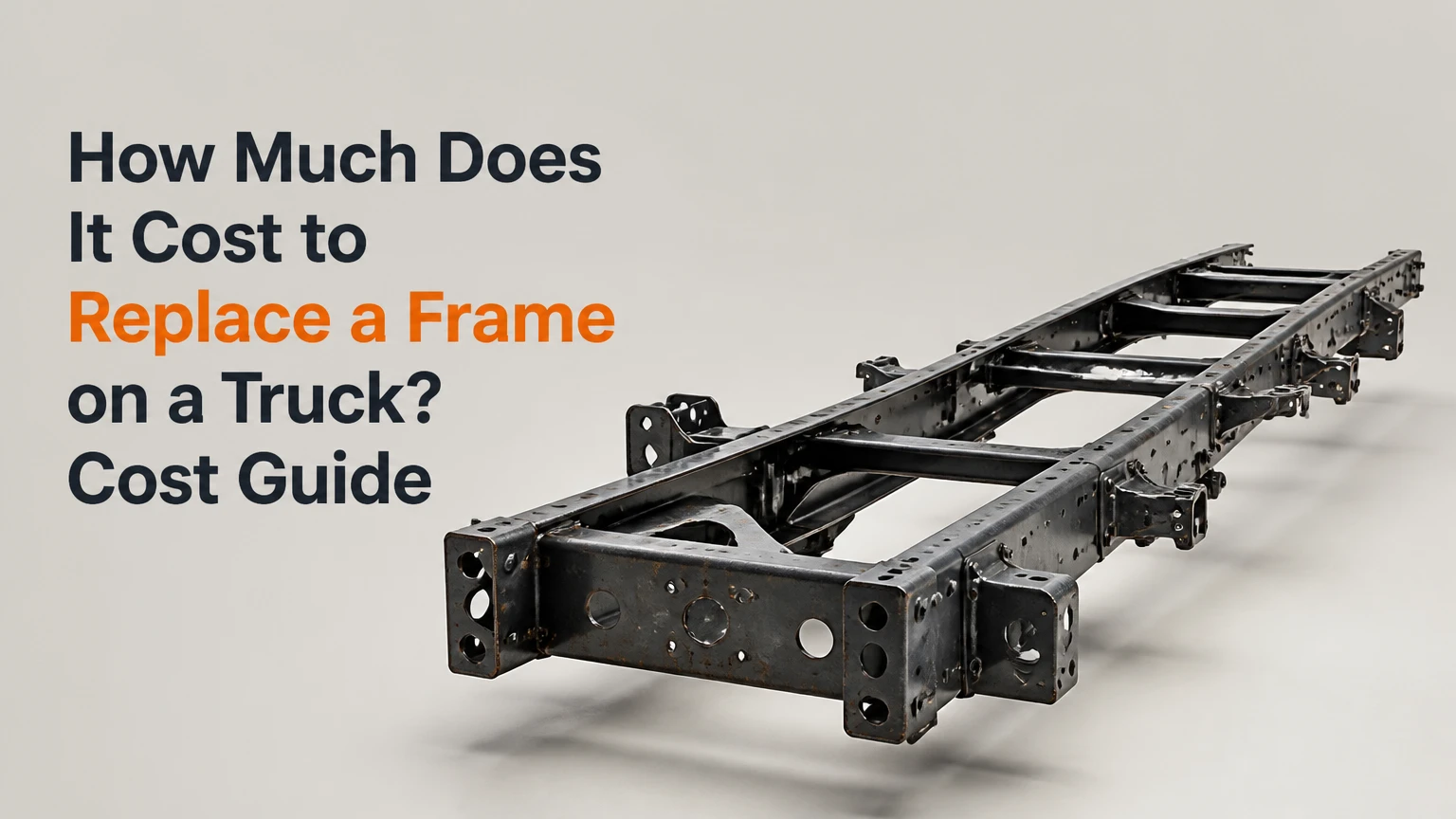
A truck frame is the ladder-shaped steel structure that supports the cab, bed, engine, transmission, suspension, axles, steering gear, fuel system, and payload. In a body-on-frame pickup, the frame also transfers crash forces through defined rails and crossmembers.
Frame damage is therefore different from a damaged fender or bolt-on suspension arm. A bent rail can alter wheelbase, steering geometry, driveshaft angles, door gaps, and load distribution. Corrosion can reduce rail thickness around suspension brackets, spring hangers, crossmembers, and body mounts.
The National Highway Traffic Safety Administration treats structural integrity as part of vehicle crashworthiness, but NHTSA does not publish one universal repair price or a universal pass-fail rust threshold. The vehicle manufacturer’s repair procedures, a qualified structural inspection, and applicable regional regulations determine whether a frame can be safely repaired.
What Is Included in a Complete Frame Swap?
A complete frame swap removes the body and mechanical systems from the old chassis, transfers them to a replacement frame, then validates steering, braking, suspension geometry, electrical systems, and restraint-related components. The work resembles a controlled vehicle rebuild rather than a conventional underbody repair.
The technician normally drains or recovers operating fluids, disconnects wiring and lines, removes the bed and cab, supports the powertrain, strips the suspension and axles, and transfers compatible assemblies. Rusted hardware, brake pipes, fuel straps, body mounts, and rubber isolators often require replacement rather than reuse.
A responsible shop should document frame part numbers, donor identification, damage photographs, measurements, alignment results, and final safety checks. I-CAR structural-repair training consistently emphasizes following vehicle-maker procedures because welding locations, sectioning methods, measuring points, and replacement parts vary by model.
Frame Replacement Labor Sequence
- Inspect and measure the truck. The shop confirms whether the rails are bent, cracked, perforated, or repairable and records pre-repair alignment data.
- Disconnect systems and fluids. Technicians isolate the battery, recover refrigerant, drain necessary fluids, and disconnect brake, fuel, steering, exhaust, and electrical connections.
- Remove the bed and cab. A lift or body-hoist system supports each assembly while technicians remove body bolts and mounts.
- Support or remove the powertrain. The engine, transmission, transfer case, exhaust, and driveshafts are separated according to the manufacturer’s procedure.
- Strip suspension and axles. Springs, control arms, shocks, axle assemblies, steering gear, fuel tank, and related brackets leave the old frame.
- Prepare the replacement chassis. The shop verifies the part number, dimensions, corrosion condition, mounting points, and included crossmembers before assembly.
- Transfer and replace components. Technicians install the drivetrain, suspension, lines, wiring, body mounts, bed, and cab, replacing unsafe single-use or corroded hardware.
- Align and validate the truck. The finished vehicle receives wheel alignment, brake and steering checks, fluid servicing, road testing, and required electronic calibration.
The transfer itself often consumes 40-70 labor hours. A compact pickup may need close to 40 hours, while a full-size four-wheel-drive diesel can approach or exceed 70 hours when corrosion slows disassembly.
Which Frame Option Has the Lowest Total Cost?
A used donor frame usually has the lowest professional installed cost, but a sound used chassis with traceable history is safer economically than the cheapest frame available. A new OEM frame offers the strongest fit and documentation, while aftermarket or repaired frames require more scrutiny.
| Frame option | Purchase price | Main benefit | Main risk | Best application |
|---|---|---|---|---|
| New OEM frame | $4,500-$12,000 | Correct geometry and mounting points | Highest parts cost | Valuable late-model truck |
| Used donor frame | $1,500-$3,000 | Lower initial price | Hidden rust, bends, missing parts | Older pickup with good body |
| Aftermarket frame component | $2,000-$8,000 | Availability or lower price | Fit and warranty variation | Approved model-specific repair |
| Commercial replacement rail | $6,000-$15,000 | Designed for heavy loads | Complex installation | Fleet or vocational truck |
A salvage frame should be inspected before purchase, not after the truck has been dismantled. Check rail straightness, weld repairs, suspension brackets, crossmember mounts, VIN markings, corrosion around spring hangers, and whether the donor frame matches wheelbase, cab style, engine, transmission, and drive configuration.
The lowest-priced donor can become the most expensive choice if it requires blasting, straightening, missing crossmembers, or additional transport. Ask whether the frame includes brackets, suspension mounts, body mounts, and documentation.
How Do Rust and Collision Damage Change the Estimate?
Rust raises the estimate through slower fastener removal and the replacement of connected parts, while collision damage raises it through measurement, straightening, and possible damage to the cab, bed, suspension, drivetrain, and steering. The cause of damage determines whether replacement is appropriate.
A collision-bent frame may be repairable when the rails remain structurally sound and the manufacturer permits straightening or sectioning. A rust-thinned rail cannot be restored by pulling it on a rack, because hydraulic force corrects shape but does not replace lost steel.
Visible perforation, layered delamination, cracked suspension mounts, torn steering-box attachments, or severe deformation around a crossmember require professional inspection. A hammer test can expose weak metal, but a clean sound does not prove that the entire frame meets thickness, alignment, or fatigue requirements.
Repair Alternatives Compared With Replacement
| Repair path | Typical total cost | Suitable damage | Typical time | Key limitation |
|---|---|---|---|---|
| Hydraulic straightening | $500-$2,000 | Measured collision bend | 1-3 days | Does not restore rust-thinned steel |
| Frame sectioning | $2,000-$7,000 | Localized approved rail damage | 3-7 days | Requires model-specific procedure |
| Crossmember or bracket repair | $1,000-$5,000 | Isolated mount failure | 2-5 days | Rail condition must remain sound |
| Complete frame replacement | $7,000-$20,000 | Widespread rust or severe damage | 1-4 weeks | High labor and secondary-part exposure |
Frame sectioning is not simply cutting out rust and welding in plate. The vehicle manufacturer or an accepted structural-repair standard must define the section location, joint design, material, weld method, corrosion protection, and measuring requirements. Some rails are not approved for sectioning in certain areas.
What Extra Costs Should You Expect?
A realistic frame replacement estimate should reserve $1,000-$3,000 for secondary parts, although heavily rusted trucks can exceed that allowance. The body-off process exposes components that were previously inaccessible, and corroded parts may break during removal.
Common additions include brake and fuel lines, fuel-tank straps, body mounts, cab bushings, spring shackles, control-arm hardware, exhaust fasteners, parking-brake cables, wiring retainers, ABS sensors, driveshaft joints, fluids, and alignment services. A diesel truck may also need damaged exhaust hardware or emissions-related sensors.
| Common additional item | Typical parts cost | Typical labor or service cost | Approval question |
|---|---|---|---|
| Brake and fuel lines | $150-$900 | $300-$1,500 | Are lines safe to reuse? |
| Body mounts and bushings | $200-$900 | $300-$1,200 | Are rubber mounts compressed or cracked? |
| Fuel-tank straps and hardware | $100-$400 | $150-$600 | Did corrosion weaken the retainers? |
| Suspension fasteners and bushings | $250-$1,500 | $400-$2,000 | Will geometry remain within specification? |
| Alignment and calibration | $150-$800 | $150-$800 | Are steering and driver-assistance systems calibrated? |
The best estimate separates mandatory safety repairs from optional maintenance. Replacing a failed brake line is mandatory for safe operation; replacing a functioning alternator during the same project is usually discretionary.
How Long Does a Truck Frame Replacement Take?
A professional frame replacement usually takes one to three weeks for a light-duty pickup and two to six weeks for a heavy-duty or commercial truck. The physical labor may total 40-70 hours, but scheduling, parts delivery, corrosion treatment, outside machining, inspection, and rework determine calendar time.
A donor frame that arrives complete and clean reduces downtime. A frame that needs blasting, coating, bracket transfer, or dimensional correction can add several days before assembly begins. Shops also may wait for approval from an insurer or for additional damage authorization.
Before authorizing work, ask for four dates: teardown start, frame arrival, assembly start, and expected road-test completion. A shop that provides only “about two weeks” has not identified the main schedule risks.
Is a Used Truck Frame Safe to Buy?
A used truck frame can be safe when its identity, dimensions, corrosion condition, and damage history are verified before installation. A salvage-yard description alone is not enough because photographs rarely show the inside of boxed rails or the condition of spring and suspension mounts.
Request the donor vehicle identification number when permitted, the frame’s source, mileage, accident history, photographs from every side, and a written return policy. Compare the wheelbase and configuration with the recipient truck. Inspect the frame on a level surface or measuring fixture, especially near suspension brackets and crossmembers.
A used frame is a poor choice when the donor came from a flood, severe collision, salt-exposed region, or vehicle with unknown configuration. The parts savings can disappear after cleaning, coating, shipping, and replacement of missing brackets.
Does Insurance or a Recall Pay for the Work?
Collision insurance may pay for a frame replacement when the damage results from a covered crash, but the insurer compares repair cost with the truck’s actual cash value and salvage value. Comprehensive coverage may apply to some non-collision events, while corrosion is commonly excluded unless a manufacturer program applies.
The insurer’s estimate should identify structural labor, frame cost, alignment, calibration, corrosion-related supplements, storage, rental transportation, and any applicable deductible. An adjuster may declare a truck a total loss when the repair approaches the carrier’s state-specific total-loss threshold.
Recall and corrosion-campaign coverage depends on the exact year, model, VIN, region, inspection result, and program expiration rules. Toyota has operated frame-corrosion programs for selected Tacoma, Tundra, and Sequoia vehicles in certain markets, but owners must use an official manufacturer or dealer lookup rather than assume eligibility from the model name.
Check recall databases before authorizing paid work. A dealer inspection may be required, and a service campaign is not always legally identical to a safety recall.
Does Replacing the Frame Change the VIN or Title?
A frame replacement can create VIN, title, insurance, and registration obligations because some trucks carry a VIN stamp or identification label on the chassis. The owner should contact the local motor-vehicle authority before installation and keep the donor invoice, recipient title, photographs, repair order, and inspection records.
Requirements differ by jurisdiction. Some authorities inspect the replacement frame, document the donor VIN, issue a supplemental label, or brand the title; others require notification without changing the title. A shop should not grind off, transfer, or alter a VIN marking.
Ask the repair facility how it handles identification and whether it will provide written documentation. A structurally correct repair can still create resale and registration problems when the frame history is undocumented.
Is Replacing the Frame Worth It?
Frame replacement is usually worth considering when the truck’s post-repair value, reliability, and intended use exceed the installed repair cost by a comfortable margin. For a pickup worth less than $15,000, a $9,000-$15,000 frame swap often competes poorly with replacement, unless the truck has unusual equipment, sentimental value, or a known low-cost repair path.
Use this calculation:
Repair margin = post-repair market value – complete repair estimate – immediate maintenance reserve.
For example, a truck worth $24,000 after repair with a $12,000 estimate and a $2,000 reserve produces a $10,000 margin. A truck worth $13,000 after repair with a $10,000 estimate and a $2,000 reserve produces only a $1,000 margin, before financing and downtime.
Commercial operators use a different calculation. A $20,000 frame repair can be reasonable when the truck generates revenue and replacing it costs $80,000-$150,000. Fleet decisions should also account for payload certification, downtime, warranty, and DOT inspection requirements.
Who Should Choose Each Repair Path?
- Late-model daily driver: Obtain an insurance estimate, dealer inspection, and OEM frame price first. Replacement may preserve a valuable truck.
- Older personal pickup: Compare the complete installed cost with a mechanically sound replacement truck and the value of existing accessories.
- Restoration or sentimental vehicle: A frame swap can make sense despite weak resale economics, provided the owner accepts extended downtime.
- Commercial fleet: Use a certified heavy-truck structural shop and require documented measurements, weld procedures, and final inspection.
- DIY owner: Raw parts may cost $1,500-$4,000, but professional lifting equipment, alignment, fluid recovery, fabrication tools, and safe support systems are mandatory.
A home frame swap is not equivalent to a driveway suspension repair. The cab and powertrain require controlled lifting, stable stands, correct torque procedures, and post-assembly alignment.
What Should a Frame Replacement Estimate Include?
A reliable written estimate names the frame source, part number, labor hours, hourly rate, included operations, excluded operations, warranty, and documentation process. It should also state whether the price is fixed, time-and-materials, or subject to supplements after teardown.
Before signing, ask these questions:
- Is the frame new OEM, aftermarket, remanufactured, or salvage?
- Has the replacement frame been measured and inspected for corrosion?
- Does the estimate include bed and cab removal, powertrain transfer, fluids, alignment, and calibration?
- Which brake lines, body mounts, bushings, and fasteners will be replaced?
- What happens if hidden rust adds more than the stated allowance?
- Will the shop provide before-and-after measurements and photographs?
- What parts and labor warranty applies?
- Who handles VIN, title, insurer, and inspection requirements?
- Does the truck require ADAS, steering-angle, TPMS, or ABS calibration?
- What road-test and brake-test results must be recorded before delivery?
A low estimate with vague exclusions is not necessarily a bargain. Structural work rewards transparent scope more than a low opening number.
FAQ
Can a rusted truck frame be repaired instead of replaced?
A rusted truck frame can be repaired when corrosion is localized and enough original steel remains for an approved section or bracket repair. Widespread perforation, layered delamination, cracked load points, or weakened suspension mounts usually make replacement safer. A structural shop must inspect thickness and geometry before recommending welding.
How much does it cost to straighten a bent truck frame?
Straightening a bent truck frame typically costs $500-$2,000 for a measurable collision deformation. The price rises when the shop must remove suspension or body parts for access, perform multiple measurements, or correct related damage. Straightening does not repair corrosion or replace metal lost through rust.
Can I replace a truck frame myself?
A skilled DIY owner can replace a truck frame with suitable lifting equipment, a level workspace, drivetrain supports, torque tools, and access to professional alignment. Parts may cost $1,500-$4,000, but mistakes involving body mounts, steering, brake lines, or VIN markings can make the truck unsafe or difficult to register.
How do I know whether a salvage frame is bent?
A salvage frame should be checked on a measuring fixture or verified level reference points, not judged only by appearance. Inspect wheelbase points, crossmember locations, spring hangers, steering mounts, welds, and boxed-rail corrosion. Compare the measured dimensions with the manufacturer’s specifications for the exact truck configuration.
Will a frame replacement lower my truck’s resale value?
A documented frame replacement can lower resale value because buyers may treat the vehicle as structurally repaired or title-branded, even when the work follows manufacturer procedures. Complete invoices, photographs, measurements, donor records, and a written warranty reduce uncertainty. Undocumented VIN changes create a more serious resale problem.
Should I repair the frame or replace the truck?
Repair the frame when the truck has strong post-repair value, reliable mechanical systems, useful equipment, or covered insurance and recall support. Replace the truck when the estimate approaches its market value, corrosion affects multiple systems, or the repair leaves little financial margin after downtime and maintenance.
The Bottom Line
The answer to how much does it cost to replace a frame on a truck is usually $7,000-$15,000 for a light-duty pickup, with used-frame swaps near $5,500-$11,000 and heavy-duty repairs reaching $15,000-$30,000 or more. Get a structural inspection, check recalls and insurance, verify VIN requirements, and compare the complete documented estimate with the truck’s post-repair value before approving the work.