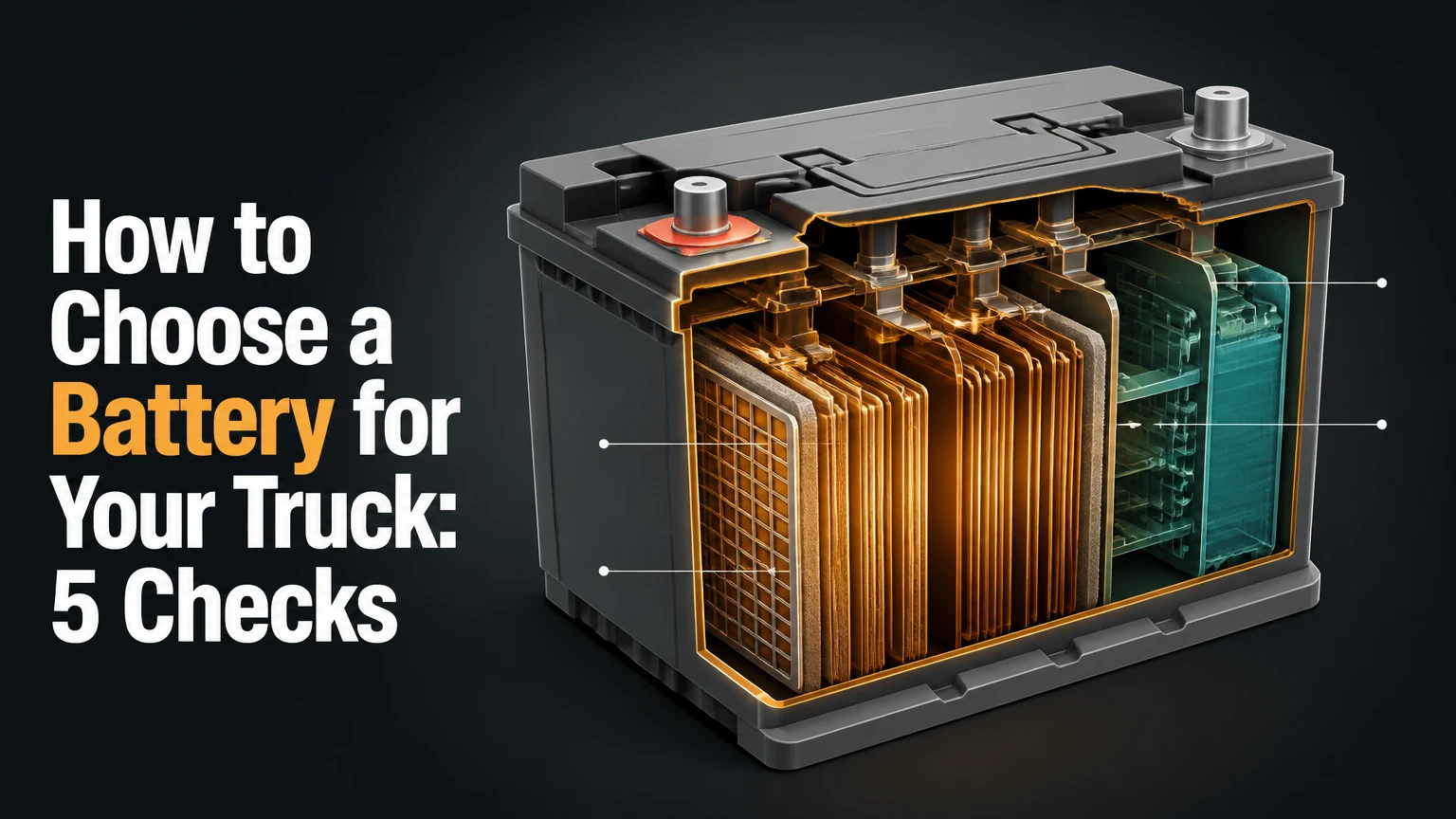
To choose a battery for your truck, match the manufacturer-approved group size, terminal layout, minimum CCA, reserve capacity, and battery chemistry to the engine, climate, and accessories. Then confirm the replacement battery fits the tray, accepts the truck’s charging strategy, and meets the electrical demands of starting and parked equipment.
Key Facts at a Glance
Battery group size specifies case dimensions, terminal placement, and often hold-down geometry; Group 24 and Group 34 are not interchangeable merely because both are 12-volt batteries.
Cold Cranking Amps, or CCA, measure a battery’s starting output at 0°F (-18°C) for 30 seconds while maintaining at least 7.2 volts for a 12-volt battery under the SAE J537 test.
A diesel truck may require 750-1,000 CCA or more, and many heavy-duty diesels use two matched batteries rather than one oversized battery.
AGM batteries tolerate vibration and repeated accessory cycling better than conventional flooded starting batteries, but AGM must be charged with a compatible voltage profile.
Reserve capacity indicates how long a fully charged battery can deliver a specified current before reaching a defined voltage; reserve capacity is not the same as amp-hour capacity.
A lithium iron phosphate battery is suitable only when the battery is specifically engineered for starting or auxiliary service and its BMS, low-temperature protection, and charger are compatible.
What Does a Truck Battery Do?
A truck battery stores chemical energy and releases electrical current for engine cranking, control-module startup, lighting, and voltage stabilization. The alternator supplies most electrical power after the engine starts, while the battery absorbs short electrical fluctuations and supplies current when demand briefly exceeds alternator output.
A conventional lead-acid battery contains lead dioxide, lead, and sulfuric-acid electrolyte. During discharge, the plates gradually form lead sulfate and release electrons through the external circuit. Recharging reverses much of that reaction, although sulfation, corrosion, heat, vibration, and deep discharge permanently reduce capacity over time.
A starter battery is designed for a short, high-current event. A deep-cycle battery uses thicker plates and tolerates repeated discharge more effectively, but its maximum starting output may be lower for the same physical size. An auxiliary refrigerator, inverter, or camping system may therefore need a separate deep-cycle battery rather than a larger starting battery.
The alternator does not automatically repair a deeply discharged battery. A typical alternator can maintain a charged battery during normal driving, but a smart charging system may reduce voltage, and a short commute may not replace energy used during starting or parked accessory operation.
Which Battery Type Fits Your Truck?
The correct battery type depends first on the truck’s original equipment specification, then on vibration, cycling, accessory load, and charging controls. Standard flooded batteries suit many basic trucks, EFB suits some higher-cycle applications, AGM suits demanding vibration and accessory conditions, and LiFePO4 suits only compatible engineered systems.
| Battery type | Typical CCA range | Typical service life | Typical retail price | Best-fit application |
|---|---|---|---|---|
| Flooded lead-acid SLI | 400-800 A | 2-4 years | $100-$220 | Basic gasoline truck |
| Enhanced flooded EFB | 600-900 A | 3-5 years | $150-$300 | Entry-level start-stop system |
| AGM starting battery | 700-1,100 A | 4-6 years | $220-$450 | Off-road or high-accessory truck |
| LiFePO4 starting battery | 600-1,200 A | 5-10 years | $500-$1,500 | Approved motorsport or specialty system |
Flooded lead-acid
Flooded lead-acid remains the lowest-cost replacement for many older gasoline pickups and work trucks. A maintenance-free flooded battery is sealed for normal use, but it still contains liquid electrolyte and can lose water through heat or overcharging.
Flooded batteries are poor choices for repeated winch pulls, long periods powering an inverter, or severe off-road vibration. Their low purchase price can be economical when the truck starts every day, carries no large accessories, and receives regular maintenance.
EFB
An enhanced flooded battery uses improved plate and separator construction to tolerate more charge-discharge cycling than a conventional SLI battery. EFB is common in some start-stop passenger vehicles and light commercial vehicles, but availability in larger truck group sizes varies by market.
EFB is not a universal AGM substitute. If the truck was built for AGM, the owner’s manual or battery-management system may require AGM, particularly when the battery is located inside the cabin or exposed to high electrical cycling.
AGM
An absorbent glass mat battery holds electrolyte in fiberglass separators, reducing free liquid movement and improving resistance to vibration. AGM batteries commonly provide high CCA, low gas release under normal charging, and better cycling performance than flooded SLI batteries.
AGM costs more and weighs more than lithium. AGM also dislikes chronic overcharging, so verify alternator voltage and charger settings before installation. The Optima YellowTop product line, for example, is marketed for applications that combine starting with cycling, but product-specific CCA and reserve-capacity figures still must match the truck.
LiFePO4
Lithium iron phosphate batteries can reduce weight and provide high usable energy, but automotive starting lithium is a specialist choice rather than a routine upgrade. A LiFePO4 battery needs a battery-management system, suitable peak-current rating, secure terminals, and charging protection.
The common claim that lithium batteries provide “100% safe depth of discharge” is misleading. A BMS may disconnect the load near empty, but repeated full discharge can shorten life, and a disconnected battery cannot crank an engine. Many LiFePO4 batteries must not accept charging below 0°C unless they include a heater or explicit low-temperature charge protection.
How Do You Read Battery Specifications?
Battery labels should be interpreted in a fixed order: group size, polarity, voltage, CCA, reserve capacity, and technology. The highest advertised CCA does not compensate for an incorrect case, terminal position, hold-down, or charging requirement.
| Specification | What it measures | Practical truck decision | Example |
|---|---|---|---|
| Voltage | Electrical system nominal voltage | Match the vehicle system | 12 V |
| BCI group size | Case and terminal geometry | Confirm tray and cable fit | Group 65 |
| CCA | Current at 0°F for 30 seconds | Set the cold-start minimum | 850 CCA |
| CA | Current at 32°F for 30 seconds | Do not substitute for CCA | 1,050 CA |
| Reserve capacity | Minutes at a defined test load | Support failure or accessory time | 140 minutes |
| Amp-hour rating | Stored charge over a specified rate | Size auxiliary energy storage | 100 Ah |
CCA, CA, and HCA
CCA is the most useful starting specification for a truck operated in cold weather. CA, sometimes called MCA, is measured at 32°F (0°C), so its number is higher than CCA for the same battery and should not be used as a direct replacement.
The SAE J537 test defines CCA at 0°F (-18°C), but manufacturer labels may also show EN or IEC ratings. An EN rating is not numerically interchangeable with SAE CCA. Compare like-for-like ratings or use the vehicle manufacturer’s stated requirement.
Diesel engines need substantial cranking current because cold oil, high compression, glow plugs, and intake heaters increase starting demand. A typical light-duty diesel may specify 800-1,000 CCA for each battery, while gasoline trucks often use approximately 600-850 CCA, but the owner’s manual remains authoritative.
Reserve capacity
Reserve capacity, or RC, describes the battery’s ability to support a defined electrical load if the alternator stops producing power. RC is commonly reported in minutes at 25 amps until the battery reaches 10.5 volts, although test standards and labels can differ.
To estimate parked accessory use, divide usable watt-hours by load watts. A 12-volt, 100-Ah lead-acid battery has about 1,200 watt-hours nominally, but using roughly 50% before recharging protects service life, leaving approximately 600 watt-hours. A 60-watt refrigerator could therefore run for about 10 hours in ideal conditions, before inverter losses and compressor cycling.
How to Choose a Battery for Your Truck Step by Step
Use the following five checks before buying. A retailer’s vehicle lookup is useful, but confirm the result against the truck’s manual and the existing battery because engine swaps, fleet modifications, and regional equipment can produce catalog errors.
Step 1: Confirm physical fit
Record the existing battery’s group size, length, width, height, terminal orientation, vent provision, and hold-down style. Measure the tray if the label is missing, and compare the replacement’s dimensions in millimeters rather than relying on a visually similar case.
A battery that fits the tray but lacks the correct bottom flange can move under braking or vibration. A battery that fits the cables but reverses polarity can create a direct short through the positive cable, fuse links, or electronic modules.
Success checkpoint: The replacement case fits without forcing cables, the hold-down contacts the approved retention points, and both terminals remain clear of metalwork.
Common mistake: Installing a taller battery beneath a hood or seat. Check clearance with the hold-down installed.
Step 2: Match the minimum CCA and voltage
Choose the vehicle’s specified voltage and at least the manufacturer’s required CCA. A modest CCA increase is usually acceptable when the group size, charging system, and physical fit remain correct; a lower CCA rating reduces cold-start margin.
For a diesel with two batteries, replace both as a matched pair when one battery is significantly older or weaker. A new battery connected in parallel with a degraded battery can be repeatedly overworked, creating imbalance and shortening the new battery’s life.
Success checkpoint: The replacement label shows the correct voltage and an SAE or equivalent rating that meets the manual’s minimum.
Common mistake: Comparing a 1,000 CA label with an 850 CCA requirement as if the values were identical.
Step 3: Calculate electrical demand
List every accessory that operates while the engine is off: winch controls, refrigeration, lighting, radio equipment, dashcams, inverters, heated gear, and telematics. Add the current draw rather than guessing from accessory wattage; watts divided by system voltage gives approximate amps.
A 300-watt inverter draws about 25 amps at 12 volts before inverter losses. A 40-amp load used for 30 minutes consumes approximately 20 amp-hours, but a starter battery should not repeatedly supply that load to a low state of charge.
Success checkpoint: The battery’s reserve capacity covers the planned parked use, and the alternator can supply the accessory load while driving.
Common mistake: Treating a higher-CCA starting battery as a substitute for a dedicated auxiliary battery. CCA improves cranking, not repeated deep cycling.
Step 4: Match climate and vibration
Cold temperatures reduce lead-acid battery output while increasing engine cranking resistance. At approximately 0°F (-18°C), a battery has substantially less available starting power than at room temperature, which is why winter CCA margin matters.
Heat also shortens battery life. Battery manufacturers commonly cite high under-hood temperatures as a major cause of plate corrosion and water loss; a truck in a hot climate may need more frequent testing even if winter starts are easy.
AGM is often the practical choice for rock crawling, corrugated roads, and heavy accessory use because immobilized electrolyte and stronger construction reduce vibration-related damage. AGM does not eliminate damage from a loose hold-down.
Success checkpoint: The battery type matches the climate, mounting location, and vibration exposure, and the battery has the manufacturer-approved temperature and charging limits.
Common mistake: Choosing lithium for winter use without checking its low-temperature charging cutoff.
Step 5: Verify charging and battery-management compatibility
Measure charging voltage only after checking the truck’s service information. Many modern trucks use smart alternators that vary voltage, monitor current, and may require battery registration after replacement.
A conventional lead-acid battery, EFB, and AGM battery can have different charging requirements. A battery-management system calibrated for AGM may undercharge a flooded replacement, while an unsuitable charger can overcharge AGM or damage lithium electronics.
Success checkpoint: The manual, battery manufacturer, and charger or alternator specifications agree on chemistry, charging voltage, registration, and sensor compatibility.
Common mistake: Replacing a factory AGM with flooded lead-acid to save money without recalibrating the charging system.
Which Battery Should You Choose?
The best battery depends on the truck’s engine and operating pattern, not on chemistry alone. A basic gasoline commuter usually needs an OEM-matched flooded battery, a diesel needs the specified high-CCA configuration, and an off-road truck with parked accessories often benefits from AGM plus a separate auxiliary system.
| Truck situation | Recommended primary battery | Typical target | Avoid |
|---|---|---|---|
| Older gasoline pickup | Flooded SLI | OEM group, 600-800 CCA | Undersized case |
| Modern start-stop truck | OEM EFB or AGM | OEM chemistry, 700-900 CCA | Conventional SLI downgrade |
| Light-duty diesel | AGM or OEM lead-acid pair | 800-1,000 CCA per battery | Mixing old and new batteries |
| Rock-crawling truck | AGM starting battery | 750-1,000 CCA, high RC | Loose hold-down |
| Winch and camping build | AGM starter plus auxiliary AGM | 100-200 Ah auxiliary bank | Running winch from one starter battery |
| Specialty lithium system | Approved LiFePO4 starter or auxiliary | BMS-rated peak current | Generic deep-cycle lithium |
Daily commuter
Choose a quality flooded SLI or EFB battery that matches the original group size and CCA. EFB makes more sense where frequent start-stop operation or repeated short trips create cycling demand, while a standard flooded battery remains cost-effective for a conventional truck with longer drives.
Heavy-duty diesel
Follow the manufacturer’s battery-pair specification, including group size, CCA, reserve capacity, and parallel-cable arrangement. Do not combine different chemistries, capacities, ages, or states of health in a dual-battery starting bank.
Off-road and overland truck
Choose AGM when vibration, winching, refrigeration, and auxiliary lighting exceed the capability of a basic flooded starter battery. For extended camping, use an isolator or DC-to-DC charger with a properly sized auxiliary battery so the starting battery remains available for engine cranking.
Fleet and work truck
Prioritize warranty terms, local availability, date code, vibration resistance, and consistent specifications across the fleet. A slightly higher purchase price can reduce downtime, but lithium rarely makes economic sense for an ordinary starter fleet unless weight, cycling, or specialist equipment justifies the additional system cost.
Can You Upgrade Battery Chemistry?
A truck can often move from flooded lead-acid to AGM when the case, terminals, charging profile, ventilation, and battery-management settings are compatible. A truck should not move to lithium merely because LiFePO4 offers lower weight or more cycle life, because starter current, cold charging, alternator control, and BMS behavior must all match.
AGM upgrades are most defensible when the original battery repeatedly fails from vibration or accessory cycling, and when the manufacturer lists AGM as an approved option. The upgrade will not fix an undersized alternator, an electrical drain, or a badly corroded ground cable.
Lithium starter batteries require additional checks: continuous and peak cranking current, inrush behavior, BMS disconnect strategy, low-temperature charging protection, charger voltage, and secure mounting. Some lithium batteries are designed only for house loads and cannot safely deliver starter current.
Important limitation: LiFePO4 is not automatically a better truck battery. A properly selected AGM battery is usually simpler, more available, and more tolerant of ordinary automotive charging systems.
What Should a Truck Battery Cost?
A typical truck battery costs about $100-$220 for flooded lead-acid, $150-$300 for EFB, $220-$450 for AGM, and $500-$1,500 for an approved lithium starting battery. Installation, core deposits, battery registration, cable repair, and a dual-battery replacement can add $30-$250.
| Replacement category | Typical battery price | Typical installed total | Expected service range |
|---|---|---|---|
| Group 24 flooded SLI | $100-$180 | $140-$260 | 2-4 years |
| Group 65 flooded SLI | $130-$220 | $170-$300 | 2-4 years |
| Group 34 AGM | $220-$350 | $270-$450 | 4-6 years |
| Heavy-duty AGM pair | $450-$800 | $550-$1,000 | 4-6 years |
| Approved LiFePO4 starter | $500-$1,500 | $600-$1,800 | 5-10 years |
Prices vary by country, warranty, reserve capacity, brand, and seasonal demand. The manufacturing date also matters: ask for a recently produced battery and inspect its date code, because a battery stored partially charged for many months may have lost capacity before installation.
What Problems Indicate a Battery or Charging Fault?
A clicking starter, slow crank, dim lights, or repeated jump-start requirement can indicate a discharged battery, failed battery, poor cable connection, parasitic drain, or alternator problem. Testing the complete starting and charging circuit prevents replacing a battery that was only a symptom.
| Symptom | Likely test result | Most useful next action | Replacement urgency |
|---|---|---|---|
| Single click, no crank | Voltage drops below 9.6 V while cranking | Load-test battery and inspect cables | Same day |
| Slow cold crank | CCA test below rated capacity | Test battery and engine oil grade | Within days |
| White or green terminal crust | High-resistance connection | Disconnect, clean, and retorque terminals | Immediate cleaning |
| Swollen case | Overcharge, heat, or freezing damage | Stop using and replace battery | Immediate |
| Battery repeatedly dies overnight | Parasitic draw above vehicle specification | Perform keyed-off current test | Diagnose before replacement |
| Charging voltage stays low | Alternator or belt fault | Test alternator output and grounds | Diagnose promptly |
A healthy fully charged lead-acid battery typically measures about 12.6-12.8 volts after resting for several hours. Around 12.4 volts indicates partial charge, while 12.0 volts indicates severe discharge; voltage alone cannot establish battery health.
During cranking, many technicians use approximately 9.6 volts at 70°F (21°C) as a practical load-test reference. Temperature, tester method, battery design, and vehicle electronics affect the exact result. A professional conductance or load test is more informative than a dashboard voltage display.
A swollen or cracked case is unsafe to clean and reuse. Replace the battery, identify overcharging or freezing, and wear eye and hand protection around lead-acid electrolyte.
Common Mistakes and How to Fix Them
- Buying by physical size only: A Group 34 battery may fit a tray intended for another case but lack the required CCA or hold-down. Compare every specification.
- Using CA instead of CCA: CA is measured at a warmer temperature. Select according to the rating named in the truck’s manual.
- Mixing batteries in a diesel pair: Replace parallel starting batteries together when their ages or test results differ materially.
- Ignoring cable and ground condition: A new battery cannot overcome a corroded negative strap or loose engine ground. Measure voltage drop during cranking.
- Leaving the hold-down loose: Vibration damages plates and terminals. The battery must remain immobile under firm, even restraint.
- Assuming the alternator recharges everything: Short trips may not restore energy used by winching, inverters, or parked electronics. Use an auxiliary charging system when needed.
- Reversing polarity: Confirm positive and negative positions before connecting cables. Reversed polarity can blow fusible links and damage electronic modules, although damage is not inevitable in every vehicle because protective fuses may open first.
How Can You Install and Maintain the Battery Safely?
Turn off the ignition, remove jewelry, wear eye protection, and photograph cable routing before disconnection. Disconnect the negative terminal first, then the positive; connect the new battery positive first and negative last.
Clean corrosion with a battery-terminal brush and an appropriate neutralizing solution, keeping liquid away from electronic connectors. Do not place tools across both terminals. Torque terminals and hold-down hardware to the vehicle or battery manufacturer’s specification rather than guessing.
After installation, start the truck and check for warning lights, abnormal charging voltage, and secure cable movement. Some newer trucks require battery registration through a scan tool so the battery-management system can reset its state-of-charge and aging calculations.
Check terminal cleanliness every service interval and test battery health before winter or extreme heat. A battery that repeatedly loses charge requires a parasitic-draw test, not repeated replacement.
FAQ
Is a higher CCA battery better for a truck?
A higher CCA battery is beneficial when the battery retains the correct group size, terminal layout, chemistry, and charging compatibility. Extra CCA cannot correct a weak starter, poor ground, unsuitable oil, or an alternator fault. Stay within the vehicle manufacturer’s approved battery range.
Do diesel trucks need two batteries?
Many diesel trucks use two batteries in parallel to provide sufficient cranking current and reserve capacity, but not every diesel requires two. Use the exact factory configuration, cable arrangement, and battery specification. Replace both batteries together when their ages or measured capacities differ significantly.
Can an AGM battery replace a flooded battery?
An AGM battery can replace a flooded battery when the physical dimensions, polarity, CCA, charging system, and ventilation requirements are compatible. AGM is a poor value for a simple low-cycle truck if no vibration or accessory demand justifies its higher price.
How long should a truck battery last?
A typical flooded truck battery lasts 2-4 years, EFB about 3-5 years, and AGM about 4-6 years. Heat, vibration, short trips, deep discharge, charging faults, and storage can shorten those ranges substantially.
What battery is best for a truck winch?
AGM is usually the better starting-battery choice for a winch-equipped truck because it tolerates vibration and high-current cycling better than basic flooded SLI. Frequent or prolonged winching still requires adequate alternator capacity, heavy-gauge cables, and often an auxiliary battery.
Should a truck battery be replaced after a jump-start?
A jump-start does not prove that the battery needs replacement. Fully charge the battery, test its conductance or load performance, inspect the charging system, and investigate parasitic draw. Replace the battery when capacity or cranking performance fails the manufacturer’s test criteria.
The Bottom Line
To choose a battery for your truck, start with the manual and verify group size, polarity, voltage, CCA, reserve capacity, and chemistry. Select AGM for demanding vibration or cycling when the charging system supports it, retain flooded or EFB for compatible ordinary use, and treat LiFePO4 as a specialist option requiring documented BMS and charging compatibility. Test the cables, alternator, and battery-management system before blaming the battery alone.