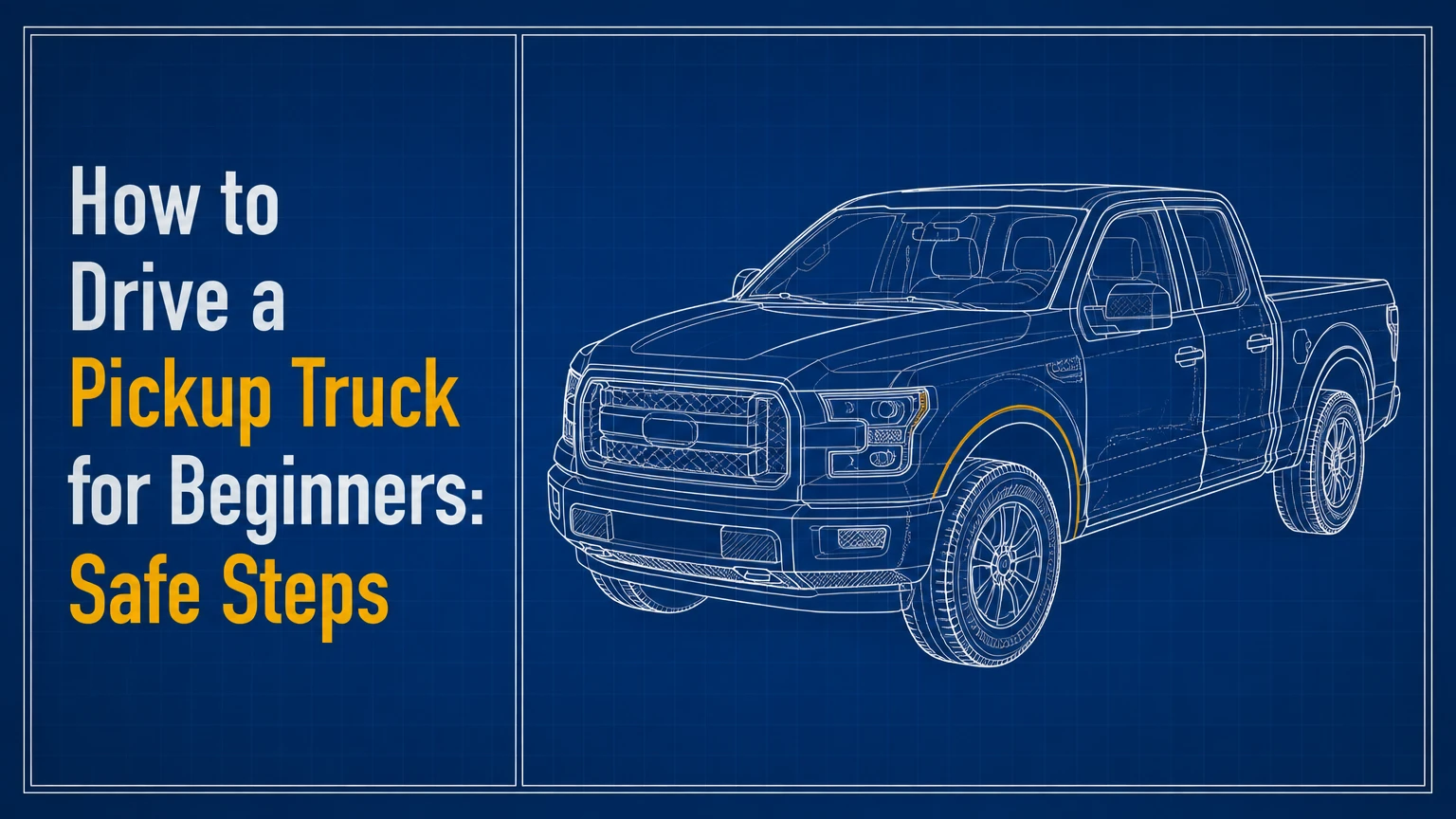
To drive a pickup truck safely, learn its dimensions, mirror blind spots, rear-wheel traction, higher center of gravity, and longer stopping behavior before entering busy traffic. Set the seat and mirrors, practice smooth acceleration and braking in an empty lot, then progress to turns, reversing, highways, cargo, and only afterward trailer work.
Key Facts at a Glance
- A pickup truck may need more stopping distance than a passenger car, especially with a heavy load or trailer.
- An empty pickup bed can reduce rear-tire grip because little vehicle weight rests over the driven axle.
- Four-wheel drive helps a pickup accelerate on snow, gravel, or mud, but it does not eliminate the need for slower braking.
- Pickup mirrors should show the bed sides and adjacent lane, while a shoulder check remains necessary before changing lanes.
- A truck’s payload rating includes passengers, cargo, accessories, and trailer tongue weight, not cargo alone.
- Backing into a parking space usually gives a clearer exit, but the driver must still inspect the space and surroundings first.
What Makes a Pickup Truck Different?
A pickup truck combines an enclosed passenger cab with an open cargo bed, usually on a body-on-frame chassis rather than a car’s unibody structure. The separate frame supports the engine, axles, cab, and bed, while higher ground clearance and a rear-biased drivetrain change braking, cornering, traction, and visibility.
Pickup trucks vary widely. A compact Ford Maverick behaves differently from a full-size Ford F-150, and a one-ton Ford F-350 has substantially different dimensions, suspension, and braking demands. The badge alone does not tell you the truck’s wheelbase, axle ratio, payload, or turning circle.
The empty-bed condition surprises many new drivers. A pickup can have a heavy engine over the front axle and comparatively little weight over the rear axle, so throttle applied too sharply on wet pavement can spin the rear tires. Leaf springs also make some unloaded trucks hop or bounce over rough pavement.
A high-riding truck has a higher center of gravity than a sedan. That increases body movement during abrupt steering, although a properly driven pickup remains stable when speed, tire condition, and load stay within the manufacturer’s limits.
Before You Drive a Pickup Truck
Before driving a pickup truck, spend 10-15 minutes reading the owner’s manual, checking the vehicle controls, and setting a position that gives clear sightlines. You need the truck’s height, tire-pressure, payload, drive-mode, parking-brake, and emergency information before practicing.
Use This Beginner Setup Checklist
- Adjust the seat. Keep your wrists near the top of the steering wheel with your shoulders against the seatback. Maintain enough knee bend to fully press the brake without locking your leg.
- Set the steering wheel. Aim the wheel toward your chest, not your face. Keep at least 10 inches between your sternum and the airbag when the vehicle allows it.
- Set the interior mirror. Frame the rear window, not the bed rails or headliner.
- Set the side mirrors. Move each mirror outward until the truck’s side occupies only a narrow inner sliver. A following car should transition from the interior mirror into the side mirror with minimal overlap.
- Find the vehicle height. Read the clearance label on the driver’s door jamb, sun visor, or owner’s manual. Add the height of any ladder rack, roof cargo, or raised suspension.
- Find the controls. Identify the gear selector, parking brake, hazard switch, headlights, wipers, 2WD or 4WD selector, trailer-brake controller, and fuel-door release.
- Check the tires. Use the cold tire pressure on the door label, not the maximum pressure molded into the tire sidewall.
- Secure the bed. Close the tailgate unless the owner’s manual or cargo arrangement specifically permits another position, and restrain every loose item.
| Item to check | Typical value or location | Why it matters |
|---|---|---|
| Cold tire pressure | 30-45 psi, vehicle-specific | Incorrect pressure changes grip, steering, and load capacity |
| Clearance label | Driver door jamb or sun visor | Prevents garage, awning, and bridge strikes |
| Payload label | Door certification label | Limits passengers, cargo, accessories, and tongue weight |
| 4WD selector | Console, dash, or rotary knob | Prevents accidental use of the wrong drive range |
| Trailer brake control | Lower dash area, if equipped | Controls electric trailer brakes separately |
| Bed tie-down rating | Owner’s manual or tie-down label | Sets the allowable force for cargo restraints |
How to Drive a Pickup Truck for Beginners
The safest beginner progression uses 10 controlled steps over roughly 90 minutes: controls, starts, stops, turns, lane changes, reversing, parking, roads, cargo, and towing. The factor that most determines success is smooth speed management, because excessive speed amplifies body roll, stopping distance, rear-wheel slip, and turning errors.
Step 1: Practice Controls in a Quiet Lot
Start in a large, empty, level parking area with an experienced licensed driver or instructor beside you. Keep the truck in Park while you locate the pedals, gear positions, turn signals, mirrors, drive-mode selector, parking brake, and camera controls.
Drive at walking speed for 5-10 minutes. Apply the accelerator with the ball of your foot, release it smoothly, and learn how much the truck creeps in Drive. Then practice stopping with steady brake pressure rather than pressing, releasing, and pressing repeatedly.
You will know the step worked when you can select Drive, move 20-30 feet, stop within a chosen parking-space line, and select Park without searching for a control. A common mistake is watching the center display instead of the road while looking for switches.
Step 2: Learn the Truck’s Length and Width
Use empty parking-space lines to estimate the truck’s front corners, rear corners, bed length, and wheel path. Place cones only where they cannot damage the vehicle, and use a spotter who remains visible rather than standing directly behind the truck.
Drive forward with the driver-side tires about 12 inches from a line, then observe where the bed and passenger-side tires track. Repeat from both directions. Pickup trucks with long beds and crew cabs need more room than their front-seat view suggests.
You will know the step worked when you can center the truck in a lane and stop with the rear bumper 12-18 inches from a line. The common mistake is judging the truck by the hood alone, because the bed corners and rear wheels remain outside that visual reference.
Step 3: Select the Correct Drive Mode
Use 2H for normal dry pavement, 4H only on a surface that permits tire-speed differences or requires extra traction, and 4L for very slow, high-resistance work such as deep mud or steep rocky terrain. Exact operation differs, so the owner’s manual controls the procedure.
Do not use part-time 4H or 4L on dry high-traction pavement unless the manufacturer permits it. Driveline wind-up can make steering difficult and may damage components. Full-time 4WD and automatic 4WD systems follow different rules.
Four-wheel drive improves acceleration traction, not ice braking. The U.S. Department of Transportation’s winter-driving guidance consistently prioritizes slower speed, greater following distance, and appropriate tires over relying on drivetrain selection.
You will know the step worked when you can explain why each mode is selected before moving. The common mistake is choosing 4WD as a substitute for winter tires or cautious speed.
Step 4: Brake Earlier and Leave a Larger Gap
Maintain at least a four-second following interval in clear conditions, measured by watching the vehicle ahead pass a fixed object and counting “one thousand one” through “one thousand four.” Increase the gap to six seconds or more in rain, snow, darkness, heavy traffic, or when carrying a load.
A pickup truck’s stopping distance depends on speed, tires, pavement, brakes, grade, and mass. A loaded truck or truck-and-trailer combination can require substantially more distance than the same vehicle empty, so begin braking before a sedan driver might.
Brake in a straight line with firm, progressive pressure. Antilock brakes may pulse under hard braking; keep pressure applied and steer toward the open path. The National Highway Traffic Safety Administration advises drivers to “always drive at a safe speed for the conditions,” which matters more in a tall, heavy vehicle.
You will know the step worked when you stop smoothly before a selected line without nose-diving or triggering ABS. The common mistake is following closely because the truck feels powerful at low speed.
Step 5: Take Turns at a Controlled Speed
Slow before the turn, look through the corner, and maintain light, steady throttle after the truck is settled. A pickup’s rear wheels follow a shorter path than its front wheels, a behavior called off-tracking, so a tight turn can pull the rear tire over a curb.
Do not swing wide across a neighboring lane to compensate. For a normal right turn, approach close enough to the right side, enter at a safe speed, and allow the rear wheels to clear the curb. Long-wheelbase trucks need a later steering input than compact trucks, but the correct path depends on the intersection.
Higher speed increases body roll and reduces the time available for correction. If the truck begins to slide, look and steer toward the intended path, release abrupt throttle, and avoid a violent countersteer.
You will know the step worked when the rear tires clear the curb by at least several inches and the truck exits centered. The common mistake is accelerating halfway through a wet turn.
Step 6: Change Lanes Using Mirrors and a Shoulder Check
Signal early, check the interior mirror, inspect the side mirror, and perform a brief shoulder check before moving laterally. Pickup blind spots can conceal a motorcycle, compact car, cyclist, or vehicle traveling alongside the bed.
Mirror-mounted blind-spot monitors provide alerts but do not replace a visual check. Cameras show selected zones, not every object, and a rear camera can hide a low object outside its field of view.
Change lanes with a single smooth steering movement. Avoid lingering beside another vehicle, especially near its rear quarter. On multi-lane roads, leave more space when a large truck is beside you because wind and lane position can influence the pickup.
You will know the step worked when you can identify the target lane, confirm it is empty, and merge without a steering correction. The common mistake is checking the mirror only after beginning the lane change.
Step 7: Reverse and Park Deliberately
Walk around the pickup before reversing whenever children, animals, loose objects, or an unfamiliar area may be present. Then use the camera, both mirrors, and direct views through the windows, reversing at idle speed with the brake ready.
Backing into a space can improve forward visibility when leaving, but it is not automatically safe. Choose a space with adequate width, signal before maneuvering, and stop immediately if the camera image, mirror view, or spotter instruction conflicts.
A pickup pivots around its rear axle area during a turn. The front end can swing outward while the rear moves toward the inside of the turn, so watch the front corners as well as the bumper.
You will know the step worked when the truck is centered, the wheels are straight, and you can name the path out before selecting Park. The common mistake is trusting parking sensors to detect a narrow post, curb, or child.
Step 8: Carry Cargo Within the Payload Rating
Find the truck’s payload rating on the certification label and subtract passengers, fuel, tools, bed accessories, and trailer tongue weight. A truck labeled for 1,800 pounds of payload does not have 1,800 pounds available after four adults and a toolbox occupy part of that allowance.
Place dense cargo low and near the axle area, distribute weight across the bed, and secure it with rated straps or chains. Do not place a heavy load at the extreme tailgate because it can unload the front axle and reduce steering authority.
The Federal Motor Carrier Safety Administration recommends securing cargo so it cannot shift or fall, while local laws may require flags, lamps, or additional restraints for projecting loads. Cover loose lightweight items that could leave the bed.
You will know the step worked when the load remains stationary during a gentle stop and the truck sits level within the manufacturer’s limits. The common mistake is using payload and towing capacity as interchangeable numbers.
Step 9: Practice on Real Roads Gradually
Use this progression: empty lot, quiet residential street, moderate urban route, highway, then hills or unpaved surfaces. Spend 15-20 minutes at each level and repeat the previous level if steering, braking, or observation feels rushed.
Highway entry requires a longer acceleration lane and a clear gap, but do not force a merge because the truck has strong torque. In a city, identify the truck’s width before entering narrow lanes, drive-throughs, older garages, or streets with parked cars.
Rain reduces tire grip and visibility. Snow and ice require slower speed, longer gaps, gentle controls, and tires suited to the conditions. The Transportation Research Board and state driver manuals generally distinguish propulsion assistance from actual braking grip, a distinction beginners often miss.
You will know the step worked when you can maintain lane position, scan mirrors every few seconds, and keep a stable gap without abrupt corrections. The common mistake is increasing speed to “make the truck feel normal.”
Step 10: Tow Only After Solo Driving Feels Routine
Before towing, confirm the truck’s maximum trailer weight, maximum tongue weight, hitch rating, gross combined weight rating, and trailer-brake requirements. The trailer’s actual loaded weight matters, not its empty brochure weight.
Connect the coupler, safety chains, electrical plug, breakaway cable, and weight-distribution equipment according to the vehicle and trailer instructions. Test brake lights, turn signals, tire pressure, wheel-lug condition, and trailer brakes before departure.
Allow extra room for turns, braking, lane changes, and backing. Practice in a large empty area before entering traffic, because a trailer reverses in the opposite direction from the initial steering input.
You will know the step worked when the trailer tracks correctly, brakes evenly, and remains within every rating. The common mistake is towing a heavy trailer because the engine can pull it, without checking payload, tongue weight, and combined weight.
Which Pickup Size Is Easiest for a Beginner?
A mid-size pickup is usually easiest for a beginner in city driving, while a full-size half-ton offers a broader compromise for family use, hauling, and highway travel. A heavy-duty truck is appropriate when the work requires its ratings, but its width, stiff suspension, and larger mass make it a poor practice vehicle for casual driving.
| Pickup category | Typical payload | Typical towing | Typical width | Best beginner use |
|---|---|---|---|---|
| Mid-size, Tacoma or Colorado | 1,000-1,600 lb | 3,500-7,700 lb | 72-76 in | Urban driving and light hauling |
| Full-size 1500, F-150 or Ram 1500 | 1,500-2,300 lb | 7,000-13,000 lb | 79-83 in | Family use, home projects, highway travel |
| Heavy-duty 2500, Silverado 2500 or F-250 | 3,000-4,500 lb | 14,000-20,000 lb | 80-83 in | Frequent heavy towing and commercial loads |
| Heavy-duty 3500, diesel configuration | 3,500-7,000 lb | 18,000-30,000+ lb | 80-84 in | High combined-weight towing within ratings |
Cab configuration changes maneuverability and utility. A regular cab often offers the longest bed, an extended cab adds occasional rear seating, and a crew cab provides four full doors but commonly pairs with a shorter bed.
| Configuration | Typical seating | Typical bed choice | Practical trade-off |
|---|---|---|---|
| Regular cab | 2-3 occupants | 6.5-8 ft | Long cargo bed, limited passenger space |
| Extended cab | 4-5 occupants | 5.5-6.5 ft | Occasional rear seats, smaller rear access |
| Crew cab | 5-6 occupants | 5.5-6.5 ft | Best rear legroom, shorter bed common |
| Mid-size crew cab | 5 occupants | 5-6 ft | Easier parking, narrower cabin and bed |
A larger truck is not automatically safer. Size can improve occupant space, but it also increases blind zones, parking difficulty, stopping mass, and the consequence of striking a smaller road user.
What Should Beginners Avoid?
Beginners should avoid speed, sudden steering, unsecured cargo, unverified clearance, and unplanned 4WD use. Most pickup errors begin with treating the vehicle like a sedan, then correcting late after the truck’s width, rear-wheel path, or load has already changed the situation.
| Mistake | Immediate risk | Corrective habit |
|---|---|---|
| Tailgating | Insufficient stopping room | Use a four-second minimum gap |
| Fast corner entry | Body roll or rear slide | Brake before steering |
| Tight turn cutting | Rear tire hits curb | Track the rear wheels |
| Unsecured bed items | Objects leave the truck | Use rated restraints |
| Ignoring clearance | Roof or rack impact | Check the highest vehicle point |
| Sudden lane correction | Fishtail or rollover risk | Make one smooth steering input |
| Overloading rear axle | Tire, brake, or suspension stress | Verify axle and payload limits |
| Relying on 4WD | Excess speed on low-grip roads | Slow down and use suitable tires |
What If the Rear Wheels Start Sliding?
If a pickup’s rear wheels slide, release abrupt acceleration, look where you want to travel, and make a small steering correction rather than braking and turning violently. Keep movements smooth, and if the vehicle does not recover immediately, brake according to the owner’s instructions and seek a safe stopping area.
On a rear-wheel-drive pickup, excessive throttle on wet, snowy, or gravel surfaces can overwhelm available grip. Worn tires and incorrect pressure make the problem worse. Weight placed over the rear axle can improve traction in some trucks, but the load must be secured and remain within payload and axle ratings.
Do not add arbitrary sandbags to a modern truck without checking the manual. Some manufacturers warn against unsecured ballast, and a heavy bed load increases stopping distance.
Why Does an Empty Pickup Bounce?
An empty pickup can bounce because rear leaf springs are designed to support cargo, so the unloaded suspension may be relatively stiff. Reduce speed over rough pavement, keep both hands positioned for control, and inspect the tires, shocks, suspension, and load if the movement is severe or new.
Normal stiffness does not include repeated loss of steering control, a damaged tire, a leaking shock absorber, or a suspension component that clunks. A tire shop or qualified technician should inspect those symptoms.
Practice Time, Tools, and Typical Costs
A first controlled session usually takes 60-90 minutes, while confident city and highway operation commonly requires several separate sessions. Typical U.S. professional driving lessons cost about $75-$150 per hour, although pickup-specific instruction and regional prices vary.
| Practice stage | Typical duration | Location | Success measure |
|---|---|---|---|
| Controls and starts | 10-15 minutes | Parked area | Select gears without searching |
| Braking and lane position | 15-20 minutes | Empty lot | Stop smoothly at marked lines |
| Turns and reversing | 20 minutes | Empty lot | Clear curbs and center spaces |
| Quiet streets | 15-20 minutes | Residential route | Hold gap and lane position |
| Highway or hills | 20-30 minutes | Supervised public road | Merge and brake without rush |
Useful materials include four soft traffic cones, a tire-pressure gauge, a phone kept out of reach, and the vehicle manual. A spotter should wear visible clothing and use agreed stop signals; the driver should stop whenever the spotter disappears from view.
The cheapest practice is an empty lot with an experienced instructor. The most expensive beginner error is a low-speed collision caused by skipping dimension, mirror, or reversing practice.
Expert Rules for Pickup Control
A camera is a supplement, not a complete view. Rear cameras commonly miss objects close below the bumper, beside the corners, or beyond the lens angle. A walk-around remains necessary.
The empty truck can be less predictable than the loaded truck. Extra rear-axle load may improve acceleration traction, but cargo also increases momentum and stopping distance. Loading changes two variables at once, so the driver must slow down rather than assume the truck is easier.
Smooth inputs matter more than strength. A pickup’s power steering, brakes, and engine torque can respond quickly, but abrupt steering or throttle changes can exceed tire grip before electronic stability control intervenes.
Modified trucks need a separate learning period. Lift kits, larger tires, altered offsets, and suspension changes can affect turning radius, braking feel, clearance, speedometer accuracy, and rollover geometry. Practice the modified vehicle as a new vehicle.
FAQ
Is a pickup truck hard to drive for the first time?
A pickup truck is manageable for a beginner after supervised practice, but its width, length, blind spots, and rear traction require different habits from a compact car. Start in an empty lot, keep speeds low, use mirrors plus shoulder checks, and delay towing or off-road driving until ordinary road control feels automatic.
How far should a pickup truck be from the vehicle ahead?
Use at least a four-second gap in dry, clear conditions and six seconds or more in rain, snow, darkness, traffic, or when carrying a heavy load. Measure the interval against a fixed roadside object, then increase it whenever visibility, tire grip, road grade, or trailer weight worsens.
Can I use 4WD on icy roads?
You can use the manufacturer-approved 4WD mode when it improves controlled acceleration, but 4WD does not create extra braking grip on ice. Drive slowly, use appropriate winter tires, leave substantial space, and avoid sudden steering, braking, and throttle inputs regardless of the selected drivetrain.
How should cargo be placed in a pickup bed?
Place heavy items low and close to the axle area, distribute weight across the bed, and secure every item with restraints rated for the load. Subtract passengers, accessories, fuel, and trailer tongue weight from the truck’s payload rating before loading, and never exceed axle or tire limits.
Should a beginner buy a mid-size or full-size pickup?
Choose a mid-size pickup for narrower streets, easier parking, and light hauling; choose a full-size 1500 when passenger space, bed utility, and heavier towing matter more. A heavy-duty pickup makes sense only when its ratings are needed regularly, because its greater width and stiff unloaded ride complicate beginner practice.
The Bottom Line
Learning how to drive a pickup truck for beginners means building control in a fixed order: set the mirrors and seat, learn the truck’s dimensions, practice smooth braking and turning, reverse deliberately, then add highways, cargo, difficult weather, and towing. Keep speeds conservative, respect payload and clearance labels, and treat 4WD as a traction aid rather than a substitute for tires, space, or judgment.