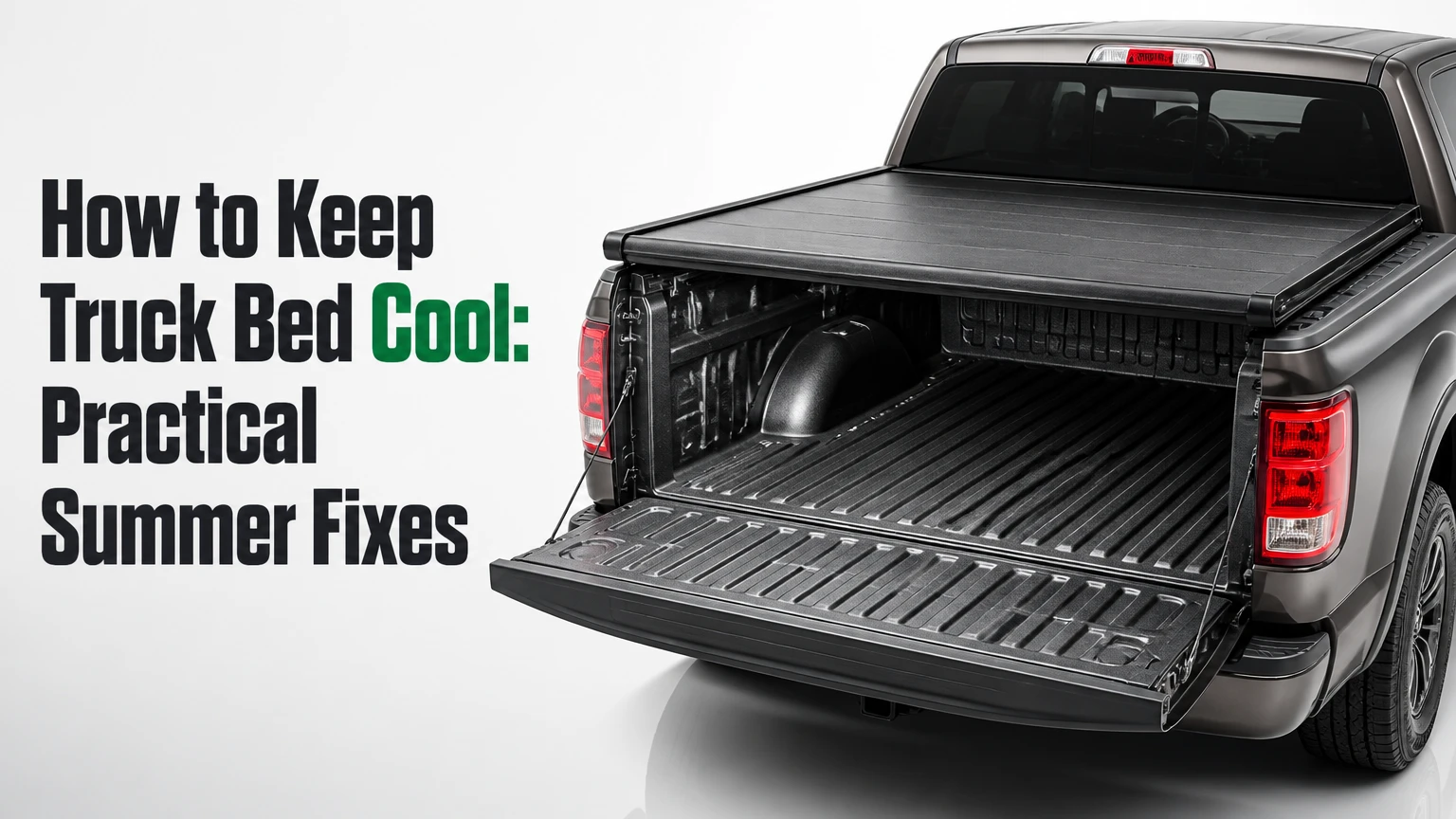
To keep a truck bed cool, block solar radiation with shade or a light-colored cover, separate cargo from the hot metal floor, ventilate enclosed air, and reduce exhaust heat below the bed. The most effective setup combines a reflective tonneau or insulated cap, a fitted rubber mat, cross-ventilation, and temperature monitoring.
Key Facts at a Glance
- A covered truck bed can become hotter than outdoor air because dark surfaces absorb sunlight and enclosed air loses convective cooling.
- A white, silver, or reflective cover generally rejects more solar energy than a black vinyl cover.
- A rubber bed mat reduces direct conduction from the metal floor, but it does not cool the air trapped above the mat.
- A truck cap needs intake and exhaust airflow because insulation alone slows heating rather than removing heat.
- A vehicle cargo area is not a safe substitute for a climate-controlled cabin when transporting dogs, cats, livestock, medication, or perishable food.
- Typical US equipment costs range from about $40 for a removable mat to more than $3,000 for a fitted insulated cap and ventilation system.
Why Truck Beds Get Hot
Truck-bed heat enters through radiation, conduction, and convection. Sunlight heats the bed floor, tailgate, cover, and sidewalls; exhaust components can heat the underside; and a closed tonneau or cap can trap warm air around the cargo.
Direct sunlight is usually the largest daytime load. A black steel bed absorbs solar energy, while a light-colored surface reflects more of it. The actual temperature difference depends on cloud cover, paint color, latitude, wind, bed orientation, cover ventilation, and whether the thermometer sits on the floor or in shaded air.
The metal floor creates a second problem. Exhaust pipes, catalytic converters, mufflers, and heat shields can transfer heat through the truck structure, especially when cargo sits directly over the exhaust route. A spray-in liner protects against abrasion and corrosion, but it is not a high-performance thermal insulator.
Convection determines what happens after heat enters. A sealed cap with no airflow can accumulate warm air, while a vented cap can release that air and draw in cooler outside air. Ventilation does not make outside air cold, so it works best when the bed is shaded and the ambient temperature is lower than the cargo-space temperature.
What temperature should you expect?
A truck bed does not have one predictable temperature. On a sunny day, surface temperatures can exceed air temperature by several tens of degrees Fahrenheit, while shaded air under a ventilated cover may remain much closer to ambient conditions.
Measure the condition that matters. Place one thermometer 2-4 inches above the floor, another beside the cargo, and a third outside the truck. A surface infrared reading and an air-temperature reading are different measurements, and confusing them produces misleading claims about cooling performance.
Which Cooling Method Works Best?
The best general-purpose arrangement is a light-colored hard tonneau cover plus a removable rubber bed mat. An insulated truck cap is better for tall cargo, camping, and repeated use, while active fans become valuable when a cap traps hot air or when a remote temperature alarm is needed.
| Method | Typical US cost | DIY time | Main heat path addressed | Best use |
|---|---|---|---|---|
| Silver or light hard tonneau | $500-$1,800 | 30-90 minutes | Solar radiation | Groceries, tools, daily cargo |
| Insulated fiberglass cap | $2,000-$5,000 | 2-4 hours | Radiation and convection | Camping, tall cargo, weather protection |
| Rubber bed mat | $40-$250 | 10-30 minutes | Floor conduction | Tools, coolers, exhaust-side cargo |
| Reflective liner for cover | $50-$250 | 1-3 hours | Radiant heat | Existing dark cover |
| 12-volt exhaust fan | $40-$250 | 1-3 hours | Trapped convection | Enclosed caps and overlanding |
| Portable insulated container | $30-$250 | 5-15 minutes | Cargo heat transfer | Food, medicine, electronics |
No single product removes every heat source. A cover blocks sunlight but can trap air; a mat blocks some floor conduction but cannot lower the air temperature; and a fan exchanges air without preventing a sun-heated cover from radiating heat downward.
Do black tonneau covers make truck beds hotter?
Black tonneau covers can become hotter than light-colored covers under direct sun because dark surfaces absorb more solar energy. A black cover can still protect cargo from direct sunlight, but its underside may radiate heat into the bed unless the cover has insulation, an air gap, or effective ventilation.
A light-colored vinyl, aluminum, fiberglass, or composite cover is usually the better passive choice. If appearance or availability requires a black cover, add shade above it when possible, use an insulated underside, and measure the cargo-space temperature rather than assuming the cover’s outside color tells the whole story.
Do bed liners and rubber mats cool the floor?
Rubber mats reduce contact between cargo and the hot steel floor, but they do not substantially cool the entire truck bed. A thick, close-fitting mat is useful when the floor is much hotter than the surrounding air, particularly above the exhaust path.
A typical 3/8-inch rubber mat provides a practical thermal break and protects cargo from hot metal, vibration, and abrasion. Spray-in polyurethane or polyurea liners add durability and some thermal resistance, but their primary functions are corrosion protection and impact resistance. For serious exhaust heat, inspect the vehicle’s factory heat shields and consider a purpose-built aluminum heat shield installed with safe clearance.
What Should You Install Before Summer?
Start with the lowest-cost barriers, then add ventilation only if measurement shows trapped air remains the problem. The correct sequence is surface protection, floor separation, cover or cap installation, perimeter sealing, ventilation, and temperature monitoring.
Before You Start
| Requirement | Typical specification |
|---|---|
| Total DIY time | 2-6 hours, excluding spray-in liner curing |
| Difficulty | Easy for mats and seals, moderate for fans and cap vents |
| Initial budget | $75-$350 for mat, seals, thermometer, and shade |
| Expanded budget | $700-$2,500 for cover, mat, fan, and monitoring |
| Tools | Tape measure, degreaser, microfiber cloth, trim tool, crimpers |
| Electrical supplies | 16-18 AWG wire, inline fuse, weatherproof connectors |
| Safety equipment | Gloves, eye protection, jack stands if working below the truck |
| Prerequisites | Correct bed length, dry surface, safe exhaust clearance |
Do not work beneath a truck supported only by a jack. Let the exhaust cool completely before inspecting shields or installing a barrier.
How to Install a Layered Cooling System
A layered system normally takes 2-6 hours and works best when the reflective surface faces the sun, the cargo stays off the metal floor, and airflow enters low and exits high. The following six steps suit most pickups with a tonneau cover or cap.
Step 1: Measure the Bed and Record Temperatures
Measure the bed length between the inside faces of the bulkhead and tailgate, then record the cover type, exhaust location, and cargo height. On a sunny afternoon, log outdoor air, floor air, cargo-level air, and cover temperature every 30 minutes.
Use a waterproof digital thermometer with a remote probe if the cargo is valuable. A temperature logger costing $20-$80 can reveal whether the primary problem is solar heating, floor conduction, or stagnant air.
You’ll know it worked when: you can identify the hottest location and hottest time rather than guessing.
Common mistake: measuring only the shaded air near the tailgate.
Step 2: Clean the Bed and Install a Floor Barrier
Remove debris, wash the bed with a mild degreaser, and let every surface dry before placing a fitted rubber mat. Trim nothing until the mat has been test-fitted around tie-downs, wheel wells, drain plugs, and the tailgate seam.
Keep drainage paths open. A mat that seals water against the steel can accelerate corrosion, especially where road salt or muddy water enters beneath the edges. Lift the mat periodically for inspection.
You’ll know it worked when: cargo no longer sits directly on hot steel and the mat lies flat without covering drain points.
Common mistake: stacking cardboard beneath cargo, which absorbs water and can ignite or degrade near heat.
Step 3: Add Exhaust Heat Protection
Inspect the underside of the bed from a safe position and locate the exhaust pipe, catalytic converter, muffler, and factory heat shields. If the floor is hot only above one section, a purpose-built aluminum or stainless heat shield with an air gap is more effective than adding random insulation against the bed.
Never wrap an exhaust component unless the vehicle manufacturer and the component supplier approve that application. Improper wrapping can retain heat, damage nearby wiring, and increase component temperatures.
You’ll know it worked when: the hot floor zone shrinks during the same driving route and the bed underside retains its designed clearance.
Common mistake: attaching foil directly to an exhaust pipe or blocking airflow around a catalytic converter.
Step 4: Fit a Reflective or Insulated Cover
Install a light-colored or reflective tonneau cover with the correct clamps, rails, and tension. Hard covers generally create a more stable reflective surface than thin tarpaulins, while an insulated composite cover reduces radiant transfer more effectively than unlined vinyl.
Check the underside after one hour in direct sun. If the underside is hot and the bed air is stagnant, the cover needs ventilation or an insulation layer with an air gap. Do not glue household foil products where adhesive heat ratings, water exposure, or flammability are unknown.
You’ll know it worked when: cargo-level air rises more slowly than uncovered-bed air during equal sun exposure.
Common mistake: assuming a waterproof cover is automatically an insulated cover.
Step 5: Seal Gaps Without Blocking Drainage
Install a truck-specific tailgate seal around the sides and upper edge where dust and hot road air enter. Use closed-cell EPDM automotive weatherstrip on clean, dry surfaces, and leave manufacturer-designed drainage routes open.
Sealing reduces dust and uncontrolled airflow, but a completely airtight bed is undesirable when heat must escape. A cap or enclosed cover needs planned intake and exhaust openings rather than random cracks that admit dust and water.
You’ll know it worked when: a low-pressure water test reveals fewer leaks without pooling inside the bed.
Common mistake: sealing the bottom edge of the tailgate and trapping water.
Step 6: Add Ventilation and Monitoring
For a truck cap, place a shaded intake low on one side and an exhaust fan high on the opposite side. A 4-6-inch 12-volt marine or automotive fan commonly draws about 0.5-3 amps, but the exact current must come from the manufacturer’s specification.
Fuse the circuit close to the power source, protect the wire from sharp edges and exhaust heat, and use weatherproof connectors. A fan that only recirculates air inside the cap moves heat around without removing it.
A fan should not operate from an unattended starting battery unless the circuit has low-voltage protection and the battery capacity has been calculated. A 1-amp fan running for 10 hours consumes approximately 10 amp-hours before wiring losses, which can prevent an engine from starting.
You’ll know it worked when: the exhaust vent produces a measurable airflow and cargo-level temperature falls relative to an identical unventilated period.
Common mistake: installing the exhaust fan low, where it pulls in dust and leaves the hottest upper air untouched.
How Much Does Truck-Bed Cooling Cost?
Basic truck-bed cooling costs about $75-$350, a practical cover-and-mat setup costs roughly $600-$2,500, and an insulated cap with fans and monitoring can exceed $3,000. Prices vary by truck size, cover material, local labor, electrical complexity, and whether the cap is new or used.
| Setup | Parts cost | Labor time | Expected benefit | Main limitation |
|---|---|---|---|---|
| Shade plus insulated cooler | $30-$200 | 5-15 minutes | Protects selected cargo | Does not cool the bed |
| Rubber mat plus light cover | $550-$2,050 | 1-2 hours | Reduces floor and solar load | Limited vertical space |
| Used cap plus vents | $700-$2,000 | 2-5 hours | Adds shade and airflow | Fit and seal condition vary |
| New insulated cap plus fan | $2,100-$5,500 | 3-6 hours | Best passive protection and volume | Cost, weight, permanent fit |
| Portable power and thermometer | $100-$900 | 30-90 minutes | Supports monitoring and fans | Batteries require charging |
Typical figures are planning ranges, not quoted prices. Spray-in liner work may add $400-$800 and often requires several hours of preparation plus a curing period before heavy use.
How Do You Keep Cargo Cool Without a Cover?
Use shade, insulated containers, reflective blankets, and short loading times when a tonneau cover is unavailable. A removable canopy or truck-bed shade reduces direct radiation, while a certified cooler or insulated case protects the contents more reliably than trying to cool the entire open bed.
Use separate strategies for different cargo:
- Groceries: place food in an insulated cooler with frozen packs, keep the lid closed, and load it immediately before driving.
- Electronics: keep laptops, cameras, power stations, and lithium batteries in padded insulated cases away from the floor.
- Medication: follow the medicine label and pharmacist’s storage range; use a validated medical cooler rather than an ordinary ice chest.
- Camping gear: shade tents, sleeping bags, and cookware, but ventilate damp items to prevent condensation and mildew.
- Plants: transport them in the cab when possible, or use shade, water management, and a short route.
The USDA Food Safety and Inspection Service states, “Keep your refrigerator at 40 °F or below and your freezer at 0 °F or below.” A hot truck bed cannot maintain refrigerator temperatures without an independently cooled container, so perishable food should not rely on a cover or fan alone.
Are Truck Beds Safe for Dogs or Other Animals?
A truck bed is not a reliably safe environment for dogs, cats, or livestock during hot weather, even with a cap and fan. Animals can suffer heat stress from radiant surfaces, humidity, poor airflow, traffic exposure, and fan or battery failure before a driver notices the danger.
The safest choice is a climate-controlled passenger compartment with an appropriate restraint. If transport in the bed is unavoidable and lawful in the relevant jurisdiction, use a secure, ventilated enclosure, continuous temperature monitoring, shade, water, backup power, and frequent direct checks.
A fan is not air conditioning. When outdoor air is already dangerously hot, ventilation may move hot air faster without bringing the animal to a safe temperature. Never leave an animal unattended while relying on a single electrical device, and check state or municipal animal-transport rules before driving.
What Are the Common Failure Modes?
Most overheated truck beds fail because owners address only one heat path. The fastest diagnosis compares floor temperature, cargo-level air, cover temperature, and outdoor air under the same conditions.
| Symptom | Likely cause | Corrective action | Verification |
|---|---|---|---|
| Floor hot near tailpipe | Exhaust conduction or radiation | Inspect shields, add safe air-gapped shield, use mat | Compare floor readings after driving |
| Air hot under black cover | Solar absorption and trapped air | Use light cover, reflective underside, high exhaust vent | Log cargo-level air for two hours |
| Fan runs but temperature stays high | Recirculation or weak airflow | Add low intake, high exhaust, verify current and direction | Hold tissue near intake and exhaust |
| Battery is weak after parking | Excessive fan runtime | Add low-voltage cutoff or auxiliary battery | Measure amp draw and runtime |
| Bed is damp after cooling | Condensation or blocked drainage | Improve ventilation, preserve drains, dry mat | Inspect beneath mat after rain |
| Dust enters through tailgate | Unsealed perimeter or wrong airflow | Fit EPDM tailgate seal and filter intake | Check bed after a dusty route |
Expert rule of thumb: if the floor is the hottest measurement, improve the thermal break before buying a larger fan. If the cover is hottest, improve reflectivity and shade. If upper air is hottest, exhaust ventilation has the strongest first-order effect.
What Should You Avoid?
Avoid black unventilated covers for heat-sensitive cargo, direct contact between cargo and the steel floor, and improvised electrical connections near water or exhaust components. Avoid placing reflective foil directly against a hot exhaust part because radiant barriers need the correct orientation and an air gap to work safely.
Do not use misters inside an enclosed cap. Misters raise humidity, wet cargo, promote corrosion, and can create electrical hazards; evaporative cooling also performs poorly in humid climates.
Do not treat a temperature reduction measured at the cover surface as a cargo-space result. A surface may cool while the air around food, electronics, or an animal remains unsafe.
Which Setup Fits Your Situation?
| User situation | Recommended setup | Typical budget | Why it fits | What it is not good for |
|---|---|---|---|---|
| Daily grocery hauling | Light hard tonneau, mat, insulated cooler | $600-$2,300 | Fast loading and weather protection | Refrigerator-temperature storage |
| Contractor with tools | Reflective cover, thick mat, floor heat shield | $650-$2,500 | Protects tools and reduces floor heat | Long-term unattended storage |
| Weekend camper | Insulated cap, screened windows, roof vent, thermometer | $2,200-$5,500 | Shade, volume, and cross-ventilation | Safe animal housing without supervision |
| Electronics owner | Cover, mat, insulated cases, logger | $650-$2,700 | Protects batteries and devices | Charging hot lithium batteries |
| Animal transporter | Climate-controlled cab, restraint, monitored enclosure only when unavoidable | Vehicle-dependent | Reduces heat and traffic exposure | Unattended transport in a bed |
For a commuter, a light-colored tonneau and removable mat provide the best balance of cost and reversibility. For an overlander, a cap with opposing vents and a remote thermometer is more useful than a sealed premium cover. For pets, move the animal into the cab instead of attempting to engineer a truck bed into a dependable kennel.
How Do You Maintain the Cooling System?
Inspect seals every three months and after pressure washing, clean fan screens monthly in dusty conditions, and remove the rubber mat at least twice each year. Check for trapped moisture, rust, loose clamps, damaged wiring, and blocked drain holes.
Test the thermometer against a second device before a long trip. Test the fan from auxiliary power before connecting it to the truck, and replace corroded connectors rather than covering them with ordinary electrical tape.
Recheck the system after changing the exhaust, adding a bed drawer, installing a toolbox, or replacing the tonneau cover. New hardware can block airflow or move cargo closer to a heat source.
Frequently Asked Questions
Will opening the tailgate cool the truck bed?
Opening the tailgate can increase airflow while driving, but it does not guarantee cooling and may increase dust, turbulence, and cargo movement. At rest, an open tailgate provides little benefit if the bed remains in direct sun. Shade, a reflective cover, and a controlled intake-and-exhaust path produce more repeatable results.
Can I put ice directly in the truck bed?
Do not place loose ice directly in the truck bed. Meltwater can enter seams, damage cardboard, corrode metal, and wet electronics. Use a sealed cooler or waterproof insulated container with drainage and enough thermal capacity for the trip.
Does a spray-in bed liner insulate against exhaust heat?
A spray-in bed liner offers limited thermal resistance but primarily protects the steel from corrosion and impact. A thick rubber mat and a properly installed heat shield provide better protection when a concentrated exhaust hotspot heats the floor.
How long can food stay in a hot truck bed?
Food-storage time depends on the food, starting temperature, container, and measured internal temperature. Perishable food should remain at 40°F or below according to USDA FSIS guidance, so a hot truck bed without a controlled cooler cannot provide a dependable safe-storage period.
Will solar fans keep a truck cap cool?
Solar fans can reduce heat buildup when the panel receives direct sunlight and the fan has a real intake-and-exhaust path. A small fan cannot overcome a dark, sun-heated roof in every climate, and nighttime operation requires stored electrical power rather than solar generation.
Should I insulate the underside of a tonneau cover?
Underside insulation can reduce radiant heat entering the bed, especially with a dark cover, but the material must tolerate heat, moisture, vibration, and the cover’s movement. Leave drainage and moving hardware clear, and verify the result with a cargo-level thermometer instead of judging by touch.
The Bottom Line
How to keep truck bed cool depends on the dominant heat path. Use shade or a light reflective cover for solar radiation, a thick fitted mat and safe exhaust shielding for floor heat, and high exhaust ventilation for trapped air. Monitor the cargo zone, protect food in a controlled cooler, and transport animals in the climate-controlled cab whenever possible.