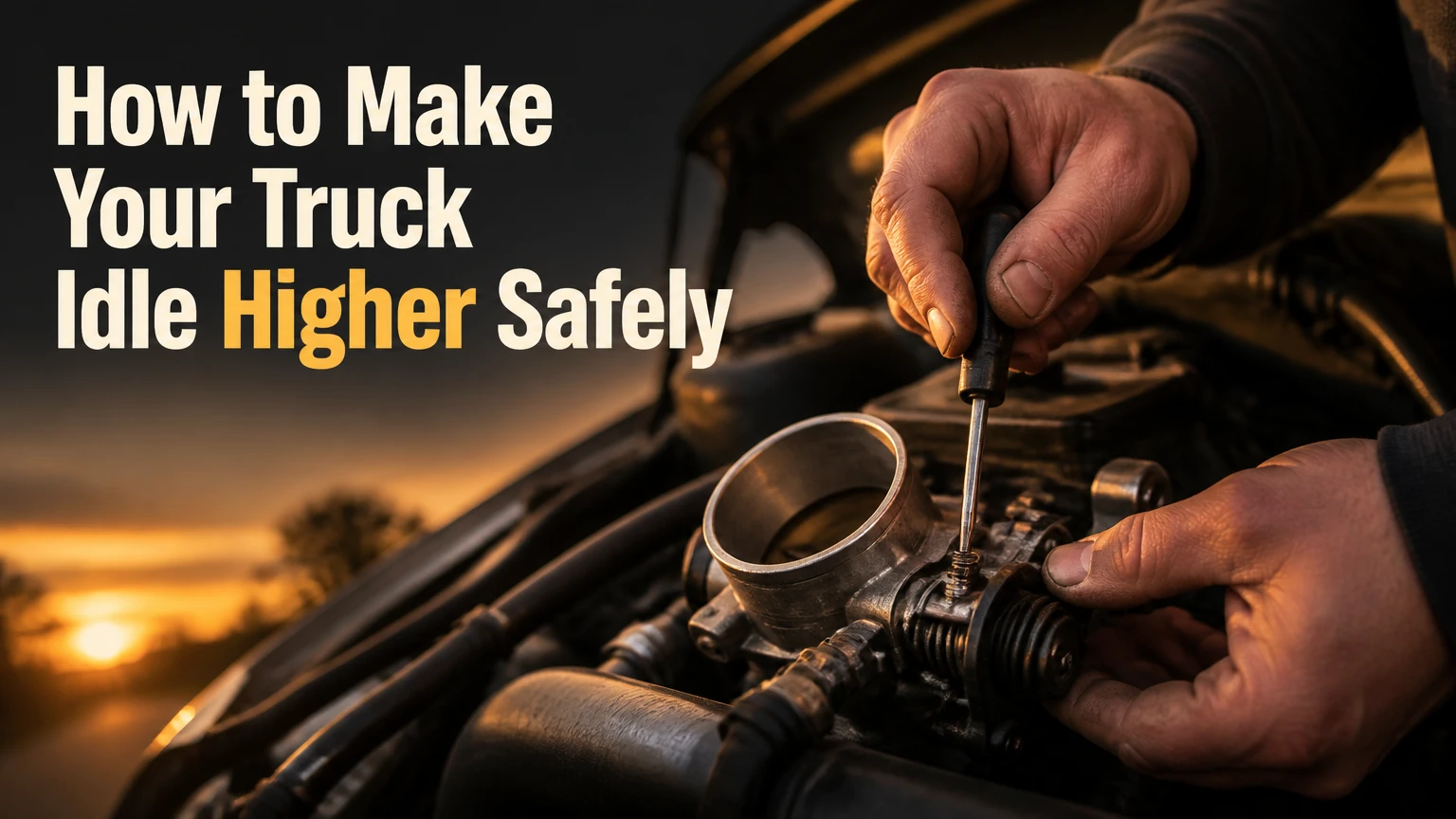
To make your truck idle higher, use its factory high-idle or SEIC/PTO function when available, an emissions-compliant plug-in module for supported vehicles, or a correctly adjusted mechanical throttle system on older trucks. Select the target RPM from the service information, preserve brake, park, neutral, and temperature interlocks, and verify the result with a scan tool or tachometer.
Key Facts
Most factory truck idle speeds fall near 600-850 RPM, while elevated idle commonly operates around 900-1,500 RPM.
Factory SEIC, PTO, or upfitter controls are safer than bypassing an accelerator-pedal sensor or altering an idle screw.
A resistor value for an OEM circuit is never universal; the correct value depends on the truck’s wiring diagram and calibration.
Typical installed costs range from $50-$250 for a factory-wire installation, $150-$500 for a plug-in module, and $300-$1,200 for tuning.
High idle cannot repair weak batteries, a failing alternator, a dirty throttle body, a vacuum leak, or a defective idle-control valve.
A truck must be stationary, in Park or Neutral, with the parking brake applied and the service brake released before elevated idle is enabled.
Why Raise Idle Speed?
A higher idle speed increases alternator speed, airflow, coolant circulation, and exhaust heat, so truck owners use it for electrical loads, PTO equipment, winter cab heating, and certain diesel aftertreatment conditions. High idle is a temporary operating mode, not a substitute for repairing a charging fault or forcing a diesel particulate filter regeneration.
Fleet trucks often use elevated idle to support hydraulic pumps, liftgates, compressors, inverters, or refrigeration equipment. A truck with a large inverter may need more alternator output, but the alternator’s rated current still depends on temperature, belt speed, wiring, and battery state.
Cold-weather operation is another common reason. Raising a diesel engine from approximately 650 RPM to 1,000-1,200 RPM can increase heat production, but it will not warm the engine as quickly as driving under light load. The United States Environmental Protection Agency also warns that unnecessary idling wastes fuel and increases emissions, and many jurisdictions restrict unattended or prolonged idling.
High idle has limits. It does not guarantee a DPF regeneration, eliminate condensation, or make a cold engine safe to load immediately.
Identify Your Truck’s Control System
The correct high-idle procedure depends primarily on the throttle system and engine controller. A 1970s carbureted gasoline truck, a 1990s mechanical-injection diesel, and a current electronically controlled diesel require different controls and different safety precautions.
| Truck configuration | Idle-control hardware | Suitable high-idle method | Main warning |
|---|---|---|---|
| Carbureted gasoline engine | Throttle stop, choke, mechanical linkage | Fast-idle cam or auxiliary solenoid | Do not use the choke as a warm-idle control |
| Mechanical diesel | Governor and injection-pump linkage | Manual throttle cable or approved solenoid | Do not alter sealed governor settings casually |
| Gasoline EFI engine | IAC valve or electronic throttle body | OEM idle-up command or compatible module | An idle screw may create an unmetered-air fault |
| Modern diesel with electronic throttle | ECU, accelerator-pedal position sensor, PTO logic | Factory SEIC/PTO, compatible module, or calibration | APPS voltage spoofing can trigger faults |
| Medium-duty PTO truck | Body-builder wiring and programmable ECU | OEM PTO or stationary idle control | Hydraulic load must remain within manufacturer limits |
Modern electronic engines do not hold idle through a single fixed screw. The engine control module continuously adjusts airflow, fuel, ignition timing, injection timing, and sometimes exhaust-brake or intake-throttle position. A disconnected sensor, vacuum leak, carbon buildup, or low battery voltage can therefore look like an idle-setting problem.
Check the owner’s manual, service manual, body-builder guide, and calibration notes before touching a wire. Record the truck’s year, engine code, transmission, emissions certification, and whether it has PTO or upfitter provisions.
Choose a Safe Target RPM
A practical starting target is 900-1,000 RPM for light electrical demand, 1,000-1,200 RPM for many winter stationary applications, and 1,200-1,500 RPM for approved PTO or heavy electrical loads. The vehicle manufacturer’s programmed limit takes priority because belt speed, oil pressure, turbocharger behavior, transmission logic, and emissions controls vary.
| Intended use | Typical target RPM | Typical activation duration | Correct qualification |
|---|---|---|---|
| Battery support during light accessory use | 900-1,000 RPM | 10-30 minutes | Confirm alternator output under load |
| Cab heating in severe cold | 1,000-1,200 RPM | 15-45 minutes | Use a block heater when available |
| PTO hydraulic operation | 1,000-1,500 RPM | Load-dependent | Follow PTO manufacturer limits |
| High electrical demand | 1,200-1,500 RPM | Load-dependent | Verify alternator and belt capacity |
| Mechanical diesel anti-wet-stacking practice | 900-1,200 RPM | Operator-dependent | Light-load idling alone may still foul the engine |
The target is not “as high as possible.” Excessive stationary RPM raises fuel use, fan noise, coolant temperature, and drivetrain risk, while a transmission left in gear can create vehicle movement. Some engines also impose a maximum stationary speed below the redline.
A useful practitioner rule is to begin at the lowest approved speed that stabilizes the load. If a 900 RPM setting supports the accessories, using 1,500 RPM adds heat and fuel consumption without a mechanical benefit.
Compare the Four High-Idle Methods
Factory controls are usually the first choice for a modern truck because the ECU can enforce conditions such as Park, Neutral, parking brake, brake-pedal release, engine temperature, and vehicle speed. A plug-in module is more practical when the truck lacks an accessible factory feature, while tuning offers flexibility at higher cost and risk.
| Method | Typical cost | Installation time | Typical adjustment | Best application |
|---|---|---|---|---|
| Factory SEIC/PTO wiring | $50-$250 | 1-3 hours | 900-1,500 RPM | Commercial Ford, GM, and Ram chassis with documented circuits |
| Plug-in high-idle module | $150-$500 | 20-60 minutes | Fixed steps or rotary selection | Supported consumer diesel and gasoline trucks |
| ECU calibration or tuner | $300-$1,200 | 1-3 hours | Model-specific tables | Trucks already needing professional calibration |
| Mechanical cable or solenoid | $40-$300 | 30-120 minutes | Manual setting | Older carbureted or mechanical-injection trucks |
When is factory SEIC the best choice?
Factory SEIC, PTO, or stationary engine control is the best choice when the truck’s body-builder documentation lists the feature and the required circuits are already present. OEM logic can block activation while driving, cancel elevated idle when the brake is pressed, and limit RPM according to engine temperature or transmission state.
Ford Super Duty, Chevrolet Silverado HD, GMC Sierra HD, and Ram commercial configurations may provide upfitter or PTO-related circuits, but availability and wire identification differ by year, cab configuration, engine, and market. Do not assume a wire is an SEIC lead because its color resembles a diagram from another model year.
When is a plug-in module appropriate?
A plug-in module is appropriate when a verified application guide lists the exact truck and engine, and the owner wants reversible installation without editing the ECU calibration. Depending on the product, the module may connect at the accelerator-pedal position sensor, an OEM diagnostic connector, or a designated control harness.
A module is not automatically safe because it is plug-and-play. It can still create an accelerator-signal fault, interfere with cruise control, or prevent normal torque management if the application is wrong. Avoid generic devices that impersonate pedal position without documented compatibility.
When does ECU tuning make sense?
ECU tuning makes sense when the truck already requires a professional calibration for a legitimate operating purpose, such as a documented PTO application or a specialized fleet configuration. A calibration can integrate elevated idle with engine temperature, load, transmission state, and aftertreatment strategy more cleanly than a crude signal modification.
A tuner is a poor choice for a single winter warm-up function. It may cost $300-$1,200, affect warranty decisions, and create emissions or inspection problems if the calibration changes regulated parameters. A tuner also cannot compensate for a failed alternator or an engine that hunts at normal idle.
When is a mechanical control suitable?
A mechanical cable or spring-return solenoid suits an older truck whose throttle and injection systems are genuinely mechanical. The control must move the throttle lever smoothly, return to normal idle when released, and remain clear of the fan, belts, exhaust, and steering components.
A mechanical control is unsuitable for most modern electronic throttles. Pulling an electronic throttle linkage, forcing an accelerator pedal, or changing a factory stop can cause an unstable idle, sensor disagreement, or an unintended throttle opening.
Use Factory High-Idle Control
Use the factory high-idle procedure only after confirming the circuit names and activation conditions in the truck-specific wiring documentation. The installation normally involves an ignition-switched enable input, an RPM-selection circuit or programmed setting, and safety inputs, but exact wire colors, resistor values, and connector locations are manufacturer-specific.
Before You Start
| Requirement | Typical value or specification |
|---|---|
| Research time | 30-60 minutes |
| Installation time | 1-3 hours |
| Electrical tools | Digital multimeter, wire stripper, crimper, heat gun |
| Materials | Automotive wire, sealed connectors, fuse holder, 1-5 amp fuse |
| Test equipment | Scan tool with live RPM data, or verified tachometer |
| Prerequisites | Correct body-builder diagram, charged battery, engine in Park or Neutral |
Disconnect the negative battery cable before modifying exposed wiring, unless the manufacturer’s procedure requires a powered circuit test. Never probe an airbag, data-bus, or pedal circuit with a test light.
Step 1: Confirm the factory feature
Find the body-builder manual for the exact model year, engine, and chassis. Search for terms including SEIC, PTO, stationary elevated idle, remote throttle, upfitter, blunt-cut wires, or engine-speed control.
You will know this step is complete when the documentation identifies the connector, circuit function, activation conditions, and RPM-selection method. The common mistake is using a wiring diagram for a similar-looking truck with a different engine controller.
Step 2: Locate and identify the circuits
Inspect the documented location, commonly behind the driver-side kick panel, below the dashboard, near an upfitter connector, or in the engine-bay harness. Identify each lead by circuit function and verify it with the wiring diagram, not color alone.
Use a multimeter to confirm ignition-switched voltage, continuity, and expected signal behavior. The common mistake is connecting a constant battery feed, which can drain the battery or leave the system active after key-off.
Step 3: Install the protected enable switch
Use a low-current control switch supplied through the specified fuse, then connect the switch to the documented enable circuit. Route the harness away from pedals, steering shafts, exhaust components, turbochargers, and sharp brackets.
You will know the wiring is physically safe when the loom has strain relief, heat protection near hot components, and no possibility of contacting a moving control. The common mistake is placing a switch where the driver can activate it accidentally while moving.
Step 4: Configure the RPM command
Set the desired RPM through the OEM programming procedure or the exact resistor and circuit specified for that truck. A 20-kilohm resistor mentioned for one application cannot be treated as a universal 1,200 RPM setting, because many circuits use different voltage windows and calibration tables.
Use the manufacturer’s specified resistor tolerance and wattage where applicable. The common mistake is guessing resistance, which can create an accelerator-pedal or engine-speed-control diagnostic code.
Step 5: Preserve every safety interlock
Verify that elevated idle requires Park or Neutral, an applied parking brake where specified, zero vehicle speed, and a released service brake. Confirm that pressing the brake, selecting Drive or Reverse, releasing the parking brake, or switching the system off cancels the elevated idle.
You will know the interlocks work when the engine returns to normal idle immediately after each cancellation test. The common mistake is bypassing a ground or brake input to make a reluctant system operate.
Step 6: Test at normal operating temperature
Start the engine at normal idle and allow oil pressure to stabilize. After at least 30-60 seconds, activate the system under no load, then apply accessories one at a time while watching RPM, voltage, coolant temperature, and warning messages.
You will know the installation works when RPM reaches the documented target, remains stable, and cancels on every required safety input. The common mistake is testing only with the truck stationary and ignoring behavior when an alternator, PTO pump, or heater load is connected.
Install an Aftermarket High-Idle Module
Install an aftermarket high-idle module only after matching the product to the exact engine, transmission, model year, and emissions system. Typical modules provide fixed settings such as 900, 1,200, and 1,500 RPM, with installation times of 20-60 minutes and prices around $150-$500.
Read the module’s cancellation logic before installation. A product that connects at the APPS harness should identify how it handles brake input, cruise control, key-off status, and communication faults.
Use sealed connectors or the manufacturer’s supplied harness. Avoid Scotchlok-style taps in engine-bay wiring, route the harness away from abrasion, and do not stack multiple pedal-signal devices. After installation, scan for stored and pending codes, then test normal pedal operation before enabling elevated idle.
A plug-in module is not a cure for a fluctuating idle. Repair vacuum leaks, dirty throttle bodies, fuel-pressure problems, failed sensors, and low system voltage first.
Adjust an Older Mechanical Truck
On a mechanical diesel or carbureted gasoline truck, raise idle with a spring-return throttle cable, approved fast-idle solenoid, or manufacturer-specified idle-stop adjustment. Set the mechanism with the engine warm, transmission secured, wheels chocked, and the throttle able to return fully without binding.
| Older system | Adjustment point | Typical target | Verification |
|---|---|---|---|
| Carburetor with fast-idle cam | Choke linkage and cam | 900-1,100 RPM | Choke plate fully open when warm |
| Mechanical diesel pump | Throttle lever cable | 900-1,200 RPM | Lever returns against normal stop |
| 12-volt idle solenoid | Solenoid plunger and bracket | 900-1,200 RPM | Spring return with power removed |
| Manual throttle cable | Cable sheath and lever | 900-1,200 RPM | No binding through full pedal travel |
Do not use a manual choke to raise a warm gasoline engine. A partially closed choke enriches the mixture, increases carbon deposits, and can wash fuel onto cylinder walls.
Do not defeat the injection-pump governor or turn a sealed maximum-fuel screw to obtain high idle. Governor changes affect overspeed protection and fueling under load, not merely stationary RPM. The safest mechanical installation is one that loses power and returns to base idle when the switch, cable, or ignition circuit is released.
Account for Diesel, DPF, and PTO Behavior
High idle can support diesel aftertreatment, but the engine controller still decides whether a regeneration is allowed. A forced high idle may fail to initiate regeneration if the DPF is overloaded, a temperature sensor is faulty, DEF quality is poor, or an emissions-related fault is active.
Cummins, Ford Power Stroke, GM Duramax, and Ram diesel systems use different regeneration strategies. Consult the engine manual rather than assuming that 1,200 RPM for 20 minutes cleans the filter.
Wet stacking is also frequently oversimplified. Light-load, prolonged idling can contribute to incomplete combustion, deposits, and exhaust-system fouling, but raising RPM without applying a suitable load does not reproduce normal road-load combustion. A PTO load or manufacturer-approved high-idle strategy is more meaningful than an arbitrary throttle increase.
For PTO operation, verify hydraulic pressure, pump speed, relief-valve settings, and the equipment maker’s maximum input RPM. A truck engine may tolerate 1,500 RPM while a connected pump or compressor cannot.
Common Mistakes and How to Fix Them
| Symptom or mistake | Likely cause | Corrective action |
|---|---|---|
| High idle never activates | Truck not in Park, brake input active, parking brake released, engine too cold | Check live data and every documented enable condition |
| RPM hunts or surges | Loose connection, vacuum leak, unstable load, incorrect pedal signal | Return to stock wiring, scan codes, repair the underlying fault |
| Check-engine light appears | Wrong resistor, APPS voltage outside range, incompatible module | Remove the modification and diagnose the stored code |
| Battery drains overnight | Switch connected to constant battery power | Move the control to fused ignition-switched power |
| Engine overheats at high idle | Blocked radiator, failed fan clutch, excessive stationary load | Stop the test, repair cooling system, inspect load |
| Truck moves when activated | Transmission not in Park or Neutral, interlock bypassed | Do not operate the system until the interlock is restored |
A warning light after installation is a stop signal, not an inconvenience to clear. Generic code P0507 can indicate idle speed higher than expected, while P2127, P2128, or related pedal-position codes can indicate an accelerator-signal problem; the correct interpretation depends on the vehicle and freeze-frame data.
A second practitioner rule is to test voltage before blaming the idle strategy. A weak battery or alternator can cause electronic throttle and controller behavior to become erratic, especially when heaters, blower motors, lights, and inverters are switched on together.
Consider Legal, Environmental, and Warranty Limits
Stationary idling laws differ by country, state, province, municipality, vehicle weight, and operating purpose. Commercial diesel restrictions commonly include time limits, temperature exemptions, school-zone rules, anti-idling zones, and exceptions for PTO or emergency work.
The EPA identifies unnecessary idling as an emissions and fuel-consumption issue, while regional agencies such as the California Air Resources Board impose specific requirements for heavy-duty diesel vehicles. Check the rules where the truck is operated, not only where it is registered.
High-idle modifications can also affect warranty and inspection outcomes. An OEM upfitter procedure documented for the truck is easier to defend than a hacked pedal circuit or emissions-related tune. Keep the original connectors, calibration files, and wiring intact so the vehicle can be returned to stock.
High idle is not suitable for an enclosed garage, an unattended vehicle, a truck with an unresolved overheating condition, or a vehicle parked where exhaust can enter a building. Carbon monoxide remains dangerous even when the engine appears to run normally.
Which Method Should You Choose?
| Owner situation | Recommended method | Target range | Typical total cost |
|---|---|---|---|
| 2017-2025 HD truck with documented SEIC | Factory circuit | 900-1,500 RPM | $50-$250 |
| Daily driver needing reversible winter idle-up | Compatible plug-in module | 900-1,200 RPM | $150-$500 |
| Fleet PTO truck requiring integrated logic | OEM PTO programming | 1,000-1,500 RPM | $200-$1,000 |
| Classic mechanical diesel | Spring-return cable or solenoid | 900-1,200 RPM | $40-$300 |
| Truck with no factory feature and no approved module | Professional diagnosis first | Manufacturer-specific | $100-$250 diagnostic cost |
Choose factory SEIC or PTO first when the option exists. Choose a verified module when reversibility matters and the application is documented. Choose a tuner only when integrated calibration is worth the cost and emissions and warranty consequences are understood.
Choose a mechanical control for a genuinely mechanical truck, not for a modern electronic throttle. If normal idle is unstable, repair that fault before adding an idle-up system.
FAQ
Will higher idle charge my truck battery faster?
Higher RPM can increase alternator output, but charging speed depends on alternator capacity, battery condition, regulator strategy, cable voltage drop, and electrical load. A 1,200 RPM idle will not restore a severely discharged or damaged battery efficiently. Measure charging voltage and current under load before relying on elevated idle.
Is 1,500 RPM too high for a diesel truck?
A 1,500 RPM stationary idle is acceptable only when the manufacturer or PTO application permits it. Many systems use lower settings for ordinary accessory loads, while commercial PTO configurations may authorize higher speed. Temperature, oil pressure, coolant condition, fan operation, and connected equipment must remain within specification.
Can I make my truck idle higher with a throttle-body screw?
Do not adjust a throttle-body stop screw on a modern fuel-injected truck unless the service procedure explicitly requires it. The screw establishes a factory mechanical reference, and changing it can create airflow, throttle-position, or idle-control faults. Use OEM software or an approved idle-control circuit instead.
Does high idle warm a truck faster than driving?
High idle produces more heat than base idle, but light-load driving usually warms the engine, transmission, and aftertreatment system more effectively. In freezing weather, a block heater plus gentle driving is generally better than prolonged stationary warm-up, provided local idling rules and the owner’s manual permit operation.
Should high idle cancel when I press the brake?
Yes. A safe stationary high-idle system should cancel when the brake is pressed, the transmission leaves Park or Neutral, the parking brake condition changes where required, or vehicle speed is detected. If the system continues at elevated RPM after a cancellation input, disable it until the interlock is repaired.
Can high idle fix low oil pressure?
High idle may raise oil pressure temporarily because the oil pump turns faster, but it cannot correct worn bearings, a failing oil pump, incorrect oil viscosity, a blocked pickup, or a defective pressure sensor. Treat low oil pressure as an engine fault and diagnose it with a mechanical gauge and service information.
The Bottom Line
The safest way to make your truck idle higher is to activate the manufacturer’s SEIC, PTO, or stationary elevated-idle feature, because the engine controller can retain speed, brake, transmission, temperature, and vehicle-motion safeguards. If no factory feature exists, use a truck-specific plug-in module or a properly engineered mechanical control for an older engine.
Start with a conservative target of 900-1,200 RPM, increase speed only for a documented load, and verify alternator output, coolant temperature, warning codes, and cancellation behavior. Never guess at resistor values, bypass a brake interlock, alter an electronic throttle stop, or use high idle to conceal an unresolved charging, cooling, fuel, or emissions problem. That is how to make your truck idle higher without turning a minor convenience into a drivability or safety fault.