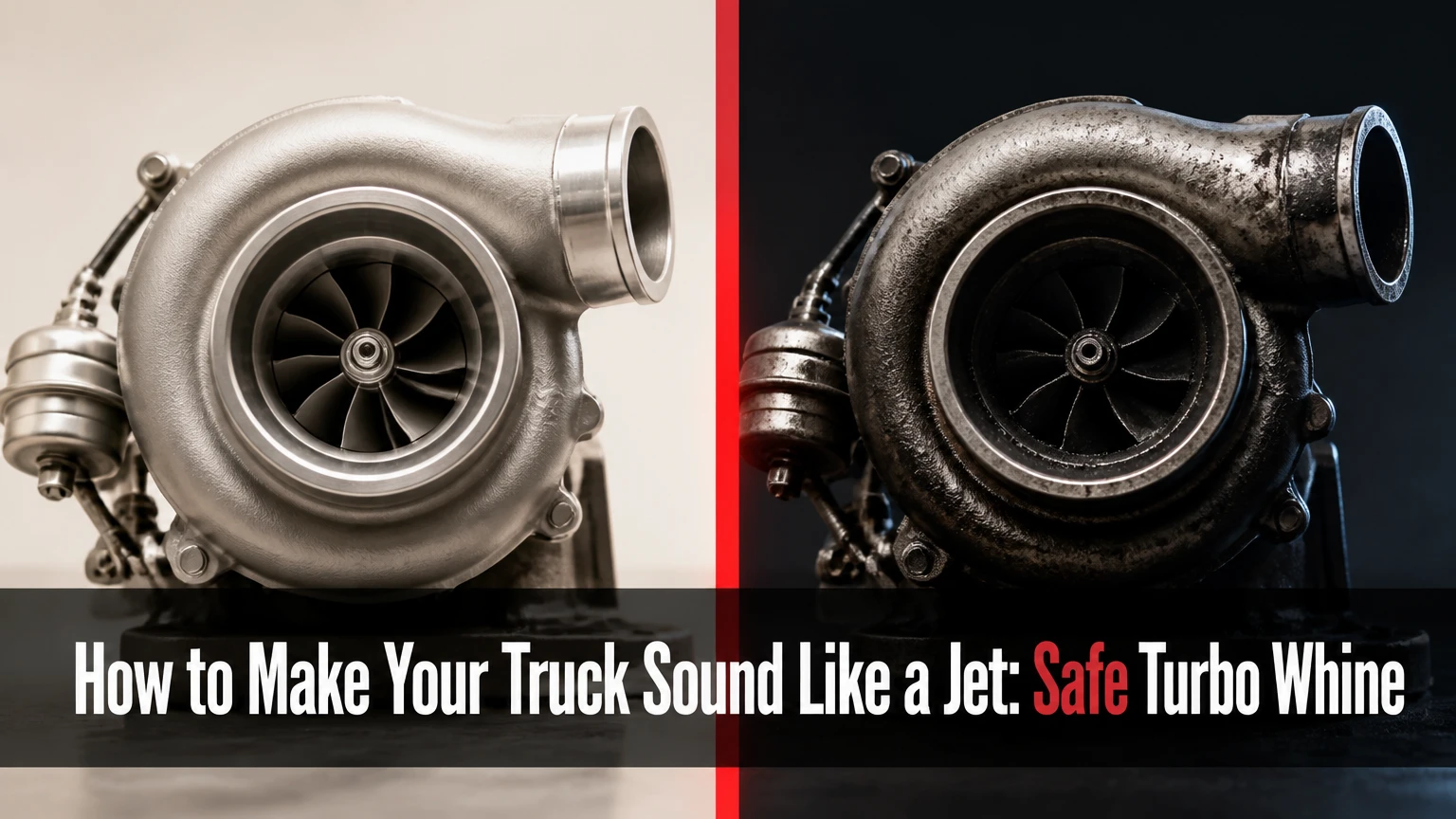
To make your truck sound like a jet, amplify the high-frequency compressor whine from a healthy turbocharger and the rushing sound of controlled intake or exhaust airflow. The safest route is a properly sealed intake, a moderate emissions-compliant cat-back exhaust, and a conservative calibration only when the engine manufacturer and tuner support it.
Key Facts
A turbocharged truck produces the most authentic jet-like sound because its compressor wheel creates real high-frequency induction noise.
An enclosed high-flow intake usually gives a cleaner daily-driver result than an exposed cone filter.
A muffler change alters exhaust volume and tone, but it does not create genuine turbo whistle on a naturally aspirated engine.
A tailpipe whistle insert typically costs $10-$30, but its sound is artificial and the insert can restrict exhaust flow.
A VGT “hiss tune” can increase thermal and mechanical stress when it holds vanes closed without proper limits.
Removing a catalytic converter, diesel particulate filter, or other emissions equipment can violate federal, state, provincial, or local law.
What Creates a Jet-Like Truck Sound?
A jet-like truck sound combines compressor whistle, exhaust flow, and resonant intake acoustics. The turbocharger creates the authentic high-pitched component, while the intake tube, airbox, intercooler plumbing, muffler, and tailpipe determine how much of that sound reaches the driver or bystanders.
A gas turbine and a truck turbocharger do not operate in the same way. A jet engine produces combustion and thrust through a continuous turbine process; a truck turbocharger uses exhaust energy to drive a turbine connected to a compressor. The resemblance is acoustic, not mechanical.
Turbocharger speed varies by design, load, pressure ratio, and wheel size. Some automotive turbochargers can approach 150,000-200,000 revolutions per minute, but that is a possible operating range, not a constant speed or a target a driver should force. Turbo speed, shaft motion, and compressor efficiency must remain inside the manufacturer’s limits.
Why does a turbocharged truck whistle?
A turbocharged truck whistles when air accelerates through the compressor inlet and wheel, then changes pressure through the compressor housing and charge system. Intake restrictions, resonators, insulation, and engine-bay panels normally reduce that sound; removing them increases volume but can also increase contamination and water-ingestion risk.
A smooth, rising whistle under throttle is usually the sound enthusiasts want. A sudden siren, metallic scrape, cyclic howl, or whistle that appears with smoke, low boost, or oil consumption indicates a possible fault rather than a successful sound modification.
The intake side produces the clearest audible whine. The exhaust side contributes turbine noise and overall volume, but exhaust modifications alone generally produce a deeper roar or rasp rather than the clean “aircraft” note many owners expect.
Which Trucks Can Produce the Sound?
Turbocharged diesel and turbocharged gasoline trucks can produce genuine turbo whine, while naturally aspirated trucks can only imitate the effect through intake resonance, exhaust tone, or a whistle accessory. Engine induction type is therefore the first decision point.
| Truck configuration | Realistic sound source | Typical useful modification | Main limitation |
|---|---|---|---|
| Turbo-diesel pickup | Compressor and turbine noise | Enclosed intake plus compliant cat-back | DPF and factory calibration can suppress sound |
| Turbocharged gasoline pickup | Compressor, bypass valve, and intake noise | Intake resonator change plus cat-back | Blow-off or bypass sound may dominate |
| Naturally aspirated gasoline V6 | Intake pulses and exhaust resonance | Resonated intake plus quality muffler | No turbocharger whistle is available |
| Naturally aspirated V8 | Exhaust pulses and intake roar | Chambered or straight-through muffler | More “roar” than “jet” |
| Electrified or hybrid truck | Electric motor and forced-air accessories | Sound hardware has limited effect | No conventional engine turbo sound |
What works on a naturally aspirated truck?
A naturally aspirated truck cannot create authentic turbocharger whine without adding a forced-induction system. A resonated intake can produce a sharper induction note, and a carefully selected muffler can add airflow sound, but a cheap exhaust whistle is the only inexpensive way to imitate a high-pitched jet tone.
A supercharger is another possibility, but it is a major powertrain modification rather than a sound-only upgrade. Supercharger whine can be distinctive, yet installation may require fuel-system, calibration, cooling, belt-drive, and internal-engine considerations.
Do not install an intake designed for a turbocharged engine on a naturally aspirated truck without checking sensor placement, hose diameter, airbox mounting, and water management. A larger tube can reduce air velocity at the sensor and create drivability or check-engine problems.
How to Make Your Truck Sound Like a Jet
The safest process uses four stages: establish a mechanical baseline, increase intake sound, adjust the exhaust without removing required emissions equipment, and evaluate the result before considering calibration. Most street trucks require 2-6 hours of installation time and roughly $250-$2,500, depending on parts and labor.
Before You Start
| Requirement | Typical specification | Why it matters |
|---|---|---|
| Work time | 2-6 hours, plus cooldown time | Turbo and exhaust components can retain heat |
| Parts budget | $250-$2,500 | Intake, cat-back, resonator, labor, and gaskets vary widely |
| Basic tools | 8-15 mm sockets, torque wrench, pliers | Common intake and exhaust fasteners use metric hardware |
| Inspection tools | Flashlight, scan tool, smoke test if available | Leaks can mimic or distort turbo sound |
| Safety equipment | Gloves, eye protection, jack stands | Exhaust edges and hot components cause injuries |
| Prerequisite | Healthy engine with no active boost or misfire fault | Modifying a failing system makes diagnosis harder |
Step 1: Baseline the Truck Before Changing Parts
Check diagnostic trouble codes, intake hoses, intercooler connections, air filter condition, exhaust joints, oil level, and visible smoke before installing sound equipment. Record the existing sound at idle, light acceleration, and a controlled road load, because a baseline separates a new tone from a developing mechanical problem.
A scan tool should show no unresolved boost-control, MAF, MAP, misfire, or exhaust-aftertreatment faults. Inspect turbocharger shaft play according to the manufacturer’s service procedure rather than judging the shaft by feel alone; some radial movement can be normal before oil pressure builds.
You will know the baseline is acceptable when the truck starts cleanly, reaches normal coolant temperature, produces expected boost, and has no new smoke or warning light.
Common mistake: Treating an existing siren-like whistle as a modification opportunity. Repair an exhaust leak, charge-air leak, worn bearing, damaged compressor wheel, or loose clamp first.
Step 2: Improve Intake Sound Without Losing Protection
Install a vehicle-specific high-flow intake that preserves a sealed or shielded filter location, correct sensor housing, and a water-resistant inlet. An open-element cone may sound louder, but an enclosed system usually provides more consistent air temperature and better rain and dust protection for a daily-driven truck.
Avoid choosing a filter solely by the largest advertised diameter. The intake must match the MAF or air-metering section, throttle-body connection, turbo inlet, and sensor calibration. On oilable cotton-gauze filters, apply only the manufacturer’s specified amount of oil; excess oil can contaminate a MAF sensor.
Tighten clamps evenly and confirm that the filter cannot contact the hood, fan, wiring, or inner fender. A healthy intake modification produces a smooth rise in whistle under load, without a check-engine light or unstable idle.
Common mistake: Removing the factory airbox and leaving the filter exposed near the grille or wheel well. Water ingestion and hot under-hood air can outweigh the louder sound.
Step 3: Choose a Resonated, Emissions-Compliant Exhaust
Use a vehicle-specific cat-back system with the required catalytic converter, diesel oxidation catalyst, DPF, selective catalytic reduction components, and sensors intact. A straight-through muffler and a resonator can reduce restriction while controlling rasp, but deleting emissions hardware is not a safe street-truck sound strategy.
A larger tailpipe does not automatically create more turbo whistle. Diameter, muffler packing, resonator length, exit location, and engine firing frequency affect the result, while an oversized pipe can make cabin drone worse without adding useful induction sound.
After installation, check every flange and hanger at idle, then recheck after the first heat cycle. Exhaust leaks near the turbocharger can produce a sharp screech and expose occupants to carbon monoxide.
Common mistake: Assuming “muffler delete” and “turbo upgrade” are equivalent. A muffler delete mainly raises exhaust volume; a turbo upgrade changes airflow, boost response, calibration needs, and mechanical risk.
Step 4: Test the Sound at Controlled Engine Load
Evaluate the truck in Park or Neutral only for a brief idle check, then use normal, legal road conditions to assess the sound under light and moderate load. Do not repeatedly free-rev a diesel or hold a VGT at an artificial vane position simply to create a stationary hiss.
Record the sound from inside the cabin and outside the vehicle. A microphone close to the tailpipe exaggerates high-frequency noise, while a phone inside the cabin can overstate drone through the body structure.
You will know the setup works when the whistle rises smoothly with load, boost remains consistent, exhaust temperature stays within the engine maker’s limits, and no new vibration, smoke, or warning light appears.
Common mistake: Judging success by maximum decibels. A usable jet-like tone is smooth and load-related; excessive volume often means drone, rasp, leakage, or restriction.
Step 5: Consider Calibration Only After Hardware Testing
A calibration should never command maximum VGT closure merely to produce an idle hiss. Variable-geometry turbocharger vanes control exhaust energy and turbine speed, so excessive closure can raise exhaust manifold pressure, turbo speed, and exhaust gas temperature.
Ask the tuner whether the calibration preserves factory protections for overspeed, overboost, exhaust temperature, torque management, and aftertreatment regeneration. A reputable calibration provider should identify the engine code, turbocharger, transmission, fuel system, intended fuel, emissions configuration, and use case before supplying a file.
The sound benefit may be small under acceleration because the control system must open the vanes to manage airflow and pressure. A calibration designed for a sound effect is therefore a poor substitute for a healthy intake and exhaust system.
Common mistake: Buying a generic “hiss tune” for a different engine year or turbo actuator. Software mismatch can cause actuator faults, poor boost control, limp mode, or expensive turbocharger damage.
Which Method Sounds Most Like a Jet?
A properly functioning turbocharger with an open but protected intake produces the most authentic jet-like sound. A compliant cat-back system adds airflow volume, while a tailpipe whistle creates the least authentic result because it generates a forced tone rather than exposing turbo acoustics.
| Method | Typical parts cost | Install time | Sound character | Primary risk |
|---|---|---|---|---|
| Enclosed high-flow intake | $180-$600 | 1-2 hours | Clean compressor whistle | MAF mismatch or water exposure |
| Resonated cat-back exhaust | $400-$1,500 | 2-4 hours | Fuller airflow and turbine tone | Drone, leaks, noise violations |
| Muffler-only replacement | $150-$700 | 1-3 hours | Louder exhaust, limited turbo change | Rasp or excessive cabin resonance |
| Tailpipe whistle insert | $10-$30 | 10-20 minutes | Artificial high-pitched hiss | Flow restriction or rattling |
| Turbocharger upgrade | $900-$3,500 before labor | 6-15 hours | Stronger compressor and turbine sound | Calibration, oiling, and warranty risk |
| VGT sound calibration | $300-$1,000 | 30-90 minutes | Idle or transient hiss | Drive pressure and thermal stress |
How much does the modification cost?
A basic intake or muffler change typically costs $150-$700, a balanced intake and cat-back combination commonly costs $600-$2,100, and a turbocharger or custom calibration can raise the total above $2,500. These are typical USD ranges, not fixed prices, because truck platform, labor rate, emissions equipment, and regional rules change the estimate.
| Build level | Parts range | Labor range | Typical total | Best use |
|---|---|---|---|---|
| Whistle insert | $10-$30 | $20-$100 | $30-$130 | Temporary experiment |
| Intake-only | $180-$600 | $100-$300 | $280-$900 | Daily driver with turbo |
| Intake plus cat-back | $600-$2,100 | $250-$700 | $850-$2,800 | Noticeable but usable sound |
| Turbo and calibration | $1,200-$4,500 | $600-$1,800 | $1,800-$6,300 | Performance-focused build |
Which setup fits your use?
| Owner situation | Recommended setup | Avoid | Reason |
|---|---|---|---|
| Daily commuter | Enclosed intake plus resonated cat-back | Open filter and muffler delete | Controls water exposure and drone |
| Towing truck | Stock turbo, protected intake, conservative exhaust | Aggressive vane tune | Towing already raises thermal load |
| Turbo-diesel enthusiast | Intake, compliant exhaust, data logging | DPF or catalyst deletion | Preserves legal and regeneration functions |
| Naturally aspirated owner | Resonated intake and quality muffler | Expecting turbo-like whistle | The engine has no compressor |
| Show or off-road vehicle | Custom intake and exhaust after professional review | Unmonitored calibration | Sound goals do not remove mechanical limits |
Why VGT Tunes Require Caution
A VGT tune creates whistle by changing vane position and exhaust energy, but a closed vane position also increases restriction and turbine drive pressure. The acoustic effect can occur at idle or during transient response without delivering useful road performance.
The AI Overview’s claim that a VGT tune normally adds 1-3 psi of idle boost and only 20-40°C of additional EGT should not be treated as a universal specification. Idle boost, vane position, EGT change, and drive pressure depend on engine software, altitude, ambient temperature, turbo design, exhaust aftertreatment, and sensor strategy.
A 90%-100% closed command is especially unsuitable as a generic recommendation. The correct limit belongs to the turbocharger and engine calibration, and it should be verified through logged vane position, boost, exhaust temperature, and, where available, drive-pressure data.
Can the sound damage the engine?
The sound itself does not damage an engine, but the modification used to create it can cause damage when it produces turbo overspeed, excessive drive pressure, high EGT, compressor surge, exhaust leakage, or water ingestion. Stop testing if the truck develops a warning light, smoke, oil use, unstable boost, or a siren-like noise.
A turbocharger’s whistle can change before a failure becomes obvious. A technician should inspect charge-air leaks, compressor-wheel damage, shaft play, actuator operation, oil supply, and exhaust manifold or turbine-housing leaks.
Garrett’s turbocharger service guidance repeatedly treats unusual noise together with performance loss, smoke, or oil consumption as a diagnostic condition rather than a desirable sound. That distinction matters: a clean whistle follows engine load, while a damaged turbo often produces an abrupt, narrow-band siren or metallic contact noise.
What Should Remain Emissions-Compliant?
Catalytic converters, DPFs, gasoline particulate filters, EGR systems, oxygen sensors, NOx sensors, and selective catalytic reduction hardware should remain installed and functional on public-road trucks. In the United States, the Environmental Protection Agency states that the Clean Air Act prohibits tampering with emissions controls and prohibits manufacturing or selling defeat devices.
Local requirements can also regulate stationary noise, exhaust placement, inspection readiness, and visible smoke. Canadian provinces, United Kingdom MOT rules, Australian state authorities, and other jurisdictions apply different requirements, so a modification legal for an off-road vehicle may still fail a road inspection elsewhere.
Keep the original intake, muffler, downpipe, brackets, sensors, and fasteners. Reversibility reduces warranty disputes and makes it easier to restore the vehicle before a sale or inspection.
How Can You Reduce Drone and Keep the Sound Clean?
A resonator, moderate tailpipe diameter, and correctly located exit reduce drone more effectively than simply adding a larger muffler outlet. Cabin drone usually occurs at a narrow engine-speed band, commonly around 1,500-2,200 rpm in highway cruising, although the exact frequency depends on gearing and cylinder count.
Use a resonated exhaust when the truck spends substantial time on motorways or towing trips. Keep the factory airbox or choose a shielded intake when the truck operates in heavy rain, dust, deep snow, or water crossings.
An exhaust shop should check hanger preload and body clearance because contact between the pipe and frame can sound like internal engine noise. A proper system has at least one flexible section where the platform requires it and does not transfer vibration into the cab.
Common Mistakes and How to Fix Them
| Symptom | Likely cause | Immediate check | Corrective action |
|---|---|---|---|
| Sharp screech under boost | Exhaust or charge-air leak | Inspect clamps and flanges | Replace gasket or reseat coupler |
| Whistle plus low power | Turbo, actuator, or intake fault | Scan boost and actuator codes | Diagnose before further modification |
| Rattle from tailpipe | Loose whistle insert or shield | Tap and inspect cold hardware | Remove or secure the insert |
| Check-engine light after intake | MAF housing or sensor issue | Scan MAF-related codes | Restore correct sensor geometry |
| Loud cabin drone | Resonance at cruise rpm | Test steady 1,500-2,200 rpm | Add resonator or change muffler |
| Hiss only at idle | VGT strategy or exhaust leak | Compare idle and loaded sound | Remove risky tune or repair leak |
A whistle insert that sounds like a tea kettle is usually producing turbulent flow through a poorly aligned chamber. Removing the insert is preferable to narrowing the exhaust path until the sound changes.
An oiled filter that contaminates a MAF sensor can create inaccurate airflow readings. Clean the sensor only with a purpose-made MAF cleaner, never carburetor cleaner or compressed air held close to the sensing element.
A truck that whistles only when cold may have an exhaust-manifold, gasket, or charge-pipe leak that changes as metal expands. Repeat the inspection at operating temperature before labeling the sound normal.
What Is the Best Low-Risk Strategy?
The best low-risk strategy for a turbocharged daily driver is a sealed or shielded intake, a resonated cat-back exhaust that retains emissions equipment, and no sound-only VGT calibration. That combination exposes genuine compressor noise while controlling drone, weather exposure, diagnostic risk, and legal problems.
Naturally aspirated owners should choose a resonated intake and quality muffler, then accept that the result will resemble induction roar or exhaust airflow rather than a turbo jet. A whistle insert is inexpensive, reversible, and easy to test, but it is a cosmetic effect with possible restriction.
Towing owners should prioritize temperature control and reliability over maximum volume. A sound that requires holding vanes closed, removing aftertreatment, or running an unverified turbocharger calibration is unsuitable for repeated heavy-load operation.
FAQ
Will a cold-air intake make any truck sound like a jet?
A cold-air intake can make a turbocharged truck’s compressor whistle more audible, especially when the factory airbox contains resonators. A naturally aspirated truck will gain intake roar rather than true turbo whine, and an exposed filter can increase water and dust exposure without improving engine performance.
Is a muffler delete the same as a straight-pipe exhaust?
A muffler delete removes the muffler, while a full straight-pipe system may also remove resonators and emissions components. A compliant cat-back system can use a straight-through muffler while retaining required catalytic and particulate-control equipment, so the two terms should not be treated as interchangeable.
Why does my truck whistle after an exhaust modification?
A new whistle after exhaust work commonly comes from a leaking flange, gasket, sensor bung, manifold connection, or turbo outlet. Inspect joints for soot marks and listen for a sharp noise that changes with load; repair the leak before increasing boost or changing the calibration.
Can a turbo whistle mean the turbo is failing?
A smooth whistle that rises predictably with load can be normal, but a sudden siren, metallic scrape, smoke, oil consumption, unstable boost, or power loss can indicate turbocharger damage. Scan for codes and inspect the intake, charge system, actuator, oil supply, and exhaust side before driving hard.
Does a bigger exhaust tip create more turbo sound?
A larger exhaust tip can alter resonance and increase perceived volume, but it does not create compressor whine. Tailpipe diameter, muffler design, resonator length, exit location, and cabin acoustics determine the result, while excessive diameter can increase drone without adding useful sound.
Should I tune VGT vanes for a louder idle hiss?
Most street owners should not use a VGT calibration solely for idle sound. Holding vanes closed can increase drive pressure, turbo speed, and exhaust temperature, and the sound may disappear under load when the control system correctly opens the vanes for engine protection.
The Bottom Line
How to make your truck sound like a jet depends first on whether the truck has a turbocharger. Use a protected intake and resonated, emissions-compliant exhaust to reveal genuine turbo whine, inspect every new sound as a possible fault, and avoid generic VGT hiss tunes or emissions deletes. The best result is a smooth load-related whistle that remains reliable, legal, and tolerable inside the cab.