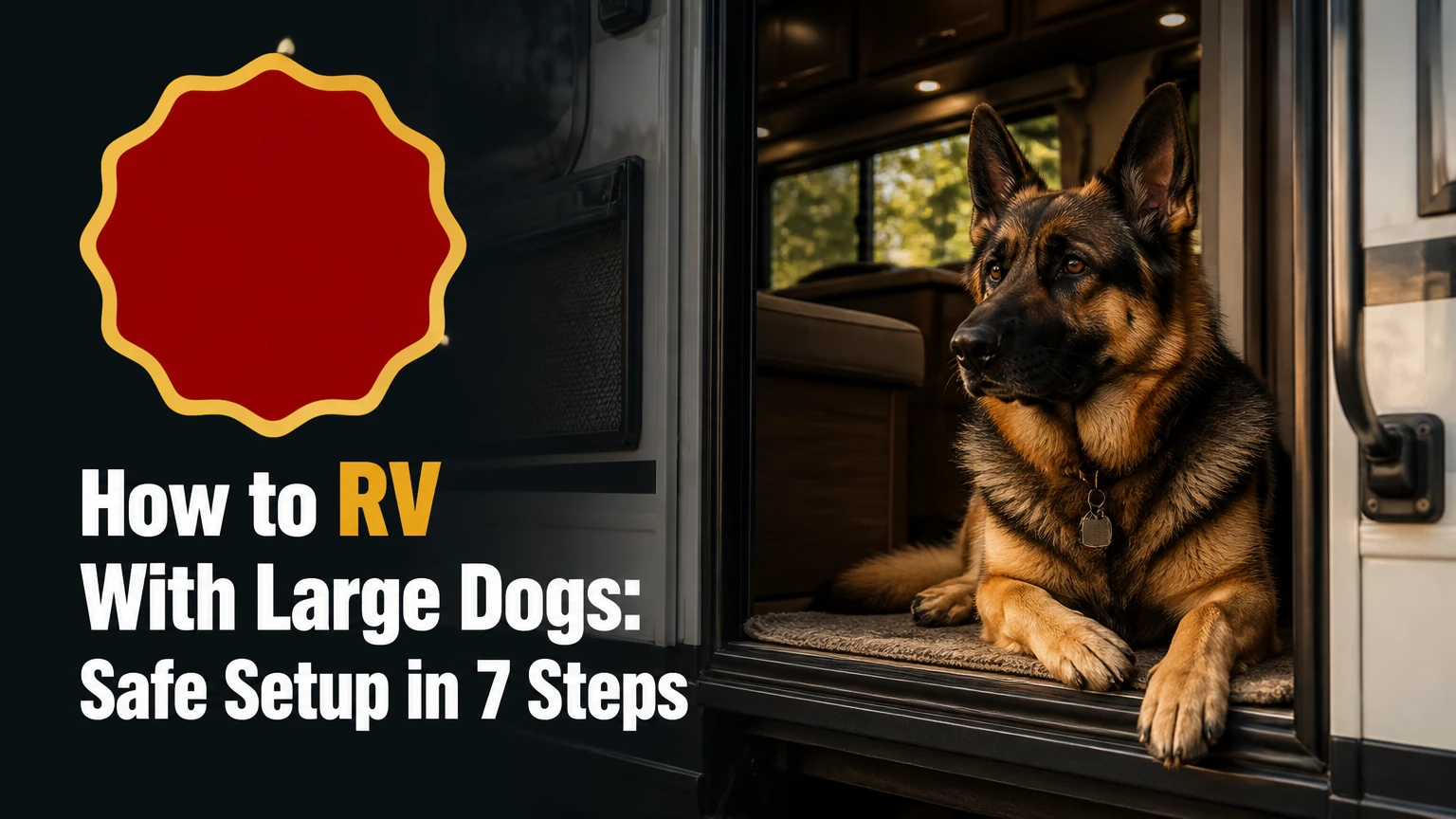
To RV with large dogs safely, choose a floor plan that gives each dog a secure resting zone, restrain the dog during travel, control cabin temperature, and build a routine around frequent stops. Successful trips also require veterinary preparation, campground-rule checks, accurate weight calculations, and a backup plan for power, heat, injury, and escape.
Key Facts at a Glance
- Large dogs generally need a floor area where they can lie fully on their side without blocking the RV’s escape path.
- Dogs should travel in a crash-tested harness or secured crate, never loose in a moving RV.
- A cellular temperature monitor is more useful than campground Wi-Fi because it can alert you when shore power or cooling fails.
- A dog’s food, crate, ramp, water, and equipment count against the RV’s Cargo Carrying Capacity and axle limits.
- A 2-3 hour driving interval is a practical starting point, but puppies, seniors, anxious dogs, and dogs with medical conditions may need more frequent stops.
- A 65-75°F interior target is a planning range, not a guaranteed safe temperature for every breed, coat, age, or health condition.
What Does RVing With a Large Dog Require?
RVing with a large dog means transporting, housing, exercising, and supervising a dog commonly weighing more than 50 pounds in a recreational vehicle. A Golden Retriever, German Shepherd, Labrador Retriever, Rottweiler, or Great Dane creates different space, restraint, cooling, mobility, and campground requirements than a small companion animal.
The central design problem is usable floor space. Slides may enlarge the living area when parked, but the dog still needs a safe position while slides are retracted, during setup, and during an emergency exit. A dog bed placed in the aisle can become a trip hazard, block a person escaping through the door, or prevent access to a fire extinguisher.
Temperature deserves equal attention. RVs have less thermal mass and insulation than most houses, and direct sunlight can heat the interior rapidly. The often-repeated claim that every RV becomes dangerous within exactly 15 minutes is not a universal rule. The rate depends on outdoor temperature, shade, window area, insulation, ventilation, dog size, and whether an air conditioner is operating.
How Much Space Does a Large Dog Need?
Measure the dog from nose to rump, then add at least 6 inches to the length and width of the sleeping surface. A 75-pound Labrador may fit a 36-by-48-inch bed, while a Great Dane or two large dogs may require a 48-by-60-inch area or more.
Keep the dog zone away from slide mechanisms, furnace vents, sharp cabinet corners, and the main walkway. Reserve enough clearance for the dog to stand, turn around, rise without slipping, and move toward the exit. A folded dinette, removable recliner, or toy-hauler garage can create useful space, but furniture removal must not interfere with seat belts, structural components, or emergency access.
Which RV Type Works Best for Large Dogs?
A Class A or spacious fifth wheel usually provides the most comfortable stationary living area, while a Class C often offers the simplest first purchase. The decisive issue is not advertised square footage; it is whether the dog can travel safely, enter without joint strain, and occupy a defined zone when slides are closed.
| RV type | Typical usable dog area | Travel arrangement | Typical price range | Main limitation |
|---|---|---|---|---|
| Class A motorhome | 70-140 sq. ft. with slides closed or partly open | Dog rides in restrained living area only if manufacturer and restraint system permit | $80,000-$400,000 new | High steps and expensive mechanical systems |
| Class C motorhome | 45-100 sq. ft. | Dog can ride in the cabin only with an approved restraint and suitable seating | $60,000-$180,000 new | Narrow aisle and limited cockpit room |
| Fifth wheel | 90-180 sq. ft. | Dog rides in the tow vehicle, not the trailer | $50,000-$180,000 new | Truck-cab space and multiple interior steps |
| Travel trailer | 45-130 sq. ft. | Dog rides in the tow vehicle, never the moving trailer | $25,000-$100,000 new | Tow vehicle comfort and variable insulation |
| Class B van | 20-55 sq. ft. | Dog rides in a belted passenger position or secured travel crate | $60,000-$180,000 new | Limited turning, sleeping, and storage space |
A fifth wheel can feel residential at camp, but its dog must ride in the truck. A travel trailer is often affordable, yet the tow vehicle must accommodate the dog, passengers, crates, cooling, and emergency gear. A Class B is maneuverable and convenient for trailheads, but it is usually a poor choice for two giant dogs or long periods indoors.
Which Layout Features Matter Most?
Prioritize a wide aisle, low entry step, washable flooring, accessible water storage, and a dog zone that remains available with slides retracted. A toy-hauler ramp can reduce the climbing angle for senior dogs, although the ramp must have a secure surface and a load rating above the dog’s weight.
Avoid layouts with a raised bedroom as the only sleeping area, narrow bathroom corridors, exposed slide rails, or glossy floors. Large breeds are more likely to struggle with traction and stairs, particularly after exercise, injury, or during old age.
Before You Start: Time, Cost, and Equipment
Allow 2-4 weeks for basic acclimation and 4-8 weeks for a dog with travel anxiety, crate resistance, or reactivity. A practical initial setup costs about $400-$2,000, excluding the RV, veterinary care, and major electrical upgrades.
| Item | Typical quantity or specification | Typical US cost | Selection rule |
|---|---|---|---|
| Crash-tested harness | 1 per dog, sized by chest measurement | $100-$250 each | Use a system tested for vehicle travel, not a walking harness |
| Heavy-duty crate | Interior length 36-54 inches | $150-$600 | Anchor it to approved vehicle points and preserve ventilation |
| Cellular temperature monitor | 1 unit, cellular subscription | $150-$300 plus $10-$20/month | Confirm coverage along the route |
| Portable fence or pen | 24-36 inch panels, 8-16 feet total | $200-$400 | Use only under supervision where rules permit |
| Ramp or step system | 60-72 inch ramp, 200-300 pound rating | $100-$350 | Match slope to the dog’s joints and confidence |
| Waterproof bed and mats | 1 bed plus 2-4 absorbent mats | $80-$250 | Keep a dry replacement available |
| Waste and cleaning kit | 1 sealed container, bags, enzyme cleaner | $30-$100 | Store outside the food-preparation area |
A cellular monitor does not cool the RV. It only reports conditions and sends an alert. Pair it with an automatic generator start system, a secondary cooling method, and a person who can physically reach the vehicle.
Step 1: Prepare the Dog and Veterinary Records
Schedule a veterinary examination 2-6 weeks before departure, especially for a senior, brachycephalic, overweight, cardiac, respiratory, or joint-compromised dog. Confirm rabies vaccination, parasite prevention, microchip registration, medication quantities, and any destination-specific certificate or vaccination requirement.
The American Veterinary Medical Association advises owners to plan for identification, health documentation, and safe restraint during travel. Rules vary by state, airline, border, campground, and event, so a rabies certificate alone may not satisfy every destination.
Train in stages:
- Park the RV at home and feed meals inside.
- Repeat with the doors closed for 5-10 minutes.
- Run the engine or generator briefly while offering high-value treats.
- Take 10-20 minute drives, then extend them to 60 minutes.
- Conduct one overnight trial before the first major trip.
Ask the veterinarian about motion sickness, anxiety medication, heat risk, and sedatives. Never test a new medication on departure day. You will know training is progressing when the dog can enter, settle, drink, and sleep without persistent panting, drooling, pacing, barking, or escape attempts.
Common mistake: using the RV only when travel begins. A dog that associates the vehicle with a long, noisy departure may resist the doorway before the trip starts.
Step 2: Choose and Install a Travel Restraint
Secure each dog before the vehicle moves. A large dog should ride in a crash-tested harness attached to an appropriate seat-belt system or in a crate secured according to the crate and vehicle manufacturer’s instructions.
The restraint location depends on the RV type. Dogs in a travel trailer or fifth wheel must ride in the tow vehicle because trailers are not designed for occupants during motion. Dogs in a motorhome need a belted seating position or a properly secured travel crate; a loose dog in the living area can be thrown during braking, and a crate placed on an unsecured slide floor can shift.
Do not attach a tether to a collar. Use a body harness that fits tightly enough to prevent backing out, while allowing two fingers between the strap and the dog’s body. Keep the dog away from airbags, driver controls, emergency exits, and hot dashboards.
You will know the restraint works when the dog can lie down and turn its head but cannot reach the driver, climb into the footwell, or become tangled. The restraint should be inspected before every departure.
Common mistake: treating a walking harness as a crash-tested travel harness. Walking equipment controls movement but does not prove that forces from a collision will be distributed safely.
Step 3: Create a Stable Dog Zone
Build the dog’s stationary zone before adding decorative or nonessential furniture. Use a washable bed, a non-slip rubber-backed mat, a water bowl that resists tipping, and a barrier that keeps the dog away from the cooking area and entry door.
Large dogs can damage joints on polished vinyl, laminate, or wet steps. Add stair treads, traction runners, and a ramp where appropriate. A ramp should have a textured surface, a stable top connection, and a slope the dog can use without jumping. Practice it outside the RV first.
Store food in airtight containers and record its weight. A 40-pound food bag, a 20-kilogram steel crate, several gallons of water, and tools can reduce available payload quickly. The RV manufacturer’s yellow certification label lists occupant and cargo capacity, while the vehicle’s GVWR and axle ratings set hard limits.
A simple payload check is:
Available cargo = GVWR minus the loaded vehicle’s actual weight.
Include passengers, dogs, water, propane, food, batteries, bicycles, firewood, and hitch equipment. Visit a certified public scale before a long trip, and check axle weights separately when towing.
You will know the zone is ready when the dog can rest there without blocking the aisle, refrigerator, bathroom, or exit. The sleeping area must remain usable with slides in.
Expert rule: optimize the closed-slide floor plan, not the showroom floor plan. A dog zone that exists only after three slides extend is unavailable during travel, roadside stops, and some emergencies.
Step 4: Plan the Drive Around the Dog
Drive for 2-3 hours between planned stops, then adjust based on age, weather, medical needs, and behavior. At each stop, offer water, provide a controlled bathroom break, inspect paws, and allow 10-20 minutes of calm movement rather than intense exercise beside traffic.
Use a fixed departure routine: bathroom break, harness or crate, measured water, temperature check, and restraint inspection. Avoid a large meal immediately before departure because motion can worsen nausea and gastric discomfort. Ask your veterinarian for individualized feeding guidance, particularly for deep-chested breeds.
Never open the RV door or vehicle door at an unsecured rest area. Attach a leash before releasing the restraint, and use a secondary identification tag with your destination phone number. Dogs can escape during the brief transition between vehicle and leash.
Keep the following within reach:
- Two leashes, including one spare.
- Collapsible bowl and 1 gallon of water per dog for emergency use.
- Towels, waste bags, paw wipes, and enzyme cleaner.
- First-aid supplies, regular medication, and a digital veterinary record.
- Reflective gear, flashlight, and a printed emergency contact card.
You will know the travel routine works when the dog settles within 10-15 minutes, drinks normally at stops, urinates on schedule, and shows no escalating panting or agitation.
Step 5: Control Heat, Power, and Air Quality
Set a monitor alert around 80°F as an early warning, but do not treat 80°F as a safe universal ceiling. A dark-coated, elderly, overweight, flat-faced, or medically vulnerable dog can develop heat stress at lower temperatures, while humidity and direct sun increase risk.
Test the cooling system before departure. Run each air conditioner, verify the thermostat, inspect filters, and confirm that vents are not blocked by bedding. Use reflective window coverings without restricting ventilation or emergency exits.
Shore power can fail when breakers trip, campground wiring faults occur, or a neighboring load affects voltage. A cellular monitor should report temperature, power status, and battery level where supported. Wi-Fi-only monitoring is inadequate when the network fails with the campground power.
For extended off-grid travel, calculate the electrical load of the air conditioner, refrigerator, monitor, inverter, and other appliances. An automatic generator start system can restore cooling after a power interruption, but it requires fuel, maintenance, compatible equipment, and safe carbon-monoxide protection.
Never run a portable generator inside a compartment, under an awning, or near an open window. Install and test carbon-monoxide alarms according to the RV manufacturer’s instructions.
Large dogs also add moisture through breathing and wet coats. Ventilate after rain, use the bathroom fan during showers, dry the dog before bed, and inspect corners for condensation. A dehumidifier may help in humid climates, but it adds electrical demand and cannot replace ventilation.
Limit of monitoring: an alert does not guarantee rescue. Campground reception, dead batteries, delayed notifications, and a locked site can all defeat the system. Leave the dog alone only when the cooling plan has a tested backup and a nearby person can intervene.
Step 6: Set Up the Campsite Safely
Register before unloading the dog when possible, or keep the dog restrained in the climate-controlled vehicle while checking in. Then inspect the site for broken glass, fishing hooks, toxic plants, sharp gravel, spilled chemicals, human food, and gaps under the RV or fence.
Confirm the campground’s written rules before booking. Private parks may impose breed, weight, noise, vaccination, or number-of-pet restrictions. Leash limits are local rules, not a single nationwide standard; six feet is common, while retractable leashes may be prohibited.
A portable pen is useful for supervised rest, drying, and short transitions, but it is not a substitute for supervision. Do not leave a dog tethered or fenced outside while visiting a bathhouse, trail, restaurant, or attraction. Wildlife, heat, theft, other dogs, and leash entanglement remain risks.
National parks frequently restrict dogs to developed areas, roads, and specified trails. The National Park Service commonly prohibits pets on many backcountry trails, so arrange a dog sitter, daycare, or alternate activity rather than assuming the dog can accompany every hike.
You will know the site is secure when the dog has a clean water station, shade or indoor access, a closed gate, a visible identification tag, and no route to traffic or wildlife.
Step 7: Establish the Daily Routine
Provide at least two substantial walks of roughly 30 minutes for a healthy adult large dog, plus sniffing, training, chewing, or food-puzzle activities. That is a starting routine, not a medical prescription. A working breed may need more activity, while a senior dog may require several short walks on level ground.
Feed at consistent times and keep portions measured. Travel stress, unfamiliar treats, heat, and reduced activity can cause diarrhea or weight gain. Bring the dog’s normal food for the first several days and change diets gradually.
Use quiet hours to manage barking. Close blinds facing roads, golf carts, and neighboring sites; run a fan or white-noise machine; reward quiet behavior; and avoid punishment that increases fear. Place the bed away from the entry door if people passing outside trigger guarding.
Clean wet fur promptly. A microfiber mat, exterior shower, absorbent towels, and sealed laundry bag prevent mud, odor, and damp bedding. Inspect paws after gravel, hot pavement, salt, and long walks.
What Are the Main Costs and Time Commitments?
A basic large-dog RV setup typically costs $400-$2,000 initially, while an advanced off-grid climate system can add $2,000-$10,000 or more. Premium campgrounds commonly cost $50-$120 per night, and dog daycare near major attractions often costs $30-$60 per day, depending on location and service level.
| Expense | Typical amount | Frequency | Cost-control option |
|---|---|---|---|
| Temperature monitor | $150-$300 | One-time | Buy a unit with power-failure alerts |
| Cellular service | $10-$20/month | Monthly | Confirm route coverage before subscribing |
| Crash-tested harness | $100-$250 per dog | Replacement after wear or crash | Measure chest before ordering |
| Heavy crate | $150-$600 | One-time | Use only if it fits and can be anchored |
| Portable pen | $200-$400 | One-time | Borrow for occasional trips |
| Campground with 50-amp service | $50-$120/night | Per night | Reserve shoulder-season sites |
| Dog daycare or sitter | $30-$60/day | As needed | Choose dog-friendly attractions |
| Emergency veterinary visit | $100-$300 exam before treatment | Unplanned | Map clinics before departure |
A first weekend can be prepared in 2-4 weeks, but equipment fitting, behavioral training, and a trial overnight should happen before the booked trip. The largest hidden cost is often not gear. It is changing an itinerary because the dog cannot safely accompany an attraction or tolerate a hot, crowded campground.
Common Problems and How to Fix Them
| Problem | Likely cause | Immediate response | Permanent fix |
|---|---|---|---|
| Dog pants continuously | Heat, anxiety, pain, or poor ventilation | Stop, cool gradually, offer water, assess gums and behavior | Veterinary review and shorter training drives |
| Dog refuses the RV | Noise, slippery floor, or negative association | Return to feeding and brief entry practice | Build duration over days, add traction |
| Dog barks at every passerby | Visual triggers and territorial behavior | Close shades, increase distance, redirect quietly | Reward calm behavior and relocate the bed |
| Dog slips on steps | Wet or glossy surface | Block stairs and assist with a ramp | Install textured treads and practice ramp use |
| Temperature alert arrives | Power loss, failed AC, or sensor issue | Contact the local responder and return immediately | Test generator, batteries, alerts, and filters |
| Diarrhea begins on route | Stress, treats, contaminated water, or food change | Stop treats, hydrate carefully, call a veterinarian | Use familiar food and a stable feeding schedule |
Seek urgent veterinary care for collapse, confusion, severe weakness, repeated vomiting, breathing difficulty, pale or abnormal gums, inability to stand, or suspected heatstroke. Do not force water into a distressed dog and do not use ice-water immersion without veterinary direction.
Which Setup Fits Different RV Travelers?
Weekend Traveler
Choose a Class C or travel trailer with a 36-by-48-inch dog zone, a crash-tested restraint, and a cellular monitor. Keep the first trip to one or two nights, select a shaded site near paved paths, and avoid an itinerary that requires the dog to remain alone for hours.
Full-Time Remote Worker
Choose a 35-foot-or-longer fifth wheel or Class A only if the tow vehicle or motorhome safely accommodates the dog during travel. Reserve separate office and dog areas, carry backup power, map emergency veterinarians, and budget for daycare when visiting attractions that prohibit pets.
Senior or Mobility-Limited Dog
Choose a low-step travel trailer or toy-hauler ramp layout, then verify ramp slope, traction, and turning space. Select paved walking routes, avoid steep terrain and extreme heat, schedule several short outings, and ask the veterinarian about arthritis, pain, and recovery needs.
Two Large Dogs
Prioritize a wide aisle, two independent sleeping surfaces, separate feeding locations, and a vehicle cabin with enough belted seating. Never assume two dogs can share one crate or one restraint; conflict, entanglement, and unequal access to water can become serious during a sudden stop.
The Bottom Line
To RV with large dogs, design the trip around restraint, temperature control, floor space, weight limits, and the dog’s actual behavior rather than the RV’s advertised sleeping capacity. Train through short drives and a trial overnight, secure the dog in transit, inspect every campsite, and maintain a tested power and emergency plan. The best RV is the one that lets the dog travel safely, rest without blocking exits, enter without injury, and remain supervised when campground rules limit access.
Frequently Asked Questions
Can a large dog ride in a travel trailer while it is being towed?
No. Large dogs should ride in the tow vehicle, not inside a moving travel trailer or fifth wheel. Trailers lack passenger restraints designed for animals, and sudden braking, sway, collision forces, temperature changes, or a detached trailer can create severe danger. Confirm that the truck or SUV has a suitable belted position and enough cabin space.
How do you keep a big dog cool in an RV without shore power?
Use shade, airflow, reflective coverings, and a tested generator or battery-inverter system sized for the cooling load. A fan alone is not adequate in hot weather because it moves warm air. A cellular monitor can report rising temperature, but a nearby person must be able to reach the RV quickly if the air conditioner fails.
Are crates or harnesses safer for RV travel?
Neither is automatically safer. A crash-tested harness is practical when a suitable belted seat exists, while a crate can provide containment when it is correctly sized, ventilated, and secured to approved anchor points. A loose crate, improvised tether, collar attachment, or crate on an unsecured slide is unsafe regardless of the dog’s size.
Can large dogs stay outside at an RV campsite?
Large dogs can spend supervised time outside when campground rules allow it and the site has shade, water, secure boundaries, and no wildlife or traffic hazard. Do not leave a dog unattended outdoors, even in a pen or on a tie-out. Many parks prohibit unattended tethering and restrict pets to specific areas.
What should you do if your dog is afraid of the RV steps?
Add a non-slip surface, use a stable ramp or wider step, and practice on level ground with treats before connecting the ramp to the RV. Do not drag or push the dog. If fear began suddenly, pain, arthritis, a paw injury, or vision loss may be involved, so arrange a veterinary examination before travel.
Are RV parks required to accept every large dog breed?
No. Private campgrounds can impose breed, weight, number, vaccination, and behavior rules, subject to applicable law and accommodation requirements. Read the current pet policy before paying a deposit, disclose the dog’s actual size, and confirm restrictions by phone when the policy uses vague terms such as aggressive breed or oversized pet.