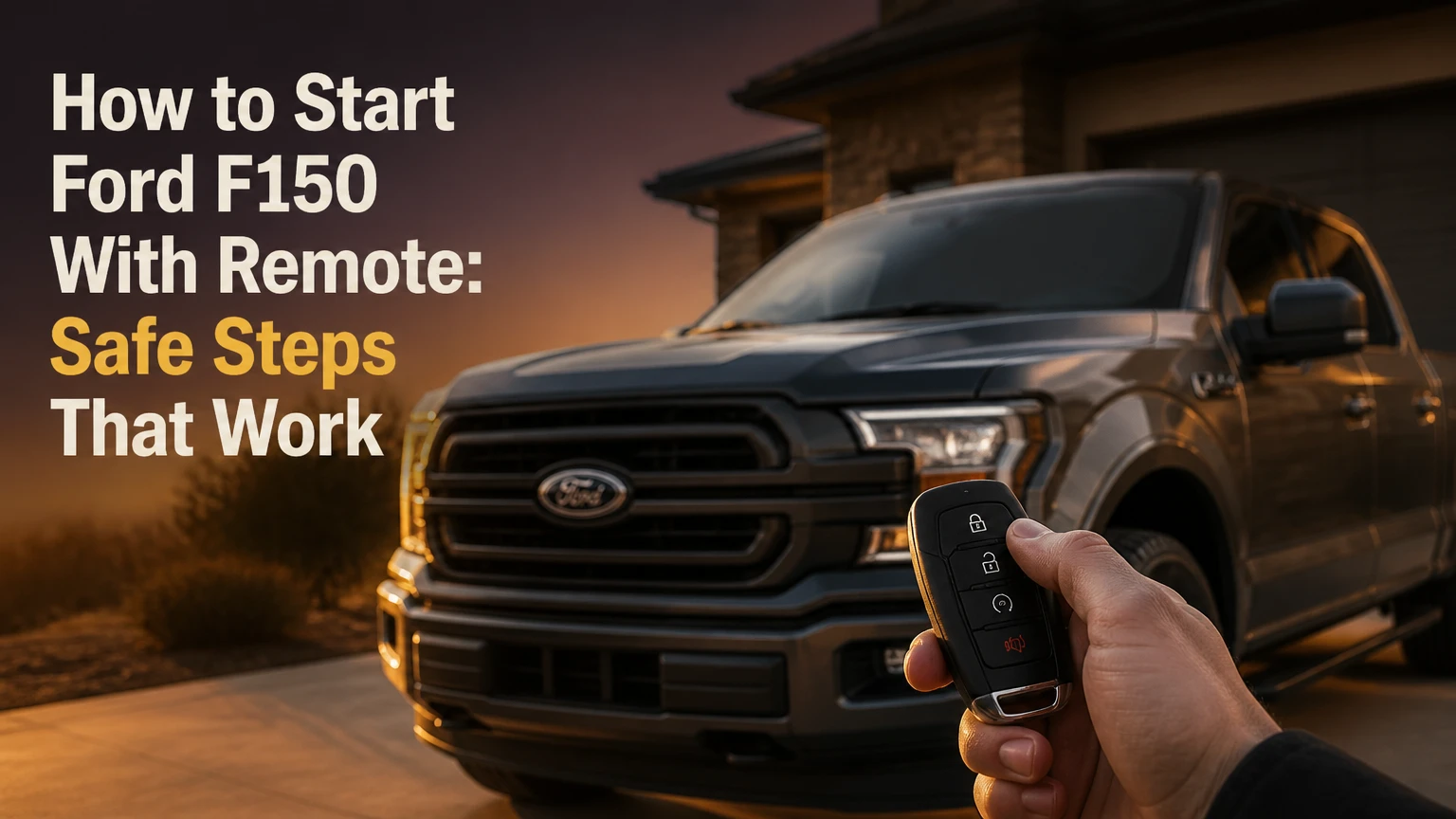
To start a Ford F-150 remotely with the factory key fob, press Lock once, then press the 2X Remote Start button twice within three seconds. The truck should flash its exterior lamps and start the engine if the hood is closed, the transmission is in Park, the alarm is inactive, and the vehicle meets its model-year safety conditions.
Key Facts at a Glance
The standard Ford F-150 key-fob sequence is Lock once, then 2X twice within three seconds.
A successful remote start normally produces two exterior-light flashes and starts a timed engine cycle.
Remote start does not authorize driving; the driver must enter with the correct key or programmed device and press the brake before shifting.
Ford F-150 remote-start availability varies by model year, trim, key fob, market, and factory equipment.
FordPass uses the truck’s modem and cellular service, so app commands can fail even when the key fob works.
Never use remote start inside a garage or another enclosed space because carbon monoxide can accumulate quickly.
How Do You Start a Ford F-150 With Remote?
The Ford F-150 remote-start procedure takes a few seconds and requires no dashboard access. Stand within normal key-fob range, press the lock button once, and immediately press the button marked 2X inside a circular arrow twice. Ford’s official remote-start instructions use the same Lock-then-2X sequence, although button layouts and confirmation behavior can differ by vehicle year.
Before You Start
| Requirement | Typical specification | What to check |
|---|---|---|
| Vehicle position | Park, level or safely parked | Confirm the gear selector shows P |
| Key-fob distance | About 300-500 feet typical | Move closer if buildings or metal obstruct the signal |
| Button timing | Two 2X presses within 3 seconds | Begin immediately after the Lock press |
| Engine cycle | About 5, 10, or 15 minutes | Check the information display or owner manual |
| Required condition | Hood fully latched | Do not test with the hood raised |
| Exhaust environment | Open outdoor air | Avoid garages, carports with poor ventilation, and enclosed bays |
Remote starting works only when the truck accepts the command and its security modules approve the request. Locking the truck first matters because the command sequence also confirms that the vehicle is in a secured state.
Step 1: Put the F-150 in a Safe Starting Condition
Park the Ford F-150, select Park, switch off the hazard flashers, close the hood, and remove anyone from the immediate area around the truck. The engine must have a clear exhaust path, and no person should work near moving belts, fans, or a hot exhaust system during the remote cycle.
You’ll know this step is complete when: the hood is latched, the truck is parked, and all doors and the tailgate are closed or secured according to the owner manual.
Common mistake: testing remote start with the hood open after servicing the engine. The hood switch is a deliberate safety interlock and can block the request.
Step 2: Press Lock Once
Press the Lock button once on the factory key fob. The exterior lamps should flash, confirming that the truck received the locking command. Do not press Lock repeatedly because rapid button presses can make the next command difficult to time and can create uncertainty about the truck’s actual lock state.
You’ll know this step is complete when: the doors lock and the turn signals or parking lamps flash.
Common mistake: using the unlock button first. The standard factory sequence begins with Lock, not Unlock.
Step 3: Press 2X Twice
Press the button marked 2X twice within three seconds of the Lock press. The button usually shows “2X” inside a circular arrow, but some Ford F-150 fobs use a remote-start icon rather than large printed lettering.
You’ll know this step is complete when: the exterior lamps flash again and the engine starts. Depending on the year and configuration, the cluster or lamps may provide the only confirmation.
Common mistake: holding the 2X button down. Use two distinct presses. A slow second press can fall outside the permitted timing window.
Step 4: Confirm the Engine Is Running
Observe the truck from a safe position and verify the engine sound, exterior-light behavior, or FordPass status. A lamp flash without engine operation means the truck received some part of the request but did not complete the start, so inspect the troubleshooting conditions rather than repeatedly pressing the fob.
You’ll know this step is complete when: the engine idles, the parking lamps remain active or the truck reports a running status, and no alarm sounds.
Common mistake: assuming a lamp flash proves a successful start. The confirmation pattern varies, and visual inspection is more reliable than interpreting one flash.
Step 5: Enter and Take Control
Unlock the Ford F-150 with the key fob or approved phone-as-key function, enter the vehicle, apply the brake, and press the ignition control if the truck has push-button start. The remote-start engine is running, but the truck remains secured against normal driving until the authorized starting procedure is completed.
You’ll know this step is complete when: the instrument cluster is active, the brake is applied, and the truck responds normally to the drive selection.
Common mistake: pressing the accelerator or shifting before pressing the brake and completing the ignition takeover. That can cause a no-drive condition or shut the remote cycle down.
What Does the 2X Button Do?
The 2X button sends a remote-start request after the key fob has locked the Ford F-150. The “2X” label means the driver must press the control twice, not hold it for two seconds. The truck’s body control module checks security and operating conditions before enabling the engine start.
The key fob communicates through a short-range radio signal. Exact frequency, encryption method, antenna arrangement, and range depend on the vehicle market and model year, so a single RF specification should not be treated as universal across all F-150 generations.
A remote start does not bypass the immobilizer. The vehicle still validates its programmed security credentials and blocks ordinary driving until an authorized key or device takes control.
How Long Does Ford F-150 Remote Start Run?
A Ford F-150 remote-start cycle typically lasts 5, 10, or 15 minutes, depending on the vehicle configuration and settings. Some trucks permit a single extension for a maximum typical total of 20 or 30 minutes, while other configurations use a fixed cycle, so the owner manual and vehicle settings determine the exact limit.
Remote start is designed to precondition the cabin, not to warm an unattended engine indefinitely. Ford’s owner information commonly warns that the system can be disabled after two consecutive remote starts; physically turning the ignition on resets that counter.
| Setting or condition | Typical behavior | Practical consequence |
|---|---|---|
| Standard cycle | 5-15 minutes | Cabin temperature improves before entry |
| Common cycle extension | 1 additional cycle | Total may reach 20-30 minutes |
| Consecutive remote starts | 2 cycles commonly allowed | Key-operated reset may be required |
| Engine takeover | Brake plus ignition control | Driver can shift after authorization |
| Remote shutdown | Press 2X once or use app stop | Engine stops without entering the truck |
Cold temperatures can make a remote-start cycle less effective when the battery is weak, the oil is excessively viscous, or the heater needs more time. In hot weather, shade, window tint, and cabin insulation influence the result more than the remote command itself.
Which Remote-Start Method Should You Use?
The factory key fob is the simplest method when the truck is nearby, FordPass is more useful when cellular coverage is available, and an aftermarket system is appropriate mainly when the owner needs longer RF range or two-way confirmation. Factory equipment remains the lowest-complexity option because it matches the truck’s security architecture.
| Method | Typical range | Typical cost | Confirmation | Main limitation |
|---|---|---|---|---|
| Factory key fob | 300-500 feet | Included, or $200-$400 retrofit | Lamp flash or engine sound | Walls and metal reduce range |
| FordPass app | Cellular coverage area | $0 app, service eligibility varies | App status and notifications | Truck and phone need connectivity |
| Aftermarket one-way RF | 1,500-3,000 feet | $150-$400 installed | Fob or vehicle response | Installation quality matters |
| Aftermarket two-way or cellular | 1,500 feet to several miles | $300-$1,000 installed | Fob or app confirmation | Subscription may cost $0-$50 yearly |
Is FordPass Better Than the Key Fob?
FordPass is better for a truck parked beyond key-fob range, while the key fob is faster and less dependent on cellular infrastructure. FordPass remote features require an eligible, connected vehicle, an enrolled Ford account, a compatible app setup, and usable cellular communication between the truck and Ford’s service.
App pricing and feature availability are not universal. Some Ford vehicles include connected-service access for a trial period, while renewal terms, remote features, and availability vary by model year, country, and account.
FordPass can also report a delayed status. A command may take several seconds or fail when the truck is in a basement, remote worksite, or area with poor modem coverage.
When Is an Aftermarket Starter Worth Considering?
An aftermarket starter is worth considering when the factory system is unavailable or its 300-500-foot practical range does not reach the parking location. A two-way system adds confirmation that the start request succeeded, while a cellular system can provide control across long distances where both the vehicle and phone have service.
Installation quality is more important than advertised range. A qualified installer must confirm compatibility with the F-150’s alarm, immobilizer, push-button ignition, remote locks, battery monitoring, and body control network. Poor wiring or an incompatible bypass module can create parasitic battery drain, warning lights, or intermittent starting faults.
Ford’s warranty terms generally do not make every aftermarket device automatically void, but damage caused by an improper installation may not receive warranty coverage. Keep the invoice, part number, and installer documentation.
Why Will a Ford F-150 Not Remote Start?
A Ford F-150 usually refuses remote start because a safety interlock, low-voltage condition, active warning, or communication problem prevents the body control module from authorizing the engine cycle. The fastest diagnosis is to check Park, hood closure, alarm status, battery voltage, warning lamps, and the remaining remote-start cycle allowance.
| Symptom | Likely cause | Corrective action |
|---|---|---|
| No lamp response | Dead fob battery, wrong button, excessive distance | Replace CR2032 if specified, move closer, repeat sequence |
| Lamps flash, engine stays off | Hood, Park, alarm, battery, or fault condition | Close hood, verify P, inspect warnings, retry once |
| Engine starts then stops | Takeover not completed or fault detected | Enter with authorized key, press brake, follow ignition procedure |
| App says unavailable | Modem, account, subscription, or signal issue | Check vehicle connectivity and FordPass enrollment |
| Starts once, then not again | Two-cycle limit | Turn ignition on and off, then retry |
| Remote start recently worked | New hood, battery, or powertrain fault | Scan diagnostic codes and repair the underlying issue |
Check the Hood, Gear Selector, and Hazards
The hood must be fully latched, the transmission must be in Park, and the hazard flashers must be off. These checks are easy to overlook after maintenance, loading cargo, or using the truck’s four-way flashers at a roadside stop.
Do not repeatedly cycle the remote start while the condition remains. Repeated attempts can drain the fob battery and the truck’s 12-volt battery without changing the interlock decision.
Check the 12-Volt Battery
A low vehicle battery can cause remote start to be disabled even when the engine still cranks normally with the key. Typical resting voltage is about 12.6 volts for a fully charged lead-acid battery, approximately 12.2 volts at a significantly discharged state, and lower voltage under load can indicate a battery or connection problem.
Voltage alone does not prove battery health. A battery with adequate resting voltage can fail a professional conductance or load test, especially after a cold night.
Check Warning Lamps and Diagnostic Codes
An active powertrain fault, malfunction indicator lamp, or other diagnostic condition may block remote start. The exact blocking logic varies by F-150 generation and fault code, so the check-engine lamp is a useful warning rather than a complete diagnostic explanation.
Use a scan tool that can read Ford-specific modules when basic checks fail. A generic code reader may identify an engine code but miss body control, hood-latch, security, or network faults that matter to remote starting.
Check the Key-Fob Battery and Signal Path
A weak fob battery, radio interference, concrete parking structure, or metal-sided building can reduce the command range. Replace the coin-cell battery with the type specified for the fob, keep the fob away from other transmitters, and test from several locations near the truck.
A practical technician rule is to diagnose range only in open air. Testing beside a steel building can make a healthy factory system appear defective.
Can You Remote Start an F-150 in a Garage?
You should never remote start a Ford F-150 inside an attached or detached garage, even with the door open. The engine produces carbon monoxide, an odorless gas that can enter living areas through doors, cracks, and ventilation paths before people recognize a problem.
Remote start is appropriate outdoors with the exhaust unobstructed. Snow, cardboard, tarps, or stored materials must not cover the tailpipe, and people should not stand behind the truck during startup.
What Happens in Cold Weather?
In cold weather, remote start can warm the cabin and allow the defroster to work before departure, but it cannot correct a weak battery, incorrect coolant level, frozen fuel-system problem, or unsuitable engine oil. Use the oil viscosity specified for the engine and climate rather than extending idle time.
Remote climate behavior depends on the truck’s climate-control design. Some F-150s restore the last setting, some use automatic temperature logic, and some limit heated seats or steering-wheel heating during remote operation.
What Happens in Hot Weather?
In hot weather, the truck generally runs the climate system according to its programmed or remembered settings, but remote start cannot cool the cabin instantly. Park in shade when possible, check that vents are unobstructed, and never leave a child or animal unattended because remote climate control is not a safety system.
How Much Does F-150 Remote Start Cost?
Using an existing factory-equipped key fob costs nothing beyond normal vehicle operation, while a retrofit commonly costs about $200-$400 for compatible factory or plug-in hardware. Aftermarket systems typically cost $150-$1,000 installed, depending on range, two-way confirmation, cellular control, and vehicle integration.
| Purchase or service | Typical price | Typical time | Key variable |
|---|---|---|---|
| Replacement fob battery | $3-$10 | 5 minutes | Correct coin-cell type |
| Additional programmed OEM fob | $100-$400 | 30-90 minutes | Key programming and dealer policy |
| Factory-compatible retrofit | $200-$400 | 1-3 hours | Model year and existing modules |
| One-way aftermarket system | $150-$400 | 1-3 hours | RF range and bypass hardware |
| Two-way or cellular aftermarket system | $300-$1,000 | 2-4 hours | Confirmation features and subscription |
Dealer labor, key programming, regional taxes, and compatibility checks can move these figures substantially. Confirm whether a quoted retrofit includes the fob, antenna, programming, labor, and any required software activation.
A plug-in kit is not automatically universal. Verify the exact year, engine, ignition type, trim, and market before connecting anything to the OBD-II port or vehicle harness.
How Do You Stop Remote Start?
Press the 2X remote-start button once, use the FordPass stop command, or enter the F-150 and complete the normal ignition procedure, depending on the system. The exact fob action can vary by model year, so confirm the stop command in the owner manual if a single press does not cancel the cycle.
Stop the engine immediately if the truck is producing unusual smoke, a strong fuel odor, abnormal noise, or warning messages. Do not troubleshoot a mechanical fault while the engine is running.
Common Mistakes and How to Fix Them
- Pressing 2X only once: Press the remote-start button twice within three seconds after Lock.
- Holding the button: Use two separate presses rather than one long press.
- Testing with an open hood: Close and latch the hood before sending the command.
- Ignoring the two-cycle limit: Turn the ignition on and off to reset the allowance.
- Starting in an enclosed area: Move the truck outdoors before remote starting.
- Assuming FordPass is always free: Check the connected-service terms for the specific vehicle and market.
- Replacing the fob before checking distance: Test close to the truck first, then replace the coin cell if the signal remains weak.
The most counterintuitive failure is a truck that locks successfully but will not start. Locking uses a simpler command path, while remote start requires additional authorization checks, so successful door locking does not prove that the starting system is healthy.
The Bottom Line
To start a Ford F-150 remotely, press Lock once, then press 2X twice within three seconds, and confirm that the engine starts outdoors. The method works only when the truck is in Park, the hood is closed, the security system is satisfied, and no battery or diagnostic condition blocks the request. Use the key fob for nearby parking, FordPass for connected long-range control, and an aftermarket system only after verifying compatibility and installation quality.
Frequently Asked Questions
Can I Start My F-150 Remotely While It Is Unlocked?
The factory sequence normally begins by locking the Ford F-150, so an unlocked truck should be locked before pressing 2X twice. The lock command establishes the expected security state. FordPass may present a separate remote-start control, but the vehicle still applies its own safety and security checks.
Can I Drive the F-150 Away Without the Key Fob?
No. Remote starting does not replace the programmed key or authorized phone-as-key function. The Ford F-150 can run unattended during the remote cycle, but the driver must enter with an approved credential, press the brake, complete ignition takeover, and satisfy the immobilizer before driving.
Does Remote Start Work With a Check-Engine Light?
A check-engine light can prevent remote start, particularly when the stored fault affects the powertrain or emissions control system. Ford’s exact behavior depends on the code and model year. Scan the truck, repair the cause, clear codes only after repair, and then test remote starting again.
Why Does My F-150 Remote Start Then Shut Off?
A Ford F-150 can shut off after remote starting when ignition takeover is not completed, a security condition changes, the timed cycle expires, or the truck detects a fault. Enter with the authorized key, press the brake, and use the ignition control. If shutdown repeats, scan for codes.
Can I Schedule Remote Starts Every Morning?
FordPass scheduling and recurring-start features vary by model year, connected-service eligibility, market, and app version. If the feature is available, configure it in FordPass and confirm the truck has cellular coverage. A factory key fob generally provides on-demand starts rather than recurring schedules.
Is Remote Starting Bad for the F-150 Engine?
A short remote-start cycle is not inherently harmful when the truck is maintained correctly, but extended idling increases fuel use and can leave the engine below efficient operating temperature. Follow Ford’s maintenance schedule, avoid repeated unnecessary cycles, and drive normally after the engine reaches operating temperature.