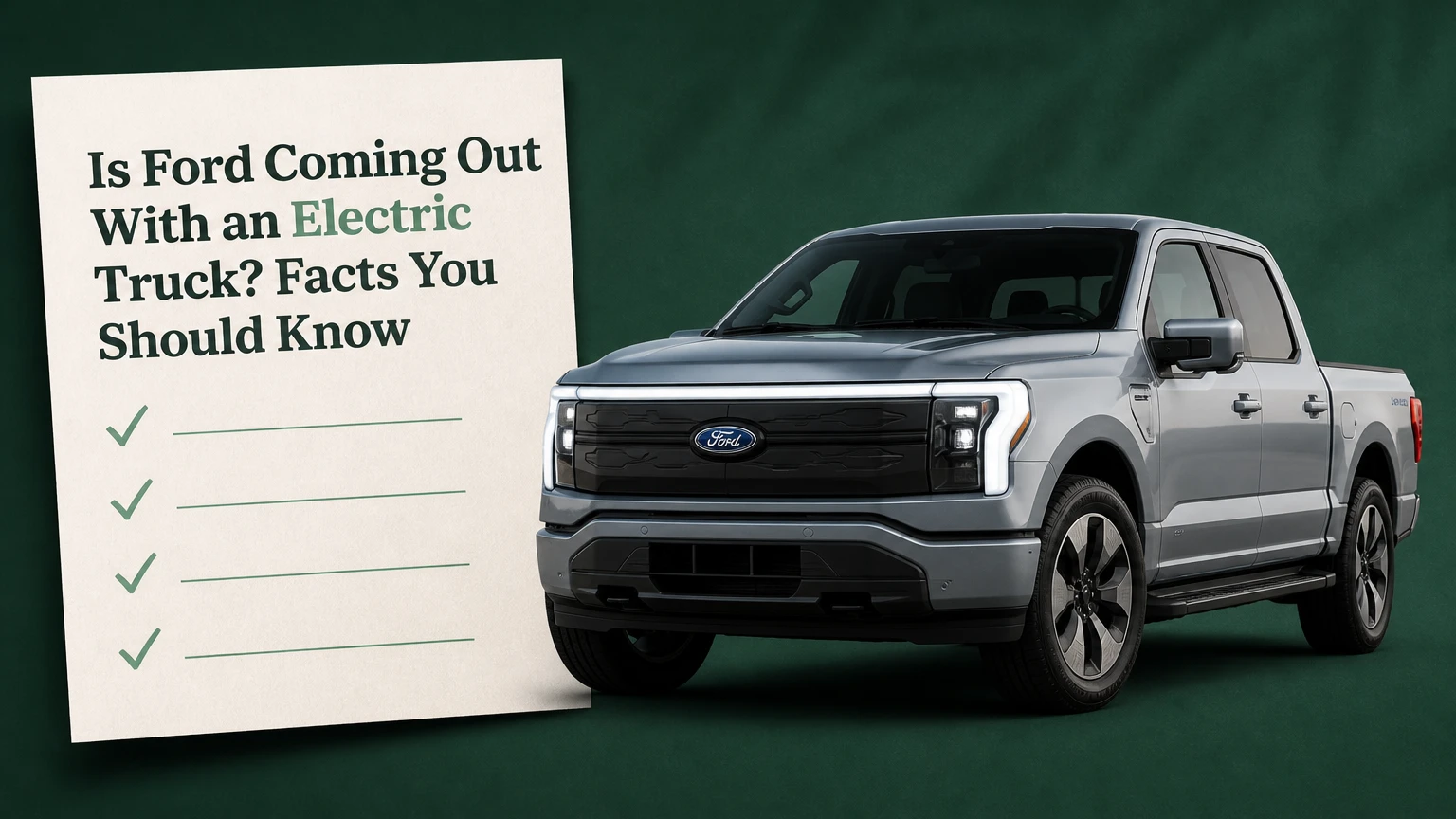
Yes, Ford is already selling an electric truck, the F-150 Lightning, and is developing a next-generation full-size electric pickup for a later launch. Ford has also announced a lower-cost electric-vehicle platform and additional commercial EV work, but names such as Ford Fathom and claims about a 700-mile F-150 Lightning EREV are not confirmed Ford production specifications.
Key Facts at a Glance
- The Ford F-150 Lightning is a battery-electric full-size pickup already sold in the United States.
- Ford has delayed its next-generation electric pickup, commonly called Project T3, from its original schedule; the precise retail launch date remains subject to production planning.
- Ford has not publicly confirmed a production truck named Fathom in its official North American product announcements.
- Ford has not officially published a production specification for an F-150 Lightning EREV, meaning range-extended electric vehicle.
- Electric-truck range can fall sharply while towing because trailer aerodynamics and weight increase energy use.
- A dedicated 240-volt Level 2 charger is usually more practical than a household 120-volt outlet for regular electric-truck ownership.
Which Ford Electric Trucks Are Confirmed?
Ford’s confirmed electric pickup is the F-150 Lightning, while the company’s next major battery-electric pickup is an announced future program often identified publicly as Project T3. Ford has also described a new lower-cost EV platform, but the company has not released a complete retail lineup, final specifications, or consumer pricing for every vehicle built from it.
The distinction between a confirmed program and a rumor matters. Automakers routinely use internal codenames, supplier descriptions, patent filings, executive comments, and media labels before revealing a production name. None of those signals automatically establishes a final model, trim walk, battery size, or release date.
Ford’s electric-truck strategy has therefore moved through three stages:
- Launch the F-150 Lightning on the existing F-150 family architecture.
- Reduce costs through a new EV platform, simplified manufacturing, and cheaper battery chemistry.
- Introduce additional electric pickups when demand, pricing, charging access, and factory economics support the investment.
Ford’s 2024 and 2025 public communications emphasized affordability and profitability rather than a rapid expansion of expensive electric models. That change explains why some earlier forecasts no longer match current expectations.
What Is Happening to the F-150 Lightning?
The F-150 Lightning remains Ford’s production battery-electric pickup, although Ford has adjusted output and investment plans as the electric-truck market developed more slowly than early forecasts predicted. A production adjustment is not the same as an announced permanent cancellation of the model.
The Lightning uses a modified version of the F-150’s body and manufacturing ecosystem. Its dual-motor all-wheel-drive powertrain produces immediate torque, and its front trunk, called the Mega Power Frunk, provides storage that a gasoline engine bay cannot offer. Depending on trim and battery configuration, EPA-estimated range has been approximately 240-320 miles in recent model years.
Ford lists a maximum available towing rating of up to 10,000 pounds for properly equipped Lightning configurations, but maximum tow rating and comfortable long-distance towing are different measurements. A heavy trailer can reduce practical driving distance between charges by roughly 40-50 percent, with the actual result depending on trailer shape, speed, temperature, payload, terrain, and wind.
When Will Ford’s Next Full-Size EV Arrive?
Ford’s next-generation full-size electric pickup, widely known as Project T3 or “Trust the Truck,” is planned for production at BlueOval City in Tennessee, but Ford has revised the original schedule. Public reporting in 2025 placed high-volume production later than the initial 2025 target, with timing commonly discussed around 2027-2028 rather than as a guaranteed showroom date.
Ford’s official 2023 announcement said Project T3 would be built at the company’s Tennessee electric-vehicle campus. The project is intended to use a dedicated EV design and manufacturing process rather than simply adapting an existing gasoline pickup. Ford has discussed large structural castings, improved aerodynamics, bidirectional charging, and a more efficient assembly system.
Those technologies can lower labor and material costs, but they do not guarantee a specific retail price. The final truck must still meet federal crash standards, towing requirements, serviceability rules, battery-sourcing constraints, and Ford’s financial targets.
What Does Project T3 Mean for Buyers?
Project T3 is expected to target full-size pickup buyers who want more cargo flexibility, stronger software integration, and improved electric efficiency than the first-generation F-150 Lightning provides. Ford has not published final EPA range, battery capacity, payload, towing rating, trim pricing, or a confirmed retail name.
The program is important because electric pickups consume large quantities of battery material. A lower-cost, more efficient truck can improve Ford’s unit economics more effectively than simply adding a larger battery to the existing Lightning. Ford’s manufacturing decisions will probably affect price and availability as much as the motor output does.
Ford also needs to solve the truck-specific problem of towing. A vehicle with 350 miles of unloaded EPA range can become a much less convenient work vehicle if a loaded trailer forces charging stops every 100-150 miles. The next-generation truck’s success will depend on energy efficiency, charging speed, trailer planning, and payload management together.
Is the Ford Fathom a Real Electric Truck?
Ford has not publicly confirmed a production electric pickup called the Fathom through the company’s established product announcements, regulatory filings, or mainstream consumer launch materials available for the current planning horizon. Claims that Fathom will cost $28,350, use a 60-kWh LFP battery, reach 300 miles, or launch in fall 2027 should therefore be treated as unverified.
The name may result from social-media speculation, an unofficial rendering, a proposed internal label, or confusion with Ford’s announced lower-cost EV platform. A Facebook post, YouTube video, dealer blog, or anonymous report cannot establish an official model specification.
Ford has confirmed that it is developing lower-cost EV technology. CEO Jim Farley described the company’s second-generation EV platform as a “radical change” in how Ford designs and builds vehicles during a 2024 earnings discussion. That statement supports a lower-cost product strategy, not the specific existence of a truck called Fathom.
A responsible buyer should wait for a Ford newsroom announcement, a formal product page, regulatory documentation, or a published order guide before treating the Fathom name as factual.
How Does Ford’s Electric-Truck Technology Work?
A Ford battery-electric truck stores electricity in a high-voltage battery pack and sends that energy through power electronics to one or more traction motors. The motors turn the wheels directly through reduction gearing, eliminating the multi-speed transmission, fuel tank, exhaust system, and many engine accessories found in an internal-combustion pickup.
The main components have different effects on ownership:
| Component | Typical function | Buyer consequence |
|---|---|---|
| High-voltage battery | Stores electrical energy | Determines range, weight, cost, and charging time |
| Inverter | Converts battery DC into motor AC | Controls motor speed and torque delivery |
| Electric motor | Turns electrical energy into wheel torque | Provides immediate acceleration and regenerative braking |
| Onboard charger | Converts AC household power for the battery | Sets the vehicle’s maximum Level 2 charging rate |
| DC fast-charge system | Accepts direct current from a public charger | Reduces trip charging time |
| Thermal-management system | Controls battery and motor temperature | Affects cold-weather performance and charge speed |
Ford has used lithium-ion battery packs in the F-150 Lightning and has discussed lithium-iron-phosphate, or LFP, batteries for some future EV applications. LFP chemistry generally costs less, avoids nickel and cobalt, and tolerates frequent full charging better than many nickel-rich chemistries. It can also be heavier or less energy-dense for a given pack size.
The practical result is a trade-off. LFP can help Ford build an affordable daily-use truck, while a nickel-rich pack may provide more energy in the same volume when range and payload are dominant priorities.
Will Future Ford EVs Use a 48-Volt System?
A 48-volt low-voltage architecture is plausible for future EV features, but Ford has not published a complete consumer specification confirming that every upcoming electric truck will use one. The high-voltage traction system and the low-voltage system are separate electrical domains.
Higher low-voltage system voltage can reduce current for the same power demand, allowing smaller conductors and potentially simplifying wiring. That benefit matters when a truck contains powered seats, cameras, driver-assistance sensors, displays, pumps, and electronic control units.
Claims about removing thousands of feet of wiring or using exactly five central computers should not be presented as final Ford truck specifications unless Ford publishes them for a named production model. Manufacturing presentations describe design goals; they do not always describe the equipment buyers will receive.
What Will Ford Electric Trucks Cost?
The current F-150 Lightning’s price has varied by model year, trim, destination charge, incentives, and dealer availability, while the future Project T3 has no official MSRP. A realistic buyer should expect a new full-size electric pickup to cost more than a compact gasoline truck, even if battery and manufacturing improvements reduce the gap.
| Vehicle or category | Official pricing status | Typical planning range | What changes the price |
|---|---|---|---|
| F-150 Lightning Pro | Ford publishes model-year pricing | Roughly $50,000-plus before destination and incentives in recent pricing periods | Fleet allocation, battery, destination charge |
| F-150 Lightning XLT | Ford publishes model-year pricing | Roughly $60,000-plus before destination and incentives in recent periods | Trim equipment, battery, regional discounts |
| Project T3 | No final MSRP published | No reliable consumer estimate | Battery cost, production volume, equipment |
| Unconfirmed Fathom | No official price published | No reliable estimate | Model existence, market, trim strategy |
Federal clean-vehicle incentives can change the effective purchase price, but eligibility depends on the vehicle’s final MSRP, battery sourcing, assembly location, buyer income, and tax-credit rules in force at purchase. State incentives, utility rebates, financing rates, and commercial deductions create additional variation.
Ownership cost can still favor an EV. A truck driven 15,000 miles annually at 2.5 miles per kWh consumes about 6,000 kWh per year. At $0.16 per kWh, home energy would cost approximately $960 annually, before charging losses and demand charges. A gasoline truck achieving 20 mpg at $3.50 per gallon would use 750 gallons and cost about $2,625 for the same distance.
That comparison changes when the driver relies on expensive public fast charging, drives in severe cold, or tows frequently.
How Does Towing Change Electric-Truck Range?
Towing reduces electric-truck range primarily through aerodynamic drag, added mass, rolling resistance, and increased drivetrain energy demand. The trailer’s frontal area often matters more than its loaded weight at highway speed, so a tall enclosed trailer can reduce range more severely than a heavier low-profile utility trailer.
Use the truck’s energy display rather than multiplying the unloaded EPA number. A practical planning method is:
- Start with the truck’s current displayed efficiency.
- Assume a 40 percent range reduction for a large conventional trailer as an initial estimate.
- Add a further buffer for headwinds, hills, cold temperatures, or a heavy payload.
- Plan charging stops before the battery reaches 10-15 percent.
- Confirm that the charger can accommodate the truck and trailer without unhitching.
| Use case | Typical range planning | Main constraint |
|---|---|---|
| Unloaded daily driving | 180-280 miles between charges | Temperature and speed |
| Small open utility trailer | 130-220 miles | Trailer shape and payload |
| Tall enclosed trailer | 100-180 miles | Aerodynamic drag |
| Heavy equipment trailer | 80-150 miles | Weight, hills, and charging spacing |
These are planning ranges, not EPA test results. The Ford F-150 Lightning’s maximum tow rating does not mean the truck can tow that load for hundreds of miles without frequent charging.
A counterintuitive ownership rule is that payload can be easier to manage than towing. Passengers and tools add weight, but a trailer adds a large moving wall of air. Buyers who tow infrequently may prefer a BEV, while contractors towing 8,000-10,000 pounds between rural destinations should evaluate charging geography before acceleration or screen size.
What Charging Setup Does a Ford Electric Truck Need?
A Ford electric truck can charge from a household 120-volt outlet, but regular use is usually better with a dedicated 240-volt Level 2 circuit. Level 1 charging typically adds only about 2-5 miles of range per hour, while a suitable Level 2 installation can add approximately 20-30 miles per hour depending on amperage, vehicle configuration, and battery temperature.
| Charging method | Electrical input | Typical added range | Best use |
|---|---|---|---|
| Level 1 household outlet | 120 volts, 12 amps | 2-5 miles per hour | Emergency or low-mileage use |
| Level 2 home charger | 240 volts, 32-48 amps | 20-30 miles per hour | Overnight charging |
| Public AC Level 2 | 6-19 kW | 15-40 miles per hour | Workplace or destination charging |
| DC fast charging | Approximately 50-350 kW station rating | 100-plus miles in 20-45 minutes | Road trips and recovery charging |
An electrician should verify the home’s panel capacity, wire length, conduit route, and local permitting requirements. A typical installation can cost approximately $800-$2,500, although detached garages, trenching, panel upgrades, and regional labor rates can push the total higher.
Ford has adopted the North American Charging Standard, or NACS, for future access to Tesla Superchargers, with vehicle compatibility depending on model year, hardware, software, and adapter availability. Owners should verify connector access for the exact truck rather than assuming every Ford EV has an integrated NACS port.
Cold weather can temporarily reduce EV efficiency by approximately 20-30 percent in severe conditions. Preconditioning the battery while the truck remains plugged in uses grid energy to warm the pack and cabin, preserving more driving energy after departure.
Which Powertrain Fits Each Buyer?
The best choice depends on towing frequency, home charging, daily distance, and tolerance for public charging. A battery-electric truck fits drivers with reliable overnight charging and predictable routes, while a gasoline hybrid or future range-extended design may better suit long-distance towing in regions with sparse fast chargers.
| Buyer profile | Best current direction | Why | Main compromise |
|---|---|---|---|
| Daily commuter with home charging | F-150 Lightning | Quiet operation and low energy cost | Large size and high purchase price |
| Family using a truck occasionally | Lightning or hybrid F-150 | Frunk utility, cabin space, flexible driving | EV range falls with trailers |
| Rural contractor | Hybrid or gasoline F-150 | Fast refueling and broad service access | Higher fuel and maintenance cost |
| Frequent heavy-towing operator | Gasoline or diesel truck today | Established towing infrastructure | Emissions, noise, fuel expense |
| Early adopter planning ahead | Project T3 watchlist | Newer efficiency and manufacturing design | Date, price, and specifications remain uncertain |
The F-150 Lightning is a poor fit for a driver who regularly tows a tall trailer across areas where the next fast charger is more than 100 miles away. It is also a poor fit for someone who cannot install home charging and depends on a public station for every overnight refill.
The Lightning is more compelling for urban and suburban owners who drive 30-80 miles per day, charge at home, and tow only occasionally. The vehicle’s low center of gravity, large frunk, quiet cabin, and bidirectional power capability can provide value that a gasoline truck cannot replicate.
Could Ford Offer an F-150 Lightning EREV?
Ford has not officially confirmed production specifications, pricing, or a launch date for an F-150 Lightning EREV. An extended-range electric vehicle would use electric motors to drive the wheels while a gasoline engine operates mainly as a generator, but reports of a 700-mile range should not be treated as a Ford guarantee.
An EREV could solve a genuine truck problem. Battery-electric propulsion would preserve smooth low-speed torque and regenerative braking, while the generator could provide energy when towing exceeds practical charging distance. However, the generator, fuel system, exhaust equipment, cooling hardware, and emissions controls would add weight, cost, maintenance, and packaging constraints.
An EREV is not automatically a better hybrid. A conventional hybrid can use the engine and electric motor together to propel the vehicle, while an EREV prioritizes electric wheel drive and uses the engine primarily to produce electricity. Final architecture determines whether the distinction matters in real towing.
Ford would need to publish the generator output, usable battery capacity, fuel-tank size, towing rating, charge rate, and emissions certification before buyers could compare an EREV with a gasoline F-150 or diesel Super Duty.
What Are the Main Electric-Truck Problems?
Electric trucks have four recurring ownership risks: towing range, charging access, winter efficiency, and weight. These risks are manageable for the right driver but expensive when ignored during purchase planning.
Towing range shock
Do not use the unloaded range estimate for a trailer trip. Test the route against charger spacing, trailer-friendly parking, elevation, and the expected return distance.
Home electrical limitations
A 120-volt outlet may not restore a truck’s daily energy overnight. Have an electrician calculate the circuit before delivery, especially in older homes with 100-amp service.
Public-charger uncertainty
A navigation route can show a charger without guaranteeing that the stall is operational, available, trailer-accessible, or delivering its advertised power. Keep a second charging location within practical reserve range.
Battery degradation assumptions
Ford’s EV battery warranty commonly covers battery defects for eight years or 100,000 miles, subject to the exact model-year terms and capacity provisions. Warranty coverage does not mean range remains unchanged. Heat, charging habits, mileage, calendar age, and software-controlled usable capacity all influence battery health.
Payload confusion
A truck’s tow rating is not its payload rating. Tongue weight from a trailer counts against payload, as do passengers, tools, accessories, and cargo in the bed. A buyer towing a 9,000-pound trailer may exceed payload before reaching the advertised tow limit.
What Should You Verify Before Ordering?
Verify the exact model year, battery configuration, usable range, tow package, payload label, connector type, and delivery status in the written order documents. Online articles often combine prototype information, estimated specifications, and unrelated Ford announcements.
Use this checklist:
- Confirm the model appears on Ford’s official consumer or fleet website.
- Check the window sticker for battery, motor, tow package, and destination charge.
- Read the driver-door payload label rather than relying on a generic brochure.
- Calculate trailer tongue weight at approximately 10-15 percent of loaded trailer weight.
- Locate fast chargers along the actual towing route.
- Price a 240-volt home installation before signing a purchase contract.
- Check federal, state, utility, and commercial incentive eligibility.
- Ask the dealer how battery repair, tires, roadside assistance, and software updates are handled.
- Separate a refundable reservation from a binding purchase order.
- Avoid deposits based solely on an unverified social-media model name.
Ford’s current electric truck is therefore a real purchase option, while future programs remain planning decisions. A buyer who needs a truck immediately should evaluate the F-150 Lightning against hybrid and gasoline alternatives instead of waiting for an unconfirmed product.
Frequently Asked Questions
Is Ford stopping electric-truck production?
Ford has adjusted electric-vehicle production plans and delayed some future programs, but those changes do not mean Ford has abandoned electric trucks. The F-150 Lightning remains Ford’s established battery-electric pickup, while future production depends on demand, battery costs, plant readiness, and profitability.
Will Ford make an affordable electric pickup?
Ford is developing lower-cost EV technology and has repeatedly identified affordability as a goal. The company has not published a final affordable electric-pickup name, MSRP, battery specification, or delivery schedule that validates the widely circulated Fathom claims.
Can the F-150 Lightning power a house?
The F-150 Lightning can provide bidirectional power through Ford’s home-energy equipment when the truck, charger, electrical service, and installation meet Ford’s requirements. Backup duration depends on household load, battery state of charge, weather, and whether high-demand appliances operate simultaneously.
How long does an F-150 Lightning battery last?
Ford’s battery warranty commonly covers eight years or 100,000 miles, with exact terms varying by model year and market. Actual service life depends on temperature exposure, mileage, charging behavior, battery chemistry, and how the vehicle is used for towing or high-load work.
Is an electric truck cheaper than a hybrid truck?
An electric truck can cost less to operate when charged mainly at home, because electricity and routine maintenance may cost less than gasoline and engine servicing. A hybrid may have a lower purchase price, faster refueling, and better trip flexibility, particularly for owners without home charging.
Should I wait for Project T3?
Wait for Project T3 only if your current vehicle is reliable, your use case benefits from a newer full-size EV, and you accept uncertain pricing and timing. Buy or lease a current truck if you need predictable capacity now, especially for frequent towing or remote work.
The Bottom Line
Ford is already in the electric-truck market through the F-150 Lightning and is developing a next-generation full-size pickup associated with Project T3. Ford is also pursuing lower-cost EV technology, but the supposed Ford Fathom, a 700-mile F-150 Lightning EREV, and several detailed 2027 specifications remain unconfirmed.
The answer to “is ford coming out with an electric truck facts you should know” is yes, but the useful distinction is between trucks Ford sells, programs Ford has officially announced, and internet claims that have not reached a Ford product announcement. Confirm the model, price, battery, payload, towing range, charging hardware, and delivery date before making a purchase decision.