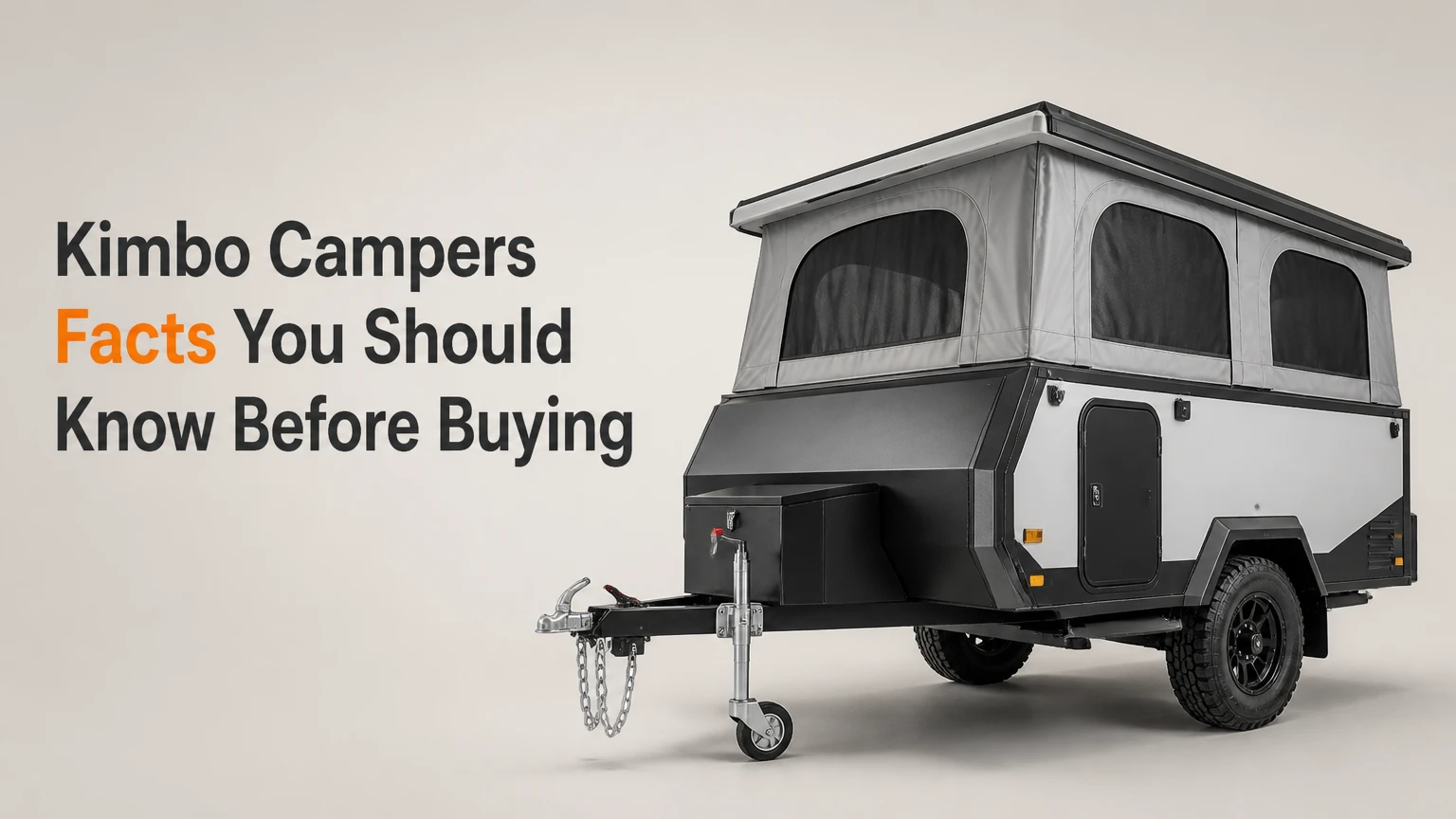
Kimbo Campers are lightweight, hard-sided truck campers built around an aluminum shell and modular interior equipment. The Kimbo 6Series is designed for truck-bed travel rather than trailer towing, but fitment depends on payload, bed dimensions, tie-down geometry, and the camper’s actual configured weight, not the brand’s general mid-size or full-size positioning.
Key Facts at a Glance
- Kimbo Campers use a riveted aluminum body with no conventional wood-framed structural shell.
- The Kimbo 6Series is a compact camper intended for selected mid-size and full-size pickup trucks.
- A reported base-shell figure near 900 pounds is a planning reference, not a universal ready-to-camp weight.
- A configured camper commonly requires a payload budget for the camper, water, propane, batteries, passengers, and equipment.
- Kimbo’s modular approach can reduce unused equipment, but portable power and external wastewater handling require more user involvement.
- Condensation control depends on ventilation, insulation continuity, cooking habits, and occupancy, especially in cold weather.
What Is a Kimbo Camper?
A Kimbo Camper is a compact, hard-sided slide-in truck camper with a riveted aluminum exterior, insulated walls, and a modular interior. The Kimbo 6Series uses the truck bed as its transport platform, allowing owners to remove the camper when they need the pickup for ordinary hauling.
The shell is often described as a frameless or monocoque structure. In practical terms, the exterior body carries much of the structural load instead of relying on a conventional wood or aluminum tube frame hidden behind wall panels. That construction reduces organic material that can rot, but it does not make the camper immune to water intrusion, fastener failure, seal deterioration, or impact damage.
Kimbo’s design prioritizes low profile, low mass, and compact living over apartment-like interior volume. The result is closer to a highly equipped sleeping pod than a conventional family RV. Two adults can use the space effectively, while taller groups, indoor-shower users, and owners carrying extensive sports equipment will encounter storage limits quickly.
Who makes Kimbo Campers?
Kimbo Campers is a North American truck-camper manufacturer associated with the Kimbo 6Series. Product details, prices, options, and delivery estimates can change by production year, dealer, and configuration, so a written factory quotation should control over an old listing or social-media post.
Ask for the current build sheet before comparing prices. The build sheet should identify shell weight, installed options, propane equipment, electrical components, jacks, windows, mattress, and any dealer-installed accessories. Those details determine whether a quoted “dry weight” is useful for truck matching.
How Does the Kimbo 6Series Work?
The Kimbo 6Series slides into a pickup bed and attaches to truck-mounted tie-down points through turnbuckles or equivalent hardware. The camper’s four corner jacks raise the body high enough for the truck to reverse underneath, after which the body is lowered, aligned, and tensioned to the truck’s tie-down system.
A heavy rubber bed mat is commonly used to increase friction and protect the truck bed. The mat is not a substitute for properly installed frame-mounted or stake-pocket tie-downs. Tie-downs transfer movement forces between camper and truck, while the mat mainly reduces sliding and abrasion.
The camper’s living systems are deliberately modular. A portable power station can supply 12-volt loads without requiring a permanently installed battery bank, inverter, and distribution system. That simplifies replacement and lets owners bring the power unit elsewhere, but it also means the owner must manage charging, connectors, battery capacity, and weather exposure.
What does monocoque aluminum construction change?
Monocoque aluminum construction changes repair priorities rather than eliminating maintenance. A damaged aluminum panel, rivet, window seal, or roof penetration still requires inspection, and a leak can damage insulation, flooring, cabinetry, or electrical components even when the structural shell cannot rot like untreated wood.
Aluminum also conducts heat rapidly. A metal interior surface or uninsulated fastener can become a thermal bridge, producing cold spots where indoor moisture condenses. Rigid foam insulation helps, but the actual result depends on joints, windows, doors, vents, and penetrations rather than the nominal insulation value alone.
What Are the Kimbo Camper’s Main Specifications?
The most frequently reported planning figures for a Kimbo shell include approximately 900 pounds of base weight, a 6-foot floor length, roughly 77 inches of exterior width, and about 6 feet 5 inches of interior headroom. These figures should be confirmed against the current manufacturer build sheet because options and measurement methods change the result.
| Attribute | Reported planning figure | Verification needed |
|---|---|---|
| Base-shell weight | Approximately 900 lb | Factory scale weight for the exact shell |
| Configured weight | Approximately 1,100-1,400 lb | Option list, propane, water, power unit, and jacks |
| Floor length | Approximately 6 ft | Bed-length and cab-clearance drawing |
| Exterior width | Approximately 77 in | Wheel-well, mirror, and side-clearance measurements |
| Interior headroom | Approximately 6 ft 5 in | Measurement location and roof-fan clearance |
| Mattress area | Approximately 54 x 75 in | Mattress shape, loft access, and usable sleeping length |
A 900-pound shell is not the same as a ready-to-camp camper. Water weighs about 8.3 pounds per U.S. gallon, propane adds container and fuel weight, and a portable power station can weigh between roughly 30 and 70 pounds depending on capacity. Bedding, food, clothing, recovery gear, and cooking equipment can add several hundred pounds.
Is a Kimbo Camper really universal?
No truck camper is universally compatible without qualification. The Kimbo profile may clear wheel wells on many mid-size and full-size pickups, but the truck still needs sufficient payload, an appropriate bed length, adequate cab clearance, compatible tie-down locations, and suitable rear-axle capacity.
The vehicle manufacturer’s payload label is the starting point. Ford, General Motors, Ram, Toyota, and Nissan assign payload by cab, engine, drivetrain, axle ratio, options, and tires, so the model badge alone cannot establish capacity. The door-jamb label is more useful than a generic internet payload chart.
Use this calculation:
Available camper payload = door-label payload minus passengers, fuel, cargo, accessories, and camper-ready equipment.
For example, a truck with a 2,000-pound payload rating, two 180-pound occupants, 150 pounds of cargo, 100 pounds of tools, and a 1,250-pound wet camper has only 140 pounds of remaining margin. That is technically different from being comfortably matched.
How Much Does a Kimbo Camper Cost?
Reported Kimbo pricing has commonly placed a base shell around $24,000-$26,000 and more extensively equipped builds around $35,000-$42,000. Those figures are purchasing benchmarks rather than guaranteed current prices, because options, freight, taxes, dealer charges, and production-year changes can materially alter the final invoice.
| Cost category | Typical planning range | What changes the number |
|---|---|---|
| Base camper shell | $24,000-$26,000 | Current production year and included equipment |
| Equipped camper | $35,000-$42,000 | Kitchen, climate, bathroom, electrical, and finish options |
| Truck tie-down system | $400-$1,500 | Brand, frame access, and installation labor |
| Bed mat and protection | $100-$350 | Custom fit, rubber thickness, and liner condition |
| Freight or delivery | $500-$2,500 | Distance, carrier, and dealer location |
| Initial truck preparation | $500-$3,000 | Tires, suspension, brakes, or payload-related upgrades |
A buyer should compare total ready-to-travel cost, not shell price. Include tie-downs, a bed mat, electrical adapters, cooking equipment, water containers, propane accessories, leveling blocks, insurance, registration, and any suspension or tire work required by the truck manufacturer’s limits.
A quoted lead time of 12-24 weeks is plausible for a made-to-order specialty camper, but the contract should define the deposit, production milestone, estimated completion date, delay remedies, and cancellation terms. A verbal delivery estimate is not a reliable planning document.
Which Kimbo Modules Matter Most?
Kimbo’s modular system allows owners to select equipment instead of automatically buying every system. The base shell is commonly associated with insulated windows, roof ventilation, a 12-volt solar input, and exterior gear storage, while kitchen, bathroom, climate, and power equipment may be selected separately.
| Module | Typical equipment | Main benefit | Main compromise |
|---|---|---|---|
| Kitchen | Stainless sink, cooktop, pump | Faster meal preparation indoors | Uses counter and storage space |
| Bathroom | Shower arrangement, dry-flush or composting toilet | More privacy and weather protection | Occupies compact floor area |
| Climate | Dickinson propane heater or roof air conditioner | Better temperature control | Adds weight, fuel, power, or ventilation demands |
| Power | Solar input and portable power station | Replaceable, movable electricity | Requires manual charging management |
| Base shell | Aluminum body, windows, fan, lockers | Lowest entry weight and price | Fewer integrated living systems |
The right configuration depends on how the camper will be used. A solo traveler who cooks outside may gain more from storage and solar capacity than from an indoor kitchen. A couple spending nights below freezing may value a properly vented heater, but the heater does not replace insulation, ventilation, and moisture management.
A dry-flush or composting toilet also does not create a complete bathroom automatically. Buyers should verify privacy, ventilation, consumable requirements, cleaning procedures, toilet capacity, and where shower water goes.
How Should You Install and Secure a Kimbo Camper?
Installing a Kimbo Camper typically takes one to two hours after the truck has compatible tie-downs and the owner has practiced the procedure. The most important success factor is correct fitment and even tie-down tension, not speed.
- Verify the truck. Confirm door-label payload, bed length, rear-axle rating, tire load capacity, cab clearance, and tie-down locations before loading.
- Prepare the bed. Remove the tailgate if the manufacturer’s clearance drawing requires removal, clean the bed, and place a properly sized rubber mat.
- Install tie-downs. Use frame-mounted or approved stake-pocket hardware that transfers load to the truck structure rather than thin bed sheet metal.
- Raise the camper. Extend all four jacks on level ground and keep the body high enough for the truck to reverse beneath it.
- Align the truck. Center the camper over the bed, check front and side clearances, and confirm that no wiring, plumbing, or trim contacts the truck.
- Lower the camper. Lower in controlled increments, checking that the floor and mat remain aligned and that the camper does not catch on bed rails.
- Attach turnbuckles. Connect each corner to its tie-down point, then tighten evenly according to the camper and tie-down manufacturer’s instructions.
- Inspect before travel. Close windows and doors, secure loose modules, check jack clearance, confirm lights and power connections, and recheck tension after a short drive.
The installation is complete when the camper cannot shift laterally, the turnbuckles are evenly tensioned, the truck remains within its ratings, and all clearance points remain free during suspension movement. Over-tightening is a genuine risk because excessive force can deform anchors or damage tie-down hardware.
What should you check after the first trip?
Recheck every turnbuckle, jack, fastener, exterior hatch, roof penetration, and electrical connector after the first 25-50 miles. Repeat the inspection after rough roads, because vibration can settle the camper against the mat and alter tension.
A practitioner rule is to photograph the installed tie-down arrangement before the first trip. The photos create a reference for correct hook orientation, turnbuckle length, cable routing, and clearance around the tailgate and exhaust.
How Does Kimbo Power and Climate Equipment Perform Off-Grid?
Kimbo’s modular 12-volt approach can work well for short off-grid trips when loads remain modest and the solar input receives unobstructed sunlight. Portable power stations are convenient because owners can remove or replace them, but a small unit may not support an air conditioner, refrigerator, cooking appliance, and charging devices for multiple days.
| Load or system | Typical demand | Practical planning implication |
|---|---|---|
| LED lighting | 3-15 W per fixture | Low impact on a 500-1,000 Wh battery |
| Roof ventilation fan | 1-4 A at 12 V | Continuous overnight use can matter |
| Compressor refrigerator | 20-60 Ah per day | Depends on ambient temperature and opening frequency |
| Portable power station | 500-2,000 Wh | Capacity varies by model and usable output |
| Roof air conditioner | Approximately 700-1,500 W | Often unsuitable for small batteries |
| Propane heater fan | Approximately 0.5-2 A at 12 V | Fuel supplies heat, battery powers controls and fan |
The solar port should be matched to the power station’s voltage, current, connector, and maximum solar-input rating. A panel can be electrically compatible yet still exceed the station’s input limit. Clean panels help, but shade, low winter sun, snow, and incorrect wiring are usually larger constraints.
Propane heat requires ventilation and a correctly installed carbon-monoxide detector. The U.S. Consumer Product Safety Commission warns that carbon monoxide is an odorless, colorless gas produced by fuel-burning appliances, so a heater should never be operated with blocked vents or without a functioning alarm.
How Can You Control Condensation?
Kimbo Camper condensation is controlled through continuous air exchange, reduced indoor moisture, and management of cold surfaces. Opening a roof fan slightly and cracking an opposite window creates cross-ventilation, while cooking, showering, and drying wet clothing without ventilation can overwhelm the insulation system.
Condensation forms when humid interior air reaches a surface below its dew point. Aluminum transfers exterior cold efficiently, so corners, window frames, fasteners, and roof edges may show moisture before insulated wall centers do.
Use this cold-weather routine:
- Run the roof fan on a low setting during sleep.
- Crack a window on the opposite side for replacement air.
- Cook with ventilation operating and use a lid on boiling water.
- Dry wet clothing outside or in a ventilated area.
- Wipe window frames and metal cold spots each morning.
- Inspect for actual leaks around roof penetrations and windows.
A propane heater can make the interior feel warmer while adding or redistributing moisture depending on the appliance and combustion arrangement. Dry heat may improve comfort, but it does not correct a blocked vent, missing seal, thermal bridge, or persistent leak.
What Are the Main Advantages and Limitations?
The strongest Kimbo advantages are low structural weight relative to many conventional hard-side campers, resistance to wood rot, compact exterior dimensions, and modular equipment selection. The same compact architecture limits interior storage, bathroom convenience, and the amount of permanently integrated utility capacity.
Advantages
- Reduced rot exposure: Aluminum and synthetic components avoid many wood-rot failure modes.
- Lower mass: A properly matched truck may retain more payload than it would with a heavier conventional camper.
- Removability: The slide-in design preserves pickup utility when the camper is stored.
- Modularity: Owners can select a kitchen, climate system, bathroom, or portable power system according to use.
- Compact profile: The short body can fit narrow campsites and some forest-road routes more easily than a large RV.
Limitations
- Small living area: A roughly 6-foot floor constrains movement and storage for two adults.
- Condensation exposure: Metal surfaces require disciplined ventilation in cold or humid weather.
- Limited wastewater integration: A portable gray-water container demands campsite compliance and daily handling.
- Truck dependence: The camper’s safety depends on the truck’s payload, tires, axle, brakes, and tie-downs.
- Option inflation: Adding kitchen, bathroom, air conditioning, heater, and power equipment can erase the initial weight advantage.
Kimbo Campers are not ideal for families needing separate beds, large wet bathrooms, extensive indoor storage, or long-duration occupancy without external gear. A compact shell can be excellent for mobile weekends and overland travel while being frustrating as a stationary four-season residence.
How Does a Kimbo Compare With Alternatives?
Kimbo is strongest when a buyer wants a hard-sided, removable camper with a distinctive compact layout and modular systems. A pop-up camper generally offers lower wind resistance and more interior space for its weight, while a conventional hard-side camper may provide larger tanks and facilities at the cost of greater mass.
| Option | Typical weight range | Sleeping capacity | Main utility pattern |
|---|---|---|---|
| Kimbo 6Series | Approximately 900-1,400 lb | 2 adults | Compact hard-side truck travel |
| Mid-size pop-up camper | Approximately 800-1,500 lb | 2-4 people | Lower profile, more flexible interior |
| Conventional hard-side slide-in | Approximately 1,500-3,000 lb | 2-5 people | Larger tanks, bathroom, and storage |
| Small cargo-van conversion | Approximately 4,500-7,000 lb vehicle | 2-4 people | Integrated living and driving platform |
| Teardrop trailer | Approximately 1,000-2,500 lb trailer | 2 adults | Separate tow vehicle and outdoor living |
A pop-up is often better for owners who prioritize sleeping capacity and lower highway profile. A conventional hard-side camper is better for owners who need a built-in bathroom, larger refrigerator, or extended stationary use. A van conversion is better when the living space must remain attached to the driving system.
The comparison changes for remote travel. A Kimbo can leave the truck available for hauling after removal, while a van conversion cannot. A trailer can provide more floor area, but reversing, campsite length, hitch weight, and off-road departure angle become separate constraints.
Which Owners Are Best Matched to a Kimbo?
A Kimbo is best matched to owners who accept compact living, perform payload calculations, and prefer modular equipment over integrated RV systems. The camper makes the most sense when the truck already has adequate capacity and the owner values removability more than a large bathroom or residential storage.
| Owner profile | Suitable configuration | Reasonable expectation | Main caution |
|---|---|---|---|
| Solo overlander | Base shell, solar, portable kitchen | Low equipment complexity and flexible storage | Outdoor cooking in poor weather |
| Weekend couple | Kitchen, fan, selected climate option | Comfortable short trips | Tight indoor movement |
| Cold-weather traveler | Heater, ventilation, insulation inspection | Better winter comfort | Condensation and fuel management |
| Remote worker | Larger power station, solar, desk arrangement | Short-duration mobile work | Battery depletion and limited privacy |
| Family of four | Usually a larger camper or trailer | More sleeping and storage capacity | Kimbo floor area is restrictive |
An owner who camps mainly at established sites may not need a bathroom module or large battery. An owner who boondocks for several days should calculate water, food, refrigeration, toilet, charging, and weather exposure separately rather than assuming a solar panel solves every utility need.
What Problems Should Owners Troubleshoot First?
The first troubleshooting step is to identify whether the problem involves movement, moisture, power, fuel, or a failed seal. Kimbo Camper owners should inspect the simplest external cause before replacing a module or blaming the aluminum shell.
| Symptom | Likely cause | First corrective action |
|---|---|---|
| Camper shifts in bed | Slick mat or loose tie-downs | Fit a 3/8-inch rubber mat and retension evenly |
| Wall moisture appears | Humid air or cold bridge | Run fan, crack window, inspect seals |
| Solar does not charge | Shade, dirty panel, loose SAE connection | Clean panel and verify connector seating |
| Heater will not run | Low battery, fuel issue, blocked vent | Check battery, propane supply, and ventilation |
| Water appears after rain | Failed seal or roof penetration | Dry area and inspect sealant path |
| Turnbuckle loosens | Settling, vibration, or poor alignment | Stop, realign, and retighten per instructions |
Do not continue driving with a shifting camper. Movement can damage the bed, tie-downs, anchor points, or camper structure even when the truck feels stable from the cab.
A second practitioner rule is to distinguish condensation from leakage with timing. Moisture after sleeping on a cold night points toward humidity, while a localized wet trail after rain points toward a seal, window, roof vent, or fastener problem. Both can occur together.
What Should You Verify Before Ordering?
Before ordering, request the current specification sheet, option prices, warranty terms, tie-down requirements, electrical diagrams, dimensions, and a truck-specific fitment confirmation. A manufacturer or dealer should be able to state which measurements they used and which assumptions remain the buyer’s responsibility.
Use this verification checklist:
- Confirm wet weight for the exact selected options.
- Compare that weight with the truck’s door-label payload.
- Calculate occupants, fuel, water, food, tools, and recreational gear.
- Confirm bed length, wheel-well dimensions, cab clearance, and tailgate requirements.
- Identify approved tie-down brands and installation points.
- Request roof-load, jack, and travel-speed instructions.
- Confirm toilet, gray-water, propane, and cooking arrangements.
- Ask how warranty claims handle rivets, seals, windows, and modular equipment.
- Confirm delivery timing, deposit terms, freight, taxes, and cancellation conditions.
- Obtain a pre-delivery inspection appointment or photo record.
The most important document is the final build sheet with weight and options. Marketing photographs cannot establish payload compliance, and a dealer’s generic “fits a Tacoma” or “fits an F-150” statement cannot replace truck-specific measurements.
Frequently Asked Questions
Can a Toyota Tacoma carry a Kimbo Camper?
Some Toyota Tacoma configurations may carry a Kimbo Camper, but compatibility depends on door-label payload, cab and bed configuration, passengers, equipment, and actual camper-ready weight. A Tacoma with a low payload label can exceed its rating after adding two adults, water, camping gear, and tie-down hardware, even when the empty shell appears lightweight.
Does a Kimbo Camper include a bathroom?
A Kimbo Camper may be configured with a toilet or shower-related module, but buyers should verify the exact current package because bathroom equipment is not necessarily included in the base shell. Ask how shower water is collected, how the toilet is ventilated, and whether the layout preserves usable sleeping and storage space.
Can you use a Kimbo Camper in winter?
A Kimbo Camper can support cold-weather trips when the heater, ventilation, insulation, plumbing, and condensation plan are appropriate. It is less suitable for careless winter use because aluminum cold bridges, window moisture, frozen water containers, propane ventilation, and limited interior drying space become significant operating concerns.
Does a Kimbo Camper need a special suspension upgrade?
A suspension upgrade is not automatically required, and it cannot legally increase the truck manufacturer’s gross vehicle weight rating. Tire capacity, axle ratings, payload, brake condition, and actual loaded weight should be assessed first; suspension aids may improve ride attitude but do not correct an overloaded truck.
How long does Kimbo Camper delivery take?
A typical quoted production window is approximately 12-24 weeks, but delivery depends on production scheduling, selected modules, inventory, freight, and seasonal demand. The purchase agreement should record the estimated completion date and explain what happens if the build is delayed.
Is a Kimbo better than a van conversion?
A Kimbo is usually better when the owner already has a suitable pickup and wants a removable camper with a compact hard-sided body. A van conversion is usually better when integrated driving and living space, interior storage, weather security, and daily usability matter more than removing the living unit from the vehicle.
The Bottom Line
The most important Kimbo Campers facts you should know concern fitment, real loaded weight, compact living, ventilation, and total ownership cost. The aluminum shell and modular systems offer a credible alternative to heavier conventional campers, but the design does not eliminate payload limits, condensation, tie-down maintenance, or the need for careful utility planning.
Treat the commonly reported 900-pound shell and $24,000-$42,000 pricing ranges as starting points. Confirm the exact build sheet, calculate the truck’s remaining payload, inspect every tie-down and roof penetration, and choose modules according to actual camping conditions rather than showroom completeness.