A truck may not go in reverse because the transmission cannot engage or hold its reverse power path. Common causes include low or incorrect automatic-transmission fluid, a failed solenoid or range sensor, worn reverse clutches, a damaged valve body, manual-clutch drag, broken shift linkage, or damaged reverse gears. The exact symptom determines the likely fault.
Key Facts at a Glance
- An automatic truck that has every forward gear but no reverse often has a reverse clutch, hydraulic circuit, valve-body, or electronic control problem.
- A manual truck that grinds when reverse is selected usually has clutch drag or a linkage problem, not necessarily a destroyed reverse gear.
- A shifter that moves loosely or fails to show the correct gear can indicate a cable, rod, range-sensor, or transmission-selector fault.
- Dark, burnt-smelling automatic-transmission fluid can indicate overheated friction material, but fluid color alone cannot prove internal failure.
- A transmission fluid flush is not an automatic cure for lost reverse and can be inappropriate when the fluid is badly contaminated or the unit has mechanical damage.
- Driving while reverse slips can spread friction material and metal through the transmission, increasing the eventual repair cost.
How Does Reverse Gear Work?
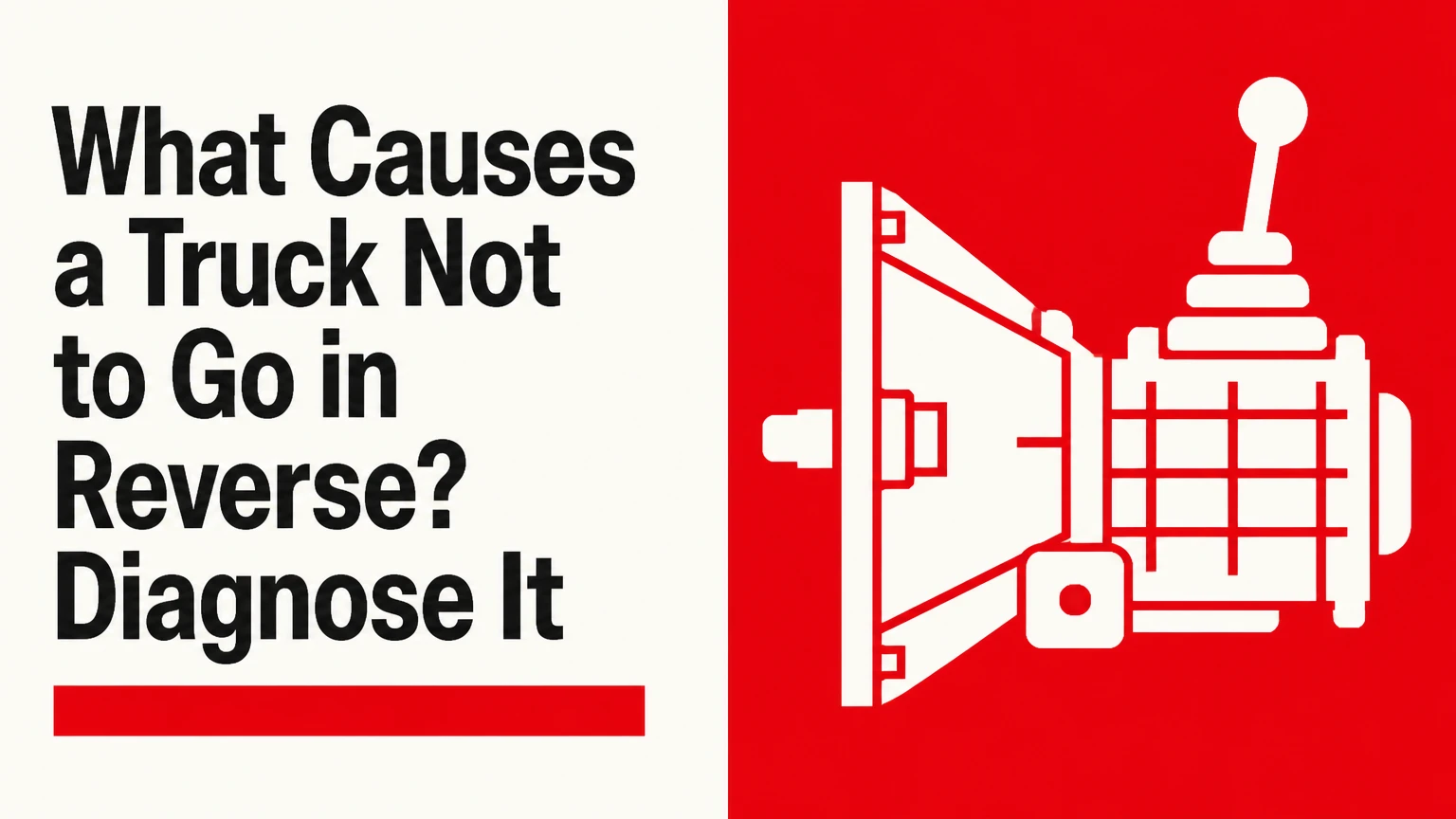
Reverse gear works by routing engine torque through a dedicated gear arrangement that changes the output direction. Automatic transmissions usually apply a reverse clutch or band within a planetary gearset, while manual transmissions engage a reverse idler gear between rotating shafts. Four-wheel-drive trucks may also require a transfer case to engage its reverse path correctly.
Automatic transmission operation
When the driver selects R, the transmission range sensor or neutral safety switch reports the selection to the transmission control module. The control module commands one or more solenoids, and pressurized automatic transmission fluid applies the reverse clutch circuit.
A torque converter allows the engine to keep running while the truck is stationary. The transmission pump then supplies hydraulic pressure, while the valve body directs that pressure through passages, valves, and accumulators. If pressure reaches the reverse clutch but the friction discs are worn, the truck may move slowly, flare in engine speed, or fail under load.
Manual transmission operation
A manual gearbox uses the clutch to disconnect engine torque from the transmission input shaft. The shift mechanism then moves a reverse idler gear or reverse slider into position, changing the direction of the output shaft.
Many manual transmissions do not use a synchronizer for reverse. That design explains why reverse may grind if the input shaft is still rotating, even when the reverse gear itself is healthy. Waiting several seconds with the clutch depressed, or selecting a forward gear briefly before reverse, can stop shaft rotation on some vehicles, but the owner’s manual should control the procedure.
Why Does an Automatic Truck Lose Reverse?
An automatic truck loses reverse when the reverse clutch circuit cannot create pressure, apply its friction elements, or transmit torque. The most likely causes are a low fluid level, restricted filter, failed solenoid, stuck valve, damaged wiring, worn reverse clutch pack, broken input component, or a control system that does not recognize R.
| Symptom on an automatic truck | More likely area | Recommended confirmation |
|---|---|---|
| No reverse, forward gears normal | Reverse clutch, servo, valve body | Line-pressure test and transmission-specific scan |
| Delayed reverse engagement | Low fluid, leaking seal, worn clutch | Fluid level check and engagement-pressure test |
| Reverse slips under throttle | Worn clutch pack or low pressure | Pressure test, fluid inspection, clutch-capacity diagnosis |
| Reverse works cold, fails hot | Internal seal leakage or worn clutch | Hot and cold pressure comparison |
| Shifter indicates wrong gear | Range sensor, cable, selector | Scan data and external selector inspection |
| Reverse works after battery reset | Control or solenoid fault | TCM codes, live data, wiring tests |
| No reverse and harsh forward shifts | Low fluid, valve body, pump, control fault | Fluid level, pressure, and full code scan |
Low, wrong, or damaged fluid
Automatic transmissions need the correct fluid volume and specification to operate their hydraulic circuits. A low level can allow the pump to draw air, while the wrong fluid can alter clutch friction and shift-control behavior.
Check the level exactly as the manufacturer specifies. Some dipsticks require the engine idling in Park, while many sealed transmissions require a temperature-controlled level check from a fill plug. Do not assume every truck uses the same method.
Fluid problems become more suspicious when reverse engagement is delayed, the transmission whines, or the fluid level is below the marked range. A leak at a cooler line, axle seal, pan gasket, front pump seal, or electrical connector can cause the loss.
Failed solenoid, wiring, or range sensor
A shift solenoid controls fluid flow, but replacing a solenoid solely because a code appears can waste money. A solenoid code may result from damaged wiring, a poor ground, contaminated fluid, a stuck valve, or a mechanical failure that prevents the commanded gear ratio.
The transmission range sensor tells the control module whether the lever is in Park, Neutral, Drive, or Reverse. A failed sensor or misadjusted selector cable may leave the cabin lever in R while the transmission manual lever remains between positions.
A professional diagnosis compares commanded gear, reported gear, solenoid current, fluid pressure, and output-speed data. A basic engine-only OBD-II scan may not retrieve manufacturer-specific transmission information.
Valve-body or hydraulic-pressure failure
The valve body contains passages, spool valves, check valves, and pressure-control components. Debris can cause a spool valve to stick, while worn bores can let pressure escape before the reverse clutch applies.
A line-pressure gauge provides more useful evidence than fluid color alone. A technician compares the pressure specification in Park, Drive, and Reverse at defined engine speeds. Low pressure in every range points toward a pump, filter, regulator, or fluid-supply problem; low pressure only in Reverse points more strongly toward the reverse circuit.
Worn reverse clutch or band
A reverse clutch pack can wear until its plates no longer clamp firmly. The usual signs are engine-speed flare, delayed engagement, slipping under load, and burnt fluid containing friction debris.
A reverse-only failure does not always mean the entire transmission has failed. Some transmissions use a dedicated reverse clutch, servo, drum, or band that can fail while forward gears remain usable. The repair still may require transmission removal because internal components are inaccessible in the vehicle.
Transfer-case and drivetrain faults
A four-wheel-drive truck can have a transmission that selects reverse correctly while the transfer case, shift motor, range fork, or driveshaft prevents motion. A damaged universal joint, differential, axle shaft, or electronically controlled transfer case can also imitate a transmission problem.
Test the truck in two-wheel drive and four-wheel drive only according to the manufacturer’s procedure. Do not crawl under a running vehicle with the wheels unsupported, and do not continue testing if the drivetrain makes a loud bang, grinding noise, or repeated clunk.
Why Does a Manual Truck Refuse Reverse?
A manual truck usually refuses reverse because the clutch fails to release fully, the external shift linkage cannot reach the reverse position, or the reverse idler gear and related teeth are damaged. Grinding with the engine running but not with the engine stopped strongly suggests clutch drag or shaft rotation.
Clutch drag
A clutch drags when the disc continues spinning after the pedal is fully depressed. Hydraulic causes include low clutch fluid, air, a leaking master cylinder, a failing slave cylinder, or insufficient pedal travel. Mechanical causes include a warped disc, damaged pilot bearing, bent fork, or incorrect clutch adjustment.
Clutch drag often affects first gear as well as reverse. The truck may creep forward with the pedal down, become difficult to shift into first at a stop, or grind during reverse selection.
Shift cable, rod, or tower damage
External linkage can stretch, break, lose a bushing, or move out of adjustment. A loose shifter with unusually little resistance is a strong clue. Another clue is a lever that selects reverse with the engine off but cannot reach it with the engine running because the driver is forcing against rotating components.
An assistant can move the cabin shifter while a technician observes the transmission selector. The selector should travel through its complete range and reach the reverse detent. Keep hands, clothing, and tools away from rotating driveshafts and exhaust components.
Reverse idler or slider damage
Reverse gear teeth can chip if the driver forces the lever while the gears are rotating, although a single grinding event does not automatically destroy the transmission. Persistent grinding, popping out of reverse, or a reverse gear that engages but produces a harsh whine points toward internal wear.
Many manual gearboxes have no reverse synchronizer, so a small amount of gear noise can be a design characteristic. Loud grinding with a correctly operating clutch is not normal.
What Should You Check First?
Start with the symptom, fluid or clutch condition, selector movement, and electronic data before authorizing a transmission replacement. The first inspection usually takes 20-45 minutes, requires basic tools, and can separate an external adjustment problem from an internal failure.
| Check | Automatic truck procedure | Manual truck procedure | Interpretation |
|---|---|---|---|
| Selector position | Verify R appears on the cluster | Verify full lever travel | Wrong indication suggests linkage or sensor trouble |
| Fluid or clutch hydraulics | Check ATF at specified temperature | Check clutch reservoir and leaks | Low level requires leak diagnosis |
| Reverse engagement | Apply brake, select R, observe delay | Select reverse with engine off and running | Delay or slip suggests hydraulic or clutch trouble |
| Noise | Listen for whine, bang, grind | Listen for grind or pop-out | Noise helps localize mechanical damage |
| Scan data | Read TCM codes and live data | Scan engine and related modules | Codes guide testing, not automatic parts replacement |
Automatic transmission checks
- Park on level ground, apply the parking brake, and chock the wheels.
- Confirm the fluid specification and level-check temperature from the service information.
- Inspect the fluid for metallic glitter, a burnt odor, coolant contamination, or an abnormal level.
- Scan the transmission control module, not only the engine computer.
- Inspect the selector cable, transmission range sensor, connectors, grounds, and visible leaks.
- Stop operating the truck if reverse slips, engages violently, or produces metal-bearing fluid.
Do not pour in fluid as a substitute for finding a leak. Do not perform a power flush on every failed transmission. A drain-and-fill, filter replacement, or fluid exchange must match the transmission design and the technician’s diagnosis.
Manual clutch test
With the truck on level ground and the parking brake applied, place the transmission in Neutral and start the engine. Depress the clutch fully, wait several seconds, then select reverse without forcing the lever.
If the truck creeps, reverse grinds heavily, or first gear is difficult to select, the clutch probably is not releasing fully. A technician can measure clutch hydraulic travel and inspect the master cylinder, slave cylinder, fork, pilot bearing, and disc.
A simple engine-off comparison is useful. If reverse selects easily with the engine off but not with the engine running, the transmission linkage may be reaching the gear while the clutch continues to spin the input shaft.
What Does Each Reverse Symptom Mean?
The symptom pattern narrows the diagnosis more effectively than the phrase “no reverse.” A truck that never engages, a truck that slips after engagement, and a truck that grinds during selection have different first suspects.
| Observed behavior | Probable fault category | Do not assume |
|---|---|---|
| Reverse never engages, no noise | Selector, solenoid, pressure, clutch pack | The whole transmission needs replacement |
| Reverse engages after 5-20 seconds | Low pressure, fluid leak, worn seals | A fluid additive will repair the seal |
| Reverse moves only at high throttle | Worn clutch, low line pressure | More throttle is a safe test |
| Reverse works on level ground only | Clutch capacity, pressure, drivetrain load | The transfer case is automatically at fault |
| Truck rolls forward in reverse | Wrong selector position, clutch drag, internal gear issue | The engine direction has changed |
| Grinding occurs only with engine running | Clutch drag or absent reverse synchronizer | Reverse teeth are necessarily broken |
| Reverse pops out | Detent, shift fork, linkage, gear engagement | Continuing to hold the lever fixes it |
| No movement in Reverse or Drive | Pump, torque converter, main pressure, axle | A reverse-only clutch is the cause |
A counterintuitive diagnostic rule is that no noise can be worse than noise. A quiet transmission with no reverse may have an electrical or hydraulic command failure, while a loud transmission gives direct mechanical evidence that helps locate the damage.
Can a Sensor or Solenoid Cause the Problem?
A sensor or solenoid can prevent reverse, but the component should be confirmed with scan data, electrical testing, and hydraulic measurement. The transmission range sensor may prevent the control module from commanding reverse, while a shift solenoid may fail to route pressure even when R is correctly recognized.
Typical diagnostic codes vary by manufacturer and transmission. Generic examples include P0705 for range-sensor performance, P0736 for an incorrect reverse ratio, and P0766 for a shift-solenoid performance fault, but code definitions and affected circuits differ by vehicle.
A code does not identify the failed part with certainty. For example, P0736 can occur because the module commanded reverse but detected an unexpected input-to-output speed relationship caused by low pressure, clutch slip, a sensor problem, or internal damage.
How Much Does Reverse Repair Usually Cost?
Typical repair costs range from about $100 for a confirmed external adjustment or fluid service to more than $5,000 for an internal automatic-transmission rebuild or replacement. Labor rates, truck size, transmission model, regional pricing, and warranty coverage change the final estimate substantially.
| Repair scenario | Typical parts cost | Typical labor time | Typical installed range |
|---|---|---|---|
| Fluid and filter service | $50-$250 | 1-3 hours | $150-$450 |
| Shift cable or linkage repair | $50-$300 | 1-3 hours | $200-$700 |
| Range sensor or solenoid | $100-$500 | 1-5 hours | $300-$1,000 |
| Manual clutch replacement | $300-$1,200 | 5-10 hours | $900-$2,500 |
| Valve-body repair | $500-$1,800 | 4-10 hours | $1,200-$3,500 |
| Automatic rebuild or remanufactured unit | $1,500-$4,000 | 10-20 hours | $3,000-$7,000 or more |
These are typical North American repair ranges, not a quote. Heavy-duty diesel transmissions, integrated transfer cases, dual-clutch systems, and commercial labor rates can exceed the table.
A shop should identify the test supporting the estimate. “Needs a transmission” is incomplete without the relevant code, pressure result, fluid evidence, teardown finding, or confirmed selector fault.
Should You Repair, Rebuild, or Replace the Transmission?
Repair the external or electronic cause when testing isolates a cable, sensor, solenoid, connector, or fluid issue. Choose a rebuild when the case and major hard parts are reusable and the shop can provide a written warranty; choose a remanufactured unit when downtime and predictable warranty coverage outweigh the higher part cost.
| Option | Typical downtime | Typical warranty pattern | Best fit |
|---|---|---|---|
| External repair | Same day to 2 days | 12-24 months typical | Cable, sensor, connector, leak |
| Local rebuild | 3-10 days | 12-36 months typical | Repairable internal wear |
| Remanufactured transmission | 2-7 days after availability | 3 years or 100,000 miles common | Fleet and high-mileage use |
| Used salvage transmission | 1-5 days | 30-90 days common | Low-value truck with limited budget |
A used transmission is not automatically cheaper after installation. If a replacement unit fails shortly after installation, the owner may pay removal and installation labor twice, even when the salvage part itself carries a limited warranty.
A remanufactured unit is also not automatically the best option. Compatibility must include the transmission code, calibration, torque-converter specification, transfer-case interface, cooler requirements, and vehicle control-module programming.
What Mistakes Make Reverse Failure Worse?
Continuing to drive with slipping reverse can turn a localized clutch problem into a contaminated transmission repair. Repeated high-throttle attempts generate heat, remove friction material, and circulate debris through solenoids, valve-body passages, bearings, and cooler lines.
Avoid these mistakes:
- Do not force a grinding manual shifter. Stop, return to Neutral, release and depress the clutch, then follow the vehicle’s recommended selection procedure.
- Do not add unspecified fluid. Verify the exact ATF or manual-transmission lubricant specification.
- Do not approve a flush before diagnosis. A service may help maintenance-related shift problems, but it cannot restore worn friction discs or broken gears.
- Do not trust an engine-only code scan. Many transmission faults require a scan tool that communicates with the TCM.
- Do not test underneath an unsupported truck. Use rated ramps or jack stands, wheel chocks, and a safe observer.
- Do not keep towing with delayed reverse. Trailer load can expose a marginal clutch or hydraulic circuit and accelerate failure.
One practitioner rule is worth remembering: reverse-only failure with normal forward operation often points to a dedicated reverse circuit, not a complete loss of transmission function. That observation helps prevent an expensive replacement before basic pressure and selector tests.
When Is the Truck Unsafe to Drive?
Do not drive the truck if reverse slips badly, the transmission leaks rapidly, the truck moves in Neutral, the selector shows the wrong gear, or a loud grinding or banging noise occurs. Arrange transport when the truck cannot maneuver safely, especially on slopes, near traffic, or while attached to a trailer.
A short drive to a repair shop may be reasonable when forward gears engage normally, fluid is at the specified level, there is no severe noise or leak, and the truck remains controllable. Avoid reversing the vehicle by spinning tires or using high engine speed.
Commercial operators should record the exact operating condition, fluid temperature, warning lights, codes, delay time, and load status. That information helps a technician reproduce an intermittent fault and reduces unnecessary parts replacement.
What Information Does a Technician Need?
A technician needs the truck’s year, make, model, engine, transmission code, drivetrain layout, mileage, and the precise reverse symptom. The most useful description includes whether forward gears work, whether reverse slips or never engages, whether the problem changes when hot, and whether warning lights or noises appeared.
Provide these details:
- Automatic, manual, automated manual, or hybrid transmission
- Two-wheel drive, four-wheel drive, or all-wheel drive
- Reverse failure when cold, hot, loaded, unloaded, or on an incline
- Delay before engagement, measured in seconds
- Grinding, whining, clicking, clunking, or no noise
- Recent fluid service, towing event, overheating, battery work, or collision
- Transmission codes and freeze-frame data
- Whether the shifter indicator matches the selected position
Limitations of symptom-based diagnosis
A symptom guide cannot identify a specific failed clutch, valve, gear, or control module without vehicle-specific service information and test results. Transmission layouts differ widely, and the same P0736 or “no reverse” complaint can arise from unrelated faults on different trucks.
Fluid color, a resistance reading, or one road test is not enough to approve a rebuild. The reliable sequence combines external inspection, electronic data, fluid condition, pressure testing, and internal inspection when the earlier tests justify removal.
Frequently Asked Questions
Can a bad battery make a truck lose reverse?
A weak battery or poor ground can cause low system voltage, communication faults, and incorrect transmission-solenoid operation, especially after a battery replacement or jump-start. Check battery voltage, charging voltage, grounds, and transmission codes before replacing hydraulic parts. A battery problem is more likely when several electrical functions fail together.
Why does reverse work when the truck is cold but fail when hot?
Reverse that works cold but fails hot commonly indicates an internal seal leak, worn clutch clearance, or pressure loss that becomes worse as fluid thins. A technician should compare cold and hot line pressure and inspect fluid condition. Replacing fluid without locating the pressure loss usually provides only temporary improvement.
Can low transmission fluid cause only reverse to fail?
Low automatic-transmission fluid can cause reverse-only failure when the reverse circuit requires more pressure or draws fluid through a pickup exposed during vehicle movement. Low fluid can also cause delayed engagement in Drive, whining, slipping, or erratic shifts. Find and repair the leak before setting the level.
Why does the truck move forward when reverse is selected?
Forward movement in the Reverse position can result from a misadjusted selector, incorrect range-sensor data, a damaged valve body, or an internal transmission control failure. On a manual truck, clutch drag can make the vehicle creep, but it does not normally create a properly powered forward gear in the reverse position.
Is a transmission additive a real fix for no reverse?
A transmission additive cannot repair broken gears, a failed solenoid coil, a leaking clutch seal, or worn friction discs. Some products temporarily alter seal swelling or friction behavior, which can mask symptoms and complicate diagnosis. Use only fluids and approved additives specifically permitted by the transmission manufacturer.
How long can a truck drive without reverse?
A truck should not be driven without reverse when maneuvering requires repeated throttle, the transmission slips, fluid leaks, or the vehicle cannot select the correct gear. Even if forward gears work, continued operation can increase heat and contamination. A tow is usually cheaper than converting a limited failure into a rebuild.
The Bottom Line
The answer to what causes a truck not to go in reverse depends first on transmission type and symptom pattern. Automatic trucks commonly lose reverse through low fluid, a range-sensor or solenoid fault, valve-body pressure loss, or a worn reverse clutch; manual trucks more often have clutch drag, linkage trouble, or damaged reverse gearing.
Check the selector, fluid or clutch hydraulics, warning codes, and operating symptoms before authorizing major work. Stop driving when reverse slips, the truck moves in Neutral, fluid leaks, or severe noise appears, because early diagnosis can separate a relatively small external repair from a high-cost transmission rebuild.