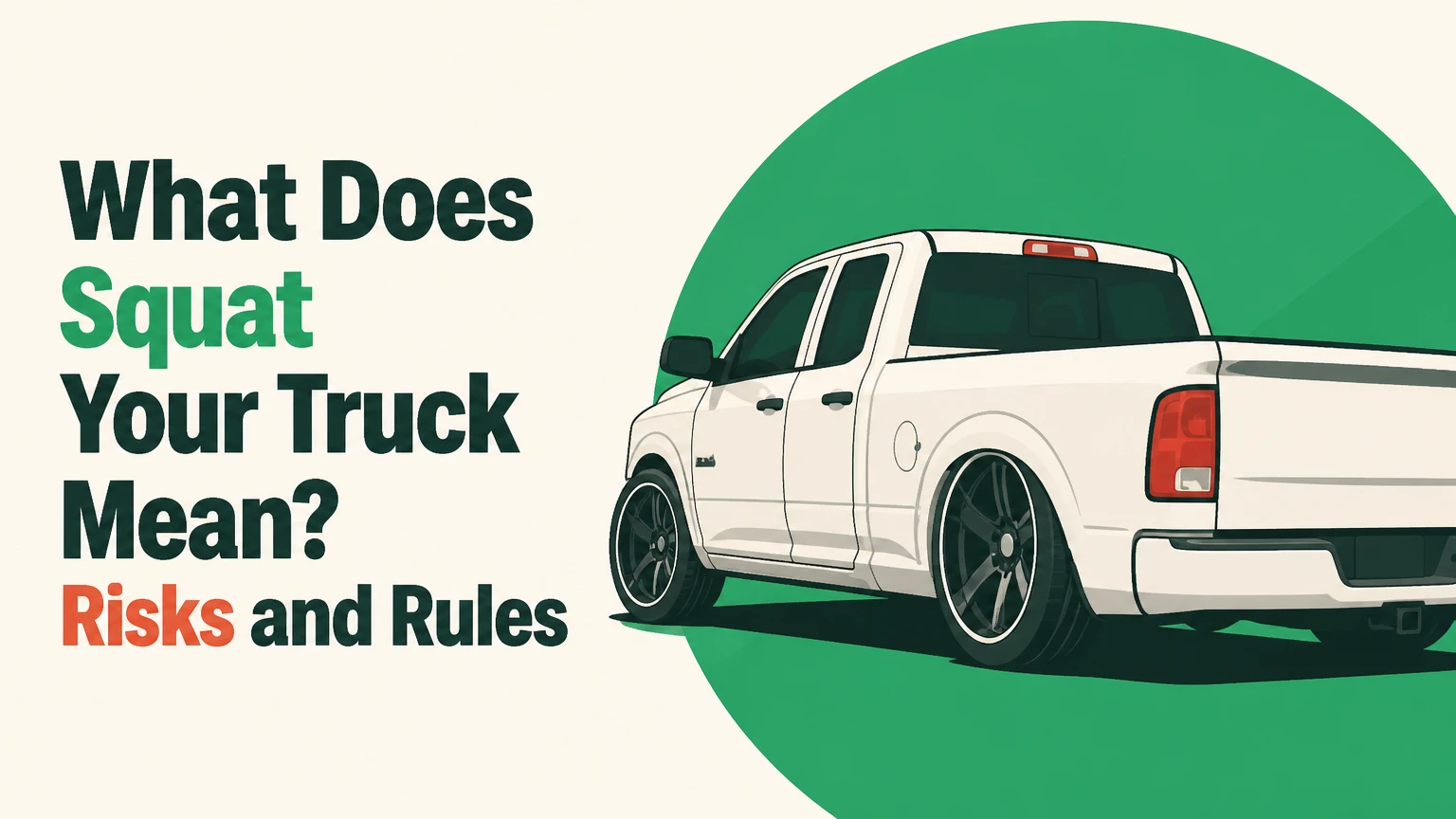
“What does squat your truck mean?” refers to modifying a pickup or SUV so the front sits substantially higher than the rear, producing a nose-up, tail-down stance. The style is commonly called the Carolina Squat, Cali Lean, or Baja Stance, although a street-built squatted truck is primarily a visual modification rather than functional desert-racing equipment.
Key Facts at a Glance
- A squatted truck has a front-to-rear height difference, not an evenly raised suspension.
- Carolina Squat commonly describes a front lift combined with a stock-height or lowered rear.
- Typical builds create roughly 2-10 inches of front height difference, but terminology is informal.
- A squatted truck can alter headlight aim, suspension travel, alignment, braking behavior, and driveline angles.
- No single four-inch rule applies across the United States; legality depends on current state and local requirements.
- A level stance, balanced lift, or adjustable air suspension usually preserves more daily-driving function than a fixed extreme rake.
What Does Squat Your Truck Mean in Automotive Terms?
A squatted truck is a pickup or SUV with a deliberately exaggerated reverse rake: the front axle or front bodywork sits higher than the rear. Factory trucks usually have a small positive rake, meaning the rear is slightly higher when unloaded so the vehicle can settle level under passengers or cargo. Squatting reverses that relationship.
The visible result is a raised hood, a lowered-looking tailgate, and a body line that slopes upward toward the front. The suspension may create the appearance through a six-inch front lift, rear block removal, rear drop shackles, altered leaf springs, or an adjustable air system. The exact parts differ by truck.
The word “squat” can also describe temporary rear suspension compression when a truck accelerates, carries a load, or launches off-road. That is different from a permanently squatted truck. In the modification context, the stance remains nose-high while the vehicle is parked.
What do Carolina Squat, Cali Lean, and Baja Stance mean?
Carolina Squat, Cali Lean, and Baja Stance usually describe variations of the same nose-high visual trend, but regional usage is inconsistent. Carolina Squat generally means a pronounced fixed rake, while Cali Lean may refer to a milder nose-up stance. Baja Stance points to desert-racing imagery, even though street versions lack the race truck’s functional suspension system.
“Baja” is therefore a style reference, not proof that a truck can safely travel at racing speeds. A genuine prerunner uses long-travel suspension, correct damping, reinforced mounting points, suitable tires, and carefully controlled geometry.
Why Do People Squat Trucks?
People squat trucks for appearance, group identity, customization, and the visual connection to desert racing. The high front end makes a standard pickup look more aggressive and creates a recognizable silhouette at shows, meets, and social events.
Some owners also want additional front fender clearance for large tires or aftermarket wheels. That objective does not require an extreme rear-to-front height mismatch. A properly engineered, even lift can provide similar clearance while retaining more predictable suspension behavior.
The modification also developed as a cultural trend, so owner motivation is not always mechanical. A squatted truck may be built for a show-only setting, personal expression, or regional scene participation rather than hauling, towing, or trail performance.
How Is a Squatted Truck Built?
A squatted truck is usually created by raising the front, lowering or retaining the rear, or combining both changes. The front may use coil spacers, torsion-bar adjustment, replacement coils, lift spindles, control arms, coilovers, or a complete suspension lift. The rear may retain its original height, lose factory lift blocks, use drop shackles, or receive a custom air-ride system.
The correct parts depend on the truck’s suspension design. Independent front suspension, solid front axles, coil-spring rears, and leaf-spring rears have different geometry and load paths. A part that fits a Chevrolet Silverado cannot automatically be transferred to a Ford F-150, Toyota Tacoma, Ram 1500, or Nissan Titan.
Common mechanical approaches
| Approach | Typical height change | Main hardware | Important consequence |
|---|---|---|---|
| Mild front rake | 1-3 inches | Front leveling kit, stock rear | Usually preserves more factory geometry |
| Fixed Carolina Squat | 4-8 inches front higher | Front lift, rear block removal or drop shackles | Requires alignment and geometry inspection |
| Extreme fixed rake | 8-10+ inches | Large front lift, rear lowering, custom parts | High risk of poor visibility and unstable handling |
| Adjustable show stance | 2-8 inches variable | Rear air bags, compressor, management system | Can return to level ride height when correctly engineered |
| Functional prerunner | 4-12 inches travel, not rake | Long-travel arms, coilovers, bypass shocks | Designed for suspension movement rather than parked angle |
The advertised lift height is not the same as the final visual difference. A “six-inch front lift” may produce a smaller or larger fender-to-ground change after tire size, spring rate, bumper weight, and rear configuration are considered.
Why does rear block removal change the stance?
Rear lift blocks sit between a leaf spring and the axle on many trucks. Removing a factory block lowers the axle relative to the leaf spring, but the final body height also depends on the leaf pack, shackle angle, tire diameter, and suspension load.
Removing blocks can affect U-bolt engagement, axle location, pinion angle, and brake-line routing. A qualified installer must use the manufacturer’s torque values and confirm that the replacement U-bolts, bump stops, shocks, and brake hoses match the new geometry.
Removing structural leaf springs is a different matter. A leaf pack is engineered as a system, and deleting leaves can reduce spring capacity, change axle control, and create unpredictable rebound behavior. It is not a safe shortcut for ordinary ride-height adjustment.
What Is the Difference Between a Carolina Squat and a Baja Truck?
A Carolina Squat is primarily a parked visual stance, while a Baja truck is a performance vehicle engineered to control suspension movement over rough terrain. The two may share a nose-high appearance, but their design goals are different.
A desert racing truck needs usable wheel travel, controlled compression and rebound, reinforced suspension mounts, suitable bump stops, correct steering geometry, and damping matched to terrain. A fixed street rake commonly sacrifices those qualities rather than adding them.
| Feature | Squatted street truck | Functional Baja prerunner | Balanced lifted truck |
|---|---|---|---|
| Primary purpose | Show styling | High-speed rough-terrain control | Road, towing, or trail use |
| Parked body angle | Nose high, often 2-10 inches | Usually near level or modest rake | Level to mild factory rake |
| Front suspension | Spacers, coils, lift components | Long-travel arms and coilovers | Matched lift springs and arms |
| Damping design | Often near-stock | Terrain-specific shocks | Road and load oriented |
| Daily usability | Reduced as angle increases | Depends on build | Usually highest |
| Towing suitability | Poor at extreme angles | Not the primary purpose | Best of these three options |
The counterintuitive point is that a real Baja setup often looks less dramatically squatted when parked. Its performance comes from controlled movement, not from pointing the hood at the sky.
How Much Does a Squatted Truck Cost?
A basic fixed stance typically costs about $500-$1,500 in parts if the owner uses inexpensive front spacers and limited rear changes, while a professionally engineered build commonly reaches $2,000-$8,000 or more. Adjustable air suspension, custom fabrication, wheels, tires, alignment, and inspection can raise the total substantially.
These are typical market ranges, not guaranteed quotes. Labor rates, truck platform, rust, four-wheel-drive components, and required replacement parts determine the final invoice.
| Build component | Typical parts cost | Typical labor time | Cost driver |
|---|---|---|---|
| Front spacer or leveling kit | $150-$600 | 2-4 hours | Strut design and alignment access |
| Moderate suspension lift | $800-$3,000 | 5-12 hours | Control arms, shocks, brackets |
| Rear shackles or block service | $150-$700 | 1-4 hours | Rusted U-bolts and brake routing |
| Rear air suspension | $1,500-$5,000 | 10-25 hours | Compressor, controls, fabrication |
| Alignment and inspection | $100-$350 | 1-3 hours | Adjustment range and local labor |
| Wheels and tires | $1,200-$4,500 | 1-3 hours | Diameter, offset, tire brand |
A build that appears inexpensive can become costly after alignment, extended brake lines, steering correction, driveshaft work, replacement shocks, and tire wear are included. A professional inspection should occur before and after installation.
Is a Squatted Truck Dangerous?
A squatted truck can be dangerous when the angle is large or the suspension geometry is poorly engineered because the modification can reduce forward visibility, redirect headlight beams, change steering response, and reduce available rear suspension travel. The risk varies by truck, height, parts, load, and workmanship.
A nose-high body changes the driver’s sightline over the hood. The driver may lose a close-range view of pedestrians, children, parking barriers, or vehicles immediately ahead. The exact blind area cannot be stated as a universal percentage because cab height, hood design, seat position, and lift height differ.
Headlights are another predictable issue. Raising the front without correcting beam aim can send low beams above the road surface and into the eyes of oncoming drivers. Headlight adjustment must follow the vehicle manufacturer’s procedure, and an adjustment screw cannot compensate for every extreme suspension angle.
How does squatting affect handling?
Squatting can reduce handling predictability by changing suspension angles, weight distribution, roll behavior, and the relationship between steering and wheel travel. A front lift may increase tie-rod and control-arm angles, while a lowered rear can reduce bump travel and change leaf-spring or coil-spring behavior.
The modification can also affect braking stability. Anti-lock braking and electronic stability systems are calibrated around the vehicle’s original ride height, tire circumference, and sensor relationships. They may continue to operate, but altered geometry and mismatched tires can change how quickly the vehicle responds during an emergency.
Practitioner rule: measure the truck at all four wheel centers before ordering parts. Fender height alone can hide a sagging spring, oversized tire, uneven pavement, or an axle that is no longer centered.
What mechanical damage can occur?
Potential consequences include accelerated tire wear, ball-joint stress, CV axle wear, altered pinion angle, driveshaft vibration, shock topping-out, reduced rear bump travel, and steering-component binding. None occurs automatically on every build, but the probability rises when the suspension is pushed beyond its intended operating range.
Four-wheel-drive trucks deserve special attention because front differential, CV axle, driveshaft, and transfer-case angles interact. A rear height change can also alter the pinion-to-driveshaft relationship. Vibration under acceleration, clunking over bumps, wandering, or uneven tread wear requires immediate diagnosis rather than another alignment adjustment.
Is a Carolina Squat Illegal?
A Carolina Squat is not governed by one nationwide four-inch limit. Vehicle-height, bumper, headlight, visibility, equipment, inspection, and unsafe-vehicle rules differ by state, and some jurisdictions specifically restrict a front end that sits materially higher than the rear.
North Carolina enacted a law restricting operation of vehicles with the front end raised more than four inches above the rear, and other states have considered or enacted related restrictions. The legal status of a truck can change through amendments, administrative rules, inspection policies, or local enforcement.
Do not rely on a social-media list of banned states. Before modifying or driving the vehicle, check the current statutes and inspection guidance from the state’s Department of Motor Vehicles, Department of Transportation, highway patrol, or equivalent agency. Ask for the rule in writing when possible.
What should a legal check include?
| Compliance item | Typical question | Why it matters |
|---|---|---|
| Front-to-rear height | Is a reverse rake restricted? | Some laws target the angle itself |
| Headlights | Are height and beam aim within limits? | Poor aim creates a night-driving hazard |
| Bumpers | Is bumper height measured from ground or frame? | Lift and tire size can change compliance |
| Tires and fenders | Is tread covered by the body? | Exposed tread may violate equipment rules |
| Inspection | Will the truck pass annual inspection? | A registered vehicle can still fail inspection |
| Insurance | Has the modification been disclosed? | Undisclosed changes can complicate claims |
A truck can be mechanically sound and still be illegal on public roads. Private property use does not automatically make a public-road conversion acceptable, and transporting the vehicle to a show may require a trailer.
Can You Tow or Haul With a Squatted Truck?
A dramatically squatted truck is a poor choice for towing or hauling because tongue weight and cargo compress the rear further, reduce clearance, alter steering balance, and may overload the rear suspension. A mild, professionally engineered setup may retain useful capacity, but the truck’s original payload and tow ratings should never be assumed after modification.
The owner must check the door-jamb payload label, axle ratings, tire load ratings, hitch rating, and trailer tongue weight. A rear that already sits low without cargo has less reserve suspension travel when a trailer is attached.
For example, a truck with 800 pounds of available payload cannot safely accept a 700-pound tongue load plus passengers, tools, and accessories merely because the suspension has been lifted. Springs, shackles, airbags, or shocks do not increase the vehicle’s certified gross vehicle weight rating.
What Are the Main Alternatives?
A balanced leveling kit is the most practical alternative for a daily driver because it raises the lower front end modestly while keeping the truck near level. A matched suspension lift is better for larger tires and ground clearance, while a functional prerunner is appropriate only when the owner needs off-road suspension travel and accepts higher cost.
Adjustable air suspension can provide a show stance and a level driving height, but it introduces compressors, valves, air lines, management electronics, and additional failure points. The system must be installed so that the vehicle cannot be driven at an unsafe height.
| Alternative | Typical height change | Typical cost | Best use |
|---|---|---|---|
| Front leveling kit | 1-3 inches | $300-$1,200 installed | Daily driving and modest tire clearance |
| Matched suspension lift | 3-6 inches | $2,000-$6,000 installed | Larger tires and trail use |
| Long-travel prerunner | 4-12 inches of travel | $6,000-$20,000+ | High-speed off-road driving |
| Rear air suspension | 0-8 inches adjustable | $3,000-$10,000 installed | Show stance with adjustable height |
| Stock suspension restoration | Factory specification | $500-$3,000 | Safety, towing, resale, inspection |
The safest substitute depends on the intended use. A leveling kit does not create Baja capability, and air suspension does not automatically make an extreme stance safe.
What Should You Inspect Before Buying a Squatted Truck?
Inspect alignment data, tire wear, steering joints, shocks, brake hoses, driveshaft angles, frame modifications, and the truck’s legal status before buying a squatted truck. A clean exterior can conceal bent brackets, overextended CV axles, poorly welded suspension mounts, or a rear leaf pack weakened by modification.
Use this inspection sequence:
- Measure all four wheel-center heights on level ground.
- Check whether the steering wheel is centered during a straight road test.
- Inspect inner and outer tire shoulders for cupping or feathering.
- Look for cracked welds, elongated bolt holes, and contact marks.
- Check CV boots, ball joints, tie rods, shocks, and brake hoses.
- Listen for driveline vibration under acceleration and deceleration.
- Confirm the headlight beam reaches the road rather than the sky.
- Verify registration, inspection, insurance disclosure, and local legality.
- Obtain a four-wheel alignment printout, not merely a verbal assurance.
- Have an independent suspension shop inspect the truck before payment.
A truck that cannot be returned to a compliant ride height may have limited resale value. Reversing a poor build can cost more than the original modification.
Common Mistakes and Better Fixes
- Removing leaf springs: This can reduce load capacity and axle control. Replace the suspension with a properly engineered lowering system instead.
- Using oversized spacers without geometry correction: Excessive angles can damage CV joints and ball joints. Use a vehicle-specific kit with compatible control arms.
- Ignoring tire offset: Wide wheels can contact control arms, fenders, or brake components. Confirm clearance at full steering lock and full compression.
- Skipping alignment: New ride height changes toe, camber, and caster. Require printed before-and-after measurements.
- Driving before headlight adjustment: A lifted front can blind oncoming traffic. Set beam aim on a level surface according to the owner’s manual.
- Treating air suspension as a cure-all: Bags provide adjustability, not automatic compliance. Use height sensors, travel limits, and professional calibration.
One expert rule is especially useful: if a suspension change requires the installer to remove a structural spring component, cut a factory mount, or force a steering part into position, stop and obtain a platform-specific engineering plan.
The Bottom Line
“What does squat your truck mean?” means a pickup or SUV has been modified into a permanent or adjustable nose-up, tail-down stance, usually through front suspension lifting and rear suspension retention or lowering. The Carolina Squat can create a distinctive show appearance, but extreme versions compromise visibility, headlights, handling, towing capacity, mechanical life, and legal compliance.
For a daily driver, a balanced leveling kit or matched lift is usually the more defensible choice. For desert performance, build a real prerunner with suspension travel and damping designed for the terrain. For a show truck, adjustable air suspension can provide the look while allowing a level transport height, provided the system is engineered and inspected correctly.
FAQ
Is squatting a truck the same as leveling a truck?
No. Leveling usually raises the front by approximately 1-3 inches so the truck sits near level when unloaded. Squatting creates a deliberate front-to-rear height mismatch, often several inches, with the front visibly higher than the rear. The two modifications have different effects on geometry, visibility, and legality.
Does a squatted truck use more fuel?
A squatted truck may use more fuel because a lifted front increases aerodynamic drag, larger wheels and tires add rolling resistance, and altered alignment can increase scrub. There is no universal fuel-economy percentage because engine, tire size, speed, gearing, and lift height determine the result. Measure consumption over several full tanks.
Can a squatted truck pass inspection?
A squatted truck can pass inspection only if its ride height, lights, steering, tires, brakes, suspension, and equipment comply with the applicable jurisdiction. Some states separately restrict extreme front-to-rear rake. Passing once does not establish nationwide legality, and inspection rules can differ from registration requirements.
What tire size works on a squatted truck?
Tire size depends on wheel offset, suspension travel, control-arm design, fender clearance, and the truck’s original gearing and load rating. A common modified-truck range is 33-35 inches, but the largest tire that fits while parked may rub during steering or compression. Test clearance at both limits before driving.
Can squatting damage a truck’s transmission?
The stance itself does not directly damage the transmission, but suspension changes can alter driveshaft and pinion angles, producing vibration and additional stress through the driveline. Four-wheel-drive trucks may also experience CV axle and transfer-case angle problems. Diagnose vibration at the driveshaft, joints, mounts, and pinion before blaming the transmission.
Should I buy a squatted truck as a daily driver?
Usually not without an independent inspection and a verified path to legal, level ride height. Daily drivers need predictable visibility, headlight performance, emergency handling, tire wear, passenger capacity, and weather reliability. If those items are uncertain, budget for suspension restoration or choose an unmodified truck instead.