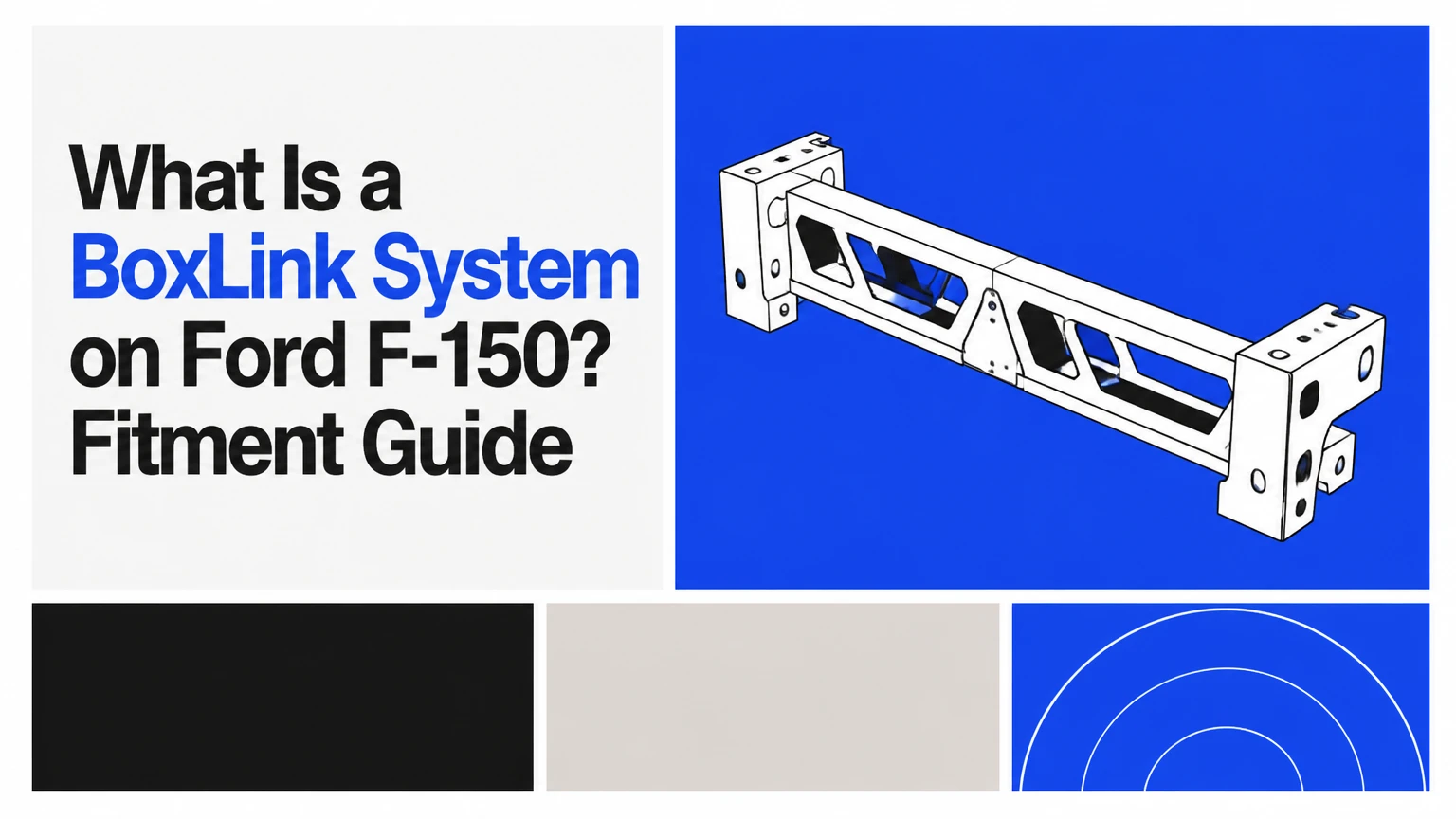
The Ford BoxLink system is a modular cargo-management system built into selected F-150 truck beds, beginning with the 2015 model year. It uses four bed-side interface plates and removable cleats or accessory brackets to create elevated attachment points for securing cargo, organizing equipment, and mounting compatible Ford bed accessories.
Key facts at a glance
BoxLink normally uses four interface-plate locations, with two on each inner bed side.
The system appeared on the aluminum-body 2015 Ford F-150 and was not standard on every trim or configuration.
BoxLink cleats attach to the plates mechanically and can be removed when the bed needs a flat loading surface.
BoxLink is useful for straps, dividers, ramps, and selected storage accessories, but it is not a substitute for a certified winch anchor.
A BoxLink plate may resemble commercial E-track, but visual similarity does not guarantee universal E-track accessory fitment.
Exact parts, load limits, and hardware specifications depend on the F-150 year, bed length, trim, and factory option package.
What Is BoxLink on an F-150?
BoxLink is Ford’s bed-side attachment interface for removable cargo accessories. Instead of relying only on fixed tie-down loops near the lower bed corners, the system places attachment hardware higher on the bed walls, where straps can better control tall, wide, or irregular loads.
A typical BoxLink installation has four steel interface plates fastened to reinforced locations inside the bed. Removable cleats engage the plate slots, creating loops for rope or ratchet straps. Other components, such as a bed divider or loading ramp, may use the same interface rather than requiring separate permanent brackets.
The system is therefore more than a tie-down loop. It is a standardized mounting pattern for a particular Ford accessory ecosystem. The important qualification is “particular”: BoxLink accessories must match the plate design and the truck’s application. A product that fits a 2018 F-150 may not fit a different Ford truck, a later redesign, or an aftermarket plate with altered dimensions.
Ford introduced BoxLink with the 2015 F-150. Availability varied by trim, package, market, and original equipment configuration, so model year alone does not prove that a truck has the system.
How Does the BoxLink System Work?
BoxLink works by transferring strap or accessory forces from a removable cleat into a steel interface plate that is fastened to a reinforced area of the bed side. The cleat is not supported by friction alone; its upper and lower engagement points must seat fully in the corresponding plate openings.
The usual cleat installation sequence is:
- Unlock the cleat. Insert the correct key and turn the cylinder to the release position.
- Engage the upper slot. Tilt the top of the cleat into the upper opening of the BoxLink plate.
- Seat the lower catch. Rotate or push the cleat downward until its lower tab engages the lower opening.
- Lock the cleat. Turn the key to the locked position and confirm that the cleat cannot lift out.
- Inspect the fit. Pull the cleat outward by hand before connecting a strap.
The release sequence reverses those actions. Remove the strap first, unlock the cylinder, lift the cleat to disengage the lower catch, then pivot the lower portion outward and remove the cleat from the upper slot.
A properly seated cleat should not lift free while locked. If the key turns but the body still moves excessively, dirt, corrosion, a bent latch, or a mismatched replacement cleat may be preventing full engagement.
What Are the Main BoxLink Components?
The four interface plates are the permanent part of the system. They usually sit in pairs on the left and right inner bed walls, with one plate toward the front and one toward the rear. Their exact shape and fastener arrangement can differ across F-150 generations and accessory versions.
The cleats are removable attachment points. Factory cleats commonly have a loop or eye for rope and webbing, while accessory brackets use the same general mounting area for a different purpose.
| Component | Typical location | Primary function | Owner action |
|---|---|---|---|
| Interface plate | Four inner bed-side positions | Receives cleats and accessories | Leave installed and inspect bolts |
| Locking cleat | Plate opening, removable | Connects straps and ropes | Install, lock, and remove as needed |
| Bed divider bracket | Bed side or floor area | Separates cargo zones | Adjust for load length |
| Ramp bracket | Rear bed area | Holds compatible loading ramps | Verify both sides before loading |
| Storage accessory | Side-mounted BoxLink position | Keeps tools above the floor | Confirm product-specific capacity |
The term “locking cleat” can cause confusion. The lock generally retains the cleat in the interface plate and discourages its removal. It does not automatically make an open truck bed, strap, toolbox, or load theft-proof. A thief may still cut a strap, open an unsecured container, or remove the cargo itself.
Does Every Ford F-150 Have BoxLink?
No. BoxLink was available on selected F-150 configurations, and a truck’s year, trim badge, or bed length does not establish fitment by itself. The quickest physical check is to look for four rectangular metal plates with slots on the inside walls of the bed.
Factory fitment can vary by:
- Model year and body generation
- XL, XLT, Lariat, King Ranch, Platinum, Tremor, or Raptor configuration
- 5.5-foot, 6.5-foot, or 8-foot bed
- Factory equipment package
- Standard versus optional cargo-management equipment
- United States, Canadian, or other market specification
A VIN lookup through a Ford dealer or Ford parts catalog provides stronger evidence than a trim-level internet listing. The original window sticker can also identify a cargo-management option, although used trucks may have missing cleats or replaced plates.
Count the plates before ordering accessories. Some sellers list “BoxLink-compatible” parts for F-150, F-250, F-350, and Raptor applications together, even though mounting geometry, plate shape, and load guidance may differ.
Which Accessories Fit BoxLink?
Ford has offered several accessories designed around BoxLink, including locking cleats, bed dividers, loading ramps, and side-mounted storage products. Aftermarket manufacturers also sell replacement cleats, brackets, hooks, and cargo organizers, but product descriptions require careful reading because “fits BoxLink” can mean direct fit, adapter fit, or only approximate dimensional similarity.
| Accessory type | Typical use | Approximate price range | Main fitment check |
|---|---|---|---|
| Replacement cleat set | Ratchet straps and rope | $50-$130 per set | Plate generation and locking style |
| Bed divider | Lumber, boxes, and groceries | $150-$350 | Bed length and divider rail design |
| Loading ramps | Mowers, motorcycles, and ATVs | $250-$700 | Ramp bracket and tailgate clearance |
| Side storage box | Small tools and recovery gear | $250-$800 | Bed wall, tonneau, and wheel-well clearance |
| Cargo hooks or brackets | Nets, straps, and partitions | $20-$100 | Actual plate interface, not title wording |
Prices are typical North American retail ranges, not Ford’s fixed pricing. Used OEM parts may cost less, while discontinued accessories can cost more because supply is limited.
A bed divider is especially useful when the cargo does not fill the entire bed. It prevents smaller loads from sliding forward under braking. A side-mounted toolbox preserves floor space but can reduce usable wall clearance for sheets, coolers, or motorcycles.
Is BoxLink Compatible With Standard E-Track?
BoxLink should not be treated as universally compatible with standard E-track. Some aftermarket products are designed to fit both systems, and some BoxLink plates use slot dimensions that resemble E-track, but a generic E-track hook may have the wrong tab thickness, engagement depth, or locking geometry.
Commercial E-track is normally a continuous horizontal steel rail with repeated slots. BoxLink uses discrete Ford bed-side plates attached at four locations. The systems can share certain accessory concepts, but they do not automatically share certified capacity or mechanical fit.
| Feature | BoxLink | Standard E-track | Full aftermarket rail |
|---|---|---|---|
| Mounting pattern | Four discrete bed-side plates | Continuous horizontal rail | Continuous rail or custom brackets |
| Common material | Steel interface plate | Steel or zinc-coated steel | Steel, aluminum, or composite |
| Attachment style | Ford cleat or matched bracket | E-track fitting | Brand-specific fitting |
| Coverage | Four fixed points | Adjustable along rail | Usually adjustable |
| Best application | F-150 bed accessories | Trailers, vans, and trucks | Custom cargo layouts |
Do not grind, bend, or drill an accessory tab to force a fit. A modified hook can appear secure while placing load on only one edge of the slot. Use a product whose manufacturer specifically names the relevant BoxLink plate, or use an adapter that states its working load limit.
The same warning applies to replacement cleats. A visually similar zinc casting may lack the correct locking tumbler, engagement depth, or material strength.
How Much Weight Can BoxLink Hold?
BoxLink capacity is not one universal number for every F-150 and every direction of pull. Ford owner information and accessory instructions govern the applicable working load, while aftermarket products may carry lower limits. A commonly repeated figure is 275 pounds per tie-down, but owners should verify that number for the specific truck and cleat rather than treating it as a universal engineering rating.
A tie-down rating also depends on force direction. A strap pulling horizontally toward the rear may load the cleat differently from a vertical load, a sideways impact, or a sudden braking event. The weakest component can control the system, including the cleat, plate, fasteners, strap, cargo anchor, or bed structure.
BoxLink is not a recommended anchor for winching a stuck truck, snatching a vehicle, lifting an engine, or applying shock loads. Recovery operations can create forces far above a static cargo rating and may deform the bed side or tear out the plate.
What Should You Check Before Loading?
Use the following inspection sequence:
- Confirm that each plate is tight and free of cracks around the fasteners.
- Check that the cleat lock fully engages and the cleat cannot lift.
- Inspect straps for cuts, melted fibers, abrasion, and damaged hooks.
- Keep strap angles practical, because a steep angle can increase tension.
- Protect webbing from sharp bed edges and metal corners.
- Place heavy cargo low and against a stable bulkhead or divider.
- Recheck the load after the first few miles and after hard braking.
- Follow the lowest rating printed in the Ford manual or accessory instructions.
A useful practitioner rule is to separate cargo retention from cargo weight. A 200-pound tool chest may be within a cleat’s stated static capacity yet still move dangerously if the strap arrangement allows forward momentum during emergency braking.
Is BoxLink Better Than Fixed Tie-Downs?
BoxLink is more versatile than fixed lower tie-down loops, while fixed loops remain simpler and less dependent on removable parts. BoxLink is usually the better choice for tall cargo, modular organization, and frequent changes; fixed loops are adequate for occasional loads that sit low and need only basic straps.
| Decision factor | BoxLink cleat | Fixed lower loop | Aftermarket D-ring | Full E-track rail |
|---|---|---|---|---|
| Attachment height | Bed-side, typically higher | Low bed corner | Depends on installation | Adjustable along rail |
| Removal | Yes, with key or release | No | Usually no | Fittings removable |
| Typical cost | $50-$130 replacement set | Factory equipment | $30-$150 installed | $150-$600 installed |
| Cargo flexibility | Cleats and accessories | Straps and hooks | Straps and hooks | Many fitting types |
| Installation risk | Low if factory plates exist | None after factory installation | Drilling or reinforcement possible | Requires structural mounting |
| Best load type | Tall equipment and divided cargo | Boxes and low loads | General tie-down use | Frequent commercial organization |
High attachment points can improve control of an upright mower, refrigerator, or motorcycle, but they do not replace a properly positioned lower restraint. Use multiple attachment points when cargo can tip, and prevent the load from contacting the cab or tailgate under movement.
BoxLink also has limitations. The plates can catch bulky items during loading, keys can seize after salt exposure, and thick drop-in bed liners may obscure or interfere with the openings. A complete E-track installation offers more positioning choices, but it requires careful structural mounting and occupies more bed-wall space.
How Do You Install BoxLink Plates?
Installing interface plates is usually a 15-30 minute task when the truck has factory reinforcement, accessible holes, and no obstructive bed liner. The difficult variable is fitment, because a replacement plate must match the truck’s bed generation and mounting hardware.
Before You Start
| Requirement | Typical specification |
|---|---|
| Time | 15-30 minutes for four plates |
| Difficulty | Basic mechanical work |
| Tools | Ratchet, socket set, torque wrench, trim tool |
| Materials | Correct plate set, factory-grade fasteners, medium threadlocker only if specified |
| Prerequisite | Confirm VIN, bed length, plate generation, and liner clearance |
Follow the Ford workshop manual for fastener torque. Do not assume a commonly posted 10 Nm value applies to every F-150 generation or plate design. Aluminum bed components and threaded inserts can be damaged by over-tightening, while under-tightening permits plate movement.
Installation Steps
- Confirm the parts. Compare each plate with the removed or original hardware and identify front, rear, left, and right positions.
Success checkpoint: Every hole and slot aligns without prying.
Common mistake: Forcing a plate from another Ford truck family into place. - Expose the mounting points. Remove obstructive trim or carefully open the bed-liner access areas according to the accessory instructions.
Success checkpoint: Bolt heads sit squarely against the plate.
Common mistake: Trimming too much liner and leaving exposed edges that can trap moisture. - Clean the threads and contact surface. Remove paint buildup, bed-liner overspray, rust, and packed dirt without enlarging the holes.
Success checkpoint: Fasteners start by hand for several turns.
Common mistake: Using an impact driver to cut through misaligned threads. - Install the plates loosely. Start all fasteners before tightening any single bolt.
Success checkpoint: The plate rests flat against the reinforced bed area.
Common mistake: Tightening the first bolt fully and losing alignment on the final hole. - Torque the fasteners. Use the model-specific Ford specification and a calibrated torque wrench.
Success checkpoint: The plate does not shift when pulled by hand.
Common mistake: Substituting a generic torque value from an unrelated F-150 year. - Fit and test each cleat. Install, lock, and pull each cleat outward before loading the truck.
Success checkpoint: The lower catch remains engaged and the cleat has no dangerous looseness.
Common mistake: Assuming a turned key proves that the lower tab is seated.
How Do You Remove a BoxLink Cleat?
Remove a BoxLink cleat by unloading it, unlocking the cylinder, lifting the body to release the lower catch, and pivoting it out of the upper slot. The strap or accessory must be removed first, because tension can bind the cleat against the plate and make release difficult.
- Remove all cargo tension from the cleat.
- Insert the matching key and turn it to the release position.
- Lift the cleat body to disengage its lower retaining tab.
- Pivot the lower portion outward.
- Lift the upper engagement point from the plate.
- Store the cleat and key in a dry compartment.
Never hammer a locked cleat out of the plate. If a cleat will not release, inspect whether a strap is still pulling sideways or downward. Relieve that force first, then clean the lock and contact surfaces.
What Problems Does BoxLink Have?
The most common BoxLink problems are seized locks, loose or rattling cleats, missing keys, damaged plate slots, and poor fitment caused by incompatible replacement parts. Most problems result from contamination, incorrect installation, or side loading rather than a defect in the basic concept.
| Symptom | Likely cause | Safe first response | Replacement threshold |
|---|---|---|---|
| Key will not turn | Dirt, ice, or corrosion | Use a lock-safe lubricant and gentle movement | Cylinder remains seized |
| Cleat rattles | Wear or incomplete seating | Remove, clean, and inspect tabs | Visible clearance or bent tab |
| Cleat will not release | Strap tension or seized catch | Remove load and unlock fully | Catch remains stuck |
| Plate moves | Loose or damaged fastener | Stop loading and inspect mounting | Torn insert or cracked bed |
| Accessory will not fit | Wrong generation or interface | Compare manufacturer dimensions | Product is not specified for BoxLink |
Use a lock lubricant appropriate for automotive cylinders. Penetrating oil may help free external corrosion, but flooding a lock with oily residue can attract grit. Do not force a frozen key, because a broken key inside the cylinder can turn a simple cleaning problem into a parts replacement.
Electrical tape around a loose cleat may temporarily reduce noise, but it is not a structural repair. Replace worn cleats or damaged plates when the engagement surfaces no longer seat positively.
Can a Bed Liner Interfere With BoxLink?
Yes. A thick drop-in liner can cover plate access, prevent a plate from sitting flat, or interfere with a cleat’s movement. Spray-in liners usually create fewer fitment problems, but overspray around bolt holes can still affect alignment.
Never remove structural bed material to make an accessory fit. Trim only removable liner material, follow the accessory instructions, and seal exposed liner edges where appropriate. If the plate itself is misaligned, verify the part number before altering the truck.
How Much Does BoxLink Cost to Replace?
A typical replacement cleat set costs about $50-$130, while a four-plate replacement set commonly costs approximately $70-$180 before shipping and labor. Dealer prices, discontinued OEM parts, keyed-alike requirements, and specialized accessories can raise the total substantially.
| Repair or upgrade | Typical parts cost | Typical labor time | Practical note |
|---|---|---|---|
| One replacement cleat | $20-$45 | 5-10 minutes | Match lock and plate design |
| Four replacement cleats | $50-$130 | 10-20 minutes | Key sets may differ |
| Four interface plates | $70-$180 | 30-90 minutes | Liner access affects labor |
| Bed divider | $150-$350 | 15-45 minutes | Check bed length |
| Loading-ramp system | $250-$700 | 30-60 minutes | Verify ramp capacity separately |
These are typical retail and installation ranges, not a Ford factory quote. A dealer VIN check is worthwhile when the truck is missing all cleats, because the correct kit may include distinct hardware that generic listings omit.
Is BoxLink Worth Having?
BoxLink is worth having for owners who regularly carry tall equipment, use bed dividers, load motorcycles or lawn equipment, or reorganize cargo frequently. It adds less value for drivers who carry only flat, low loads and already have accessible factory tie-down loops.
The strongest practical benefit is attachment position. A strap connected higher on the bed wall can restrain the upper portion of a tall object, reducing tipping compared with a strap connected only near the floor. That benefit disappears when the load is too heavy, the strap angle is poor, or the cargo has no stable contact with the bed.
BoxLink is not a reason to exceed payload, ignore Ford tie-down instructions, or treat a removable cleat as recovery hardware. The system organizes restraint points; it does not increase the truck’s payload rating or transform the bed into a certified lifting structure.
For contractors, BoxLink supports quick changes between cleats, dividers, tool storage, and nets. For occasional household hauling, the factory cleats are usually sufficient. For commercial vans or trailers requiring continuous adjustment across the full wall, a properly installed E-track rail may be more capable.
What Are the Best Alternatives to BoxLink?
The best alternative depends on whether the priority is low cost, permanent strength, or adjustable coverage. Factory lower loops are the simplest option, bolt-on D-rings provide a robust fixed point, and a full E-track rail offers more attachment positions than four BoxLink plates.
| Alternative | Typical installed cost | Adjustment range | Best use |
|---|---|---|---|
| Factory lower tie-downs | $0 if equipped | Four fixed positions | Occasional low cargo |
| Bolt-on D-rings | $50-$200 | Fixed locations | Heavy general-purpose loads |
| Full E-track rail | $200-$800 | Nearly continuous rail | Trades and frequent reconfiguration |
| Bed divider system | $150-$350 | Bed-length dependent | Boxes and segmented cargo |
| Bed-mounted toolbox | $250-$1,000 | Fixed storage position | Daily tool organization |
A bolt-on D-ring can be stronger than a small removable cleat if it is mounted to a properly reinforced location, but installation quality determines the result. Drilling through thin bed sheet metal without backing reinforcement creates a weak attachment regardless of the D-ring’s advertised rating.
Choose full E-track when the cargo position changes every day. Choose BoxLink when the truck already has factory plates and the desired accessories are available for that exact application.
What Should You Check Before Buying Accessories?
Check the truck’s model year, bed length, plate count, interface shape, accessory part number, and published working load before buying. Product titles are less reliable than installation diagrams and manufacturer fitment tables.
Use this buying checklist:
- Photograph one plate and its slot pattern.
- Record the F-150 model year and bed length.
- Confirm whether the truck is an F-150, Raptor, Lightning, or Super Duty.
- Check whether a tonneau cover, liner, or toolbox blocks the mounting area.
- Verify the accessory’s stated BoxLink compatibility.
- Confirm the accessory’s separate load rating.
- Check whether replacement cleats include keys and mounting hardware.
- Avoid listings that say only “Ford truck compatible.”
An accessory can fit the plate while remaining unsuitable for a particular load. Ramps, dividers, and storage boxes carry their own capacity limits, which may be lower than the attachment point’s rating.
FAQ
Does BoxLink increase the F-150 payload rating?
No. BoxLink does not change the truck’s payload, axle, tire, or braking limits. The system only provides cargo attachment and organization points. The load must remain within the payload shown on the truck’s certification label, and the lowest-rated strap, cleat, accessory, or mounting component controls the securement arrangement.
Can I add BoxLink to an F-150 that did not come with it?
Often, yes, if the bed has the correct reinforced mounting locations and a compatible retrofit kit exists. Confirm the truck by VIN and inspect the inner bed structure before ordering. A retrofit may require liner trimming, different fasteners, or a model-specific plate, so universal listings deserve caution.
Are BoxLink cleats interchangeable between F-150 generations?
Not necessarily. Cleat shape, lock design, plate openings, and accessory interfaces can change between generations or applications. Compare the part number and engagement geometry rather than relying on the F-150 name alone. A cleat that enters the slot but does not lock fully is unsafe.
Can BoxLink hold a motorcycle or ATV?
BoxLink can help secure a motorcycle, ATV, mower, or similar machine when compatible ramps, wheel chocks, straps, and lower restraints are used together. BoxLink alone does not prevent rolling. Secure the wheels, use appropriate strap angles, protect painted surfaces, and follow the machine and Ford load instructions.
Why does my BoxLink cleat keep coming loose?
A loose cleat may have a worn lower tab, damaged plate slot, incomplete locking rotation, or side tension that prevents full seating. Remove the load, clean the interface, reinstall the cleat, and perform a hand-pull test. Replace the cleat or plate if the engagement surfaces remain visibly worn.
Can I leave BoxLink cleats installed all the time?
Yes, provided the cleats are locked, fully seated, and not damaged. Removing them can make it easier to slide bulky cargo across the bed and reduces the chance of snagging. Many owners leave the cleats installed for daily strap access, then remove them when carrying large flat items.
The Bottom Line
The Ford BoxLink system is a four-point, bed-side cargo interface that accepts removable cleats and selected accessories on compatible F-150 trucks. It is more flexible than fixed lower tie-downs, but its benefits depend on correct fitment, complete cleat engagement, and compliance with the specific Ford load instructions.
Before buying parts, confirm the truck’s VIN, bed length, model year, plate design, and accessory rating. Remember that BoxLink is a cargo-management system, not a universal E-track rail or a recovery anchor. Used within those limits, BoxLink provides a practical way to secure tall loads and reorganize an F-150 bed without permanently filling the floor with brackets.
Title tag: what is a boxlink system on ford f150? Fitment Guide
Meta description: Check BoxLink plates, cleat ratings, E-track fitment, prices, and stuck-lock fixes before choosing Ford F-150 bed accessories.