All 50 states regulate firearms in vehicles in some circumstances, but no single state list answers every truck-carry question. California, Connecticut, Hawaii, Illinois, Maryland, Massachusetts, New Jersey, and New York are among the most restrictive, yet each uses different rules for permits, loading, accessibility, storage, destination, and travel purpose.
Key Facts at a Glance
- Federal law does not generally ban a firearm in a private truck, but the Gun-Free School Zones Act, federal facilities, military property, and employer policies create separate restrictions.
- The eight commonly identified restrictive states are not identical legal categories: some regulate unlicensed handguns, some regulate loaded firearms, and some restrict transport to specific destinations.
- 18 U.S.C. § 926A, the federal Firearms Owners Protection Act safe-passage provision, requires lawful possession at the origin and destination, continuous interstate travel, and unloaded, inaccessible storage.
- A locked glove box or center console is not automatically sufficient. California expressly excludes a vehicle utility compartment from its locked-container definition for many firearm-transport purposes.
- A commercial carrier can prohibit firearms even when state law allows them. A company rule may create termination or contract consequences without changing the underlying criminal statute.
- A pickup truck bed is not automatically a legally secure location. The container, lock, visibility, weather exposure, access by others, and state-specific wording all matter.
What States Have Laws Against Guns in Trucks?
The short answer is that every state has some vehicle-firearm restrictions, while the most difficult jurisdictions for an unlicensed traveler commonly include California, Connecticut, Hawaii, Illinois, Maryland, Massachusetts, New Jersey, and New York. The phrase “laws against guns in trucks” is therefore broader than a list of states that ban all firearms in truck cabins.
State law may regulate a firearm because it is loaded, concealed, accessible, possessed without a permit, transported for an unauthorized purpose, carried near a school, or stored in a particular way. A state may also distinguish a handgun from a rifle or shotgun, and a private pickup from a commercial motor vehicle.
The legal question is not simply whether a gun is inside the truck. It is whether the person may possess it, whether the truck is a permitted place of carry, whether the firearm is loaded, and whether the transport method satisfies the applicable statute.
Does Federal Law Ban Guns in Trucks?
Federal law does not impose a general nationwide ban on firearms inside private trucks or commercial motor vehicles. Federal restrictions can still apply near schools, on federal property, in post offices, on military installations, and when the driver or firearm falls within a separate federal prohibition.
The Gun-Free School Zones Act, 18 U.S.C. § 922(q), generally restricts knowing possession of a firearm in a school zone, subject to statutory exceptions that include certain state-issued licenses and unloaded firearms in locked containers or locked firearm racks. The statute is fact-sensitive, and a route passing a school is not the same as a lawful stop on school property.
The federal Firearms Owners Protection Act provision, 18 U.S.C. § 926A, says that a qualified traveler “shall be entitled to transport” a firearm between places where the person may lawfully possess and carry it, provided the firearm is unloaded and neither the firearm nor ammunition is readily accessible.
FOPA is a defense or safe-passage protection, not a nationwide carry permit. State officers may still arrest a traveler, and courts may later disagree about whether the journey, storage, stops, or destination satisfied Section 926A.
Which States Require the Most Care?
California, Connecticut, Hawaii, Illinois, Maryland, Massachusetts, New Jersey, and New York require particularly careful planning because an ordinary out-of-state permit may not authorize the same vehicle conduct as a local permit. The states also differ substantially, so treating them as one “nonreciprocal eight” can produce unsafe advice.
| State | Common transport concern | Typical unlicensed transport issue |
|---|---|---|
| California | Loaded and concealed vehicle carry | Handguns generally must be unloaded and secured in a locked container or trunk; a glove box or console is excluded from the statutory locked-container definition |
| Connecticut | Handgun possession in a vehicle | A handgun generally requires a Connecticut permit or another statutory exception; long-gun transport rules differ |
| Hawaii | Loaded or accessible firearms | Unloaded, enclosed transport and registration or importation requirements can apply; local rules require current verification |
| Illinois | Carry authorization and accessibility | A Firearm Concealed Carry License or statutory transport exception may matter; unloaded, enclosed transport is the conservative baseline |
| Maryland | Handgun transport and destination | Unlicensed handgun movement is limited and destination-specific exceptions commonly include ranges, dealers, residences, and repair locations |
| Massachusetts | Loaded firearms and locked transport | Firearm licensing, unloaded status, and locked-container or trunk rules interact; license categories matter |
| New Jersey | Possession, transport purpose, and storage | Unloaded, fastened-container transport is commonly required for recognized destinations; unnecessary deviations create risk |
| New York | Licensing and loaded firearm possession | A New York pistol license is generally required for handgun possession, while transport exceptions and long-gun rules require separate analysis |
Why Is the Eight-State List Only a Starting Point?
The eight-state list is useful for identifying high-risk routes, but it is not a complete legal classification. New Jersey, for example, does not make every firearm in every truck automatically illegal; the transport purpose, container, ammunition placement, and route can determine whether an exception applies.
New York also cannot be reduced to “passing through with a locked gun is always legal.” New York handgun licensing is highly restrictive, and long guns, assault-weapon statutes, sensitive locations, magazine rules, and local enforcement concerns can change the outcome.
Hawaii presents an additional problem for mainland travelers. Importation, registration, possession, and transport requirements may involve county or state procedures, and an internet summary claiming a universal 72-hour registration period should not be relied upon without checking the current Hawaii statute and local police instructions.
What Do Loaded, Unloaded, and Accessible Mean?
A firearm is not necessarily legally “unloaded” merely because no cartridge is chambered. Some statutes examine whether ammunition is inserted, attached, or immediately available, while others define loading differently for handguns and long guns.
Accessibility is equally important. A firearm in an unlocked door pocket, center console, seat-back pouch, or under-seat compartment may be reachable from the driver’s position even if the weapon is unloaded. A hard case behind the rear seat can reduce accessibility, but the case must remain locked and the truck’s configuration must fit the statute.
| Storage location | Accessibility concern | Conservative interstate configuration |
|---|---|---|
| Driver-side console | Reachable within seconds | Avoid for FOPA transport and restrictive-state travel |
| Locked glove box | Utility compartment may be excluded by state law | Do not treat as a universal legal container |
| Rear passenger floor | Reachable in an extended cab | Use a locked hard-sided case and verify state wording |
| Behind rear seat | Less reachable, but still cabin-adjacent | Lock the firearm and keep ammunition separately secured |
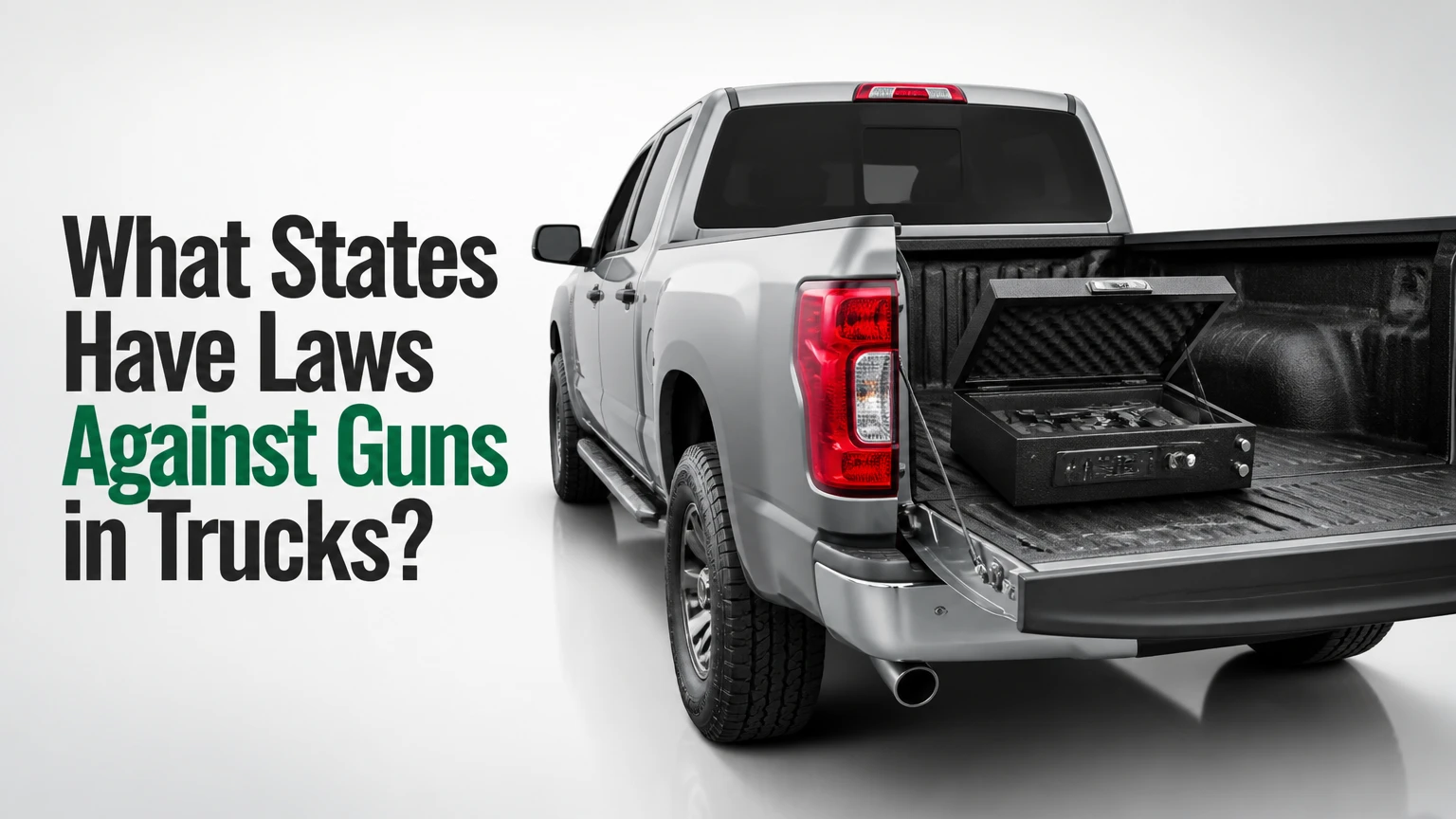
| Pickup-bed toolbox | Potentially inaccessible from the cab | Use a bolted, weather-resistant, locked hard-sided container |
| Truck-bed loose case | Theft and visibility risk | Never rely on an unsecured or exposed case |
A loaded magazine beside an unloaded firearm can also create a legal problem. The safest multi-state configuration is an unloaded firearm with the chamber and magazine well clear, ammunition in a separate closed container, and both stored outside the driver’s reach.
Is a Truck Vault Better Than a Hard Case?
A truck vault improves theft resistance, but a permanently mounted console vault is not automatically the best legal choice. A container within the driver’s reach may satisfy a security policy while failing a state’s accessibility requirement or the practical standard used by an officer or court.
| Storage option | Typical price | Typical installation | Main limitation |
|---|---|---|---|
| Portable steel lockbox | $30-$150 | 5-20 minutes | Cable or small lockboxes may be pried loose |
| Frame-mounted console vault | $250-$600 | 1-3 hours | Driver reach may remain legally significant |
| Hard-sided polymer case | $40-$180 | 5-15 minutes | Requires a separate anchor or secure placement |
| Aluminum rifle case | $100-$350 | 10-30 minutes | Large size can be difficult in a pickup cab |
| Locking bed toolbox | $250-$1,200 | 1-4 hours | Visibility, weather, and tool-access issues remain |
For interstate transport, a rigid locked case placed in the rearmost practical area is usually easier to explain than a quick-access vault. For theft prevention, a bolted steel enclosure is stronger. Those goals can conflict.
An expert rule of thumb is to design for the strictest state on the route, not the most permissive state where the trip begins. A Texas-compliant console setup can become a New Jersey or California problem after a border crossing.
How Should a Driver Transport a Firearm Across State Lines?
A driver should verify the origin, destination, route, permits, storage method, and stopping plan before departure. The practical baseline is an unloaded firearm in a locked hard-sided container, with ammunition separately secured and neither item accessible from the driver’s seat.
Step 1: Confirm Lawful Possession at Both Ends
Verify that the driver may lawfully possess the firearm at the origin and destination. Federal FOPA protection under 18 U.S.C. § 926A depends on legality at both locations, so a prohibited person, prohibited firearm, or unlawful destination can defeat the protection.
Check state statutes, attorney-general guidance, state police guidance, and current permit-recognition information. A commercial carrier’s policy must be checked separately.
Step 2: Identify Every High-Risk Location
Mark schools, federal facilities, military bases, national parks, tribal lands, toll facilities, ports, and company-controlled terminals along the route. The federal school-zone rule and property-specific regulations can apply even when a state generally permits vehicle carry.
National parks generally follow applicable federal firearms possession rules, but buildings and facilities may have separate restrictions. A park parking lot is not a substitute for legal research.
Step 3: Unload Before Entering the Restrictive State
Unload the firearm in a safe, lawful location before crossing the state line. Remove the magazine, clear the chamber, inspect the action, and place ammunition in a separate container.
A driver should not unload on a highway shoulder unless necessary for safety and lawful under local conditions. Prepare before departure or use a lawful private location.
Step 4: Lock the Firearm and Ammunition Separately
Place the firearm in a hard-sided locked container. Place cartridges and loaded magazines in a separate closed container, preferably locked, and keep both away from the passenger compartment when the truck design allows.
A locked container does not turn an otherwise prohibited firearm into a legal one. The container addresses storage and accessibility only.
Step 5: Use the Rearmost Practical Storage Area
For an extended-cab pickup, the rear area behind the seats may be less accessible than the front console, but a pickup-bed toolbox provides a stronger separation from the driver. Secure the case against theft and conceal it from ordinary view.
FOPA refers to a trunk or a locked container other than the glove compartment or console. In a vehicle without a trunk, the rear-most locked area is the conservative practical approach, but state law can impose stricter wording.
Step 6: Keep the Trip Truly Interstate and Continuous
Travel directly between lawful origin and destination. Fueling, food, traffic delays, and emergency stops are ordinary travel incidents, while a hotel stay, sightseeing detour, or extended visit can create an argument that the journey was no longer continuous.
FOPA does not provide a guaranteed hotel exception. If an overnight stop is unavoidable, seek state-specific legal advice before the trip and keep the firearm secured without opening the container.
Step 7: Recheck the Rules Before Returning
The return trip may use different states, and the destination state’s rules may differ from the departure state’s rules. Confirm the route again rather than assuming the outbound setup automatically satisfies every return jurisdiction.
How Do Commercial Truck Rules Differ From Private Pickup Rules?
Commercial truck drivers face two separate rule systems: public firearms law and private employment or carrier policy. State law may allow a firearm in a private vehicle while a motor carrier prohibits firearms in company equipment, terminals, yards, or customer property.
The Federal Motor Carrier Safety Administration does not create a blanket rule authorizing truckers to carry guns. A carrier’s operating agreement, employee handbook, insurance terms, and customer contracts may impose stricter conditions.
| Driver situation | State-law question | Business consequence |
|---|---|---|
| Owner-operator in personal pickup | Is possession and carry lawful? | Customer contracts may still prohibit weapons |
| Company tractor-trailer | Is the firearm allowed in company property? | Written policy may support discipline or termination |
| Team truck with a sleeper berth | Is the firearm accessible to another occupant? | Shared-cab storage creates added safety and policy issues |
| Hazmat route near restricted facilities | Do federal or facility rules apply? | Security screening can cause removal or delay |
| Truck parked at a customer terminal | Does private property prohibit firearms? | Trespass or contract consequences may follow |
A carrier policy can be stricter than state law because the policy governs employment and property access. Drivers should obtain written authorization, not rely on a dispatcher’s informal statement.
What Are the Most Common Legal Mistakes?
The most common mistakes involve confusing a safe-storage device with legal authorization, assuming a permit travels everywhere, and overlooking ammunition or temporary stops. Each mistake can turn an otherwise lawful possession into a state-specific charge.
- Using the glove box as the universal answer. California’s statutory definition excludes a vehicle’s utility compartment for the relevant locked-container rule, and other states may apply different language.
- Leaving a loaded magazine in the same reachable area. Some states treat ammunition placement as part of the loaded or accessible analysis.
- Assuming FOPA covers every trip. The origin and destination must be lawful, the firearm must be inaccessible, and the journey must be interstate and continuous.
- Stopping overnight without legal planning. A hotel room, restaurant visit, or tourist stop can create a state-law possession issue that FOPA may not resolve.
- Ignoring long-gun distinctions. A rifle or shotgun can have different transport, magazine, assault-weapon, and school-zone rules from a handgun.
- Forgetting company property rules. A carrier may ban firearms from trucks, terminals, and customer sites even when the state allows possession.
- Crossing a state line with the gun in a console. The setup may be lawful at departure and unlawful minutes later.
A practitioner’s rule is to photograph the locked configuration before departure, keep the firearm’s documentation available, and record the planned route. Documentation does not create immunity, but it reduces accidental handling and helps establish the intended transport method.
What Should You Do During a Traffic Stop?
During a traffic stop, keep both hands visible, follow lawful instructions, and do not reach toward the firearm or its container. Whether the driver must disclose the firearm depends on the state’s duty-to-inform statute, the officer’s questions, and the driver’s permit status.
Do not volunteer consent to a search merely because the firearm is lawfully stored. A driver can politely ask whether the officer is requesting consent, but must not physically resist a search or obstruct instructions.
A safe communication approach is concise and factual: state that a firearm is secured in a locked container if disclosure is required or if the officer asks directly, then ask how the officer wants the driver to proceed. Do not open the case or retrieve documents without permission.
An officer’s discovery of a firearm does not prove a crime, and a locked container does not prove legality. The controlling issues remain possession, location, loading, accessibility, permit status, and the specific statute.
Which Transport Method Fits Each Situation?
The best method depends on the vehicle, route, firearm type, and legal purpose. A quick-access vault suits a lawful local-carry environment, while a separate locked case in rear storage is more defensible for interstate travel through restrictive jurisdictions.
| Situation | Preferred storage | Why it fits |
|---|---|---|
| Local travel in a permitless-carry state | Locked console vault | Fast access with improved theft resistance |
| Interstate trip through restrictive states | Separate locked hard-sided case | Better separation from driver and passenger area |
| Pickup with no rear cabin | Bolted locking bed toolbox | Creates distance from the driver and hides the firearm |
| Rifle transport to a range | Locked rifle case in rear cargo area | Supports unloaded, enclosed transport |
| Company tractor with no written authorization | No firearm in truck | Avoids employment and property-policy violations |
A quick-access safe is not good for every legal environment. Its accessibility, even when locked, can be the exact fact that creates a problem in a restrictive state.
What Does FOPA Protect, and What Does It Not Protect?
FOPA can protect qualifying interstate transportation, but it does not legalize local carry, eliminate state arrest risk, or override every federal property restriction. Section 926A is strongest when the trip has a clear lawful origin and destination, the firearm is unloaded, and the storage arrangement is plainly inaccessible.
FOPA generally does not solve these situations:
- The firearm is illegal at the destination.
- The person is prohibited from possessing firearms.
- The trip begins and ends in the same state.
- The firearm is accessible from the passenger compartment.
- The traveler makes an extended recreational stop.
- The firearm is carried into a federal building or restricted facility.
- A company or private property owner bans firearms.
- The traveler violates a separate state assault-weapon or magazine restriction.
Courts have differed in how they evaluate temporary stops and continuous travel. A driver facing criminal investigation should request counsel and avoid detailed roadside explanations about the route or storage decisions.
What Should Travelers Verify Before Departure?
Travelers should verify current law from official state sources because firearm statutes change frequently through legislation, litigation, emergency orders, and administrative guidance. A permit-reciprocity map is useful for screening routes, but it is not a substitute for the state statute governing vehicle possession.
Use this pre-trip checklist:
- Confirm handgun, rifle, or shotgun legality at the destination.
- Confirm whether the driver’s permit is recognized.
- Check loaded-firearm and ammunition definitions.
- Check locked-container and trunk requirements.
- Check transport-purpose restrictions.
- Identify schools, federal facilities, military bases, and private terminals.
- Review carrier, employer, rental-truck, and customer policies.
- Prepare separate locked firearm and ammunition containers.
- Plan lawful stops and avoid unnecessary overnight stays.
- Recheck the return route before leaving.
Current official sources commonly include a state police firearms page, attorney-general firearms guidance, legislative code, state licensing agency, and the Bureau of Alcohol, Tobacco, Firearms and Explosives for federal information. Secondary sources can identify issues, but the statute controls.
Frequently Asked Questions
Can I Carry a Gun in a Truck Without a Permit?
A person may carry a firearm in a truck without a permit in some states, but the answer depends on the state, firearm type, loading condition, concealment, vehicle ownership, and location. In restrictive states, unlicensed handgun possession or accessible carry may be criminal even when the same conduct is lawful elsewhere.
Does a Locked Center Console Count as a Locked Container?
A locked center console does not universally count as a legally sufficient firearm container. California excludes vehicle utility compartments from its relevant locked-container definition, and FOPA specifically refers to a locked container other than the glove compartment or console. Rear hard-sided storage is safer for interstate travel.
Can Ammunition Stay Beside the Firearm?
Ammunition may be legally transportable beside an unloaded firearm in some jurisdictions, but separation reduces risk when crossing restrictive states. Keep cartridges and loaded magazines in a separate closed container, and never leave ammunition in door pockets, open bags, or a reachable console.
Does an Out-of-State Concealed-Carry Permit Work in New York or New Jersey?
An out-of-state concealed-carry permit does not automatically authorize vehicle carry in New York or New Jersey. Recognition rules, licensing requirements, transport exceptions, firearm features, and destination restrictions differ, so travelers should verify the current law before entering either state.
Can I Stop at a Hotel With a Firearm Protected by FOPA?
FOPA does not guarantee protection during an overnight hotel stop. A planned or extended stop can create an argument that the journey is no longer continuous, and the hotel’s property rules may independently prohibit firearms. Obtain state-specific advice before making a nonessential stop.
Are Guns Allowed in Commercial Trucks?
A firearm may be lawful in a commercial truck under a particular state’s law, but a motor carrier, customer, terminal, or insurer may prohibit it. Drivers should treat written company policy as a separate requirement and obtain authorization before placing any firearm in employer-owned equipment.
The Bottom Line
The answer to what states have laws against guns in trucks is not limited to eight jurisdictions. Every state regulates some combination of vehicle possession, loaded carry, concealment, accessibility, storage, permits, school zones, and transport purpose, while California, Connecticut, Hawaii, Illinois, Maryland, Massachusetts, New Jersey, and New York generally demand the most careful planning.
For interstate travel, use the conservative setup: verify lawful possession at both ends, unload the firearm completely, secure it in a locked hard-sided container, separate the ammunition, place both beyond the driver’s reach, follow a continuous route, and confirm employer and property rules. State statutes and court decisions change, so current official guidance or advice from a firearms attorney is necessary before a high-risk trip.