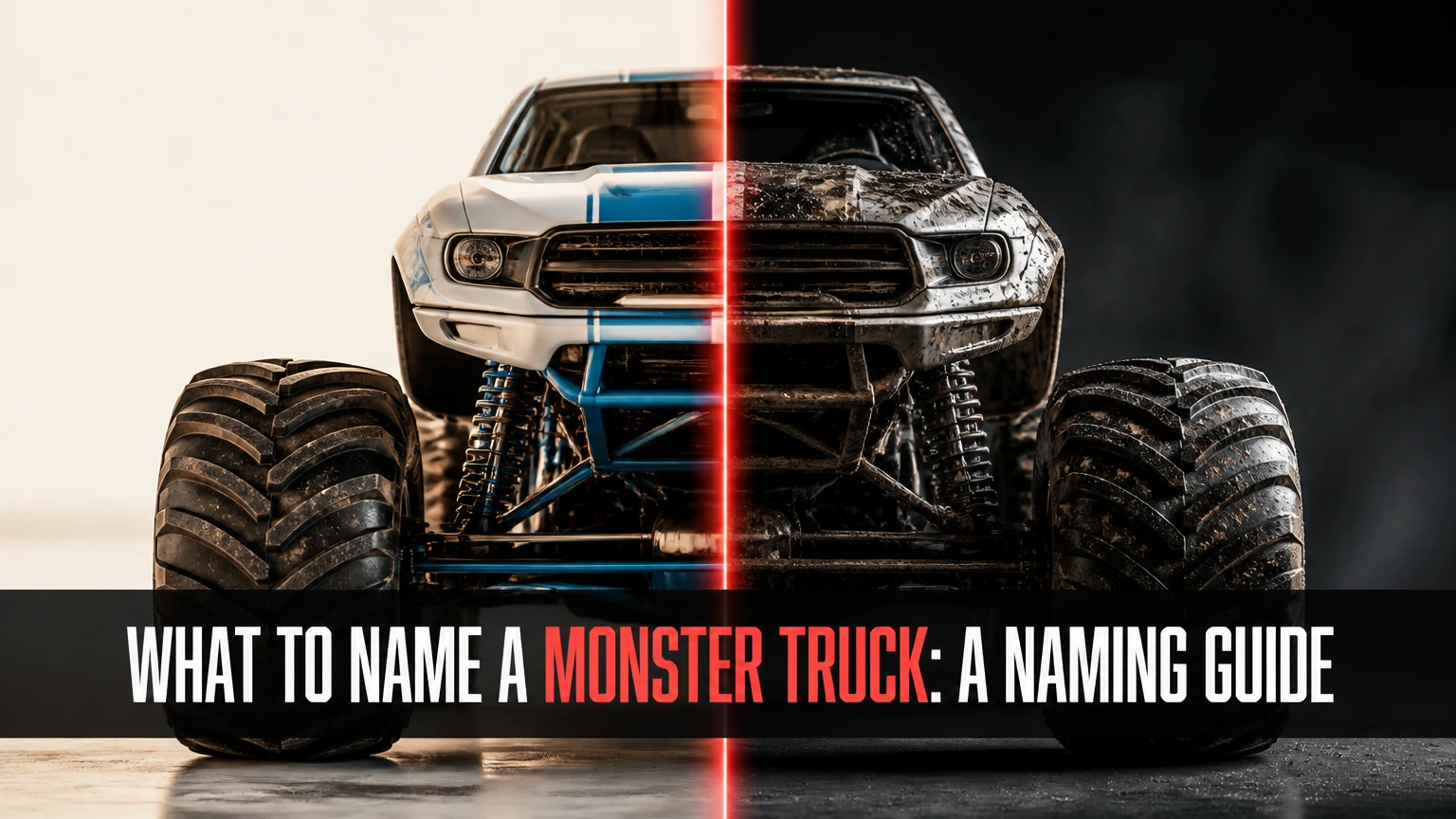
The best monster truck name combines a clear persona, strong stadium pronunciation, visual compatibility, and enough originality for search and trademark screening. Choose a two- or three-syllable name that matches the truck’s body, colors, driving character, and audience, then test it on a logo, announcer script, shirt, and online search before committing.
Key Facts at a Glance
A strong monster truck name usually contains two to three stressed syllables and one memorable image.
The truck’s body shape, paint colors, driver persona, and competition style should support the same concept.
A name that sounds powerful may still fail if fans cannot spell it, search it, or read it from a distance.
A preliminary USPTO search can reveal conflicts, but it does not replace professional trademark clearance.
Typical naming work takes one to three days for brainstorming and one to two weeks for a serious preliminary clearance search.
Real teams, RC builders, game developers, and backyard hobbyists need different levels of legal and branding review.
What Does a Monster Truck Name Need to Communicate?
A monster truck name should communicate one dominant idea within the first few seconds: mechanical force, a creature, a joke, local pride, speed, destruction, or a specific character. Names become easier to remember when the audience can connect the word to the truck’s silhouette and behavior.
A professional competition truck needs an identity that announcers can repeat, fans can chant, and designers can place on a fiberglass body. An RC truck can tolerate an inside joke or a personal reference because its audience is smaller. A video game vehicle can use a more unusual name if the name remains readable in menus and memorable during play.
The strongest names align four attributes:
| Naming attribute | Practical target | Failure signal | Example |
|---|---|---|---|
| Spoken length | 2-3 syllables | Announcer needs to pause | Iron Fang |
| Visual image | 1 dominant creature or object | Wrap contains unrelated symbols | Frostbite |
| Spelling | 1 obvious spelling | Fans ask how to type it | Khaosz |
| Emotional direction | 1 clear persona | Name feels brave and silly together | Thunder Warden |
The name should also leave room for evolution. A local racer may later add a sponsor, new body, or different driver, so an overly narrow name can become inconvenient. “Redline Reaper” can survive a body change better than “Blue Flame Pickup.”
How Do You Create a Monster Truck Name?
Create a monster truck name in seven stages: define the persona, inventory the vehicle, select a naming category, generate candidates, test the sound, test the visual identity, and screen for conflicts. The process typically takes 3-8 focused hours for a shortlist of 10 names, excluding legal review.
Step 1: Define the Truck’s Persona
Select a role before selecting vocabulary. The most useful choices are hero, villain, predator, machine, comedian, guardian, or local icon. A hero name generally uses protection, speed, courage, or weather. A villain name can use fear, darkness, corrosion, or destruction.
Write a one-sentence brief:
“This is a blue 1950s-style pickup driven as a fearless crowd hero, with a lightning theme and family-friendly presentation.”
That sentence prevents unrelated ideas from entering the shortlist. “Lightning Bandit” fits the brief. “Swamp Goblin” does not, even if the phrase sounds entertaining.
Step 2: Inventory the Vehicle
Record the body type, dominant color, accent color, wheel appearance, engine sound, driving style, and intended audience. Physical details create stronger names than random adjective combinations.
| Truck feature | Useful semantic direction | Suitable name examples | Avoid when |
|---|---|---|---|
| Black body | Night, coal, shadow, eclipse | Coal Viper, Night Forge | The truck is marketed as a cheerful hero |
| Red body | Heat, ember, warpath, fire | Ember Rush, Crimson Brawler | A sponsor requires a calm image |
| Blue body | Ice, storm, ocean, voltage | Arctic Charge, Storm Current | The body has no cool-toned design |
| School bus body | Classroom, grades, homework, learning | Torque Tutor, Grade Crusher | The brand must appear serious |
| Dinosaur body | Fossil, claw, extinction, roar | Fossil Fury, Cretaceous Crush | The audience is unfamiliar with the reference |
| Military-style body | Patrol, armor, sentinel, strike | Steel Sentinel, Armor Charge | The design implies a protected real-world unit |
The name does not need to describe every feature. One dominant visual hook is usually stronger than a crowded concept.
Step 3: Choose a Naming Category
Aggressive names emphasize power and impact. Beast names give the truck a creature identity. Mechanical names fit fabricated bodies and futuristic designs. Pun-based names create quick family recognition but require careful testing because jokes can age quickly.
| Category | Naming formula | Best audience | Original ideas |
|---|---|---|---|
| Aggressive | Force word + impact noun | Racing and demolition fans | Torque Hammer, Rampage Circuit |
| Beastly | Creature + attack or terrain word | Children and family crowds | Gator Voltage, Howler Ridge |
| Mythic | Legend + mechanical noun | Custom fiberglass bodies | Titan Furnace, Kraken Drive |
| Military-inspired | Duty word + power noun | Sponsor and regional events | Iron Patrol, Steel Convoy |
| Pun-based | Familiar phrase + truck term | RC and family entertainment | Axle Rose, Lug Nut Larry |
| Futuristic | Energy word + machine term | Games and electric builds | Neon Vector, Volt Reign |
Existing famous names such as Grave Digger, Maximum Destruction, Raminator, Megalodon, Zombie, El Toro Loco, Soldier Fortune, Monster Mutt, and Higher Education demonstrate recognizable categories. They are useful pattern references, not names to imitate closely.
What Are Good Monster Truck Names?
Good monster truck names are short, distinctive, visually specific, and easy to announce. The following ideas are original combinations for brainstorming, not a guarantee of trademark availability, domain availability, or freedom from prior use.
Aggressive and Destructive Names
- Torque Hammer
- Rampage Circuit
- Steel Havoc
- Crush Voltage
- Iron Collision
- Breaker Beast
- Wreck Current
- Asphalt Anvil
- Riot Engine
- Impact King
- Savage Torque
- Concrete Cobra
- Overdrive Outlaw
- Smash Vector
- Thunder Bruiser
Beastly and Mythological Names
- Frostfang
- Ember Kraken
- Gator Voltage
- Howler Ridge
- Titan Furnace
- Basilisk Bolt
- Mammoth Charge
- Viper Summit
- Dragon Axle
- Cerberus Crush
- Direwolf Drive
- Phoenix Rumble
- Leviathan Lift
- Horned Havoc
- Chimera Torque
Funny and Pun-Based Names
- Axle Rose
- Lug Nut Larry
- Torque and Roll
- Grill Seeker
- Mud Zeppelin
- Tire Pressure
- Fender Bender
- Gear Bear
- Road Toad
- Wheelie Nelson
- Crank Sinatra
- Brake Expectations
- Sump Thing
- Piston Impossible
- Muddy Buddy
Patriotic, Military-Inspired, and Local Names
- Steel Sentinel
- Iron Patrol
- Liberty Torque
- Freedom Foundry
- Redline Ranger
- Star-Spangled Steel
- Convoy Crusher
- Patriot Axle
- County Line Charger
- Homefront Hammer
- Rustbelt Ranger
- Mountain State Mayhem
- Harbor Defender
- Prairie Thunder
- Desert Guardian
Futuristic, Electric, and Game-Friendly Names
- Neon Vector
- Volt Reign
- Plasma Raptor
- Circuit Titan
- Hypercharge
- Quantum Crusher
- Chrome Comet
- Pulse Predator
- Nova Wrecker
- Grid Goblin
- Ion Inferno
- Cyber Stampede
- Static Surge
- Orbit Breaker
- Photon Fury
How Should You Match the Name to the Body?
Match the name to the truck body by choosing one visible feature and one action or emotional word. A shark-shaped truck might use “Riptide Rumbler,” while a black muscle-car body could use “Coal Brawler.” The match becomes weak when the wording suggests an animal or color absent from the design.
Use a two-column design brief before approving a name:
| Body or design fact | Name implication |
|---|---|
| Oversized ram horns | Charge, ram, horn, stampede |
| Exposed metallic panels | Forge, steel, chrome, foundry |
| Flame graphics | Ember, inferno, blaze, ignition |
| Wide rear tires | Grip, traction, stomp, ground |
| LED or neon accents | Pulse, voltage, circuit, photon |
| White-and-blue paint | Frost, arctic, sky, glacier |
An expert rule of thumb is to keep the primary word visible from 100 feet away. A logo with six tiny words may look attractive on a computer but become unreadable on a stadium side panel.
Which Monster Truck Naming Style Should You Choose?
Choose aggressive or beastly naming for competitive credibility, pun-based naming for family entertainment, patriotic naming for community sponsorship, and futuristic naming for games or electric builds. The best category depends on the truck’s audience, body, event setting, and expected lifespan.
| Style | Best use | Strength | Main risk | Recommended length |
|---|---|---|---|---|
| Aggressive | Racing team | Strong introductions | Generic vocabulary | 2-3 syllables |
| Beastly | Custom body | Immediate visual mascot | Crowded animal market | 2-4 syllables |
| Pun-based | RC or family show | High recall | Joke may age | 2-5 syllables |
| Patriotic | Local events | Sponsor alignment | Political interpretation | 2-4 syllables |
| Futuristic | Video game | Distinctive world-building | Less emotional warmth | 2-4 syllables |
Real Competition Truck or Independent Racer
Use a name with a durable persona and a clean logo. “Steel Sentinel” can support a guardian-themed body, sponsor patches, uniforms, and a serious announcer introduction. Avoid relying on a temporary sponsor, current driver nickname, or a joke that only one local group understands.
A professional team also needs clearance before spending on fiberglass, wraps, uniforms, websites, and merchandise. Changing the legal name after production can cost much more than an early search.
RC or Backyard Hobby Truck
Use humor, family references, pet names, or technical jokes. Legal screening may be less extensive for a private project, but public videos, paid events, merchandise, and online sales can create commercial exposure.
“Lug Nut Larry” fits a hobby vehicle with a cartoon driver. “Axle Rose” fits an adult fan project, although a commercial release would need a more serious conflict review.
Video Game or Fictional Truck
Choose a name that remains clear at small sizes and works in a roster of 20 or more vehicles. Avoid punctuation, unusual capitalization, and homophones that players cannot search.
“Neon Vector” communicates speed and technology without requiring a long explanation. Game developers should also check game titles, character marks, app stores, domain names, and international markets.
How Do You Test a Name Before Using It?
Test a candidate in five environments: spoken introduction, logo, side-panel view, online search, and merchandise mockup. Reject a name when two unrelated people mispronounce it, confuse its spelling, or fail to identify the intended persona after seeing the truck image.
Use this practical screening sequence:
- Say the name at normal speed, then as a stadium announcer: “Coming into the arena, Torque Hammer.”
- Record the sentence and listen for swallowed consonants, awkward stress, and accidental double meanings.
- Write the name in uppercase, lowercase, a social-media handle, and a 10-inch logo.
- Ask five people to spell it after hearing it once.
- Show the name beside the body silhouette for three seconds, then ask what creature or attitude they remember.
- Search the exact phrase in Google, social platforms, racing databases, and merchandise marketplaces.
- Search related phrases, singular and plural forms, alternate spellings, and phonetic equivalents.
- Remove candidates that closely resemble a famous existing truck or entertainment brand.
The announcer test is often more revealing than the brainstorming session. Names with hard consonants such as T, K, B, and R tend to remain intelligible over loud engines, although the complete phrase matters more than one letter.
How Long Should a Monster Truck Name Be?
A monster truck name should usually contain two to four words and two to five total syllables, with the strongest spoken stress near the beginning. The two-to-three-syllable rule is a useful performance target, not a legal or creative requirement.
Names over four syllables can still work when they contain a familiar phrase, such as a school-themed pun. The problem is not length alone. A long name fails when the announcer cannot finish it before the next jump, the audience cannot chant it, or the logo becomes too small.
| Name | Syllable estimate | Spoken clarity | Merchandise fit | Decision |
|---|---|---|---|---|
| Frostfang | 2 | High | High | Strong |
| Torque Hammer | 3 | High | High | Strong |
| Cretaceous Crusher | 6 | Medium | Medium | Use only for dinosaur theme |
| Lug Nut Larry | 4 | High | High | Strong for comedy |
| The Unstoppable Mechanical Thunder Beast | 10 | Low | Low | Reject |
An uncommon spelling does not make a name more ownable by itself. “Khaosz” may appear distinctive, but fans can type “Chaos,” “Khaos,” or another variant, splitting search signals and increasing confusion.
How Do You Check a Monster Truck Name for Trademark Conflicts?
Check a monster truck name through the USPTO trademark database, state business records, internet search results, social platforms, and relevant motorsport directories. A preliminary search identifies obvious conflicts; only a qualified trademark professional can assess confusing similarity, classes, geographic use, and filing strategy.
The United States Patent and Trademark Office explains that trademark infringement analysis considers whether marks are confusingly similar and whether the related goods or services overlap. An identical phrase is not the only concern. A similar name used for motorsport entertainment, toys, apparel, or live events may create a practical problem.
Search these sources:
| Search location | What to inspect | Typical time |
|---|---|---|
| USPTO trademark search | Live, pending, abandoned, and related marks | 1-3 hours |
| Google and Bing | Event, team, fan, and merchandise use | 1-2 hours |
| Social platforms | Handles, pages, and audience confusion | 30-90 minutes |
| State business registry | Team and company names | 30-60 minutes |
| Domain registries | .com and relevant country domains | 15-30 minutes |
| Motorsport directories | Existing racing identities | 30-60 minutes |
The USPTO’s base electronic filing fee is commonly listed at $350 per international class, but application requirements and fees can change, so verify the current schedule at USPTO.gov before filing. A professional search and opinion may cost approximately $500-$2,500 or more, depending on markets and geographic scope.
Trademark registration processing commonly takes six to nine months or longer, while an initial office action or other issue can extend the timeline. Filing does not guarantee registration. A search should happen before ordering a body, wrap, apparel, or toy packaging.
What Does a Name Cost to Develop and Protect?
A private hobby name can cost $0-$100, while a commercial monster truck identity commonly costs $500-$5,000 before major merchandise production. The largest variables are professional clearance, logo design, filing classes, and whether the team needs a custom body or full brand system.
| Activity | Typical cost | Typical timeframe | Required for |
|---|---|---|---|
| Brainstorming and internal testing | $0-$300 | 1-3 days | Every project |
| Preliminary online search | $0-$250 | 2-6 hours | Public use |
| Professional trademark search | $500-$2,500 | 1-3 weeks | Commercial launch |
| Logo and wrap design | $500-$2,500 | 1-4 weeks | Sponsored or public truck |
| USPTO electronic filing | $350 per class, commonly | Filing day | U.S. applicants seeking registration |
| Full brand package | $2,000-$10,000 | 3-8 weeks | Professional team |
These are typical planning ranges, not quoted legal or design fees. An RC builder uploading a private project to a personal account may need no filing. A team selling shirts across the United States has a different risk profile.
What Commonly Goes Wrong With Monster Truck Names?
The most common failures are generic wording, accidental similarity, poor pronunciation, unreadable logos, and a mismatch between name and driving persona. Each failure is cheaper to fix before the truck body, wrap, social accounts, and merchandise exist.
| Failure | Why it happens | Early warning | Recovery |
|---|---|---|---|
| Name sounds like a famous truck | Brainstorm copies category leaders | People make the same comparison | Change the noun and visual concept |
| Fans cannot spell it | Decorative spelling was prioritized | Search results split across variants | Use standard spelling |
| Name is too long | Every idea was added | Announcer shortens it | Create a two-word public form |
| Joke becomes dated | Reference depends on a trend | Children do not understand it | Replace reference with a broader pun |
| Logo is unreadable | Design begins after naming | Letters disappear at distance | Shorten and increase contrast |
| Persona conflicts with behavior | Name was chosen without driver input | Hero name on a destructive villain | Reframe the character or rename |
If a cease-and-desist letter arrives, stop new commercial use and obtain legal advice rather than casually changing one letter. A minor spelling change may remain confusingly similar, and it can also create inconsistent branding.
If fans dislike the name but the legal identity is clear, keep the underlying mark only when the audience problem is fixable. A new wrap, mascot expression, entrance sound, or slogan can alter perception without rebuilding the entire identity.
Which Name Fits Each Monster Truck Situation?
The right name changes according to audience, body, and commercial exposure. A real stadium truck needs durable brand architecture, an RC truck needs personal recall, a video game vehicle needs menu readability, and a school bus truck needs an instantly understandable joke.
| Situation | Recommended direction | Example | Avoid |
|---|---|---|---|
| Independent local racer | Region plus force word | County Line Charger | Unlicensed city or team references |
| Family event truck | Friendly animal or clean pun | Gear Bear | Graphic violence or profanity |
| Dinosaur body | Fossil or extinction language | Fossil Fury | Generic “Dino Truck” |
| Electric prototype | Voltage or circuit language | Static Surge | Name implying gasoline performance |
| School bus body | Education plus mechanical action | Torque Tutor | Joke requiring adult context |
| Fantasy game vehicle | Invented beast or technology | Plasma Raptor | Names difficult to display in menus |
A local name can improve sponsorship conversations because regional businesses understand “Prairie Thunder” immediately. It can also limit future touring if the team later wants a national identity. Make that trade-off deliberately.
What Are the Best Finalists for Different Personas?
The strongest finalists depend on the intended character rather than a universal ranking. “Torque Hammer” fits an aggressive mechanical hero, “Frostfang” fits a compact creature identity, “Lug Nut Larry” fits family comedy, and “Neon Vector” fits a futuristic game or electric build.
| Persona | Recommended finalist | Why it fits | Main limitation |
|---|---|---|---|
| Mechanical hero | Torque Hammer | Hard sounds and clear machinery | Less suitable for a cute body |
| Ice predator | Frostfang | Two syllables and strong silhouette | Requires cold visual treatment |
| Family comedian | Lug Nut Larry | Easy chant and cartoon potential | Weak for a serious race team |
| Patriotic guardian | Steel Sentinel | Sponsor-safe protective image | Less destructive in tone |
| Futuristic racer | Neon Vector | Short, searchable concept | Needs a modern design system |
| Dinosaur villain | Fossil Fury | Clear creature-era association | Similar fossil vocabulary is crowded |
The “best” choice should survive a five-year test. Ask whether the name still works if the truck changes drivers, gains a sponsor, appears at a children’s event, or receives a new body.
Expert Insight: Visual Specificity Beats Raw Aggression
Many weak names rely on words such as “extreme,” “ultimate,” “killer,” or “maximum.” Those words communicate intensity but provide no unique design instruction. “Coal Viper” gives a designer a color, creature, eye treatment, scale pattern, and lighting direction.
Expert Insight: Searchability Is a Performance Feature
A name that fans pronounce correctly but cannot spell loses social mentions and merchandise searches. Standard spelling, a clean handle, and one dominant word often produce more usable fan behavior than an elaborate invented spelling.
Expert Insight: Legal Clearance Is Not the Same as Brand Ownership
A name can have no obvious federal registration and still create problems through common-law use, an active event identity, a domain, or a highly similar mark. Conversely, a registered mark in an unrelated class may not automatically block every use. The facts require review.
How Do You Turn the Name Into a Brand?
Turn the selected name into a consistent brand by assigning a mascot, color code, type treatment, entrance phrase, and merchandise symbol. The same central image should appear on the truck body, driver shirt, social avatar, pit banner, and product packaging.
Create these assets in order:
- Primary mark: the readable name in a bold typeface.
- Icon: a simplified fang, gear, lightning bolt, helmet, or animal head.
- Color system: one dominant color, one contrast color, and black or white for legibility.
- Announcer line: a sentence under 12 words that includes the complete name.
- Mascot behavior: a brave, mischievous, threatening, or protective expression.
- Merchandise lockup: a version that remains recognizable at 2 inches wide.
- Digital handle: one consistent spelling across major platforms.
Before production, print the name at 2 inches, 10 inches, and 36 inches. Check it in daylight, under stadium lighting, and in a black-and-white photograph. A truck name that depends on a subtle gradient may disappear in news coverage or low-resolution social video.
FAQ
Can I name my monster truck after a famous truck?
You can brainstorm in the same broad category, but copying a famous truck’s distinctive name, spelling, mascot, or visual identity creates legal and audience risks. “Grave Crusher” next to Grave Digger may invite comparison even if the words are not identical. Choose a separate concept, body shape, color system, and logo.
Should a monster truck name include the driver’s name?
Include the driver’s name only when the driver already has meaningful recognition or the team expects a personal brand. A driver-based name can become outdated after a personnel change. A vehicle-based name usually has greater continuity for sponsors, merchandise, and repeat appearances.
Are one-word monster truck names better?
One-word names can be effective when they create a specific image and remain easy to pronounce, such as Frostfang or Hypercharge. They are often harder to secure because short marks are crowded across entertainment, apparel, games, and sporting categories. Screen one-word candidates more aggressively.
Do I need a trademark for an RC monster truck?
You generally do not need a trademark filing for a private RC truck used only for personal enjoyment. Public events, monetized videos, paid appearances, merchandise, and commercial sales change the risk profile. Search the name before public use, even when registration is unnecessary.
How can I make a monster truck name sound scarier?
Use a concrete threat or force image, strong consonants, and a short rhythm. “Iron Fang,” “Riot Engine,” and “Frost Reaper” sound more menacing than vague phrases such as “Extreme Power Machine.” Match the frightening name to darker graphics, lighting, and driving behavior.
Can I change the name after building the truck?
You can change the public name, but the cost rises after fabrication and merchandise production. A rename may require a new wrap, logo, social handles, website, sponsor materials, and announcer copy. Test at least five finalists before committing to permanent fiberglass or printed inventory.
The Bottom Line
The answer to what to name a monster truck begins with the truck’s persona, not a random list of powerful words. Choose one visual idea, keep the spoken form short, test the name with an announcer and audience, confirm that fans can spell it, and conduct trademark screening before public commercial use. For a mechanical hero, start with Torque Hammer; for a creature, consider Frostfang; for a family comedy truck, test Lug Nut Larry; and for a futuristic vehicle, evaluate Neon Vector.