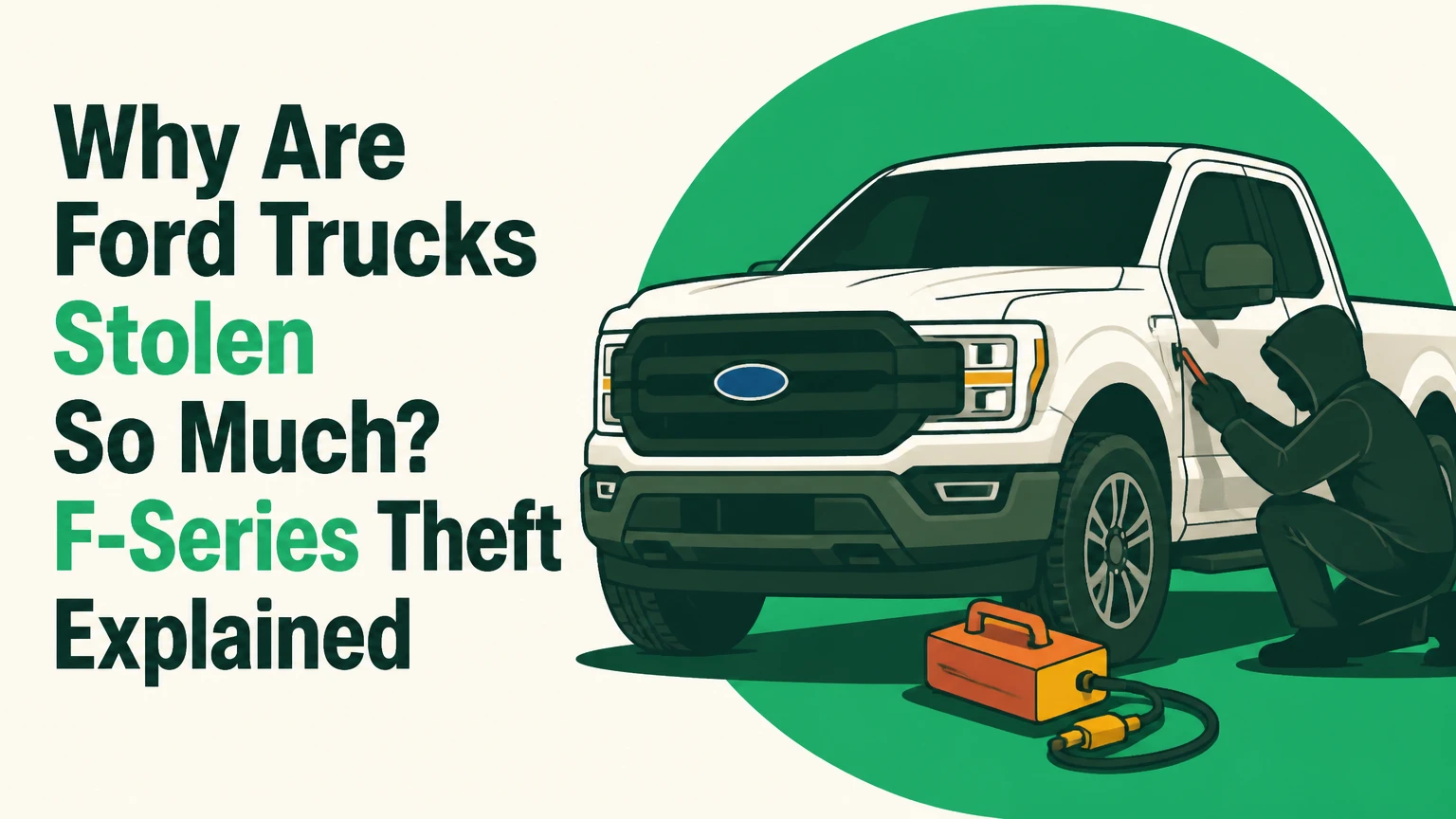
Ford trucks are stolen so often because the F-Series combines enormous population, strong resale demand, valuable parts, and security weaknesses that vary by model year. Older trucks may be attacked mechanically, while newer F-150 and Super Duty models can face keyless-entry, diagnostic-port, or network-based attacks. Their usefulness to criminals increases demand beyond ordinary joyriding.
Key Facts at a Glance
- The Ford F-Series regularly ranks among the most stolen vehicle lines in North American theft reports, although total thefts are not the same as theft risk per vehicle.
- High sales volume gives thieves more Ford trucks to find, more interchangeable parts to sell, and more vehicles that look ordinary in traffic.
- Older Ford pickups without effective electronic immobilizers are generally more exposed to physical ignition attacks than newer models.
- Modern keyless Fords can be targeted through relay equipment, unauthorized key programming, or attacks on vehicle communication networks.
- Tailgates, LED lamps, wheels, tires, and exposed work tools can be stolen even when the truck itself remains parked.
- The strongest practical defense combines parking choices, key protection, a visible physical deterrent, layered tracking, and comprehensive insurance.
Why Are Ford Trucks Stolen So Much?
Ford trucks are attractive theft targets because they offer thieves four advantages at once: availability, value, utility, and predictable demand. The F-150 has been the best-selling vehicle line in the United States for decades, so a stolen example can blend into a large legitimate population while its parts fit a broad replacement market.
Theft data needs careful interpretation. The National Insurance Crime Bureau’s 2023 Hot Wheels report listed the Ford F-Series pickup as the most stolen vehicle model line in the United States, with 15,852 reported thefts. A high count partly reflects how many F-Series trucks are on the road. A vehicle with fewer total thefts can still have a higher theft rate if far fewer examples are registered.
The economic motive is usually stronger than joyriding. A thief may want the complete truck, a shipment of parts, a work vehicle, or the tools inside it. Ford trucks also have high ground clearance, substantial payload capacity, four-wheel-drive configurations, and widespread service support, which makes them useful after theft.
What makes an F-Series truck economically attractive?
An F-Series truck can generate value through several channels:
- Whole-vehicle resale: A stolen truck may be moved locally, exported, dismantled, or given false identity documents.
- Parts resale: Tailgates, lamps, wheels, tires, and body panels can be sold separately.
- Criminal utility: A truck can haul trailers, equipment, or other stolen goods.
- Low owner suspicion: Common colors and factory configurations make an F-150 less conspicuous than a rare sports car.
- Repair demand: Collision damage and work use create ongoing demand for replacement parts.
Organized theft groups may use different methods from opportunistic thieves. A professional crew may select a specific trim, watch a residence, and move a truck quickly. An opportunist may break a window, steal tools, or remove an unlocked tailgate without attempting to start the vehicle.
Does Model Year Change the Attack?
Model year changes the theft method substantially. Older Ford pickups are more likely to face lock, ignition, and wiring attacks, while newer trucks use immobilizers and encrypted modules that raise the technical barrier but create different electronic targets.
The exact cutoff is not universal. Ford introduced electronic anti-theft equipment across different lines and years, and equipment varies by market, engine, trim, and key system. Owners should verify features through the vehicle identification number, owner’s manual, Ford service information, or a dealer rather than assume that every truck from a particular year has identical protection.
Older Ford pickups
Many 1990s and early-2000s Ford trucks have simpler door locks and ignition systems than current vehicles. If a truck lacks a functioning transponder immobilizer, forced entry followed by ignition-cylinder damage can allow a thief to start it with comparatively basic tools.
Older trucks also have characteristics that increase exposure:
- High replacement value relative to purchase price
- Large surviving population and shared components
- Worn door and ignition cylinders
- Limited factory tracking
- Aftermarket alarm installations of inconsistent quality
- Easy access to common replacement keys
A steering-wheel lock and professionally installed hidden immobilizer can provide meaningful additional resistance. A hidden fuel-pump interruption circuit should be installed by a qualified automotive technician because poor wiring can create fire, starting, or warranty problems.
Newer F-150 and Super Duty trucks
Newer Ford trucks generally use passive anti-theft systems, electronic modules, encrypted key authentication, and networked control units. Those features prevent some old-fashioned hotwiring attacks, but security becomes more dependent on software, diagnostic access, wireless communication, and module integrity.
Modern security is better, not absolute. Attackers may use relay equipment against susceptible passive-entry systems, obtain unauthorized replacement keys, exploit diagnostic access, or attack vehicle networks. Attack feasibility depends on the exact generation and whether Ford has issued software updates or changed the relevant module configuration.
How Does Keyless Ford Truck Theft Work?
Keyless theft usually exploits communication between a proximity key and the truck, rather than copying the metal key blade. In a relay attack, equipment extends the apparent distance between the key fob and the vehicle, allowing a susceptible truck to believe that its authorized key is nearby.
A simplified relay sequence looks like this:
- An attacker places a relay device near the home, where the key fob may be stored.
- A second device communicates with the truck near the driveway.
- The equipment passes authentication traffic between the two locations.
- The truck may unlock or permit starting if its system accepts the relayed exchange.
Relay attacks do not affect every Ford truck in the same way. Some keys reduce wireless activity when stationary, some vehicles use motion-sensitive fobs, and some systems apply timing or cryptographic controls that make relay attempts harder. A Faraday pouch can reduce radio exposure, but owners must test the pouch with their own key because poor materials, gaps, or an unshielded spare key defeat the measure.
What is the OBD-II risk?
The OBD-II port gives technicians access to diagnostic functions, and on some vehicles unauthorized access can support key programming or module manipulation. The risk is greatest when a thief can enter the cabin and the vehicle’s security architecture permits a new key or altered commands through diagnostic equipment.
An OBD port lock blocks physical access, but it does not repair a compromised key, protect the wireless system, or stop a thief from towing the truck. Some locks also interfere with legitimate diagnostics, emissions testing, or dealer service. Keep the removal key with the vehicle records, and tell the service center that the lock is installed.
Network attacks are another category. Modern vehicles use controller area network, or CAN, communication among modules. Owners should avoid internet instructions that expose diagnostic procedures, because those details can facilitate theft and can damage safety-critical systems.
Why Are Tailgates, Lamps, Wheels, and Tools Targeted?
Truck components are targeted because they are valuable, removable, widely demanded, and often lack a unique VIN marking. A thief can leave the vehicle behind, avoid a full ignition attack, and sell a part through a repair shop, online marketplace, salvage channel, or informal buyer.
| Component | Typical replacement range | Removal exposure | Main reason for demand |
|---|---|---|---|
| Integrated tailgate | $1,000-$4,000 | Seconds to several minutes | Camera, step, actuator, and trim content |
| LED tail lamps | $1,500-$5,000 per pair | Several minutes | Expensive electronics and blind-spot hardware |
| Premium wheels and tires | $2,500-$6,000 per set | About 5-15 minutes | High resale value and common fitments |
| Contractor tools | $500-$10,000+ | Minutes if unlocked | Portable, unregistered, and immediately usable |
Prices are typical U.S. replacement estimates, not guaranteed claim values. Trim, labor, paint, calibration, deductible, and local parts supply can change the final bill substantially.
Tailgates
Tailgates often use accessible hinges, latches, wiring connectors, and removable straps. Some can be removed quickly when unlocked or when the owner has not enabled the power-locking feature. A tailgate lock or hinge shield can increase effort, but the device must not prevent normal emergency release or damage backup-camera wiring.
LED lamps
High-trim lamps can contain blind-spot monitoring sensors, radar-related hardware, control electronics, and distinctive LED assemblies. Their replacement price is therefore far higher than a basic reflector lamp. A factory alarm may not trigger when a thief removes a lamp without opening a monitored door.
Wheels and tires
Large factory wheels and premium all-terrain tires carry recognizable resale value. Wheel locks help only when the locking pattern is not already compromised and the key is not left inside the truck. Spinning-collar designs resist some gripping tools better than basic spline locks, but no wheel lock prevents towing or protects a truck with no layered security.
Work tools
Tools are often a more immediate target than the truck. An unlocked bed, contractor cap, or visible toolbox can convert a vehicle break-in into a high-dollar loss even when the truck cannot be started.
How Fast Can a Ford Truck Be Stolen?
A prepared theft can take less than five minutes, but timing varies widely by model, parking conditions, security equipment, and whether the criminal wants the whole truck or only a part. Claims that every modern Ford truck can be stolen in exactly two minutes are unreliable because attack tools and vehicle protections differ.
| Theft objective | Typical time range | Required access | Common defensive response |
|---|---|---|---|
| Remove an unlocked tailgate | 30 seconds-5 minutes | Rear of truck | Tailgate lock and rear-facing camera |
| Strip four wheels | 5-15 minutes | Space for jack and tools | Wheel locks, lighting, driveway barriers |
| Steal visible tools | 1-10 minutes | Open bed or weak toolbox | Hard tonneau, locked toolbox, inventory |
| Drive away with prepared keyless attack | 2-10 minutes | Near vehicle and key area | Faraday storage, software updates, tracker |
| Attack an older ignition | 5-20 minutes | Cab and steering column | Steering lock, immobilizer, secure parking |
These are practitioner ranges, not universal test results. A monitored garage, blocked driveway, bright lighting, or a neighbor’s camera can add more practical resistance than a single inexpensive gadget.
Which Protections Actually Reduce Risk?
Layered security is more effective than relying on one factory feature. The best combination for most owners is a locked parking location or well-lit driveway, protected keys, a visible steering lock, secured cargo, a tracker, and insurance that covers theft and parts loss.
| Protection | Typical cost | Protects against | Important limitation |
|---|---|---|---|
| Faraday pouch or box | $15-$100 | Some relay attacks | Fails if the spare key remains exposed |
| Steering-wheel lock | $25-$150 | Opportunistic drive-away theft | Does not stop parts theft or towing |
| OBD-II lock | $30-$150 | Direct diagnostic-port access | May complicate service and cannot stop relay attacks |
| Wheel locks | $30-$200 | Casual wheel removal | Professional crews can use other methods |
| GPS or cellular tracker | $50-$300 plus service | Recovery after unauthorized movement | Location data is not a physical immobilizer |
| Hidden immobilizer | $150-$600 installed | Unauthorized starting | Poor installation can cause reliability problems |
Is FordPass Start Inhibit enough?
Ford connected-vehicle features may include remote commands or stolen-vehicle assistance, but availability, naming, subscription terms, cellular dependence, and model-year support vary. Start Inhibit is not a universal replacement for physical security, and a remote command cannot undo a completed theft or recover a truck from a low-connectivity location.
Confirm the feature inside the current Ford app and owner documentation. Keep software current, protect the Ford account with a unique password and multifactor authentication, and remove former users from vehicle access after a sale or lease return.
Practical owner rules
- Store every active key and spare key away from exterior walls and windows.
- Test a Faraday container by standing beside the locked truck and attempting passive unlock.
- Lock the tailgate separately if the truck does not verify tailgate status.
- Photograph the truck, VIN plate, wheels, accessories, and tools for an insurance claim.
- Record serial numbers for tools and aftermarket equipment.
- Use a tracker as a recovery aid, not as proof that theft cannot occur.
- Check Ford recalls and software campaigns by VIN.
- Do not leave the key inside a vehicle parked near the house.
The counterintuitive point is that an alarm is often better at notifying an owner than stopping a professional thief. Alarms may detect doors, hood movement, or glass breakage, but they may not detect a quiet tailgate removal, wheel theft, or a tow-away event.
How Should Owners Protect Different Trucks?
The correct plan depends on the truck’s age, contents, parking location, and downtime cost. A contractor with $8,000 of tools has a different exposure from a weekend owner of a basic older pickup.
| Owner situation | Highest exposure | First purchase | Second layer |
|---|---|---|---|
| Older budget truck | Ignition and forced entry | Steering lock, $25-$150 | Professionally installed immobilizer |
| New keyless F-150 | Wireless and diagnostic access | Faraday storage, $15-$100 | OBD lock and tracker |
| Premium urban truck | Lamps, wheels, and tailgate | Wheel and tailgate security, $60-$350 | Bright lighting and camera coverage |
| Construction fleet | Tools and downtime | Locked bed systems, $500-$3,000 | Fleet tracker and documented key control |
| Street-parked truck | Visibility and access | Steering lock and lighting | Layered camera, tracker, and insurance |
Fleet managers should maintain a key inventory, restrict spare-key access, install trackers discreetly, and photograph each vehicle’s equipment. A tracker mounted in an obvious location can be removed, while a tracker with no cellular coverage may provide delayed or incomplete location data.
Insurance, Recovery, and Financial Exposure
Comprehensive auto insurance generally covers theft of the vehicle, subject to the policy deductible, while liability-only coverage generally does not pay for a stolen truck. Coverage for tools, detachable equipment, custom parts, and personal property may require separate endorsements or a commercial policy.
Before a loss, verify these details:
- Comprehensive deductible
- Actual cash value versus agreed value
- Replacement coverage eligibility
- Rental-vehicle limits
- Custom-equipment endorsements
- Commercial-use exclusions
- Tool and cargo coverage
- Reporting deadlines
- Required proof of ownership
After a theft, call law enforcement and the insurer promptly, preserve surveillance footage, provide the VIN and license plate, and do not confront suspected thieves. If a tracking service provides a location, give it to police rather than attempting recovery yourself.
Recovery does not guarantee a full financial recovery. A truck may return with stripped lamps, damaged wiring, missing modules, altered identification, or contamination from cargo. Document pre-existing condition and installed accessories before the loss.
What If the Theft Light Flashes?
A flashing theft indicator with a crank-no-start condition usually means the vehicle has not authenticated the key, but a weak fob battery, damaged antenna, low vehicle voltage, module fault, or wiring problem can produce similar symptoms. The symptom does not prove an attempted theft.
Use the owner’s manual for the exact backup-key procedure. Depending on the Ford model, the backup location may be a marked slot in the center console, a cupholder, or another designated compartment. Replacing the fob battery may help, but it will not fix a damaged key, failed receiver, or immobilizer fault.
Avoid repeatedly cycling ignition reset procedures copied from unrelated vehicles. If the theft light continues flashing, scan the vehicle with Ford-compatible diagnostic equipment or contact a qualified locksmith or Ford dealer. Do not bypass the immobilizer or splice security wiring without a professional diagnosis.
What Should You Do After a Ford Truck Theft?
Report the theft immediately, notify the insurer, and provide the VIN, registration, photos, tracker data, and installed equipment list. Do not enter the truck or handle suspected evidence if it is recovered, because fingerprints, biological evidence, and altered parts may matter to the investigation.
Take these actions in order:
- Confirm the truck is not at a different authorized location.
- Call local police and obtain the report number.
- Contact the insurer and open a comprehensive claim.
- Suspend connected-app access if account compromise is possible.
- Give police the tracker location, never pursue the vehicle.
- Notify lenders or lease companies.
- Alert nearby businesses and preserve camera footage.
- Watch for fraudulent listings using your truck’s VIN or photos.
If a replacement key disappeared with the truck, ask the dealer or qualified automotive locksmith whether all lost keys can be erased from the vehicle’s authorized-key list.
FAQ
Are Ford Super Duty trucks stolen more than F-150s?
The F-150 commonly produces more total theft reports because far more F-150s are registered. Super Duty trucks can still be attractive targets because diesel powertrains, four-wheel drive, towing capability, and high trim prices create strong resale and criminal utility. Local theft patterns can differ sharply from national rankings.
Are Ford trucks safer when parked in a garage?
A locked garage usually lowers exposure because it blocks visual access, delays towing, reduces wireless signal reach, and removes opportunities for parts theft. A garage is not a complete defense if keys are stored beside the exterior wall, the door is left open, or connected accounts are compromised.
Can a steering-wheel lock stop a professional thief?
A steering-wheel lock can deter opportunistic theft and force a professional to spend more time, but it cannot stop towing, parts removal, or every method of defeating the lock. Its value comes from visibility and delay. Pair it with protected keys, secure parking, and a tracker.
Do Ford trucks have built-in immobilizers?
Many newer Ford trucks use electronic passive anti-theft systems, but equipment varies by model year, market, engine, and trim. Older trucks may have weaker or absent immobilizer protection. Verify the system through the VIN-specific owner’s manual or Ford dealer rather than relying on the model name alone.
Does a hidden GPS tracker prevent theft?
A GPS tracker usually does not prevent a thief from entering or starting a Ford truck. The tracker can improve recovery odds by transmitting location, but cellular dead zones, battery disconnection, removal, and delayed alerts limit its usefulness. Use tracking as one layer, not as an immobilizer.
Should I buy a Ford truck if theft rates are high?
A Ford truck can still be a sensible purchase when its capability, service access, and operating costs fit your needs. Check local theft data, insurance premiums, repair-part delays, factory security features, and parking conditions before buying. The risk is manageable with layered protection, but insurance and security costs belong in the ownership budget.
The Bottom Line
Why are Ford trucks stolen so much? The F-Series is common, valuable, useful, and supported by a deep parts market, so criminals can profit from complete vehicles or individual components. Older Ford trucks face more physical attacks, while newer keyless models create wireless and diagnostic risks. Protect the exact truck you own with layered measures, then confirm comprehensive insurance, connected-service settings, and VIN-specific security updates.